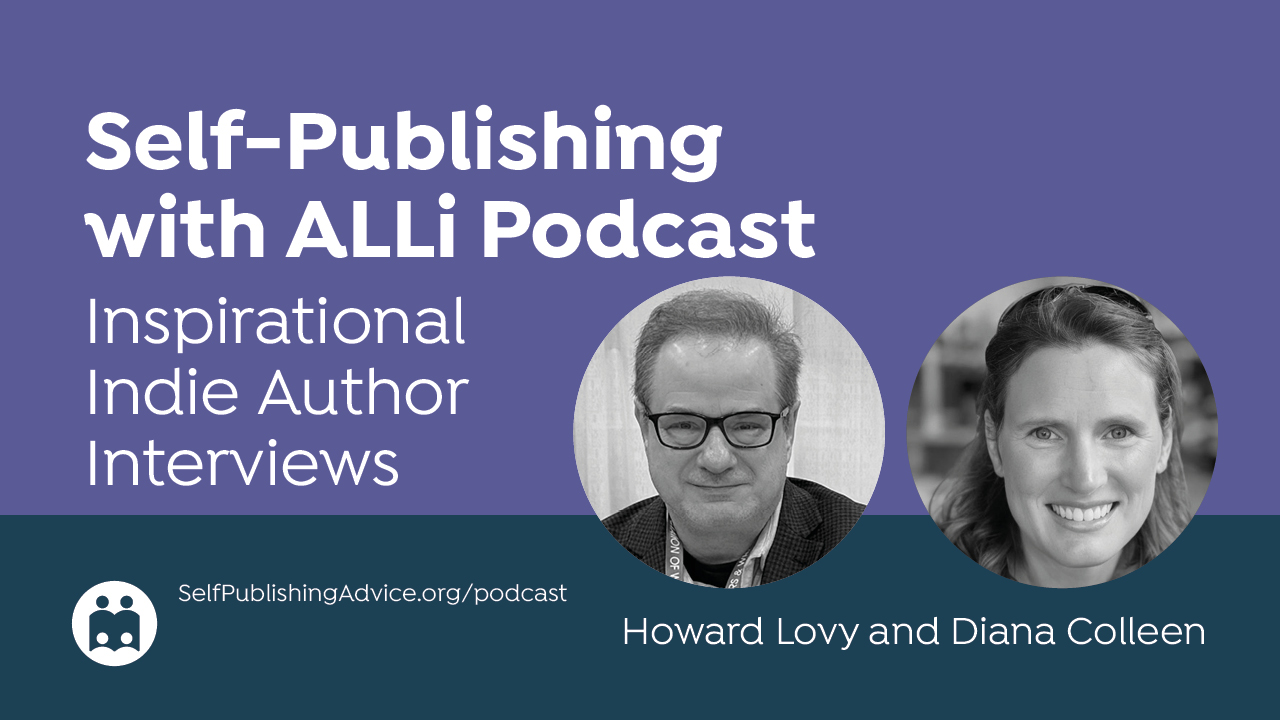
My ALLi author guest this episode is Diana Colleen, a Canadian-born, Seattle-based writer whose work is shaped by a life of activism, public service, trauma, and healing. Drawing on her experience with meditation and psychedelic-assisted therapy, her fiction explores climate responsibility, wealth, power, and the possibility of personal and societal transformation.
Listen to the Inspirational Indie Author Interview: Diana Colleen
About the Host
Author Howard Lovy has been a journalist for 40 years, and now amplifies the voices of independent author-publishers and works with authors as a developmental editor. Find Howard at howardlovy.com, LinkedIn and X.
About the Guest
Diana Colleen is a Canadian, Seattle-based psychedelic facilitator and writer whose work blends consciousness, healing, and social change. After a profound personal transformation through psychedelic-assisted therapy, she committed to storytelling as a way to challenge entrenched systems of power. Her fiction explores the climate crisis, billionaire-ism, and the inner work required for meaningful change, asking what humanity could become if empathy, accountability, and contribution replaced ego and competition. Diana Colleen can be found at her website, dianacolleenauthor.com, and on Instagram, Facebook, Bluesky, and LinkedIn.
Thoughts or further questions on this post or any self-publishing issue?
If you’re an ALLi member, head over to the SelfPubConnect forum for support from our experienced community of indie authors, advisors, and team. Simply create an account (if you haven’t already) to request to join the forum and get going.
Non-members looking for more information can search our extensive archive of blog posts and podcast episodes packed with tips and advice at ALLi's Self-Publishing Advice Center. And if you haven’t already, we invite you to join our organization and become a self-publishing ally.
If you’re a published indie author who would like to be interviewed by Howard for the Inspirational Indie Authors podcast, you need to be a member of the Alliance of Independent Authors.
Then contact Howard, including your membership number, explaining why you’re an inspirational indie author and what inspires you.
If you haven’t already, we invite you to join our organization.
Read the Transcript
Diana Colleen: Hi, my name is Diana Colleen. My debut novel, They Could Be Saviors, is launching on January 13th. It asks the question: what if the only way to save the planet is to kidnap the billionaires destroying it? It looks at billionairism as a mental illness that can be cured with psychedelic-assisted therapy.
Howard Lovy: Wow. That's a lot to take in. I'm learning new words, including billionairism, and we'll get into that. Let's first talk about where you grew up and whether reading and writing were always a part of your life.
Growing Up in Kamloops
Diana Colleen: I grew up in Kamloops, British Columbia, and I was born into a very poor family. We didn't live off the grid, but we didn't have a telephone, we didn't have a television, so I spent most of my time reading. I devoured books as a kid. I wrote poetry as a child, between the ages of about 10 and 15, and after that I really didn't think about writing at all. This book was a total surprise to me. I've never been one of those people who thought I would ever write a book, so it was as shocking to me as it was to my husband.
Howard Lovy: Sometimes it sneaks up on you, especially if you have something important to say. So what did you do for a living? Did you go to college?
Diana Colleen: I put myself through college working three jobs and going to school full time. That was really hard. I was planning to go to law school, but by the time I finished my bachelor's I was so burned out I couldn't face another three or four years of working that hard. So I decided to join the RCMP — the Royal Canadian Mounted Police — and while I was waiting to get in, I was a firefighter at Sun Peaks Resort.
Howard Lovy: What appealed to you about public service?
Diana Colleen: From a really young age I'd always had a feeling that I was meant to be part of something bigger than myself, part of something that helped society. I've always been an activist and always wanted to make change.
Trauma, Turning Points, and Leaving Canada
Howard Lovy: You were about to tell a story about something that changed your life.
Diana Colleen: I was sexually assaulted by my boss, and the RCMP decided to victim-blame. They said I was no longer a candidate because I had allowed myself to be blackmailed — which is a whole other story. I just didn't know what to do with my life at that point. I packed up my cats and whatever I could fit in my car and drove to Seattle. I didn't have citizenship, I didn't know how I was going to work. It took about a year living on my savings to figure out how to get citizenship, and I've been here ever since. Now I'm a dual citizen, though I still consider myself Canadian first and foremost.
Howard Lovy: My mother was born in Toronto, so I'm half Canadian on my mother's side. Is there anything more you want to share about how the assault changed you?
Diana Colleen: I'd had a lot of trauma growing up, so this was just one more thing on top of everything else. I've always been the kind of person who puts on a strong face and stuffs everything down. But in 2018 — a long time after all of that happened — things just kind of bubbled up. I could no longer ignore everything that had happened to me, and I became suicidal. That's when my life really changed, because I was put in touch with an underground psychedelic therapist, which I believe saved my life. That put me on the trajectory of writing about psychedelic-assisted therapy, and I've since become a trained facilitator myself.
Psychedelic-Assisted Therapy and a Life Transformed
Howard Lovy: What was it about 2018 that triggered everything? I'm assuming there's some PTSD involved.
Diana Colleen: There's definitely some PTSD. The catalyst was a really unhealthy relationship I was in. It was kind of the first time I had — I don't know if I'd call it an out-of-body experience, but I remember one day viewing my life from the outside, looking at myself and the person I was with from a distance, and thinking: Diana, this is not who you are or what you're meant to be. It was like my higher self saying: you really need to get some help.
Howard Lovy: Since 2018, psychedelic-assisted therapy has gotten more attention and become more accepted. But in 2018, did you seek it out or did you happen to find it?
Diana Colleen: I knew about it and about plant medicines, and I joined a meetup for plant medicines. I got talking to someone there who had treatment-resistant depression and had found a therapist, and he recommended her to me. The therapist said he was so booked up that he couldn't get me in for six months, and I said I didn't think I was going to be here in six months. He was training someone at the time, so that person was able to get me in immediately.
Howard Lovy: Describe the process — what was it like in 2018?
Diana Colleen: A session of psychedelic-assisted therapy involves multiple days. You have a couple of sessions with the therapist ahead of time — just getting to know each other, talking about what brought you in, what you're dealing with. Then you have a full day on a substance with the therapist. And then usually within a couple of days you have another session to integrate. The integration part is really important — that's where you take everything you learned under the influence and apply it to your life.
Howard Lovy: What kind of psychedelics are involved?
Diana Colleen: My first therapy session was with MDMA, and I've also done it with psilocybin — magic mushrooms. Those are the two most common.
Howard Lovy: Can you describe that first experience? Was it a kind of wow, where have you been all my life?
Diana Colleen: I was really scared going in. I grew up in the eighties with the war on drugs and was very anti-drug my whole life. I was scared of the illegality and didn't know what to expect. But that first experience — it's really hard to describe any psychedelic experience to someone who hasn't had one, and even among people who have, every experience is different. That first experience kind of opens your heart. It takes away your fear of looking at your trauma. In talk therapy, if you're talking about a trauma, you can be re-traumatized — your body goes back into fight or flight and you're reliving the experience. But under the influence of MDMA, you're looking at it through a lens of love. You see things from a very different perspective and you really get in touch with your heart. It was life-changing in one session.
How ‘They Could Be Saviors' Came to Be
Howard Lovy: When did you decide you not only wanted to experience this but write about it?
Diana Colleen: Part of my healing journey has been learning tools that help me, and one I've found really valuable is meditation. My entire story for They Could Be Saviors came to me through meditation — that's why it was such a shock. The idea just kept coming up in meditation. I was talking to my partner at the time about it, and I was in a job I was really unhappy in. He said: you're so unhappy, why don't you quit and write this book? It was a huge risk — I trusted him that he could support me, but for someone who's been so independent her whole life, accepting that was a big thing. But I did it and made it my full-time job. At my desk at least eight hours a day, sometimes twelve, writing and learning the craft and learning about publishing.
I never really had writer's block, because when I didn't know where the story was going I meditated and the rest of it came. When I started, I had no idea what was going to happen or how it was going to end — very much a pantser.
Howard Lovy: That's a fun way to write. I'm the same way — I know where a scene might go but I let the characters speak for themselves. Why did you choose fiction instead of nonfiction?
Diana Colleen: I think stories have a way of sticking with people. You can listen to a lecture or read a paper about something and get the general concept, but stories — like music — stick with you. I remember stories I read when I was ten years old. Fiction has a way of showing us what's possible. There's a lot of dystopian doom out there and I really wanted this to be a hopeful book. I don't think there's enough hope in the world.
Howard Lovy: A hopeful dystopia. So tell me about the story — it's not out yet but it's coming out later this month?
Diana Colleen: January 13th. It's on presale now and it's already won quite a few awards — the Blue Ink Notable Book award, a Kirkus Indie designation, the gold medal from Literary Titan, and a best digital books award. That was my external validation. I didn't know if I'd actually written a good book until the first award came, and I thought: okay, it's good. Because I know it's a good book, I'm putting a lot of money behind it, which is scary, but I believe in this message and I'm trying to do everything I can to get it out there.
Billionairism: A Curable Illness
Howard Lovy: What's the message? Give me the 30-second elevator pitch.
Diana Colleen: The message is that billionairism is a curable illness. I don't want society to look at billionaires as success. It is a mental illness that is affecting all of us and the planet. By changing the narrative around billionairism, I think we can make reform happen.
Howard Lovy: You'll have to define billionairism for me. Is that a term you coined?
Diana Colleen: I think I coined it, though I'm not sure. Think about alcoholism — I wanted a word that shows it is an illness. We see the TV show Hoarders and we can recognize that as a mental illness affecting that person and their family. Billionaires are hoarding at a level that affects every single person on the planet.
Howard Lovy: Do you think your upbringing had a big influence on your worldview?
Diana Colleen: I think it did. I saw how privileged people got a step up. I was working three jobs to put myself through school while other people had their parents pay for it. A lot of scholarships require extracurricular activities, but I didn't have time for that because I was working, so I couldn't get scholarships that were available to other people. The education system in the US boggles my mind — taxes go to the school system but where you live determines what education you get. Poor kids deserve the same education as rich kids.
Howard Lovy: The difference between today's tech billionaires and the robber barons of the past is that those older billionaires built things — art institutions, hospitals. I can't think of much that modern tech billionaires, aside from maybe Bill Gates, have actually built. Is that part of the disease you're describing?
Diana Colleen: Yeah — they don't give back. And when they do, it's a tax break. The money being spent on things like space exploration makes me sick, because those billions of dollars are also causing emissions, and that money could be fixing Earth instead. Why aren't they using those billions to fix the planet rather than talking about colonizing Mars? Why don't they want to be the people who save the planet? Isn't that a greater legacy than ruining it?
Climate Change, Billionairism, and Psychedelics
Howard Lovy: Part of the narrative engine of the book is psychedelic therapy. How do you combine all these disparate ideas into one story?
Diana Colleen: I know I'm tackling a lot — three main themes: climate change, billionairism, and psychedelics. But I think they really do work together. Psychedelics connect people. I think society in general, and billionaires in particular, are very disconnected — from humanity, from the planet, from nature. Psychedelics have a way of reconnecting the individual back to humanity, back to nature. If billionaires can realize that we're all in this together and we only have one planet, maybe they can actually do some good.
Howard Lovy: Psychedelics have come a little more mainstream since 2018, but they're still not fully there. Are you afraid that element is going to turn some readers off?
Diana Colleen: I'm hoping readers will want to know why it's not mainstream. A big reason is Nixon's war on drugs during the Vietnam era — there had been lots of promising studies on psychedelic therapy prior to that, and then he just shut everything down. It's only just now starting to open up again. But the results are impossible to ignore. For PTSD alone, if we can treat war veterans with this, the suicide rate for veterans will plummet. And addiction, and homelessness — if people had access, it would change society.
Why She Self-Published
Howard Lovy: You spent about a year querying and got strong interest from agents, but what ultimately pushed you to self-publish?
Diana Colleen: Three separate agents said the same thing — they wished I'd gotten the manuscript to them a couple of years earlier so it could be published right now, because it's needed right now. And I agreed. With traditional publishing, even if I'd gotten an agent in 2025, the book probably wouldn't be out until 2027 at the earliest. By 2027, who knows what the world will look like. But right now, with everything going on, these three topics are front and center. So I switched gears and learned all about self-publishing.
Howard Lovy: What kind of marketing are you planning?
Diana Colleen: Everything. I've been on probably 15 podcasts already. I've got a TV interview lined up for next week. I hired a publicist. I'm advertising with Kirkus Indie, doing a Love Books tour, a BookBub ad, and Facebook ads. I'm trying to do it all.
Howard Lovy: You're the poster person for indie publishing right here. What genre would you call this?
Diana Colleen: I say near-future speculative, which people can interpret however they like — some say dystopian, some say sci-fi, some say cli-fi. I really like the term hopepunk, which is a new and upcoming genre that I hope gets bigger. I think the world needs more hope.
Howard Lovy: Hopepunk — dystopian, but with the smiley face at the end. It's been a long road through your life and career to reach this point. What advice would you give to other authors who have something to say and a mission like yours?
Diana Colleen: For authors just starting out, write your first draft before you learn anything about craft or about the business of publishing. Because if you don't have that first draft finished and you start learning all this stuff, it gets so scary that you might not want to do it at all. If I had known how much work this was going to be, I don't know that I would have started.
Howard Lovy: Well, thank you Diana. This has been fascinating. I learned a few new words and a great deal about your journey. Thank you so much for sharing it with us.
Diana Colleen: Thank you very much for having me. I really appreciate it.
Howard Lovy: Thank you, Diana. Bye.
Diana Colleen: Bye.