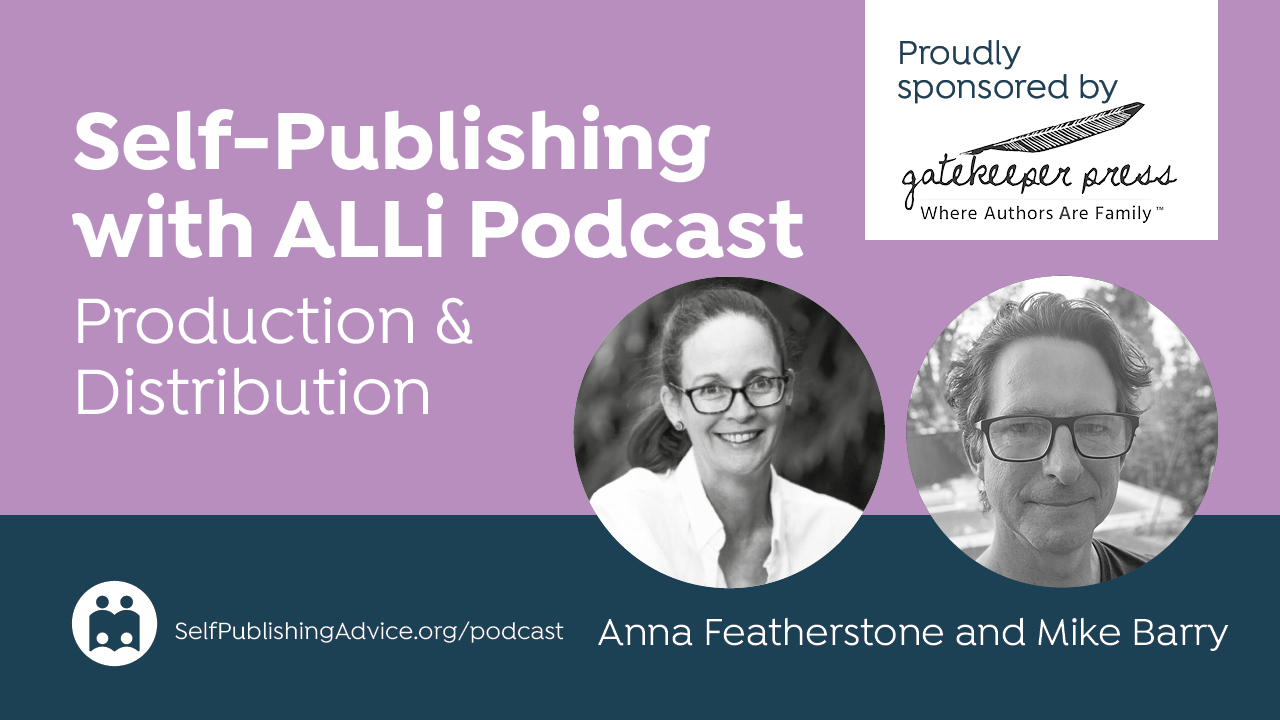
On the Self-Publishing with ALLi podcast, host Anna Featherstone speaks with indie author-illustrator Mike Barry about the production and distribution decisions behind his children’s graphic novel trilogy Action Tank, from reverse-engineering Marvel’s print specifications to building a loyal school and library audience. Barry reflects on Kickstarter, the realities of international distribution, and his publishing adventures. Whether you write for children or not, the conversation offers insight into finishing what you start, finding your market, and letting one opportunity lead to the next.
Listen to the Podcast: How One Indie Author-Illustrator Cracked the Kids' Graphic Novel Market
Sponsor
This podcast is proudly sponsored by Gatekeeper Press — your partner in premium independent publishing. Empowering authors with expert guidance, 100% rights, 100% royalties, and global distribution. From editing to marketing, their all-inclusive services help you publish professionally and confidently. Gatekeeper Press — Where Authors Are Family.
About the Host
Anna Featherstone is ALLi’s nonfiction adviser and an author advocate and mentor. A judge of The Australian Business Book Awards and Australian Society of Travel Writers awards, she’s also the founder of Bold Authors and presents author marketing and self-publishing workshops for organizations, including Byron Writers Festival. Anna has authored books including how-to and memoirs and her book Look-It’s Your Book! about writing, publishing, marketing, and leveraging nonfiction is on the Australian Society of Authors recommended reading list. When she’s not being bookish, Anna’s into bees, beings, and the big issues of our time.
About the Guest
Mike Barry is the writer, artist and singular creative force behind Action Tank, his graphic novel trilogy for kids about intergalactic adventure and spaghetti carbonara. He won a Comic Arts Award of Australia for Action Tank in 2021, when he was also nominated for the NSW Premier’s Literary Awards, The Russell Prize for Humour Writing for Young People, and the Aurealis Awards. Action Tank was also included in the American Library Association’s 2022 Best Graphic Novels for Children Reading List. He lives with his wife and sons near the beach in Sydney, Australia, which is even better than it sounds. You can find Mike Barry on Instagram.
Read the Transcript
Anna Featherstone: Welcome, and thanks for tuning in from your special part of this beautiful planet. I'm Anna Featherstone, joining you today from the lands of the Gadigal people, the original storytellers of this land in Sydney, Australia. Today we're talking about producing and distributing graphic novels for young readers — but there will be lots of ideas and learnings in this conversation for authors of all genres. Graphic novels have been having quite a moment for the last few years, and one indie author who was ahead of the curve is Mike Barry. Welcome, Mike.
Mike Barry: Thanks, Anna. Nice to be here talking with you.
Anna Featherstone: You're the writer and artist behind Action Tank, which is a graphic novel trilogy for kids about intergalactic adventure and spaghetti carbonara.
Mike Barry: That's right. Good summary, actually.
Anna Featherstone: I love that combination. You've been shortlisted for many awards, you've won a Comic Arts Award in Australia, and you got Action Tank onto the American Library Association's Best Graphic Novels for Children list in 2022 — a massive achievement. How did that come about?
Mike Barry: I've self-published Action Tank since the beginning — three books over about seven or eight years. At some point during that process a comic publisher in America was interested in handling global publishing and distribution. We started doing that, and I think that publisher was connected to Simon and Schuster. The first book got some circulation and then — I honestly don't know how it happened, I just got an email about it and thought, terrific. Some librarian somewhere must have really liked it and put it on the list.
Anna Featherstone: So exciting. We'll talk about how you've run your business as both an indie and hybrid author, and about the fact that a lot of people aren't even aware you can have different publishing arrangements in different countries. You've also collaborated with Australian author Nathan Moore on a part-novel, part-graphic-novel published by Penguin. But let's take it back a bit — what led you down the path of becoming an author-illustrator?
From Advertising Creative Director to Graphic Novelist
Mike Barry: I've always loved writing and drawing. I worked in marketing and advertising full-time for about 15 years, in creative departments as an art director or copywriter, and eventually as a creative director. When I had kids and we were reading stories every night, they started wanting to read some of the comics I'd begun making — and I thought, I could make something they would really love. When I looked at my career, I'd accumulated exactly the skills I needed: I knew how to draw, how to write, how to use Photoshop, how to organize book production. I'd always dreamed about making comics, and I found a reason to go for it. At a minimum, me and my kids could read this.
Anna Featherstone: So when you made that decision, how long did it take to get the story done versus the illustration side?
Mike Barry: I didn't really take it that seriously when I started — it was a fun side project. I'd only work on the writing when we were on holidays, or a bit on a weekend, or late at night. I had a vision for a big story, but I'd never made a serious graphic novel before, so I didn't want to bite off more than I could chew. I conceived the first main chapter over about 18 months. The format was a little sketchbook — I'd think about what the next page was going to be, write it and draw it, then put it away and think about the next page.
It's probably not the most efficient way to do it, but every page got a lot of consideration and I really pushed myself to make it a visually interesting reading experience. I didn't want talking heads or the same kind of thing every time — I wanted noticeable changes in tone, mood, and action. Once I'd locked the story in sketch format and was happy with the rhythm, I drew it properly — that took about three months in black and white and another month to color it, then more time to organize the actual production of the book itself.
Anna Featherstone: What age group were you targeting?
Mike Barry: It was pitched at seven to twelve year olds. My eldest son was about seven at the time — that was what drove the whole thing. It's been really interesting watching my two boys grow up alongside the series. By the end of book three it's pitched more at eleven to twelve year olds, because that's where my kids were. I love that idea — like Harry Potter — that you grow up with the book. Each one demands a little more from you as a reader.
Reverse Engineering the Production: Pencils, Photoshop, and the Right Printer
Anna Featherstone: You mentioned the tools you used. Did you start with pencils on paper, or straight onto the computer?
Mike Barry: I find a lot more joy drawing by hand, so I draw on paper — pencil, then pen, filling in the blacks. I love doing all that myself. But I wasn't super confident I could get the production quality high enough if it was entirely by hand, and I had a lot of computer skills from advertising. So I found a middle ground. Drawing is a bit like handwriting — you can see different people have different handwriting and it reflects something of who they are. I didn't want to lose my hand-drawn line, the thing that was me. But I also wanted it to look super professional because if I was going to self-publish it, it had to look as good as or better than what was on the shelf beside it. At that time, self-publishing had a pretty big stigma — if you couldn't get published properly you had to self-publish — and I'll admit I was in that mindset too. So I thought: I'm just going to make it look like it could easily have come from a major publisher.
Anna Featherstone: How did you work out the specs — the paper quality, how Marvel comics were produced? How did you reverse engineer it all?
Mike Barry: The internet is amazing — anything you want to know is out there somewhere. For the actual process of writing and illustrating a graphic novel, I'd spent years listening to interviews with creators I admired, so I felt I had that locked. For the production side, it took a lot of research. The truth is a lot of these books have in the fine print who printed them and where. If they don't, you can usually find out — I started meeting other authors at little meetups or wherever I could, and I just asked. If someone had a book that looked good, I asked them. And it's amazing: people are happy to share when they've had a good result. Things like the width of the paper, how it feels between your fingers — I wanted all of that to feel like, yes, this could be a Marvel comic, this could be a Penguin book.
The printer I found sent me a bunch of samples and even mocked up a full version of the book — empty, nothing in it — so I could hold it and feel the weight, feel what the cover was going to be like, practice turning the pages. I wanted it to feel right.
Anna Featherstone: Do you still use the same printer?
Mike Barry: Not really. Printing is a tough business and that first printer did a great job but I think they went out of business — hopefully not because of me. For the second book, which was two and a half times longer, I needed a new printer and wanted it to be exceptional. There's a book called Jack Scratch by Craig Phillips — he's Australian — and those books are amazing. I was holding one and thinking, these are so good, so I emailed him and asked how he got it made. He connected me with someone who had an incredible global printing business, mostly in Asia. I've been connected with them since then.
When I was published with Penguin on the collaboration, the first print run of that had way too much black ink. I could see straight away — it was only black and white, but I'd applied gray tones for depth and they just looked far too dark. That's when I really appreciated the time I'd taken getting my own print runs right. For my own books I'd printed out every single page — all 256 of them — full size at the copy shop, and gone through checking all the colors, fonts, everything. It takes so long to make a book like this that you don't want to fall over at the last step.
Kickstarter: Building a Community One Pre-Order at a Time
Anna Featherstone: You had to back yourself, but you also needed the backing of others — so you went to Kickstarter.
Mike Barry: If people don't know what Kickstarter is, it's a crowdfunding platform. Lots of people make pledges — in my case it's not a donation, it's a pre-order. You give me your credit card details, but I don't get any money unless enough other people pre-order as well. I'd always wanted to try a Kickstarter, I just never had a product. Suddenly I did, and I thought, this could be really fun. It felt a bit terrifying that I could fail so publicly — but I was kind of at peace with it. I'd already made a book out of nothing, and I thought: if it fails, so what? Most people do nothing. I'm doing something.
Kickstarter has a 30-day time limit to raise your money. I worked out that to print 1,000 books I needed $7,000 — printing, shipping to my house, individual shipping out to everyone who ordered, bubble wrap, stickers, all of it. My goal was to never have to put any of my own money in, and so far I never have. By raising that $7,000 I printed 1,000 books but only needed 250 pre-orders, so I had 750 books left to sell through my online store, at events, author talks, workshops — all the different ways to unlock new audiences. I can sign them, give people two books, do whatever I want. I'm the boss.
Anna Featherstone: A lot of authors think it'll be all strangers buying their book on Kickstarter. What's the reality?
Mike Barry: I definitely thought that — I thought I probably wouldn't even tell my friends, I'd just put it out there and see if they found it. But the research and advice I got was clear: you have to use your core network first. You need a good first day to build momentum. So I emailed everyone I'd ever met — family, friends, old workmates — and said: I don't know if you care, but I'm launching this thing and if you're interested in supporting, please do it on the first day because it creates momentum.
I was working full-time and had to go into a four-hour client workshop on launch day. I'd told everyone at work what I was doing — I didn't want it to seem like I was doing anything dodgy — and I launched it and walked into the workshop. People kept opening the door and sticking their head in: ‘You're at $1,500. You're at $2,000.' When I came out of the workshop it was at $5,000. Four hours. The whole workplace had mobilized. I was getting bombarded with messages from family and friends. People feel like they're part of it — they've only committed $20 or $25 but they're making this thing a reality. It was one of the best days of my life.
Anna Featherstone: Did that percentage change with the third book — more strangers and readers who'd bought your earlier books?
Mike Barry: My strategy started to shift. For the first book it was amazing that all my friends loved me, but if I was going to take this seriously as a product I needed a legitimate audience beyond that. So every single person I sold a book to, I tried to get their email address — I'd say there's a second book coming, I'll let you know when it's ready. By the second book the split had probably shifted to around 30% friends and family and 70% people who'd discovered the campaign or already bought book one. And I offered a combo pack with a slight discount on both books. By book three I had a bigger list. It's about continually building that email list. If you buy through my online store I get your email. If I meet you at a comic convention and you buy a book, I ask you to put your name on the list before you go because there will be a third book. Very simple strategy, but the whole time I was thinking: I'm going to have to sell the next book.
Getting into Schools, Libraries, and Building a Local Audience
Anna Featherstone: One thing you've concentrated on is direct distribution into schools. A lot of authors would love to crack that but don't know how to build those relationships. What does it look like operationally?
Mike Barry: There are two ways. Libraries first — there are library distributors in Australia, and I'm connected to maybe four of them. If a librarian wants to order a book they go to one of these distributors. My book is now in libraries all over Australia that I've never visited. And some schools use that same system for their libraries.
On the other hand, I went on about an 18-month tour of schools doing author talks. I've developed a make-your-own-comic workshop that fits into a 60-minute block and works really well as a school visit. How did I get in? Most of it happened organically — parents of kids who owned the book would email me and ask if I came to schools. Or teachers I knew would say I should come and do something. Very weird, organic ways. Once I started doing visits I made sure to photograph everything. If it's not on social media it didn't happen. I'd tell my email list and social media that I did workshops and show photos from the last one — and that generated interest at other schools. I'm local, I've got something very visual, and I've got a proven workshop. It's actually a pretty easy sell.
Going Global vs. Staying Hyper Local
Anna Featherstone: How did you work out how to reach the US and UK markets?
Mike Barry: My initial goal was to become a global phenomenon — but reality helped me realize that the better strategy was to go hyper local. Partly because it's genuinely enjoyable to connect with readers for real. And I realized that if I sold a book to every kid in my son's class, that's already 50 books. Every kid in the school is 800. Every kid in my suburb, my state — that's actually a lot of books. I don't necessarily need to reach someone in Kentucky. It's probably more hassle. So I put most of my energy into Australia over the last few years, and I'm really happy with that.
I did feel I had a product that could speak to kids in other countries, and logistically direct selling overseas is expensive — the shipping alone can cost more than the book. When I connected with an American publisher — and I should say I've now ended that relationship for various reasons — it was an experiment. It was exciting, and in my mind it was almost free money: my real audience is here, but if it works over there, great, and I don't have to do much. I've stopped that arrangement now and I'm rethinking how I might approach the global side. But Action Tank has always been my calling card — the thing that opens opportunities for other books and other projects. I'm happy to send a box set to a publisher in the States if I'm pitching a new project. No pressure to pick up and distribute Action Tank itself, but it works perfectly as a portfolio piece.
Sustainability, AI, and What Comes Next
Anna Featherstone: You're on a constant journey about how to make a life as an artist sustainable. How do you think about that?
Mike Barry: People value art enormously, but it's not really reflected financially for artists. And yet I also feel like maybe that's part of the beauty of it — it really requires a lot of you to make it worthwhile. If it was easy, more people would do it, but then maybe it wouldn't mean as much. I think about this a lot, particularly as AI tools emerge that are basically meant to shortcut you to an execution. Okay, yeah — but what does that mean then?
Drawing the third book — 288 pages, nearly three years — there was a lot of sitting alone at my desk going, what am I doing? How are we going to survive? But I keep going back to why I started. Book three is the end of the Action Tank story, but it's not the end of my story.
Anna Featherstone: What's one piece of advice for authors starting out or up to their fifth book?
Mike Barry: I'm really glad I went for it. If you're starting something, finish it. My goal for the first book was simply that I wanted it to exist — I didn't realize what opportunities it would create, opportunities that continue years later. Starting something is pretty easy. A lot of people have started things. But finishing it takes discipline, sacrifice, and a lot of yourself. I think it's really worth it.
Anna Featherstone: Where can people find you and find out about Action Tank?
Mike Barry: The best place is actiontankcomic.com. You can obviously buy the books there, but explore the menu — there's a lot I've put there over the years about what I've learned from the crowdfunding campaigns, every interview I've done, and the story of how each book was made. You can connect with me from there or find my social media links. It really does capture the whole heart of the project.
Anna Featherstone: Now I want to read it too — I want to find out if your hero makes it home for his spaghetti carbonara.
Mike Barry: No spoilers — but definitely worth finding out.
Anna Featherstone: What a quest. Thank you so much, Mike — it's been great learning about your journey. And it sounds like we might have to have you back on in a year or two, because the adventure is going to continue.
Mike Barry: Book three is the end of the Action Tank story — but that's not the end of my story.
Anna Featherstone: To all of you out there, whether you're writing, drawing, or dreaming something up — thank you for being part of our very special ALLi podcast family. I'm Anna Featherstone, and here's to you and your creativity. Catch you next time. Thanks again, Mike.
Mike Barry: Thank you.