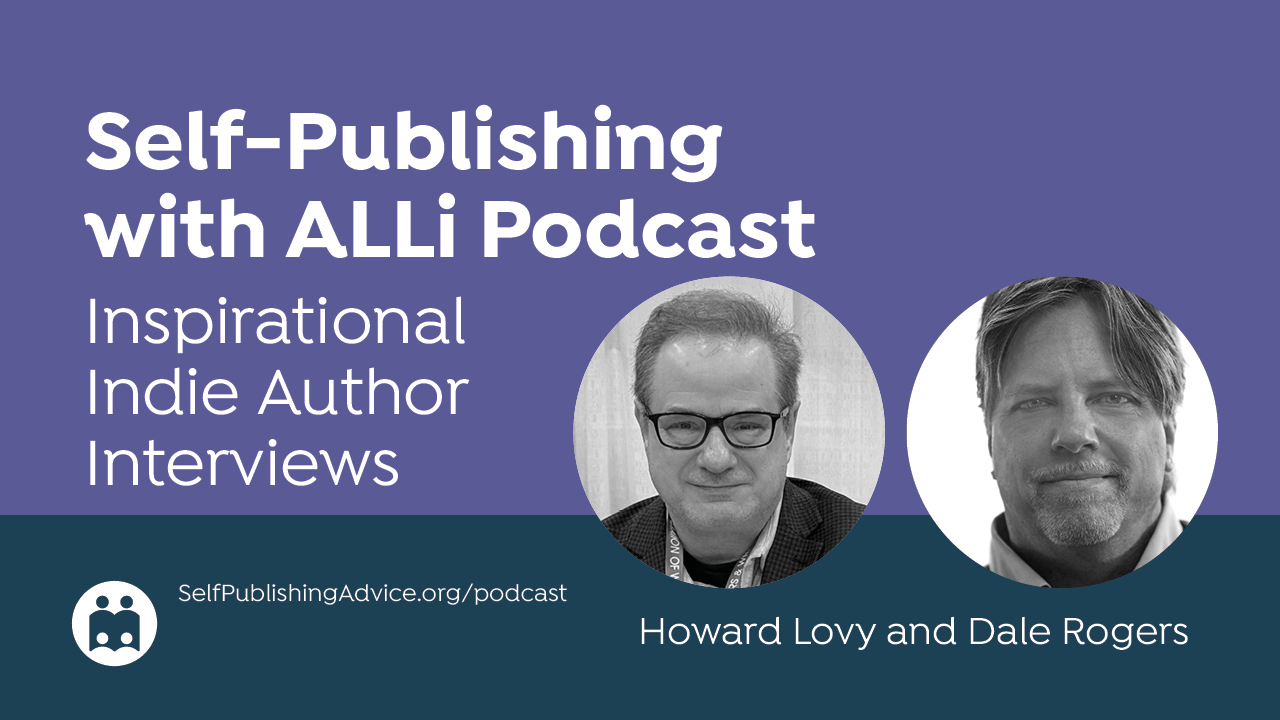
My ALLi author guest this episode is Dale Rogers, an indie author, illustrator, and former assistant professor who retired after eighteen years in higher education to focus on his creative work. Based in Nashville, Dale blends poetry, visual storytelling, design, and spirituality in what he calls Poetry Comics, a genre he’s developing as an indie publisher. We talk about his early creative life, his years as an educator, and what it means to start something new later in life.
Listen to the Inspirational Indie Author Interview: Dale Rogers
About the Host
Author Howard Lovy has been a journalist for 40 years, and now amplifies the voices of independent author-publishers and works with authors as a developmental editor. Find Howard at howardlovy.com, LinkedIn and X.
About the Guest
Dale R. Rogers is an independent author and artist whose work explores creator-owned storytelling shaped by a background in music theory and years spent teaching scripting and storyboarding, with a focus on how stories move from concept to experience. That process led him to develop Poetry Comics, a hybrid form where poetic language, visual composition, and pacing work together to share the narrative load. Publishing through his own imprint, eDrawingBoard LLC, Dale approaches self-publishing from the inside out, combining craft, technical literacy, and accessibility, while also serving as an Invited Expert with the W3C on digital publishing standards that affect indie creators. After an eighteen-year academic career, he is now doing for himself what he spent years teaching others. You can find Dale on his website, and learn more about his imprint at edrawingboard.com.
Thoughts or further questions on this post or any self-publishing issue?
If you’re an ALLi member, head over to the SelfPubConnect forum for support from our experienced community of indie authors, advisors, and team. Simply create an account (if you haven’t already) to request to join the forum and get going.
Non-members looking for more information can search our extensive archive of blog posts and podcast episodes packed with tips and advice at ALLi's Self-Publishing Advice Center. And if you haven’t already, we invite you to join our organization and become a self-publishing ally.
If you’re a published indie author who would like to be interviewed by Howard for the Inspirational Indie Authors podcast, you need to be a member of the Alliance of Independent Authors.
Then contact Howard, including your membership number, explaining why you’re an inspirational indie author and what inspires you.
If you haven’t already, we invite you to join our organization.
Read the Transcript
Dale Rogers: My name is Dale Rogers and I live in Nashville, Tennessee. I am an indie author and illustrator, and I have an LLC called eDrawing Board, which is currently focusing on poetry comics — a genre I am experimenting with. I retired in 2023 from an 18-year career as assistant professor of web and interactive multimedia at Nashville State Community College, which is the largest community college in middle Tennessee. I have a long history of thinking about design, thinking about creation, and teaching people how to create scripts and storyboards and turn that into online media. When it was time to retire, I thought: let me take some of this stuff I've been teaching others to do and go do it myself.
Howard Lovy: Tell me where you grew up and was reading and writing always part of your life.
Growing Up in Miami: Music, Art, and Storytelling
Dale Rogers: I grew up in Miami, Florida — born in Miami and raised in Hialeah, which is a suburb west of Miami, kind of in between the city and the Everglades. I first started off in music. I was always in choir, a choir boy from the time I was five until I was in my twenties, and I studied theory and composition. I was a classical guitar major when I first went to college. I thought I was going to be the next James Taylor or Cat Stevens, you know, that kind of thing. It's all storytelling.
But I was also really attracted to art. I was always either drawing or playing music. I was usually the last person picked for the sports team, so sports was not going to be in my future. But I really excelled in art and music, and that's where I put my emphasis.
Howard Lovy: You don't have to explain the pain of being last picked in gym class.
Dale Rogers: Yeah. The guy on crutches was usually picked before I was.
Howard Lovy: But you were off doing creative things. And eventually in college you wrote your first poem — “I Am Man.” Can you tell me about that?
Dale Rogers: Yeah, that was really interesting. I was living with a group of people kind of out in the woods — we were all spiritually minded and had started a small community. This was in Alabama, in a little tiny town called Holly Pond. I was going to school at Alabama A&M, which is a land grant university, and I was a drafting major at the time. Drafting is very precise drawing — not designed to represent emotions but to create machinery and architecture. Everything is very much to scale and exact. But it really taught me a lot about line work.
What happened was I came across a competition. I was looking for scholarships to help pay for school, and I saw this competition for artwork. I've always been a fairly introspective person, and I sat down and wrote a poem about how I feel like I am one particle in a million particles, just drifting through life — what is that like, what does it feel like, what is the experience of that particle being a man? I wrote it, submitted it, and it won first place in the Academy of American Poets competition. I was pretty thrilled.
Howard Lovy: Reminds me of a song that was popular around that time — Kansas, “Dust in the Wind.”
Dale Rogers: Yeah, very much along those lines. I have it on my website if anyone wants to go look at it.
Howard Lovy: That gave you confidence as a writer. Had you thought of yourself as a writer before that?
Dale Rogers: Well, I had written songs, and writing lyrics is poetry. Growing up in the seventies, I go back and look at lyrics and sometimes think, what the hell does that mean? But a lot of poetry is very symbolic — it's not always literal, it evokes an emotion. And I noticed the interplay of guitar and rhythm and melody and harmony — the music would do part of the emotional expression, but words would do part of it. Having written songs, I knew what rhythm is. I had studied composition, so I understood the different parts of songs. I approached poetry as a lyricist who didn't have to follow a strict structure — no A-B-A or chorus or bridge. Poetry was more open-ended, but there were similarities too.
From Guitar Major to Multimedia Professor
Howard Lovy: Eventually you built a career in multimedia design and education. How did that shape the way you approach storytelling?
Dale Rogers: I was working for Vanderbilt University as a program assistant doing web design and running the database — hired under a National Science Foundation grant. But it was a three-year grant and I knew it was going to end. I was already in the second year and at a fork in the road: do I become a database administrator, or do I go into e-learning? I had already been a corporate trainer for a couple of different companies, and I really enjoyed taking really technical subjects and making them palatable. I had a head for it — I found I could take technical stuff and make it understandable.
Talking to people felt better than talking to a computer all day, so I decided to go that route. I got my master's in e-learning design, but Vanderbilt wasn't doing online training at the time — I was ahead of the curve. Then I saw an ad in the paper for a position at Nashville State. They asked me to give a demonstration of my teaching style, so I taught a room full of educators and deans how to create something with what was then Macromedia Flash. I got the job, but my dean said: I don't want you as a graphic designer, I want you over multimedia. So I had to do a deep dive.
Instructional design works the same way good writing does — you start with what you want people to walk away with. Once people walk out the door, what do I want them to remember? So I focused on exactly what people need to know, researched it thoroughly, and if I understood it, I could teach it. That took me down the road of scriptwriting. In Nashville they say everything starts with a song. In instructional design, everything starts with a script or an idea, and then you flesh it out. I found that creating courses, writing scripts and storyboards, and creating media were not that different.
Howard Lovy: Similar to any kind of storytelling — you start with the idea, maybe an ending or a good riff, and fill in the blanks. Now you're a bit of an anomaly in the coding world because you like people.
Dale Rogers: Yes.
Hearing Orna Ross Speak and Discovering ALLi
Howard Lovy: In 2018 you joined ALLi after hearing Orna Ross speak at Digital Book World. Why did that moment resonate with you, and how did it affect your thinking about publishing?
Dale Rogers: As an educator, you come into the room with expertise to share, but higher education also requires accreditation, assessments, advising, grading, course development, meeting lots of different stakeholders — there are a lot of moving parts. I really wanted to create. Being a creator, a designer, a writer, expressing myself is what got me into teaching in the beginning. But it became so administrative after a while that I started becoming almost jealous of my students, because they were going to take what I was teaching them and go out in the world and create things. And I was going to be teaching another semester of basic HTML.
One of the people on our advisory committee was the head of Digital Book World, and it turned out he lived in my neighborhood — we'd met on LinkedIn. He said, come to Digital Book World. I knew digital books were basically a website in a zip package, but I didn't know anything about the publishing business side. Going there, I noticed Orna Ross was one of the speakers. I stayed in the room, and as soon as she hit that stage the entire room erupted in applause. And I thought: this is somebody I need to pay attention to.
Howard Lovy: She's a rockstar.
Dale Rogers: She is. I had never heard of her before that day. But as she was speaking I really paid attention, and I learned about the Alliance of Independent Authors. Before I left that table that day, I was already a member.
Howard Lovy: Before then, had you thought about producing a digital book or what later became poetry comics, or was that already brewing?
Dale Rogers: I think it was probably already brewing, which is probably what drew me to hear her talk. But it was a seed — it hadn't really sprouted yet. I wanted to look closer at it and see if there was something there. I could have gone deeper into technology or web design, but something inside me was saying I want to express and I want to create. I had been to a panel discussion at the Nashville Film Festival with scriptwriters from LA, and one thing they said really caught my attention — that people are always hungry for content. When you finish watching a series on Netflix, you look for the next one. When you finish reading a book, you look for the next book. We're always looking for stories. And then when I heard Orna say you can actually make a career out of this, I thought: it is time to take a deep dive.
Howard Lovy: And you did. You retired in 2023 and shifted fully into indie publishing. Tell me about your first book, Sparrow. You call it a poetry comic — is that a genre you invented, or was it preexisting?
Poetry Comics: Sparrow and a New Genre
Dale Rogers: It was new for me. To say that I created it is probably a stretch — ideas are kind of floating out there. What got close was Shel Silverstein. His work was definitely poetry but also artwork. But I noticed from teaching storyboarding — going from script to storyboard, reading through a script and making it come alive visually — and I had heard Scott McCloud's TED talk about understanding comics. He talked about how comics are more than just superheroes. You can see that in manga, which explores more everyday and spiritual things. I thought, well, why couldn't the same thing be done with poetry?
Sometimes it starts with a flash of insight — meditating and an idea comes, or it's three o'clock in the morning. I'm working on one now called 3:00 AM, which is about me having an argument with myself about why I keep waking up at three in the morning. All of a sudden metaphors start coming. So I took a poem and wrote a script around it — what I could see in my head, what if I did this, what if I did that. Then I treated every panel like a shot in a movie, and asked: can I do for poetry what I've done with other scripting?
Sparrow is a story about a little bird and its evolving relationship with the wind. It's on a branch, a strong wind comes by, it's gripping the branch, afraid — doesn't know how to work with the wind. Kind of like I am with my emotions sometimes when I'm overwhelmed. The metaphor is: the wind is to the sparrow as my emotions are to myself. How would you depict emotions on a page? You can't directly. But I can draw a sparrow and I can show the effects of wind. The sparrow and the wind became my metaphor. I learned a lot about metaphor by creating that poetry comic.
Howard Lovy: Poetry is a language of the imagination where everybody creates their own pictures. Does creating a physical drawing limit that, or is it more of an interplay between the two?
Dale Rogers: It's a really good question. I heard an interview with James Taylor years ago where somebody asked if he would explain what was going through his head when he wrote “Fire and Rain.” He said he'd rather not, because everybody has their own personal relationship with his songs, and if he tells people what it means to him, it's probably going to deconstruct what it means for them. For me, the comic is my adaptation of the poem — like Harry Potter started as a book, then became a movie, and now there are graphic novels. Every one of those is a different adaptation of an idea or a story. This is my interpretation. Other people may do it differently.
Accessibility in Digital Comics: A Complex Challenge
Howard Lovy: Are there accessibility problems in comics and graphic novels?
Dale Rogers: Yes, and it's a really huge conversation going on right now. I'm an invited expert with the World Wide Web Consortium — the W3C — in the Publishing Maintenance Working Group. It used to be the EPUB group, but after the EPUB standard recommendation was written, the name shifted to reflect that we're now maintaining it rather than creating it. A subset of that group is very interested in web comics and digital comics, so we created a task force focused on that, and within that a subset focused specifically on accessibility of digital comics.
Everything in an ebook is basically a webpage. If you have an image on a page, that's fine for sighted people, but if someone is consuming the content and they can't see, how are they going to experience it? The EU is fairly strict about content needing to be accessible. Accessibility is a very hot topic, but the question of what accessibility actually means for comics is complex. I'm writing a LinkedIn article series on exactly this.
Comics have panels, narrative boxes, dialogue boxes, sound effects, multiple characters. Even from an accessibility standpoint, the question is typically: how does an unsighted person move through the page? Assistive technologies help people navigate through content, and that's relatively straightforward if all you have is headings and paragraphs and a figure with a description. But take that into a comic book or manga — you've got panels scattered all over the page, background textures, a hundred different things happening at once, lots of different dialogue. How would you turn all of that into code? How would you describe that in text? It's really difficult.
So the conversation is: to what degree does something need to be accessible, and to what degree do we just need to say: rather than trying to describe every panel, maybe it would be better to do a novelization of this? In my poetry comics, the poem can stand alone and the comic can stand alone, and I have a script of the poem, which is another aspect of it. So there's text equivalence that people can go through to get a gist of what I'm trying to express. But is it going to be the exact same experience as seeing the comic? Probably not.
Howard Lovy: I live in a remote area of northern Michigan and have a 40-minute drive to the nearest big town, so I have my phone read news articles to me while I'm driving. When it comes to a picture, it'll describe the picture — I'm not sure if it's AI or something built into the news story, but it helps.
Dale Rogers: So in an ebook it's an HTML or XHTML page, and within that there's an image tag that tells the computer where to find the image. There's also what's called an alt attribute — alternate text for people who can't see the image. The computer reads that text to describe what's there. When I looked at how complex a comic page is to describe, I took a panel and uploaded it to ChatGPT and asked it: describe this in a way that would work as an alt attribute on an image tag, so it would be accessible. And what it gave back — I thought, damn, it did a really good job.
Howard Lovy: That saves me from having to ask the requisite AI question. It's not replacing what you're doing, but it's helping make it more accessible.
Dale Rogers: And it also gives me ideas. I'll say, hey, I just want to see how you would do this, and it'll throw something back. I could do the same thing — I could give it to my wife and say, can you describe what this is? It really is just getting another set of eyes, and this set of eyes just happens to be a computer. I look at what it created and say, it got a lot of it, but it missed a few things, and I tweak it a little. And sometimes it is so on the nose it's like: I wouldn't change a thing.
Advice for Late-Blooming Authors
Howard Lovy: One last question, and this is a personal one to me too since I just turned 60. You've spoken about encouraging people to start creating later in life. What would you say to a retired or late-blooming author who thinks it might be too late to begin?
Dale Rogers: I hear stories all the time of people who did the bulk of their creation in their seventies and eighties. I'm retired — semi-retired, because you can't live on Social Security — so everybody has to pay the bills and keep the lights on. But I always used to tell my students: if you're going to be up until two o'clock in the morning working on something, do something you like. And so I do the same thing.
Poetry comics is a new genre. When I say poetry comics, a lot of people look at me like a dog cocking its head to the side — what's that? There's an educational component in just explaining it to people. Sometimes I just hand them my phone, show them one of my poetry comics, and they start flipping through it and go: ooh, I really like this. I'm getting great feedback from people. Has it become a steady source of income? Not yet. And that's the beauty of this podcast and of listening to Orna Ross and being a member of ALLi, because I know I'm not the only one struggling with marketing. I can hear how other authors are doing it, and it gives me ideas and teaches me a lot about who my audience is.
One of the reasons I retired was to create. I don't fish, I don't play golf — all the things people typically associate with retirement, that's not me. I'm going to create, and hopefully that creation, if I just keep putting it out there, will build. The saying is put out 20 products and you start cranking up the revenue engine. So that's what I'm doing. Right now I'm mostly wearing my production hat. When I have more products up there and it makes sense to start purchasing ads, I'll go more deeply into my marketing hat.
For people that are retiring: what else are you going to do? Do something you love, put it out there, and see what happens. Keep in touch with me and we'll figure it out together.
Howard Lovy: I'm not sure if it's a law that you have to play pickleball after a certain age. I hope not, because I think that's going to deepen the trauma I had in high school about not getting picked. I'm going to stick to what I'm doing. Thank you, Dale. I appreciate you taking the time to talk to us about your life and career and philosophy. This has been a fascinating discussion.
Dale Rogers: Thank you. It was lovely chatting with you, and thank you for having me on the show. And thank you for everything you're doing, because it's listening to you that helps keep the wind under my sails and keeps me going.
Howard Lovy: Oh, thank you. Okay. Bye, Dale.
Dale Rogers: Bye-bye.