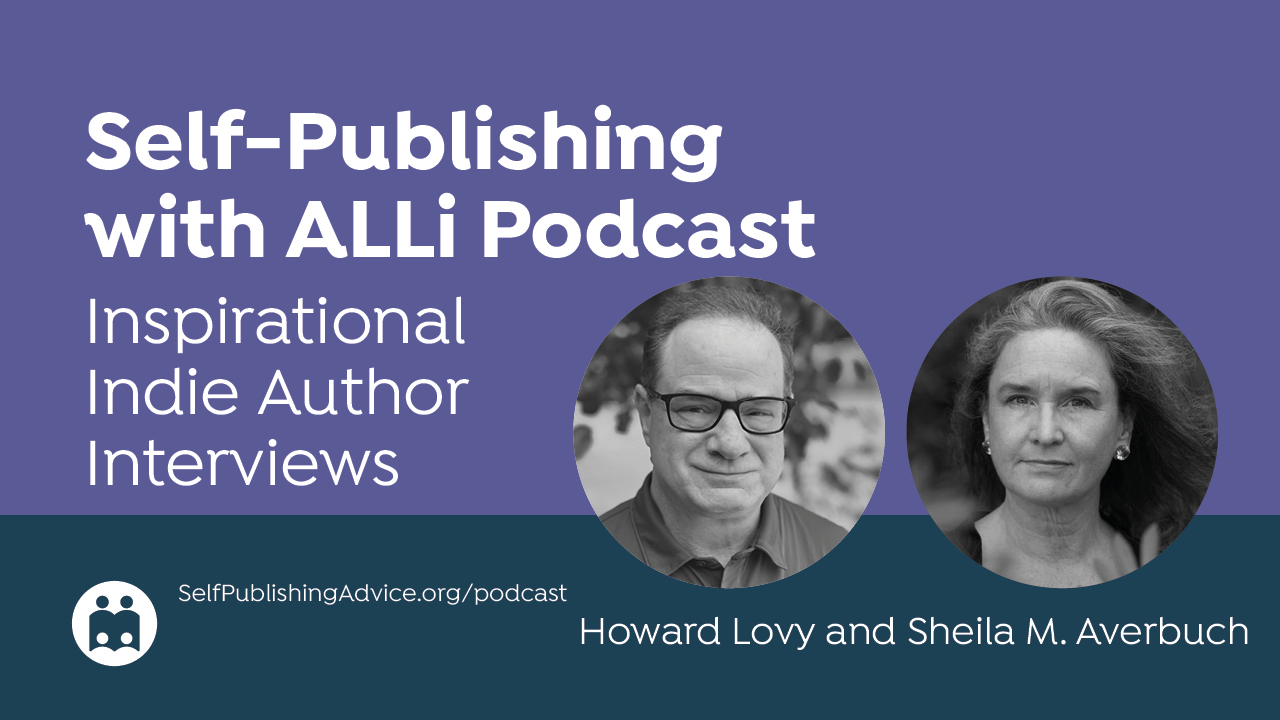
My ALLi author guest this episode is Sheila M. Averbuch, a former journalist and technology publisher who spent years pursuing her dream of writing for children. More recently, she embraced independent publishing as a way to share what she learned from her own long and sometimes difficult path to publication and to help other writers along the way.
Listen to the Inspirational Indie Author Interview: Sheila M. Averbuch
About the Host
Howard Lovy is an author, developmental editor, and writing coach with a long career in journalism and publishing. He works with writers at many stages of their careers, with a focus on helping them develop their ideas and strengthen their work while preserving their unique voices. He lives in Northern Michigan.
About the Guest
Sheila M. Averbuch is the author of middle-grade thriller Friend Me (Scholastic Press New York) and Pitch Your Book (ENNclick Editions) and is the UK's first pitching champion for the Society of Children's Book Writers and Illustrators (SCBWI.) She holds degrees from Harvard and Stanford universities and a New Writers Award from the Scottish Book Trust, and she co-founded the SCBWI network in Scotland. Sheila lives with her family near Edinburgh, Scotland. You can find her on her website and Instagram.
Further Reading
Thoughts or further questions on this post or any self-publishing issue?
If you’re an ALLi member, head over to the SelfPubConnect forum for support from our experienced community of indie authors, advisors, and team. Simply create an account (if you haven’t already) to request to join the forum and get going.
Non-members looking for more information can search our extensive archive of blog posts and podcast episodes packed with tips and advice at ALLi's Self-Publishing Advice Center. And if you haven’t already, we invite you to join our organization and become a self-publishing ally.
If you’re a published indie author who would like to be interviewed by Howard for the Inspirational Indie Authors podcast, you need to be a member of the Alliance of Independent Authors.
Then contact Howard, including your membership number, explaining why you’re an inspirational indie author and what inspires you.
If you haven’t already, we invite you to join our organization.
Read the Transcript
Sheila M. Averbuch: Hi, I'm Sheila M. Averbuch. I am an author and a pitching coach. I wrote the middle grade thriller Friend Me from Scholastic Press, and I have a brand new book out called Pitch Your Book: Write the Letter That Hooks an Agent on Your Novel.
Howard Lovy: Great. Well, I hope by pitch you don't mean throw. Pitch has two meanings. So we'll get into that. But first of all, tell us where you grew up, and was reading and writing always an important part of your life?
Sheila Falls Into Books at Age 11
Sheila M. Averbuch: Absolutely. I grew up between Massachusetts and Ireland, where my father was raised. As soon as my parents had enough money to rub together, they would bring us back to Ireland to visit his family, as well as my mum's more distant relatives. And that was where my father started picking up children's boarding school books by Enid Blyton and other authors, and he would bring them back to me. I'm sure I was the only kid in Wilmington, Massachusetts, reading endless books about being in a girls' boarding school in England or some things like that. And then of course C.S. Lewis, and Anne of Green Gables. I mean, I fell into books at age 11, and I never escaped. And I knew, I absolutely knew that I wanted to write for 11-year-old readers the whole time, and that's what I passionately do, as well as writing nonfiction for adults.
Howard Lovy: Well, writing for children came later. You studied literature and history at Harvard, and eventually earned a master's degree in journalism.
Sheila M. Averbuch: That's correct. I wanted to find a way to make money from writing, and I didn't really think that writing books was going to do it. But I didn't have a great impression of journalism from growing up and looking at tabloid papers in the '70s and '80s and thought, oh, I don't want to be chasing ambulances and doing that kind of journalism. However, I eventually did get my journalism degree, and as soon as I was in there, I absolutely loved it. I loved that there was a set way to write a compelling news story. And as you know from being a journalist yourself, the skills that you learn from being a journalist, you get words on the page. So when I started writing fiction, that wasn't hard for me to actually get the words out. They weren't the best words, but yeah. So I went from Harvard and I worked as an actor briefly in Ireland, and then I went back to Stanford to get my journalism degree.
And when I was finishing that, one of my teachers at Stanford said that their contact at USA Today needed a journalist to cover the peace process in Northern Ireland. So that's what I did. I did that for a number of years until I started writing about technology, and that was how I eventually, very roundabout way, came to write techno thrillers and sci-fi for middle grade readers.
Covering the Peace Process Teaches Her to Let the Words Speak
Howard Lovy: Wow. That's a roundabout way. Let's back up a little bit and talk about how you covered the peace process and the Troubles for USA Today. What did that experience teach you about writing and storytelling?
Sheila M. Averbuch: The first thing I learned is that the old boy network of foreign media correspondents in Ireland weren't going to take me seriously because I was a 24-year-old woman, and as soon as I met them, they were hitting on me. I'm like, “Oh, this is nice in the workplace,” but I just learned, listen, keep your ears open and these guys have things to teach you. So as soon as I got back in Ireland from doing the degree in Stanford, one of them was giving me a lift up to Belfast to interview people. I interviewed people up there about what it was like to be a Catholic in West Belfast, what the peace process was like, and then I wrote my first piece and I showed it to the guy from one of the big international papers. And he read it, and this is one of the guys who had hit on me the first time I met him. He read it and he said, “Did you really write this?” Oh, no. “Did you really?” I think I really did write it, Jim. Jim's dead now, so we can say that. But yeah, I learned that if you are not going to be taken seriously as a young woman reporter, you just stick to the job and your words will speak for you, and they soon saw that I could write solid stuff. It's just that I didn't really enjoy writing about the sectarian violence and all that kind of thing, so it was quite a challenge, but it certainly got me some A1 clips on the front page of the international edition of the USA Today at the age of 25. I didn't know how good I had it.
She Trades the Troubles for Technology
Howard Lovy: That's amazing, yeah. Covering historic stuff. And yeah, I had a similar trajectory. I was covering the Mideast peace process in the late '90s and early 2000s, and then I burned out of that and then I went and started covering technology and science too, and you had a similar trajectory. You started Ireland's first technology news website. So how did you go from the Troubles to technology?
Sheila M. Averbuch: Because when I was in Stanford doing my degree, I still had contacts back in Ireland where I had been visiting all my life with my family, but I had lived there as an actor for a couple years. So when I was in Stanford, I was contacting editors back in Ireland saying, “Can I write for you while I'm here?” And they were saying, “Yeah, write about technology. Write about Silicon Valley.” So I started doing my first couple clips, and it was all about this new thing called the World Wide Web. I remember another student in the journalism lab in Stanford, it was 1994, she said, “Come look at this. It's the Mosaic browser. You can search things on the internet.” And so I started writing about tech because I was in the crucible of it there. So when I went to Ireland, even though I was a stringer for USA Today, I was already being asked to write things for the Sunday Business Post and the Irish Independent about this new kind of internet thing that was going on. I actually used to write a column for the biggest daily in Ireland called the Irish Independent about recommended websites to visit. “Here's a new website. You might want to check it out.” Can you imagine, a column about recommended websites?
Method Acting Unlocks Her Children's Fiction
Howard Lovy: Your work at USA Today and your technology work, that's all aimed at adults. When did you decide to seriously pursue children's fiction?
Sheila M. Averbuch: I was 32 and I had a little bit of time on my hands because my husband and I were in the process of moving from Ireland to Scotland. He's Scottish. And I had a little bit of time on my hands because we were kind of between here and there, so on my lunch breaks from working at the technology news website that I started, I started writing a children's adventure very much inspired by those boarding school books that I had read back in the '80s, but it was about a school which orbits Mars on a space station. And I just thought, “I know how to do this. I've read so many of those books about the kids having an adventure. I think this is the kind of thing that kids would like to read.” And it was almost like, if you can picture somebody writing with their hand stretched out, I was writing it at a great distance from the actual material thinking, “Maybe this is what kids would like. I think kids would like this.” What I wasn't doing was using my acting ability. It took me, I don't know, four years of writing fiction before I realized this is what I had to do. I had to be the kid on the space station. I had to be the sister. I had to be living where you never saw anything green. You were living in an artificial environment which might be fun when it's on Star Trek, but maybe not so much when you're 11 living on a space station and you remember Earth.
Howard Lovy: Kind of like method acting for writing.
Sheila M. Averbuch: That's exactly it. So the first space station adventure I wrote, it wasn't very good because I wasn't doing the method acting thing, and it really did take me years to figure out I need to actually write as if I am acting every part, as if I am painting all the scenery behind me. I'm stitching all the costumes. But it did, Howard, it took years for me to realize that because, I don't know, one of the many things they don't tell you about writer's craft when you're trying to figure out how to be a novelist is not hacks, but, like, tips that really resonate with you. If someone had said, “Write this book like you're acting every character,” God, that would've saved me years. Years.
SCBWI Delivers an Epiphany
Howard Lovy: Well, how did you become involved with the Society of Children's Book Writers and Illustrators in Scotland?
Sheila M. Averbuch: I did everything wrong when I was first trying to get my manuscripts published, so I sent my manuscript to my neighbor's daughter. She's a successful children's book writer and illustrator, and I said, “Could you maybe send this to your agent? What do you think?” And she said, “No, that's not how it works. What you need to do is join the Society of Children's Book Writers and Illustrators, a professional group. It's the largest international professional association for children's book writers and illustrators.” She said, “Go, join them, go to their conferences, find out who's publishing what, meet editors, meet agents.” I'd never heard of the fact that there were even professional associations for certain genres of writing. So that's what Debbie said to do, so I did it, and the first conference I went to, what an epiphany. Because there were one-on-ones that you could have with editors who'd read your first 10 pages of your manuscript and tell you what you were good at and tell you what needed work.
That's the first time I ever heard of voice, at that first conference for SCBWI in 2012. The first time I was told by people, “Gosh, you need to read more of the kind of book that you're trying to write.” Because I don't know about you, but my instinct was, oh, well, I've read plenty of children's books, not thinking about the fact that I'd read them when I was a child. And maybe part of me thought, “If I read other people's middle-grade novels, I don't want to unconsciously or consciously nick something from there. I don't want to be polluted by other people's work.” So it was at the conference that I was told, “Listen, you have to read more,” and that's when I started reading dozens and then hundreds of middle-grade novels. And yeah, that was wonderful inspiration. Talk about writer's inspiration. I was reading stories with incredible voice and wonderful plots that pulled the rug out from under you. Fantastic characters and, even down at the sentence and paragraph level, beautiful writing. People who don't read middle-grade or young adult books these days might not realize how excellent the writer's craft is inside them. Absolutely brilliant. So yeah, SCBWI was a big step forward for me.
Scholastic Says Yes After 120 Rejections
Howard Lovy: And it paid off. Your middle-grade thriller, Friend Me, was eventually published by Scholastic Press.
Sheila M. Averbuch: Yes. I will tell you where I was standing the day I found out that we had an offer from Scholastic. It was like an out-of-body experience. I was at the bottom of the stairs, my daughter was at the top of the stairs, and I gave a big gasp, and she said, “What?” I said, “Scholastic wants to publish my book,” and I'm going to choke up now describing this to you, because it had been 17 years. More than 120 actually, when I counted it up, rejections, if you count up all the rejections from literary agents and all the rejections after that from editors who my agent and I were approaching with my work. And finally, here was an offer from the world's biggest publisher of children's fiction.
Howard Lovy: Oh, yeah. I remember the Scholastic little handouts my teacher would give us. We'd pick out our favorite books through Scholastic Press.
Sheila M. Averbuch: That's the thing. With the Scholastic Book Fairs, the children are making the decision themselves. So you need to have a great story and you need to have a cover that's going to appeal to the 11-year-old or 12-year-old taking it off the rack in the Scholastic Book Fair. But yeah, 'cause a lot of people writing children's fiction, the fiction is getting put into the reader's hands by their parents, by someone at a birthday party, by a librarian. But with Scholastic, it's the reader themselves who's taking it off the shelf. What a thrill.
AI Kills the Copywriting Business
Howard Lovy: Now, alongside your fiction, you also built a career writing blogs and other content for clients. And that eventually led to, I guess, what you would call a disruption in the age of AI. It's already affected you professionally?
Sheila M. Averbuch: Yes. Oh, absolutely. When I first started my technology news website in Ireland, we had a sideline in the business of doing corporate copywriting for people, and eventually we shut down the news website and my journalists and I were just doing corporate writing for people. And then it got quite large. We were doing thought leadership, blogs, brochures for people. But that work fell away with the tech crash, and then marketing budgets contracting. But what really put all the nails in our coffin was AI, because we were being paid good money to write thought leadership pieces, and then overnight we lost 24,000 a year, that's in euro, of revenue from a few clients who were just going to use AI to write this thought leadership stuff that we were taking pains to write at a very high level. I mean, eventually we just gave up trying. I had one final writer still with me and I had to let her go and just accept the fact that the industry was moving on. And I had the option to devote myself to writing books. Fiction and nonfiction. I said, “That's just what I'm going to do,” and I went back to my journalism roots and I started pitching myself, believe it or not, to garden magazine editors here in the UK, the spiritual home of great gardening. I'm an avid gardener, and I started proposing to editors that I write for them, and now I'm one of the feature writers for one of the biggest glossy gardening magazines here called The English Garden.
Howard Lovy: Oh, wonderful. Well, you need experience for that, that AI can't necessarily give you, right?
Sheila M. Averbuch: Yes, AI has been such a heartbreaker for writers of all kinds, but we are resilient by nature, we writers. We keep going.
Howard Lovy: Although I admit if there's something funny growing in my garden that I don't recognize, I upload the picture to AI and it tells me what it is. But I'm not—
Sheila M. Averbuch: Just email me, Howard. I'll tell you.
A Low Point Inspires Pitch Your Book
Howard Lovy: I will. I'll do that, okay. And so your reinvention also eventually led to your book, Pitch Your Book, which grew out of everything you learned about the query process for an agent. And I've been through that, and a lot of our listeners have been through that, and it's just such a soul-sucking, dispiriting process looking for an agent. At what point did you realize that your experience could be something useful to other writers?
Sheila M. Averbuch: Well, after my copywriting business was strangled to death, mostly by AI, I was really low. And there'd been some other things that had happened in my life. I had a couple bereavements, and I started thinking, how can I carry on? I can't carry on like this. I thought I was going to have a copywriting business forever and ever, and that's not happening. I thought if I just lived a good life as a good person, bad things wouldn't happen to me, and that's not true either. So it was in a conversation with my counselor that I said, “You know what I would really like to do?” ‘Cause she asked me about goals. I said, “One day, I would love to write a book to give some hope to authors,” because getting an agent and figuring out how to develop my craft to the stage where I could get an agent was the most grueling experience of my life, and that includes childbirth without painkillers. And one day, I want to try to spare writers some of the pain that I experienced. And I really think that came out of the fact that I had gone so low in my life, and my therapist said to me, “You know what you just said there, that you want writers to know that there is hope?” She said, “Well, I want to say that to you, too. I know you feel bad right now, but there is hope.” So, at the end of that year, I had a draft ready of Pitch Your Book, and I sent her a message to say, “I did that thing. I did that thing. You encouraged me to set a goal, and I did it.”
Howard Lovy: I'm going to steal that: looking for an agent is worse than childbirth without anesthetic.
Sheila M. Averbuch: Thank you.
Every Book Needs a Pitch
Howard Lovy: I don't have firsthand knowledge of that, but I can only imagine. So you decided for Pitch Your Book to go indie rather than a traditional publisher, which almost seems like a contradiction. Like, well, if you're telling other people how to pitch a book to an agent, why don't you have one?
Sheila M. Averbuch: That's true. So the short answer is every book needs a pitch. Whether you are independently published or traditionally published or you want to be traditionally published and go via a literary agent, your book needs a pitch, and if you know what that pitch is, then you have the best chance of connecting with readers. So yes, when you are contacting a literary agent, you need the heart of your query letter to that agent to be a really strong, say, 250-word pitch that just answers one question: What is your book about? Now, the agent has that question in their mind as soon as they start reading your email: what's this book about? But the same question is in the mind of a podcaster who you might do an interview with, or a book festival programmer, or an independent bookstore who might stock your book. You need to be able to answer the question succinctly, what's your book about? So pitch your book. Yes, it's aimed at people who want to catch the attention of an agent, but it's really aimed at any novelist who wants the secret to distilling tens of thousands of words down into a really compelling description of what's in the book that makes people want to know more.
Why Not Let ChatGPT Write the Pitch?
Howard Lovy: Now, we mentioned earlier AI replacing this. Why can't people just ask ChatGPT to write a pitch?
Sheila M. Averbuch: Well, it might involve uploading your manuscript to a large language model like ChatGPT saying, “Hey, just summarize this for me.” So when you do that, do you realize that you are just giving your fiction to the monster? That it has stolen the ability to speak and understand language by ripping off monographs from copyrighted works all over the place? So I hope that people are aware that generative AI, although it seems to be able to spit out this miraculous content, including, if you like, to write a pitch for your book, I hope people are aware that these large language models only learned how to do that through unethical means of stealing copyrighted books from authors. So don't do it because it's really not the right thing to do. I don't think there's any way to ethically use generative AI, and I certainly wouldn't voluntarily, if I were a querying author, be handing my manuscript to the machine, because it just becomes something that they are munching on. So it seems unwise.
Howard Lovy: And I can still tell. I'm at the other end of the process. I get queries all the time from authors for another project I'm involved with, and I can tell which ones were written by a machine. I don't have any software that tells me it was, it's just I can feel it in my gut. There's word choices, there's a certain cadence to it.
Sheila M. Averbuch: It has the smell of AI to it, even if you can't quite put your finger on it. And if you're a writer, you're a reader, I hope, as well, but if you are a writer you love words. Why outsource that love to the machine? Why?
Magazine Editing Prepares Her to Self-Publish
Howard Lovy: Absolutely. So let's turn to the business part of being a self-publisher. Earlier you ran your own tech publication, so did that prepare you to control the entire publishing process?
Sheila M. Averbuch: It did, Howard, actually. When I got to the stage where I was proofreading Pitch Your Book, the book about how to write a letter that hooks an agent, that came out in 2025. I put it out as an e-book and an audiobook. But in 2026, I came out with it as a print version, and especially when it came to looking at the proof copies and going over everything to make sure it was word-perfect, it gave me such a flashback to when I was a magazine editor in Ireland in 1998, '99, 2000. And you were about to press the button on what would be thousands and thousands of copies of this printed thing, and then you can't take back the typo. So I used to proofread by running my finger along every line and reading every single word, and then stepping back and looking at the double page spread, 'cause each double page spread is a performance. It has to look beautiful on the page. It's not just a matter of not having widows and orphans of text at the ends of pages, but the whole thing has to be pleasing. So certainly writing Pitch Your Book and publishing it brought me straight back to my magazine editor days.
Howard Lovy: I remember those days. Back when I was a journalist, I was in charge of the Sunday edition at a major newspaper, and I would actually go home, go to bed, and in my sleep think, “Oh no, I think there's a typo in our lead story,” go back to the office and recheck it. But that's how paranoid I was.
Sheila M. Averbuch: I love your commitment. But that's what it's about really. I discovered the Alliance of Independent Authors when they ran a seminar half-day thing here outside of Edinburgh in Scotland where I live, and as soon as I started listening to the speakers, I'm thinking, “Oh, if I ever independently publish something, I am joining these people,” because they really are about quality. And that quality commitment that you just mentioned, people who care about the details, what a comfort to me to know that ALLi was there when I decided, okay, I'm going to self-publish Pitch Your Book, which, by the way, I did in discussion with my agent. She said, “Sheila, there is only one publisher that I can sell this to, and they're not going to give you a good deal.” She said, “I think what you should do is publish it, make it affordable, and in the back promote your masterclass,” because I work one-on-one with writers on their query letters. And so that's what I do. So there's an upsell at the very end of Pitch Your Book if you want to work one-on-one with me, but the book is really everything that you need to know if you are a querying fiction writer. But my agent was the one who said, “I think you should self-publish this.”
Short Videos and Old-Fashioned Email Sell the Book
Howard Lovy: So how do you pitch Pitch Your Book? Do you have a newsletter, social media, all of the above?
Sheila M. Averbuch: I teased a lot of video bits from it when I was coming out with the first edition in 2025, just taking a bit from the text and saying, “Listen, okay, when it comes to the query letter and you're talking about yourself, you really need to keep it short. And by short, I mean 50, 5-0, words at most at the very end of the letter. Keep it short.” So I would do little videos like that looking at social media marketing. I would put that on Instagram, TikTok, Facebook, and YouTube Shorts. One of my clients when I was a copywriter was a book prize here in Scotland called the Walter Scott Prize, and I was their social media strategist and manager. So I learned a lot from them about how video content and social media content works in the book world. So yeah, I did a lot of social media for Pitch Your Book. I also have an author newsletter, which I send out about four times a year, which is the frequency that I can cope with. And really, email, Howard. I don't know what other writers find, but I find that a good old-fashioned email to a library or to a bookshop telling them about the book gets them to look at it and acquire it.
She Tackles Historical Fiction Next
Howard Lovy: Now, are you still writing children's books in a traditional way?
Sheila M. Averbuch: Yes, I am. In fact, I am about to go on a research trip to Massachusetts, where I grew up, to look at some first-hand resources at the Massachusetts Historical Society because, for my sins, I am endeavoring to write a book set in 1680 in Massachusetts, and I have never attempted historical fiction. The closest I've ever gotten to historical fiction has been being that social media manager for the historical fiction book prize. So I really want to try it. It's something that I really want to do, so I'm going to give it a bash and who knows where it'll turn out. My agent and I are also on submission with another middle-grade thriller that I did as a follow-up to Friend Me, not set in the same universe, but again, it's a contemporary realistic novel with a sci-fi twist.
Better Tools Make This the Best Time to Go Indie
Howard Lovy: So you see yourself as essentially a hybrid author, a publishing entrepreneur and a writer for traditional press. Where do you think that combination will take you next?
Sheila M. Averbuch: Well, I already mentioned how useful I find ALLi. I have to tip my hat also to the quality of the resources that have been made available to independent authors. The layout software—so I use Atticus to lay out my books in digital form as well as in print form. Then when it came to trying to do my audiobook, it was so easy with the resources available out there to do it at a high quality. So when I look back to being a technology journalist in the 1990s in Ireland, I started my own technology news website because I was writing technology news and features for traditional publishing, and they were all embedded with print, so none of them were experimenting with the web. So I said, “I'm going to do this.” But I had to pay, like, 30,000 pounds Irish to somebody to do a website for me, which would be a news website with database functionality and all that stuff. What really impresses me is how the quality of tools has improved tremendously to make publishing available to writers who, let's face it, writers are where books come from. Books should not come from AI. They should come from the mind of a writer. And if you are thinking of being independently published, then I say now is the best time because the tools available, whether you're looking at audio or layout or anything else, are fantastic. I still do want to be traditionally published for children's fiction, especially because it's hard to get that book into the 11-year-old's hands unless you are going through the traditional methods.
Howard Lovy: Well, wonderful, Sheila. This has been fascinating to go through the trajectory of your life from journalist to entrepreneur and publisher and author. Thank you very much for sharing your story with us.
Sheila M. Averbuch: Thank you so much, Howard. It's been a pleasure.
Howard Lovy: Thank you, Sheila. Bye.
Sheila M. Averbuch: Bye-bye.