



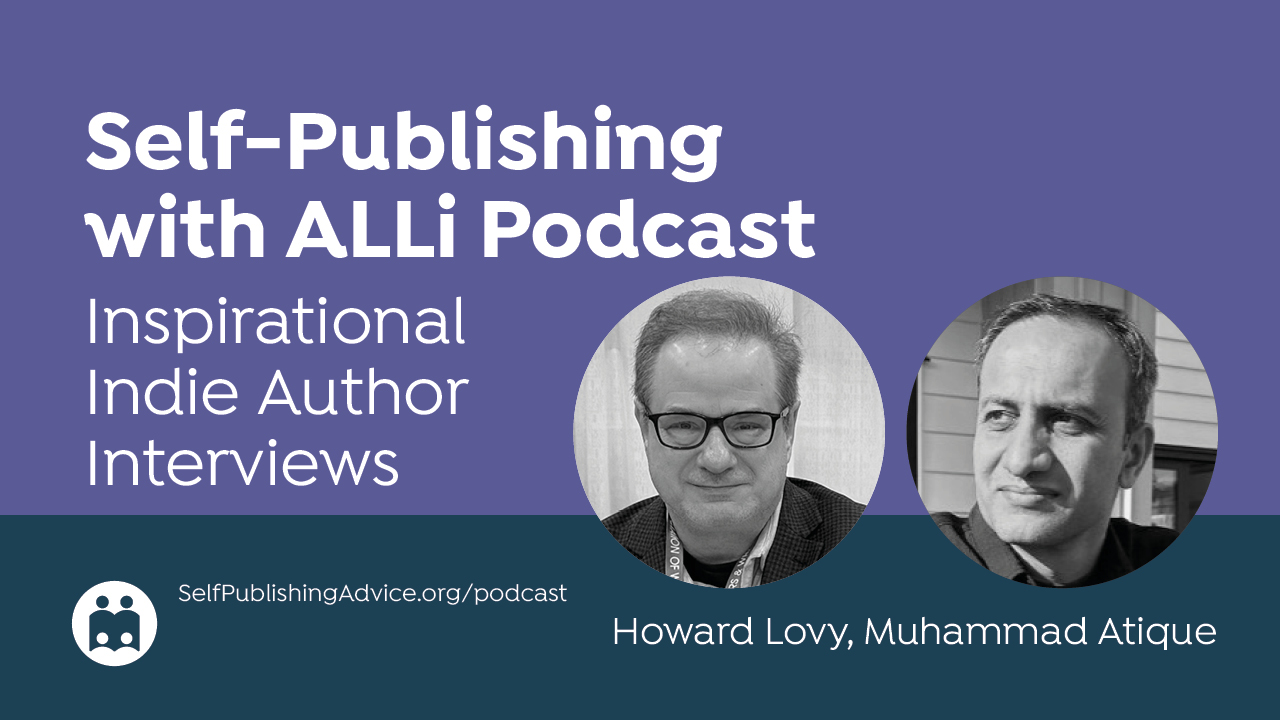
My ALLi author guest this episode is Muhammad Atique, an author and lecturer whose journey has taken him from Pakistan to China, the United States, and now New Zealand, where he’s connecting with the indie author community. His book explores how AI, algorithms, and digital media are reshaping the way we communicate, think, and relate to one another in an increasingly online world.
Listen to the Inspirational Indie Author Interview: Muhammad Atique
About the Host
Howard Lovy is an author, developmental editor, and writing coach with a long career in journalism and publishing. He works with writers at many stages of their careers, with a focus on helping them develop their ideas and strengthen their work while preserving their unique voices. He lives in Northern Michigan.
About the Guest
Muhammad Atique holds a PhD in digital government and is a Fellow of Advance HE in the UK. He has spent more than fifteen years working across the media industry and academia, focusing on digital media, culture, and how people adopt new technologies. His work examines how rapidly changing technology is shaping the way people live and communicate. Originally from Pakistan, he enjoys exploring different cultures, traveling, and meeting people from all backgrounds. He is currently based in Auckland, New Zealand. His latest book, Algorithmic Saga: Understanding Media, Culture, and Transformation in the AI Age, examines how technology is reshaping everyday life and why it is important to maintain a balance between digital change and real-world values.
Thoughts or further questions on this post or any self-publishing issue?
If you’re an ALLi member, head over to the SelfPubConnect forum for support from our experienced community of indie authors, advisors, and team. Simply create an account (if you haven’t already) to request to join the forum and get going.
Non-members looking for more information can search our extensive archive of blog posts and podcast episodes packed with tips and advice at ALLi's Self-Publishing Advice Center. And if you haven’t already, we invite you to join our organization and become a self-publishing ally.
If you’re a published indie author who would like to be interviewed by Howard for the Inspirational Indie Authors podcast, you need to be a member of the Alliance of Independent Authors.
Then contact Howard, including your membership number, explaining why you’re an inspirational indie author and what inspires you.
If you haven’t already, we invite you to join our organization.
Read the Transcript
Muhammad Atique: Hi, Howard. Good morning from New Zealand. I'm Dr. Muhammad Atique, and I'm originally from Pakistan. I studied and worked there in journalism, media, and communication. Then, when AI came along two or three years ago, everything changed. First came the YouTube disruption, and I also changed my profession. I studied management and related fields, came to China, and lived there for almost eight or nine years. In the meantime, I also came to the United States — in 2014 I worked at Houston Public Media for a couple of months on an exchange program, which was a very good experience. Eventually I came to write my book, The Algorithmic Saga: Understanding Media, Culture, and Transformations, which covers so many revolutionary changes — AI, media, podcasting, how digital things are changing the offline world, and much more.
Howard Lovy: There's a lot to unpack there, so let's take it one at a time. Tell me more about where you grew up, and was reading and writing always a part of your life?
Growing Up in Pakistan
Muhammad Atique: I was born and grew up in Islamabad, which is the capital of Pakistan. My schooling and college were there, and then I went to study journalism in Lahore. Lahore is a very famous, very old city, very traditional — central to Pakistani culture. The University of the Punjab there was built during the British era, more than 150 years ago. A very old institution. That's where I studied journalism and communication.
Howard Lovy: Why were you interested in journalism and communication? What about that field appealed to you?
Muhammad Atique: At that time I was not so good in mathematics, statistics, or anything computer-related — and I'm still not entirely comfortable with technical applications, to be honest. In the beginning I was more of an outdoor person. And when you're an outdoor person, journalism and media communication is the best fit. Every day you need to go outside, connect with people, sometimes with celebrities as well. My side was more with production. I practiced it for a while and then moved on.
Howard Lovy: It's the same with me. I started my career as a journalist, probably for the same general reasons — most writers aren't very good at math. And then journalism changed and I had to figure out something else to do.
Living Between Cultures: Pakistan, China, Sweden, the US, New Zealand
Howard Lovy: You've lived all over the world — Pakistan, China, New Zealand, the United States. How do those early experiences shape the way you think about culture and communication?
Muhammad Atique: My personality is an exploring personality. When you study media and journalism, you want to explore, you want to talk to people. I also went to study leadership in Sweden, in Europe. America, from my experience, is a very straightforward culture. Europe had the language barrier. Same with China — no English — so learning a new language was a different kind of challenge. I learned some Chinese, not fluently, but it was a very different culture from the South Asian perspective.
And now New Zealand. New Zealand is a slow, calm, very peaceful country — pleasant weather, a slower pace. That suits me well when I'm in academic mode, because I'm teaching here as a lecturer. The countries I've come from are very heavily populated, very different environments. Exploring these cultures gives me something fascinating. It's more close to my nature — talking with people, exploring their stories, writing about them, reading about them.
For example, here in New Zealand the Māori people have a culture of tattooing — they make tattoos on their faces and bodies. Every symbolic act, whether on the body or in writing, carries a message, and you need a long time interacting with people to understand what that message is. When I was in China, their written language is pictorial — the characters for sun and eye are images, not letters. You find meanings. That kind of exploration is very close to my nature and very fascinating.
Howard Lovy: It sounds like you have a lot more space to breathe in New Zealand. You've described living between cultures — do you see that as something that strengthens your writing, because you're a little removed from the culture you're living in?
The Algorithmic Saga: Technology, Society, and the Loss of Human Connection
Muhammad Atique: My book is about AI cultural transformation, digital media, podcasting, digital art, and digital transformation. These topics are slightly technical by nature, but my approach is more sociological. That's why it took me almost two years to write — I had to find my way into that world of AI algorithms and come at it from a human perspective. Because it really is irritating now, to many of us. People in journalism are thinking about AI writing for them. Hollywood writers are thinking about AI writing their characters. Technology is increasingly writing for people.
Howard Lovy: Writing badly, I should add. I'm a book editor, and some of the AI writing I see is just awful. Maybe it will improve, maybe it'll mimic a human being better in later generations. But right now I don't feel particularly threatened by it. It sounds like you approach this not as someone interested in the technology itself, but in how it affects culture — and you argue that we're not just using technology, but that technology is actually changing the way we interact and live our lives.
Muhammad Atique: Yes. Two things are happening now. You're right that the writing is plain, robotic. But AI does help people translate from their first language into English — emails, daily work. That's a genuine use. Coming back to the book's central idea: I always focus on balance — technology and society. We still want to meet people. We still want to enjoy a coffee, taste it, be present. But now we're talking with machines, and our ability to communicate with the stranger next door, the new person on the street, is getting poorer. We're not practicing that. We're working on technology. Your mother is waiting to talk to you. Your grandfather has stories to share. That's the essence of our history — we love to tell stories. But now we're telling those stories to robots, and the robot says, yes, you're right.
Howard Lovy: It always agrees with you, even when you're making bad decisions. The chatbot tells you that you're doing something wonderful. And I've noticed that the human mind is unpredictable — it goes off on tangents, it has obsessions, likes and dislikes. I just don't see that in AI writing. So you're saying we're losing that humanity because we're letting algorithms take over?
Muhammad Atique: The machine is dominating now. In the last three or four years it has dominated our behavior. We give more and more time to mobile and machines. This genre — technology and society — is a nonfiction genre, and many authors, especially from America, have written about how to balance it: giving time to family, friends, workplace. Self-help books address this. But coming back to basics: how we communicate better with our neighbors, our colleagues, our family. I come from a culture where family is first, work is second. We put more emphasis on family bonds and relationship building — we have a collective culture. Technology is eroding that.
As a lecturer, I see it clearly: students copy-paste from AI when I ask them for their own ideas. They don't know what their idea is. They put forward a statement without thinking, and ten minutes later they've forgotten it because they never even read it. From an academic standpoint, this is going in a bad direction and I'm afraid about it.
Critical Thinking and the Classroom
Howard Lovy: You must see a lot of AI use in your role as a teacher. How do you discourage that? How do you get students to put forth their own ideas rather than cutting and pasting from an algorithm?
Muhammad Atique: In the last couple of years, universities and academics have been focusing on critical thinking. It's becoming a popular topic. Critical thinking means: come with your own point first, then ask the chatbot what it thinks. Prefer your own conscious thought, because your conscious thought is much better than that robotic, plain-language output. In imagination, we can jump from Mars to the Moon and back. Our imagination is still stronger than any machine's.
Thomas Edison — a great inventor who came up with thousands of inventions — had the habit of critical thinking and imagination, and then putting those imaginations to work. That's still the model. First, come with your own critical thinking. What are you sensing? How are you naming things — colors, feelings, good, bad, the weather? That's life. When a student opens their mouth and starts to speak, I can tell immediately if it's not really them — if they're just copy-pasting. At that point I become a little firm: please sit down and think for a couple of minutes. Technology is creating urgency — jump in, give the reply, never think, never read. That's dangerous.
Echo Chambers, FOMO, and Delusionships
Howard Lovy: You go into some psychological effects in the book as well — FOMO, fear of missing out, echo chambers, and what you call delusionships. Can you describe those?
Muhammad Atique: An echo chamber is when we reinforce our pre-existing beliefs — we build a picture in our minds and then keep feeding it the same material. A delusionship is a similar dynamic: what we believe and what media tells us is what we act on. Seeing is believing. FOMO — fear of missing out — is social media constantly showing us that others have reached some place, got a promotion, bought a home, gone on vacation. The average adult uses social media eight to nine hours a day. When you see that, the fear sets in: I'm falling behind. But you are not falling behind. You have no real comparison with others. You only have a comparison with your own self.
Media makes it worse because your mind is absorbing enormous amounts of information in seconds. It's a game of seconds now — attention economy — and these words and images are jumping and popping up in our social media feeds constantly. Our minds are no longer calm. Creativity suffers. The echo chamber, FOMO, and delusionships are the key dynamics we live with every day.
Howard Lovy: And the algorithm amplifies it. If you look at your friend who just bought a new house, it will then show you more friends buying houses. It thinks that because you looked at something once, you want to see it 100 times. So your book doesn't just diagnose the problems — it offers strategies, including what you call a digital detox. That's a big ask for people. I'm 60 years old, I remember days before all this, but I depend on technology because I work from home, do these podcasts, edit books. How do you do a digital detox and still remain connected with the world?
Digital Fasting: A New Framework for Balance
Muhammad Atique: Many people have written about digital detox, many papers have been published. I've come up with a related concept: digital fasting. The idea is balance — eight hours for work, eight hours for sleep, eight hours for family, friends, and socialization. How do we divide our 24 hours? Digital fasting means: this is my office time, and I focus on that. Then when I'm socializing, visiting places, or spending time with friends, I put the phone away. Your friend is sitting next to you and you're not talking to them — you're making videos or checking your phone and messaging someone else. That person right beside you could be a great conversation, even a book conversation.
I've noticed this in New Zealand — people here love to read. On buses, at bus stops, in parks, even in laundromats, people are reading physical books. Kindle is not as common here; hard copies are. That means something. Digital fasting and digital detox are about giving value back to humans and to your work. When you're more focused, you produce better content. Right now, from the moment we wake up, our first instinct is to check our phone. Our mind gets mixed up with that immediately. The goal of digital fasting is to empower your focus — to recognize that we now live in a specialized world that rewards concentrated attention, not scattered multitasking.
Howard Lovy: I like the digital fasting idea. I started intermittent fasting for my diet and lost 12 pounds. Somehow the same principle applies — at a certain time, food is not an option. And maybe for technology the same applies: after you're done with what you need it for, during a set time it's simply not an option. Socialize. Talk to your spouse, your kids, your neighbors.
Finding Community in New Zealand
Howard Lovy: You're relatively new in New Zealand. How are you settling in — are you making connections in the literary community there?
Muhammad Atique: I'm a socialized person. I love talking with people, even when they might not immediately want to engage — I still try. New Zealand is a very peaceful, calm, pleasant country. You can experience four seasons in a single day. I recently joined the New Zealand Society of Authors and they welcomed me warmly. An author festival is coming next month, with authors coming from the United States, the UK, and Australia. I've also joined library clubs — people here love to read and love to talk.
My genre is nonfiction, and I can see that people here tend to prefer fiction. I went to a library in Auckland just yesterday and at the main display table almost everything was fiction. I asked where the new nonfiction arrivals were — they said second floor. So I'm getting a sense that readers here love stories. But New Zealand is also a multicultural, English-speaking country, which makes it much easier for me than China, where there was a huge language barrier. Here I can find people from all over the world, find my food, find Pakistani dishes. I'm happy. And it's another exploration — of minority cultures, of people from different backgrounds. That's very much in keeping with my nature.
Cautious Concern, Quiet Optimism
Howard Lovy: You look at the future with some concern but also some optimism. In what ways are you worried, and in what ways are you hopeful?
Muhammad Atique: The worry is that machines will replace many jobs soon — and writing is one of them. When you add voice cloning, emotional simulation, and audio capabilities, I'm worried about where fiction writing and many other creative fields are heading. I'm also worried that technology has already damaged our relationships with other human beings. Unless we come back to basics — unless we divide our time consciously between work, family, and friends — we'll keep running in a race without knowing where we're going. At the end we may find we are nowhere. We were just following the trend, the fashion of the society. That rat race. Society needs stability — in different terms, in different ways. That's what concerns me: that technology will increasingly dominate the human feeling, the human taste.
Howard Lovy: I hate to end on a pessimistic note, but for me I'm still somewhat optimistic because I can tell the difference between a human writer and a machine. Maybe a few more generations down the line I won't be able to, and that's concerning. This has been fascinating, Muhammad. Thank you so much for sharing your story and telling us about your book.
Muhammad Atique: Thank you so much, and thank you for having me on this podcast.
Howard Lovy: Okay. Bye.

A very interesting and meaningful podcast.
Thank you so much Professor for sharing your ideas with us. These are very helpful which we need to put in our daily routine as well. Being your student I understand what has to be followed while you study. In addition to that I liked the point of Digital Fasting. Similarly, I used to ask my colleagues to do fasting of thoughts if you want to focus or concentrate something.
Overall, this podcast is genuinely very informative.
Thank you Professor.
Thanks for sharing.