



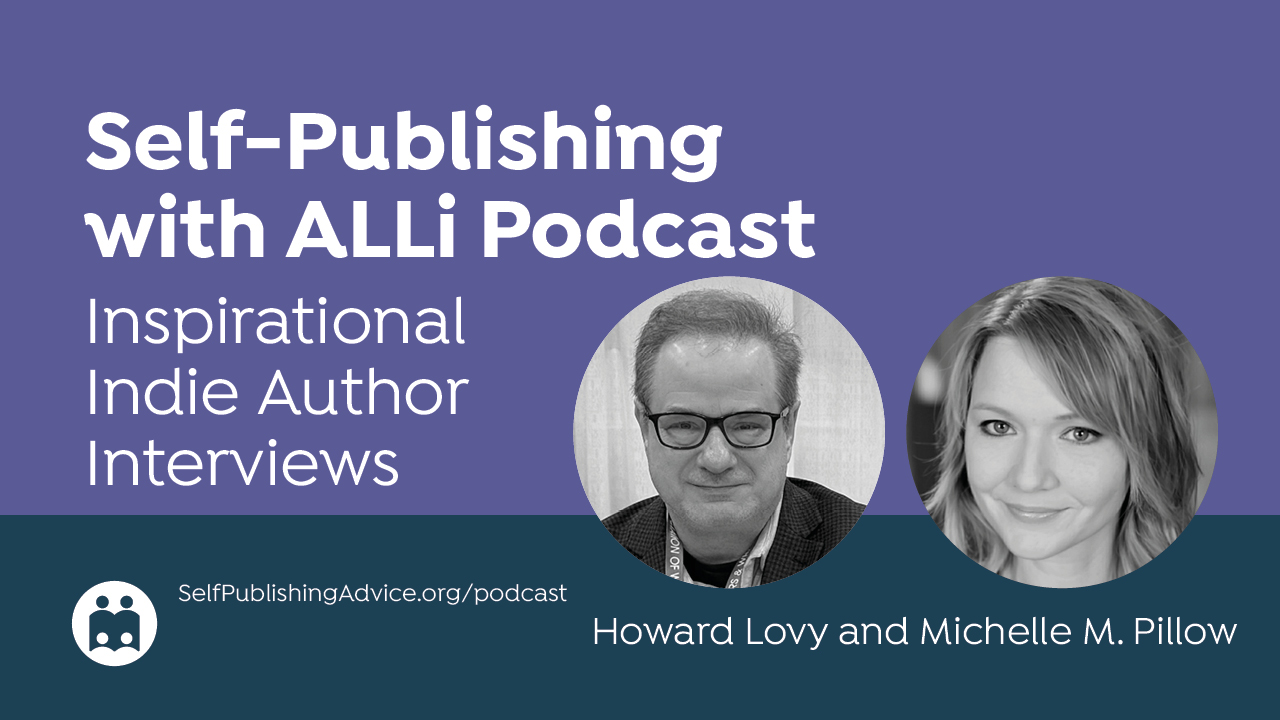
My ALLi author guest this episode is Michelle M. Pillow, a bestselling romance author who has published more than one hundred books during a career spanning more than twenty years. She talks about her early love of reading, the unexpected path that led her to indie publishing, the fictional worlds she has built, and the challenge of managing a large backlist while staying connected to her readers.
Listen to the Inspirational Indie Author Interview: Michelle M. Pillow
Bookstore
You can find Michelle M. Pillow’s books in the Indie Author Bookstore.
About the Host
Howard Lovy is an author, developmental editor, and writing coach with a long career in journalism and publishing. He works with writers at many stages of their careers, with a focus on helping them develop their ideas and strengthen their work while preserving their unique voices. He lives in Northern Michigan.
About the Guest
Michelle M. Pillow is a New York Times and USA Today bestselling author who has published more than one hundred novels over a career spanning more than twenty years. She writes romance, fantasy, science fiction, mystery, and paranormal women’s fiction. She is best known for her Qurilixen World and Warlocks MacGregor series. You can find Michelle M. Pillow on Facebook, TikTok, and Instagram, visit her website, or view her ALLi author profile.
Thoughts or further questions on this post or any self-publishing issue?
If you’re an ALLi member, head over to the SelfPubConnect forum for support from our experienced community of indie authors, advisors, and team. Simply create an account (if you haven’t already) to request to join the forum and get going.
Non-members looking for more information can search our extensive archive of blog posts and podcast episodes packed with tips and advice at ALLi's Self-Publishing Advice Center. And if you haven’t already, we invite you to join our organization and become a self-publishing ally.
If you’re a published indie author who would like to be interviewed by Howard for the Inspirational Indie Authors podcast, you need to be a member of the Alliance of Independent Authors.
Then contact Howard, including your membership number, explaining why you’re an inspirational indie author and what inspires you.
If you haven’t already, we invite you to join our organization.
Read the Transcript
Michelle M. Pillow: Hi, everyone, and thank you so much for having me, Howard. My name is Michelle M. Pillow. I am a romance author of many genres — I've been at it for a while, and I've published over 100 books over the course of my career. I write everything from paranormal romance, romantasy, and sci-fi romance to historical romance, contemporary, chick lit back in the day, gothic, and combinations thereof. I always like to joke that I'm the author of all things romance, because there's not a genre I won't try.
Howard Lovy: I wrote a book about a year ago that had some of the tropes of second chance romance. Have you ever done second chance romance?
Michelle M. Pillow: Yes. I actually have a book called Second Chance Magic — paranormal women's fiction. But yes, second chance is one of the favorite tropes in the romance genre for sure.
Howard Lovy: True romance readers would be very disappointed in me, because I didn't even realize that was what I was writing, so I didn't follow all of the tropes. Anyway — before we go into all the various subgenres of romance, tell me a little more about you. Where did you grow up, and was reading and writing always a part of your life?
Growing Up in the Midwest: Card Catalogs and Classic Literature
Michelle M. Pillow: I grew up in the Midwest in the US. My mom always had books — she put us in the Sesame Street Book Club when we were growing up, and she would always take us to the library. It was always this big, fun event, so I've always had a fondness for libraries. She always encouraged reading and creativity and expressing ourselves, which lends itself naturally to writing. She never told us we couldn't do something. Same with my dad — he always said we could be anything we wanted to be, and he would be proud of us as long as we tried to live a good life. I feel like I had really great encouragement from my parents to explore creative fields.
Howard Lovy: My parents were the same way. I come from a family of doctors and engineers, and I'm the black sheep who became a writer. They never discouraged it, though my brothers keep asking when I'm going to get a real job — and I'm 60 years old and still haven't had one.
Michelle M. Pillow: I think our job might be harder than theirs, honestly.
Howard Lovy: Let's debate that. Did you study literature in college?
Michelle M. Pillow: I did, though I went back to college as an adult. In high school is when I really started writing and reading seriously. I used to play a little game with myself — back when I was in high school, we still had card catalogs. The systems weren't yet computerized. So I would go find the books that hadn't been checked out for decades — sometimes 30 or 40 years — and those were the ones I would pick up and read. A lot of them turned out to be classic literature: Tolstoy, Jane Austen, books I felt nobody had appreciated for a really long time. That was my game.
Around the same time I discovered romance novels and genre fiction — Mary Higgins Clark, Anne Rice, Stephen King. I think all of us were reading Stephen King way before we should have. All of those inspired me to want to tell stories, to create worlds not only that other people could fall into, but where I got to decide every little detail that went into making a believable place. And that game of finding the forgotten books is what propelled me to try genres my friends weren't reading and that people weren't talking about at the time. I feel like it gave me a great foundation.
Sci-Fi, Horror, and a Weakness for the Happy Ending
Howard Lovy: You've said you were fascinated by science fiction and the supernatural. Why those genres?
Michelle M. Pillow: Growing up, my brother and I used to love watching campy horror movies and sci-fi. We liked a lot of fantasy. Star Trek, Star Wars, exploring these worlds and spaces — things we hadn't yet seen but could imagine. Those fantasy-type shows and horror movies just kind of melded with my love of reading, and that's how I ended up where I am.
Howard Lovy: So how did romance eventually become part of the mix?
Michelle M. Pillow: I like to tease my mom that I discovered her romance novels in high school. But honestly, I've always been a sucker for a happily ever after. In life you've got a lot of heartache and stress and drama that you have to face, and reality is just reality. But I love the idea that at the end of that hardship or journey, you do get a happy ending. My love of the supernatural and sci-fi melded with my love of the happily ever after, and things end up well for the characters — even though they went through all this horrific stuff I put them through. I'm just a sucker for the happy ending.
Starting Out: Rejections, Research, and Writing What You Have To
Howard Lovy: What was happening in your life when you began writing seriously, and what led you to publish your first book?
Michelle M. Pillow: Writing was something I had always done. My daughter had just been born and I had a little extra time. We got our first computer, and that gave me the means to really practice and explore. I'd always been a reader. At first I just did it because I wanted to challenge myself to see if I could. I sent some things in, got rejections as you do — they're not great when you get them, but sometimes they give you a hint of what you might do better. And I found I really enjoyed it. I wanted to keep writing. It was just in me. I couldn't think of any other career that resonated with me more.
Howard Lovy: It's fun to make things up for a living. I'm ordinarily a nonfiction writer, but I wrote my first fiction last year and it was fun.
Michelle M. Pillow: So between nonfiction and fiction — which did you find more satisfying or more freeing?
Howard Lovy: Fiction was freeing, because I'd spent most of my career as a journalist where everything has to be a verified fact. But I found you can tell a different kind of truth through fiction, through this closed, made-up world. And somehow this became you interviewing me. How did that happen?
Michelle M. Pillow: Because I'm really good at digressing. But to that point — I don't think a lot of people realize, when you say you write fiction, they think you're going to make everything up. If you're not a writer, you don't stop to think that a lot of it has to be founded in fact. If you're writing historical romance, you want to get the history right. You were writing about the music industry, so you want that to be factual. People don't realize how much research goes into fiction.
Howard Lovy: Do romance readers call you out on anachronisms?
Michelle M. Pillow: I work really hard. I probably own more nonfiction research books than fiction books. When I started my career writing medieval historical romance, I wanted it to be realistic — not just knowing there was a war going on during this time, but social anthropology: what did they eat, where did they sleep, what was the feudal hierarchy, what spices would be available? Every little tiny detail. To me, that was the fun puzzle — creating a fictional story in a factual world. The research resonates with readers whether they consciously know you've done it or not. And it's often readers who call you out if they think something's factually wrong — which you don't love when it happens. But part of the fun is that everyone brings their own experiences to reading.
From Small Press to Hybrid: Finding Her Way to Indie
Howard Lovy: So eventually you got over your rejections and went independent. Is that how you first published?
Michelle M. Pillow: No — my first book was published with a small press. It was called The Mist of Midnight, since renamed to Forget Me Not, a Regency-set gothic ghost story. Then I started my sci-fi fiction. The publisher wanted to launch a sci-fi romance line and asked if I'd be interested in writing for it. At the time I was going to be a historical writer, so I said I'd do this for them and then they'd let me write whatever I wanted. But the sci-fi romance took off. The first four books of the Dragon Lord series I wrote over a two-month period — they had a concurrent timeline, so I was writing a little on each simultaneously and readers would see scenes from different points of view. It outsold my historical book hands down, and that has since grown into a 30-plus book series with spinoff series, all within what I call the Qurilixen universe. That's the big world I've created over the course of my career.
That small press gave me my start, and then other small presses picked me up. I've been with Virgin Books and then Random House when they acquired Virgin. So I've worked with everyone from traditional publishers to small press to indie. How I ended up indie was that I had a bunch of books coming out of contract at the same time — nine books in a series and connected books — right at the beginning of the indie boom. I first sold them on my own website, and then Fictionwise was around, and Amazon was just starting. And I say ‘we' because I had author friends in the same boat. The indie movement kind of came for me, or I became hybrid, because I had all these books coming out of contract. Nobody was going to take a giant backlist, and if they did it might be one a year, meaning seven or ten years before the entire series was re-released. So I kept writing for publishers for new books, and when books came out of their time-release contracts I started going indie. Then indie took off, and I stopped saying yes to some of my bigger contracts. I'm still hybrid, but most of my catalog has gone indie and I have not looked back. I love it — I love the freedom of it, deciding my own schedule, my own deadlines, writing what I want to write.
Managing a 100-Book Catalog: Caffeine and Priorities
Howard Lovy: But you've got nobody else to handle the business side, and you have such a huge catalog. How do you keep it all straight — production schedules, metadata, covers, marketing?
Michelle M. Pillow: Caffeine. Lots and lots of caffeine. An unhealthy coffee addiction and little sleep. But honestly, that's one of the most difficult things about a large backlist. Things fall by the wayside and you have to prioritize what books and what tasks are going to get your attention. You can get lost in admin work. If Amazon changes their backend — and they've done this before, changed how the Kindle app reads book files — and you have to reprocess and reload a hundred books, that's a week of work on its own. So streamline your processes as best you can, prioritize what absolutely has to be done, and don't fall into the trap of feeling like everything has to be handled at once.
Direct Sales, Signed Books, and the Pillow Fighters
Howard Lovy: You don't depend only on Amazon — you offer signed books through your own store. What role does direct selling play in your business?
Michelle M. Pillow: I love direct sales. I'm always interested in new opportunities to diversify income as an author, because things change so fast. I'm wide — Barnes and Noble, Kobo, Apple, Google Play, all the major platforms — and I have print books through IngramSpark. I want readers to be able to find my books however and wherever they want to find them. The storefront is just another extension of that. It lets me sell direct, give readers a coupon or a sale or a freebie promotion to my newsletter list in a way I can control. Interestingly, my digital books are probably my best-sellers on that website — readers wanting to support me directly, and I get to keep more of that income. But close behind are autographed print copies. Readers can buy gifts for people, get a whole collection, autographed bundles. If they can't get to a book signing, or if there's a book in my backlist they can't find in a store, I can order it, sign it, and send it to them. And they get a personal note. That connection with readers matters.
Howard Lovy: You've built a pretty strong community through your newsletter, social media, and the Pillow Fighter Fan Club.
Michelle M. Pillow: They named themselves, actually. Pillow Cases and Pillow Case were both on the table. They voted. They named themselves Pillow Fighters. I thought it was hilarious, so we went with it. But yes — that connection is very important, especially when you're indie and don't have a giant marketing budget or a big production team behind you. A publisher putting everything they have behind you in marketing — there's no way to match that as an indie unless you have a huge income base to play with, and that takes time. So the personal connection with readers matters enormously. Without readers we wouldn't have jobs, and it's very important to me that they know I appreciate them as much as they appreciate reading the books.
Dystomance, Hybrid Words, and Loving a Challenge
Howard Lovy: This is breaking news, at least to me. There's something called dystomance — dystopian romance. Is that on your radar?
Michelle M. Pillow: There are a lot of hybrid portmanteau words coming out — romantasy being the obvious one. Dystopian romance has been around for a while. I actually have one: when Amazon had Kindle Worlds, they asked me to write something in Hugh Howey's Wool universe, so that one is my apocalyptic, dystopian-type romance.
Howard Lovy: Oh, really? I love it. Dan Holloway, who does our news podcast three days a week, mentioned that dystomance is emerging as a BookTok trend.
Michelle M. Pillow: It's kind of a mouthful. But I love those subgenres and I love the challenge — I love a puzzle when it comes to work. If someone says, ‘Can you write me a superhero romance?' I'm like, ‘Absolutely, I'll figure it out.' And I've done that. So yes, bring on the dystomance.
Travel, Reconsidering Pen Names, and Advice for New Authors
Howard Lovy: When you're not writing, your website mentions you love to travel.
Michelle M. Pillow: Absolutely. I love to travel, try new things, have new experiences, meet new people. The more you put yourself out there in the world, the more empathetic you become, and the more the world becomes this big, interesting place. My husband and I both love to travel. We're lucky that we're both creative and can do our jobs anywhere.
Howard Lovy: You've been doing this for more than 20 years. What parts of your indie author business are you reconsidering, and what opportunities do you see out there?
Michelle M. Pillow: One thing I've reconsidered a lot is pen names and branding. Early in my career, publishers wanted my name attached to different genres because my name was doing well, so I ended up with a bunch of subgenres all under one name — cozy mysteries alongside spicier sci-fi and paranormal romances, and those reader bases don't always cross. A lot of my spicier romance readers will read the cozies, but not all the cozy readers will go to the spicy. Had I thought about it more carefully at the very beginning, I might have built out two pen names for different lanes. That would have made branding a lot easier. But after 10, 15, 20 years in, it didn't make sense to separate them because my readers already knew. So my advice to new authors: really stop and think and map out the different courses in front of you and decide how you want to go. But if you choose a path that turns out not to be the best, don't worry about it — just keep going.
Closing
Howard Lovy: Thank you so much, Michelle. I appreciate you taking the time to talk to us about all things romance.
Michelle M. Pillow: Thank you so much for having me. I appreciate it.
Howard Lovy: All right. Thank you. Bye.
Michelle M. Pillow: Bye.


Thank you for having me Howard and ALLi. Hello to my fellow authors out there.