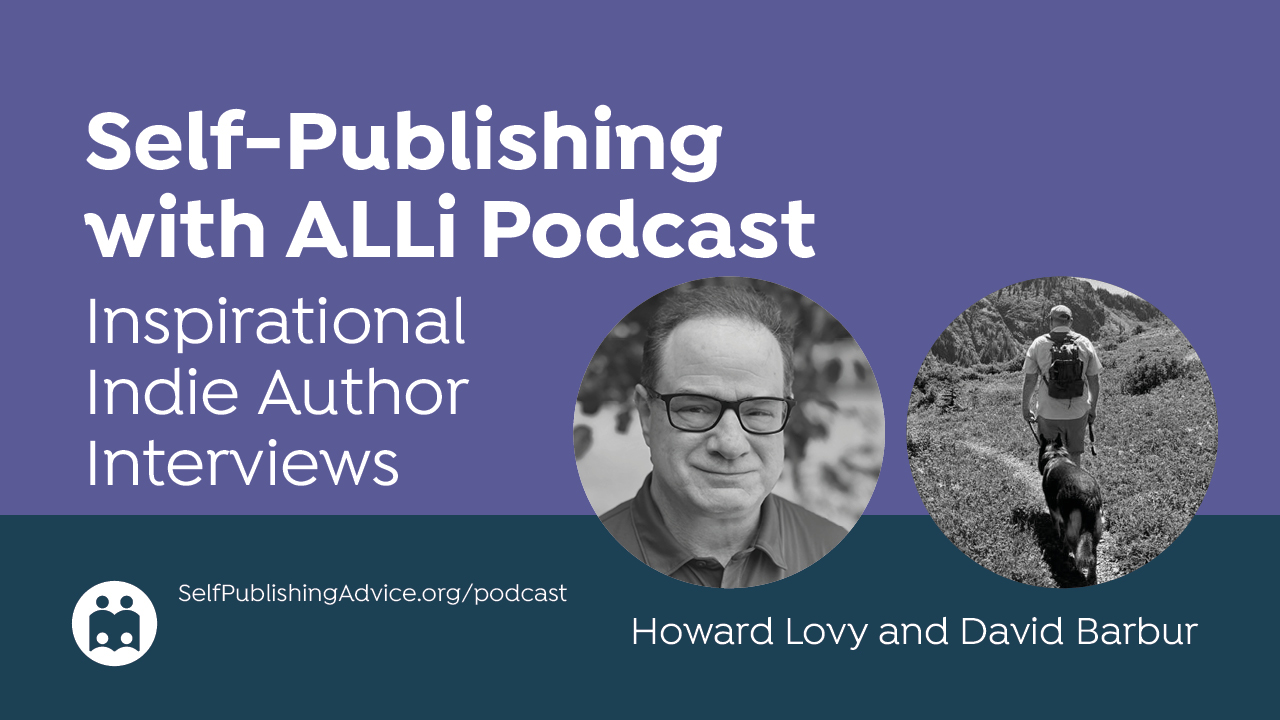
My ALLi author guest this episode is David Barbur, a former law enforcement officer who now writes wilderness mysteries inspired by his interests in hiking, tracking, survival skills, and the natural world. Since 2017, he has published a novel every year while balancing writing with a full-time job and family.
Listen to the Inspirational Indie Author Interview: David Barbur
About the Host
Howard Lovy is an author, developmental editor, and writing coach with a long career in journalism and publishing. He works with writers at many stages of their careers, with a focus on helping them develop their ideas and strengthen their work while preserving their unique voices. He lives in Northern Michigan.
About the Guest
David Barbur lives in the foothills of the Cascade Mountains. He can often be found wandering the forest with a longbow in his hand, tracking animals and trying to figure out what happens next in his latest story. His latest release, Time of Ashes, is the seventh Tye Caine Wilderness Mystery. You can find him on his website.
Thoughts or further questions on this post or any self-publishing issue?
If you’re an ALLi member, head over to the SelfPubConnect forum for support from our experienced community of indie authors, advisors, and team. Simply create an account (if you haven’t already) to request to join the forum and get going.
Non-members looking for more information can search our extensive archive of blog posts and podcast episodes packed with tips and advice at ALLi's Self-Publishing Advice Center. And if you haven’t already, we invite you to join our organization and become a self-publishing ally.
If you’re a published indie author who would like to be interviewed by Howard for the Inspirational Indie Authors podcast, you need to be a member of the Alliance of Independent Authors.
Then contact Howard, including your membership number, explaining why you’re an inspirational indie author and what inspires you.
If you haven’t already, we invite you to join our organization.
Read the Transcript
David Barbur: My name's David Barbur. I'm the author of the Tye Caine Wilderness Mystery Series. Indie publishing has really been a dream come true for me. I daydreamed about being an author when I was a teenager, and seeing my books in print has just really been life-changing. I always seem to be getting ready for the next book — I just published one a little over a week ago and I'm already starting to work on the next one.
Howard Lovy: Isn't that a great feeling — seeing your name on a book and knowing you did that?
David Barbur: It is. Yeah, absolutely.
Growing Up in Appalachia: Hardy Boys, Dungeons & Dragons, and the Library
Howard Lovy: Let's talk about your backstory. Where did you grow up?
David Barbur: I grew up in Appalachia. I was kind of the weird kid who liked to read, play Dungeons and Dragons, and daydream. The beginning of my origin story as a writer is probably the summer my mom brought home a giant box of Hardy Boys books when I was in second or third grade. I just became an avid reader. I had a lot of support from folks at my local library — they gave me an adult library card before I really should have had one, and would screen what I checked out. I'd walk up to the desk with a pile of books and occasionally they'd just set one aside and say, ‘No, maybe not that one yet.'
Howard Lovy: What did you study in college?
David Barbur: I went to a community college in Appalachia, and then joined the military for a while. Not a whole lot of writing happened during that period, although reading was always a refuge for me. After the military I wound up in the Pacific Northwest — funny how the wind blows you in different directions.
Howard Lovy: That's a beautiful place for the wind to blow you.
From Military to Police Officer: 9/11 and a Long Detour From Writing
David Barbur: I wrote a little in the early 2000s — actually started a book in early September 2001. Then 9/11 happened. I was a police officer at the time and didn't come up for air for quite a while after that. I eventually left law enforcement, went through a big career change, and it took a while for the pieces to settle. I always had in the back of my mind that I'd write when life settled down.
Howard Lovy: Your experience in the military and as a police officer could be considered research for your eventual writing career.
David Barbur: Absolutely. Near the end of the 2000s, life had settled down enough that I wrote the first of three dark, gritty crime thrillers. Those sat on the shelf for a while as I debated whether to try the traditional route. The whole traditional publishing process seemed really daunting and not well-suited to me.
Howard Lovy: Were your crime thrillers based on real experiences from your time as an officer?
David Barbur: They're based on real experience, and then I turned the volume up to 11. Everything is hyper-exaggerated. They're still fairly realistic, but you leave out the parts where you do paperwork and respond to barking dog calls, you know? Eventually I left law enforcement — that career didn't last too long — and settled into a nice 9-to-5 day job. Life calmed down, and I was able to take stock. The thing that had always been undone in my life was writing.
Publishing Rose City Freefall — with a Homemade Cover
David Barbur: Around 2015 I was reading a published book — I don't remember what it was, and if I did I probably wouldn't say. Parts of it were so bad and so unrealistic around the details of law enforcement that I literally threw it across the room. I thought: I have books on a hard drive. I had one completed novel and ideas for two more. I dusted those off, and they became Rose City Freefall, which I published under the pen name D.L. Barbur in November of 2017 — with a homemade cover that looked exactly like what it was. That first month I sold about $60 worth of books, and I immediately rolled that money into a pre-made cover. I've published a novel every year since then.
Howard Lovy: A novel a year — that's great. Why was traditional publishing off the table for you?
David Barbur: It was a matter of control. I was well into my 40s, and I thought: I'd like to make this happen before I'm dead. The whole process reminded me of trying to get the cool kids to like you in high school.
Howard Lovy: If you were into Dungeons and Dragons in Appalachia, I'm guessing you weren't one of the cool kids.
David Barbur: I was absolutely not one of the cool kids. So I published three books in that dark, gritty crime thriller series. It was just exhilarating to put a book out — at the end of the month I'd have enough in sales to buy a pizza, and I was genuinely thrilled about that.
Pivoting to the Wilderness: The Tye Caine Mystery Series
David Barbur: Around 2019 two funny things happened. The first was that I decided I was done with dark, gritty crime thrillers and wanted to write something different. But at exactly that moment I got a BookBub featured deal on those books — the free first in series, the common indie strategy — and we went from pizza money to ‘wow, this is actually a thing.' The temptation was to keep writing crime thrillers. But I took a deep breath and pivoted.
Howard Lovy: Your own life had taken a pivot too.
David Barbur: Right. Through that whole period I had left law enforcement and gotten super interested in hiking and backpacking, which led me into wilderness skills, animal tracking, bushcraft, survival skills, nature connection, plant identification, birdwatching. That's how my wife and I met, and we eventually moved out into the woods. My desire to write dark, gritty crime thrillers just kind of receded.
The Tye Caine Wilderness Mystery Series was a classic case of writing the book you want to read. I had this idea: wouldn't it be cool if there was a mystery series featuring an animal tracker, a naturalist, as the protagonist? I went looking for that series and it didn't exist. I thought, maybe I should just write it. Shows like Alone and Naked and Afraid were becoming very popular, and I suspected that mashing all of that together with some supernatural and spiritual elements might hit a nerve.
Howard Lovy: The first book published in July 2020, in the middle of the pandemic.
David Barbur: And it did really well. Valley of Lost Children resonated with people. My crime thriller series were pretty noir-ish — there wasn't a lot of hope in those books. But the Tye Caine series deals with dark topics while maintaining a thread of human decency. The characters are the kind of people you'd want as your neighbors, and that seemed to land in that moment and in the years since. The series has done really well for me and the dream keeps going.
The Supernatural Element: Not Quite Paranormal, Not Quite Realistic
Howard Lovy: You mentioned a spiritual element. Is that magical realism or something else?
David Barbur: You could put it in that realm. The character has an ability to perceive things. I lean more heavily into it in some books than others. The gamble was that it's not full-on paranormal mystery, but there is an element of that — and my fear was it would be too much for some readers and not enough for others. But it seems to work. When people spend a lot of time out in the woods, connecting with animals and tracking and things like that, it tends to open up perceptions that we don't normally get in modern life. That's what the book explores, and it resonates.
Writing One Book a Year While Working Full Time
Howard Lovy: How do you maintain the pace of a book a year? I'm roughly at one book every 20 years.
David Barbur: If you average out my whole writing career starting from age 14, I'm definitely not a book a year. But since 2017 it's been a book a year, and the game changer was getting up an hour early before my day job and sitting down to write. For decades I told myself I'd write when everything else was done. I wrote zero books that way — well, one book over the course of several years. Making writing the first thing, not the last, made a book a year possible. I sit down and write no matter what. It's like going to the gym: if you get out of the habit, getting back in is painful. Some mornings I sit there for an hour and type 10 words. But after a while your brain habituates — this is writing time, and the words come.
Howard Lovy: You also have a day job and a family.
David Barbur: Yes. There are a lot of things I don't do — not much social media, not much TV. I'm pretty disciplined about my time. By evening I've got a lot of decision fatigue, but I feel like I'm juggling all the balls pretty well.
Marketing Without Social Media: Newsletter, BookBub, and Email Promos
Howard Lovy: What about marketing? You mentioned you don't spend a lot of time on social media, so how do you promote yourself?
David Barbur: I have a pretty robust newsletter, and one of my goals is to be more engaged with it. I recently asked my subscribers how often they want to hear from me, and whether it's okay if we talk about things other than new releases. I got an overwhelming yes — they'd like to hear more, about tracking, the natural world, the writing process. I own that mailing list and can take it wherever I need to.
Social media was always the undone thing on my to-do list — the thing I wasn't doing well. A couple of years ago I just stopped. And dropping social media made zero difference in my book sales. I know it's the magic ingredient for some people. It just wasn't for me. My readers are probably off enjoying the wilderness and not online.
I get a lot of mileage from email promotions — Written Word Media, Robin Reads, those kinds of services, running them every month. I pretty reliably get two BookBub featured deals a year, and that's still significant. AMS ads are working well enough. The way I put it: I try to be a B+ writer and a C- marketer. That's what I've got time for right now. My biggest area for growth is wide sales on platforms other than Amazon — that's what I'm focusing on next.
The Emotional Consequences of What Ty Experiences
Howard Lovy: As the series progressed, you've written about becoming more interested in the emotional consequences of what Ty experiences, rather than just the mystery or survival story itself.
David Barbur: We have to be careful as writers about how much of our own experience we make our books about — but settling leftover emotional residuals from difficult experiences has definitely been a through line in my own life. Tye has been through a lot. He's seen dark things, been injured, had his life at risk. That has an emotional toll on people and changes them — sometimes for the better, often for the worse. That's not what the books are about, exactly, but it informs the narrative and the choices characters make. Tye as a character has matured — he's in his early 30s, that period where you're starting to figure life out. I think that resonates with readers, and it's interesting for me to write. Life has consequences, and how you deal with them is informed by your character.
What's Next — and Advice for New Authors
Howard Lovy: You've been publishing independently for nearly a decade and achieved the goal your teenage self once imagined. What does the next stage look like?
David Barbur: In the short term, definitely one book a year. I have plenty of ideas for the Tye Caine series, and I also have ideas for other books and other series. I'm fortunate enough that I can hopefully retire at a fairly young age, and then we'll see what happens. There's a real question of whether, without a day job, I could get more than one book a year out — or whether I'm just a one-book-a-year person. I definitely don't want to end up on a hamster wheel feeling like I have to crank books out in rapid succession. My number one goal is to continue to enjoy it.
And I'll be honest — there have been times this year when I've been glad I'm not full-time. Sales have been more difficult, and I'm glad the mortgage isn't riding on my book sales. The income from writing is a nice thing to have, but I've been grateful at times that it's not my primary income.
Howard Lovy: What's your day job?
David Barbur: I don't talk about that publicly. I work for the US government, which is a very politically charged environment right now. So I keep my writing under my pen name and my day job very separate.
Howard Lovy: So if you told me, you'd have to shoot me.
David Barbur: Not quite that bad. But yes, it's a tightrope right now.
Howard Lovy: What advice would you give younger authors who want to do what you're doing?
David Barbur: Take your writing seriously and make it a priority. We all have non-optional things in our lives — family, making a living. After those are satisfied, take a hard look at how you're spending your time. If you're binge-watching Netflix, you're consciously or unconsciously choosing that over writing. You have to decide what you want. Writing and publishing one book often doesn't change people's lives as much as they think, but writing and publishing multiple books changes your life more than you realize. So take that seriously. This is a craft that has to come before other things, as much as you can make it.
And know why you're doing this. I'd put indie authors into four broad categories. First, people who are just thrilled to have their work in print — holding the book in their hand or seeing the ebook on their reader. That's amazing, and the business side doesn't have to be a priority. Then there are people who want a part-time income, like me — and at that point your business decisions start to become meaningful. Then there are people who want to go full-time, and honestly I don't know how to tell people how to do that — it often involves writing a lot of books very quickly. And finally, people who want literary acclaim and awards — that's tough as an indie, and if that's your primary goal you might want to consider the traditional route.
If you're going to treat this as a business, treat it like one. Starting a business costs money — covers, editing — and people sometimes balk at that. But as businesses go, being an indie author has a fairly low bar to entry compared to opening a restaurant or starting a tech company. One thing I wish I'd had is more business education at the start. Small business or marketing classes, or resources like ALLi — there's a lot of information there where you can self-educate and avoid a lot of the pitfalls waiting for new indie authors.
Closing
Howard Lovy: Thank you, David. I appreciate you taking the time — and I'm sorry I couldn't get your top-secret profession out of you. I'm going to assume you're an international spy, which makes for a better story anyway.
David Barbur: That does make for a better story.
Howard Lovy: Best of luck, David.
David Barbur: Hey, thank you, Howard.
Howard Lovy: Thank you. Bye.
David Barbur: Bye.