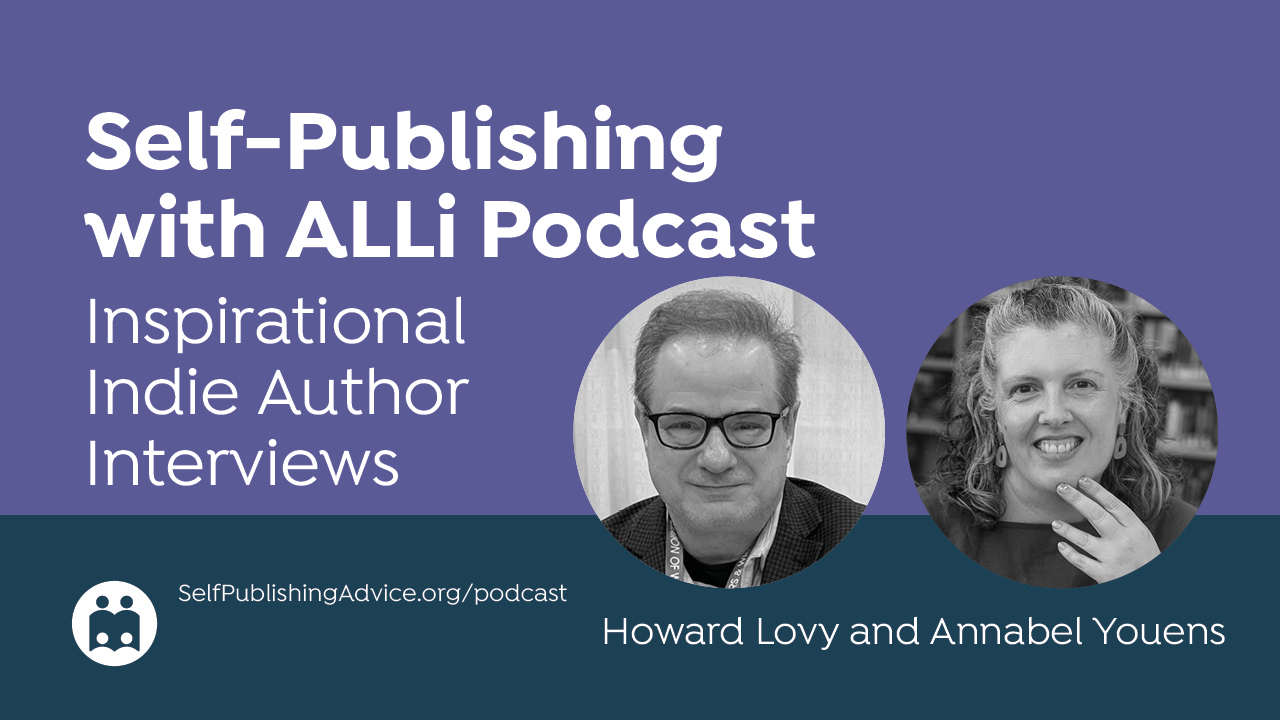
My ALLi author guest this episode is Annabel Youens, a novelist who left a long career in tech to return to her first love: writing fiction. Her work explores midlife reinvention, creativity, nature, and the courage it takes to stop putting off the life you meant to live. She also brings a business founder’s discipline to indie publishing, treating authorship not just as a creative act but as a serious enterprise.
Listen to the Inspirational Indie Author Interview: Annabel Youens
About the Host
Howard Lovy is an author, developmental editor, and writing coach with a long career in journalism and publishing. He works with writers at many stages of their careers, with a focus on helping them develop their ideas and strengthen their work while preserving their unique voices. He lives in Northern Michigan.
About the Guest
Annabel Youens writes mythic fiction where the change is the magic. Thread Traveller—a Kirkus Best Indie Book of 2025 and a 2026 CANREADS Award finalist—is her debut novel, written at forty-seven after twenty years of building tech companies. She was employee number eleven at Abebooks.com and co-founded two global startups before returning to her first love: storytelling. She lives on Vancouver Island and writes a Substack called Saved by the Spell on midlife, motherhood, and mushrooms. Find her at annabelyouens.com and on BookTok.
Thoughts or further questions on this post or any self-publishing issue?
If you’re an ALLi member, head over to the SelfPubConnect forum for support from our experienced community of indie authors, advisors, and team. Simply create an account (if you haven’t already) to request to join the forum and get going.
Non-members looking for more information can search our extensive archive of blog posts and podcast episodes packed with tips and advice at ALLi's Self-Publishing Advice Center. And if you haven’t already, we invite you to join our organization and become a self-publishing ally.
If you’re a published indie author who would like to be interviewed by Howard for the Inspirational Indie Authors podcast, you need to be a member of the Alliance of Independent Authors.
Then contact Howard, including your membership number, explaining why you’re an inspirational indie author and what inspires you.
If you haven’t already, we invite you to join our organization.
Read the Transcript
Annabel Youens: Hi, I'm Annabel Youens. I'm a debut author of the speculative fiction novel Thread Traveler. I'm almost 50, and it was really ten years ago I realized that I'd better go and write my first novel, like I'd always said I would.
Howard Lovy: That's great. I hear you. I'm 60 and a half, and I feel that crunch of time as well.
Annabel Youens: I know, right? It's getting real.
Growing Up Around the World, Settling on Vancouver Island
Howard Lovy: Let's go back in time a little. Tell me where you grew up.
Annabel Youens: I kind of grew up all over the world. I was born in Canada, but my dad was in the oil industry, so we lived in Jakarta, we lived in Australia when I was younger, and then eventually we settled back in Canada. I've also lived in New Zealand and LA, so I am a traveler. But the saying goes that the more you travel, the more you realize where home is, and home for me is Vancouver Island, where I live now. I just love being near the ocean.
Howard Lovy: I'll bet — it's beautiful there. During all that traveling when you were growing up, were you able to do a lot of reading and writing?
Annabel Youens: I think reading saved me from all the travel we did when I was young. We had Wind in the Willows on audiobook, and I have that novel basically memorized. Reading saved me so I could deal with — when you're a small child, it feels like you're constantly traveling in the car. My love of reading definitely started at that age.
From Journalism to AbeBooks to 25 Years in Tech
Howard Lovy: Did that translate into your study of creative writing at the University of Victoria?
Annabel Youens: It did. I always wanted to write, and funnily enough my parents said, ‘Well, you have to go do journalism, because how else are you going to support yourself?' So I went into journalism at UVic to start, and then promptly changed tracks because I thought, that's not for me, there are other people for that. I explored poetry, creative nonfiction, and fiction, and then I fell into a technology job at a startup, which put my creative writing on hold.
Howard Lovy: I guess your parents were right that you had to make a living first.
Annabel Youens: I know, right? You really do.
Howard Lovy: You started off as an employee at AbeBooks.com. How did that happen, and what did you learn from seeing the internet change the lives of booksellers?
Annabel Youens: It was such a cool job. For people who don't know AbeBooks, it's a network of independent booksellers. I was training used booksellers from all over the world how to upload books onto this new thing called the internet. Before AbeBooks existed, they were putting rare manuscripts into printed newsletters that were shipped around the world, and now they could list them online. What I loved about it was that it was life-changing for these booksellers. I was on the phone with booksellers who were crying, because six months earlier they'd been getting kicked out of their stores, they couldn't afford rent anymore, and now they were making more money than they'd ever made, shipping rare books all over the world. I was in my twenties, and it was so fun to be building this and working with a group of people who loved books and had such an important mission in the world.
Howard Lovy: You were able to combine your love of books with being tech-savvy.
Annabel Youens: Exactly.
Howard Lovy: You went on to co-found global startups and spent 25 years in tech. What kept you in that world for so long?
Annabel Youens: It's addictive, Howard. You work so intensely with people in a startup, constantly changing and pivoting and doing different things, and my ADHD brain loves all that stimulation. I could still access my creativity while doing all that work, and I was working with my husband — he's the CTO behind the scenes, and we were co-founders together. I loved meeting new people, talking to them. We worked in the music industry for a while, helping independent bands. I really enjoyed how different the job was every day. It was awesome — and then suddenly I thought, wow, I'm 45 all of a sudden.
Deciding to Write — and Leaving the Business
Howard Lovy: In the meantime, did you have a secret manuscript in your desk drawer, or was writing taking a backseat?
Annabel Youens: All my friends knew I was going to write a novel one day. I did NaNoWriMo one year and actually managed the 50,000 words, but then it got put away. I always told myself, oh, one day. Then my friend Mark turned 50 a few years ago, and we were at his birthday party, and he said, ‘So when are you actually going to write your novel?' He really kicked me into gear. I thought, I keep putting it off — okay, now's the time to change gears and do what I always wanted to do.
Howard Lovy: You didn't just decide to write it on the side — you decided to actually leave your job.
Annabel Youens: I did. It was pretty tough at first, especially because my husband and I had worked and lived together for the past 30 years. I'd be working in my office and he would come in to say something to me, and then just turn around and walk back out without saying anything — there was a real shift in dynamics. I realized I needed to put all the energy I'd had for the business into experimenting with the book instead. I was lucky enough to be able to do that.
Ale Wives and the Origin of Thread Traveler
Howard Lovy: The topic you chose involves midlife transition, and it obviously has parallels to your real life. Was there a specific moment when you knew this was what you wanted to write about?
Annabel Youens: It's funny — a few years ago we were in the UK visiting my family, and I went to Britain's oldest brewery in Kent on a tour. I learned about ale wives. I asked what an ale wife was, and it turned out they were the original brewers of beer — of course it was women who brewed first. That idea stuck with me. I'd heard other writers say an idea just wouldn't let them go, and it wouldn't let me go. That's really what kicked off the story of a character named August having a beer and being transported to an alternate dimension. I always knew I wanted to write speculative fiction — I love Doctor Who, I love Margaret Atwood. I wanted to explore ideas but basically make up whatever I wanted.
Howard Lovy: Some people are transported to an alternate dimension after a beer without going into speculative fiction — but that's a different kind of story. You combined a lot there: women's fiction, speculative fiction, folklore. How did you find the right balance between emotional realism and world building?
Annabel Youens: That's a really good question. Because it was my first novel, I really didn't know what I was doing, and the biggest thing I worried about wasn't how to blend the elements — it was whether I could actually do this at all. I honestly thought I'd do three drafts and be done, and then eleven drafts later you realize it's never really done.
Howard Lovy: Right.
Annabel Youens: That was the hardest part, actually — I realized I could keep tinkering on this book forever and never publish it. I was searching the internet and found a piece of advice from David Byrne. Someone asked him, ‘When do you know a song is done?' And he said, ‘When it hits the deadline.' I thought, okay, I have to do the same thing — create a deadline for myself so I can end that part of the process and move on to marketing and selling the book. I trusted my gut and wrote what I thought was fun and interesting to read.
Midlife, Transition, and Writing What's True
Howard Lovy: You wrote that your work speaks to that moment when the noise gets too loud, the expectations too heavy, and something inside you starts to shift. Does that describe you as well?
Annabel Youens: Definitely. The parallels between myself and what my character August goes through are super relatable. It's interesting to explore parts of your own personality, and aspects I've seen in my female friends as they're straddling this moment where your kids might be older, your parents are aging and you're helping them, and you're trying to figure out — when's my time? When do I get time for myself? I didn't realize how much of that was going to come out in the text until I'd written it, and then I thought, oh, that's clearly top of mind for me.
Mushrooms, Fungal Networks, and a Trilogy in Progress
Howard Lovy: Another player in your book is mushrooms and fungal networks. How does that tie in?
Annabel Youens: It's interesting — I was writing the book and I knew August was going to be sent to a parallel dimension with beer and hops involved, and I wanted a thread to tie things together, since I knew this was going to be book one of a trilogy. I started thinking about being on Vancouver Island — we have the most beautiful rainforests on the West Coast, and I spend a lot of time in the woods, thinking about the system underneath our feet that works in harmony. Mushrooms underneath the soil help feed cedar trees that need more nutrients or more water — this whole ecosystem we don't even see. I found that so inspiring, the way nature has created this system of balance, when we as humans struggle with balance in so many ways. That's where the mushrooms came in — I wanted to explore how they keep things in balance, but I also used them as a communication network, a way some of the women in my novel can communicate with one another. I got to have fun with it.
Howard Lovy: That sounds fascinating — a fun book that takes you on quite a journey.
Annabel Youens: It was so fun to write. Last year I went to Scotland on a walking holiday, and I thought, this is going to inspire book two. My main character and her daughter have now traveled to a Scotland-inspired world, so I'm thick in the midst of that, with mushrooms and lochs and all the wonderful things I discovered about Scotland.
Kirkus Recognition and What ALLi Taught Her
Howard Lovy: It's gotten some recognition too — you were named a Kirkus Best Indie Book of 2025.
Annabel Youens: I know. That's the dream. I've learned so much from the ALLi network. Whenever I meet a new author and they ask for tips, I say: join ALLi. Anyone serious about publishing and understanding how the world works should — everyone there has been so helpful. My biggest takeaway from what I read through ALLi was that I wanted to build a business, and in order to do that I needed to spend a lot of time and energy putting out the best book I possibly could as a debut author. We all look back and think we'd have done something differently, but I tried the best I could, and seeing people recognize that work was really gratifying. It encourages me to keep going, to trust my gut, and keep writing the stories I really want to tell, rather than getting caught up in genre and market — just being true to myself.
Founding Salt Line Press
Howard Lovy: You've spent your career launching businesses, so you know how to do this. Tell me about Salt Line Press — is that just for your own work, or for other people too?
Annabel Youens: It's initially just for my own work, but you never know what's going to happen in ten years, so maybe I'll work with other authors eventually. For now, I thought it was important to treat my books as a true business. Setting up my own press gives you access to applying for grants in Canada and for certain awards — having a publisher name in that field is helpful. But I'll tell you, when I started building my website and generating everything you need, I thought: I don't know how people without a marketing background do this. It is so much work, and so hard to do well. I take my hat off to all the authors out there giving it a go without my background — it's a lot of work to do yourself, but also incredibly gratifying when you know you can do it.
Marketing Through Substack and BookTok
Howard Lovy: Give us some of your wisdom — how are you handling marketing right now?
Annabel Youens: At the top of my funnel I decided to bring people in two ways. One is Substack — I have a creative nonfiction Substack called Saved by the Spell, where I write every week about whatever's top of mind for me. Last week was '10 Things I Know About AI Right Now (and I Reserve the Right to Change My Mind).' I also write about midlife things, or books I'm reading. That's one funnel capturing readers interested in the same topics I am.
The other, surprisingly, was BookTok. I'm not really a fan of social media — I find it overwhelming — but there's something special about the BookTok community. I thought it would be mostly young readers, but there are people of all different ages there, and I've made friends, even a pen pal. Because I enjoy it, I consider it another funnel — if people like my sense of humor and my book reviews, they're likely to like my novel too.
Howard Lovy: But these aren't hard sells — it's not ‘buy my book, buy my book.' It's more that you're participating in a community.
Annabel Youens: Exactly. We've all seen indie authors who, with the best of intentions, get on there and just sell, sell, sell, and you end up unfollowing them because you don't want to hear it anymore. On BookTok and Substack, I'm talking about the stuff I care about. I was posting this morning about a sweatshirt I got that says ‘Do It for the Plot' — which I think is hilarious, because yes, we're all characters in our own novels. I post that kind of stuff. And then I have my systems in place — a links page driving traffic to my website, tracking everything through metrics so I can see what's working. That's the business and entrepreneur side of my brain. My advice for any indie author: as painful as it is to set up tracking at the very beginning, if you can track your links and understand where your readers are coming from, you'll know where to double down. Initially I was spread across many platforms trying to figure out the best ones, and with a year of data I realized Substack and BookTok were working for me. Now I spend most of my energy being part of the community on those platforms, and occasionally talking about my book.
Howard Lovy: And you can tell that's where your traffic is coming from because you've got the metrics.
Annabel Youens: Yes — every link I add to different services gets UTM parameters so I can see where traffic is coming from. That really helps me narrow down where to spend my time and focus, especially with my ADHD brain — I'm attracted to the shiny thing. The metrics remind me not to chase the shiny thing, but to keep going after what I'm consistently working on and what's actually paying off.
Using AI as a Business Partner, Not a Ghostwriter
Howard Lovy: Something I found surprising looking at my own website metrics: I'm getting traffic from AI — Claude, ChatGPT, Perplexity — and I don't know how to encourage or discourage it, or whether that's just how things are now.
Annabel Youens: It's interesting, because I'm a Claude user, and I was actually talking to Claude this morning about coming onto this podcast. I use AI a lot for my business systems, and to help with my executive dysfunction — it helps me not chase the shiny thing but go after consistent, repeatable behaviors that move the needle. While I was talking to Claude, it turned out Claude already knew who you were, Howard.
Howard Lovy: Oh, no.
Annabel Youens: It's so interesting, because I don't think we have any real idea yet where this is going to go — how traffic gets generated, or how you'd even turn off large language model traffic if you wanted to. It feels very unknown and blue sky right now.
Howard Lovy: It's getting better, though. A few years ago I asked ChatGPT who I was and it got everything wrong. Now it seems to know me a bit better.
Annabel Youens: Right? It takes time. I know AI is incredibly divisive within the community, and rightly so — new technology is very hard to wrap your brain around. My real stance on AI as a writer is that I don't use it for any of my actual writing, because that's what I love to do — I'm not going to give that to Claude. But for editing, it definitely helps. I still hire a human editor for my book, though.
Howard Lovy: That's good to hear.
Annabel Youens: I think there always needs to be a human in those systems. AI is really good at pattern recognition — it's always looking for patterns — but it's not going to come up with something brand new and exciting for the human brain. I think AI is most helpful for me as a business partner. It really operates like one. Every morning I sit down and say, ‘Hey, Claude — out of all the billion things I want to do today, what are the top three based on my strategy?' It helps me focus on what's actually moving the needle with book sales.
Howard Lovy: What did Claude advise you about how to talk to me for this podcast?
Annabel Youens: It said you could take any number of approaches, and then, based on an analysis of your other indie author interviews, it guessed this would probably end up being a journey through my career. So it was kind of right.
Howard Lovy: That's right, yeah.
What's Next: Book Two and Loving the Work
Howard Lovy: We've reached almost the end — though obviously not the end of your career. What's next for you? You're finishing the trilogy?
Annabel Youens: I'm working on book two right now — on my second draft. It's so different from the first book, because the first book was all ‘can I even do this?' and the second book is ‘how do you do it better?' Why are we so hard on ourselves? But I've also learned from the first draft that I freed myself up a lot — I just wrote whatever I wanted, because I now know how much editing and how many drafts come after. I'm trying to enjoy that part of the process. I still do some consulting on the side to earn money, but my primary thing — I'm thrilled every day that I get to work on my book.
Howard Lovy: That's wonderful. It sounds like you're having a good time writing, which is how it should be.
Annabel Youens: Well — what's the point otherwise? If you don't enjoy it, why are you doing it? Maybe that's our age now, Howard — we just want to spend time on the things we truly love.
Howard Lovy: Exactly. I'm probably about ten years older than you, and it's hitting me hard. I really don't care what other people think anymore.
Annabel Youens: So freeing, isn't it?
Howard Lovy: Wonderful. Thank you so much, Annabel — I appreciate you sharing your knowledge and your life with us, and your fascinating-sounding book.
Annabel Youens: Oh, thank you so much, Howard.
Howard Lovy: Thank you, Annabel. Bye.