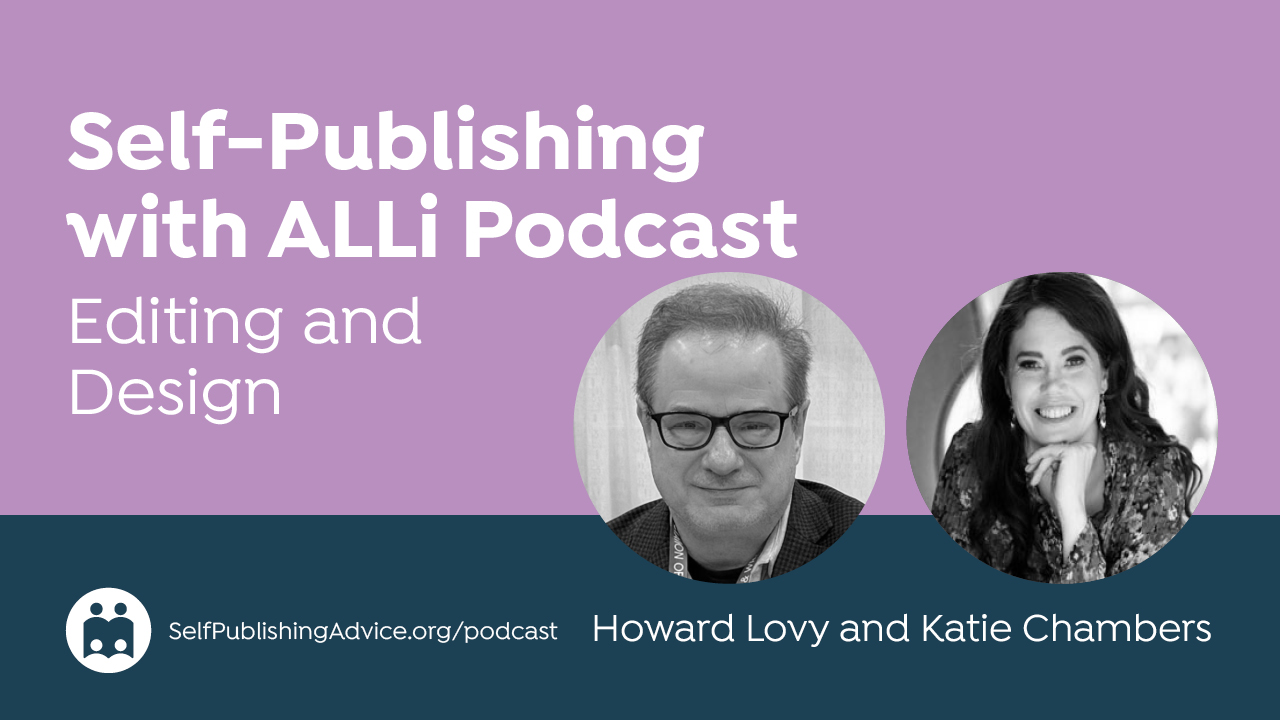
On the Self-Publishing with ALLi podcast, host Howard Lovy talks to Katie Chambers of Beacon Point, an editing and writing services company, about what self-editing really means and why it’s a critical step before hiring a professional editor. Chambers explains her structured, multi-pass approach, showing how authors can strengthen their manuscripts, reduce editing costs, and make better use of professional feedback. They discuss common self-editing mistakes, practical techniques authors can apply right away, the careful use of AI as a tool rather than a shortcut, and how developing these skills helps writers improve with each book.
Listen to the Podcast: Why Self-Editing Matters
Show Notes
About the Host
Howard Lovy is an author, developmental editor, and writing coach with a long career in journalism and publishing. He works with writers at many stages of their careers, with a focus on helping them develop their ideas and strengthen their work while preserving their unique voices. He lives in Northern Michigan.
About the Guest
Katie Chambers is a developmental and copy editor and the owner of Beacon Point LLC, an editing and writing services company. She works with indie authors to shape fiction and nonfiction manuscripts and to better understand the editing process. With a background in teaching middle and high school English and formal training in public speaking, she brings a clear, practical approach to her work and presentations. She has also published two self-editing guidebooks for authors, released in February 2026.
Thoughts or further questions on this post or any self-publishing issue?
 If you’re an ALLi member, head over to the SelfPubConnect forum for support from our experienced community of indie authors, advisors, and team. Simply create an account (if you haven’t already) to request to join the forum and get going.
Non-members looking for more information can search our extensive archive of blog posts and podcast episodes packed with tips and advice at ALLi's Self-Publishing Advice Center. And if you haven’t already, we invite you to join our organization and become a self-publishing ally.
Read the Transcript
Howard Lovy: Hi, I'm Howard Lovy and this is the Self-Publishing with ALLi Podcast. A bit about me: I'm an author, a developmental editor, and a writing coach at howardlovy.com. In my editing work I often see manuscripts at very different stages of readiness — some are fairly polished, others still need significant work before they're ready.
Which raises an important question for many authors: how much editing should you try to do yourself before bringing in a professional editor? So today we're talking about self-editing. It's not a replacement for professional editing, but a stage in the process. What should authors realistically be able to do on their own, and how can learning to self-edit make you a better writer? That's what we'll explore today.
My guest is Katie Chambers, founder and editor of Beacon Point, an editing and writing services company. Katie works closely with authors to help them improve their manuscripts before they reach the professional editing stage, and she's especially interested in teaching writers how to approach self-editing in a practical and productive way. Katie, thanks for joining me.
Katie Chambers: Thank you for having me.
From English Teacher to Editor
Howard Lovy: You run Beacon Point, but tell me a little bit first about your background. How did you get into editing, and what led you to launch the service?
Katie Chambers: So I used to be an English teacher, and I thought I was going to be a teacher for life — I was born wanting to be a teacher. I loved it, but it wasn't something I could do well once I had kids. I don't know how my colleagues manage, because I really taught my students how to write. And I also taught them how to edit — really edit, not just change a word.
I feel like in school, the writing process is discussed, but the editing stage gets overlooked. Nobody grades you on it or gives you instructions on how to do it — you're just told that it's part of the writing process, and you change a word or two. But I graded my students on their ability to edit, because I actually taught them how to do it.
So I thought, you know what, I love this work, but I need something I can do and still be a mom and still be present in my kids' lives. I decided to give editing a shot, took some training courses to see if I liked it — and I loved it. So here I am. I work from home, I get to spend time with my kids, and I get to come into my office and do my thing.
Howard Lovy: You know what I tell my editing clients: I am not your English teacher. I'm not going to go in there with a red pen and tell you everything you did wrong. It's more of a collaborative process than you'd get with an English teacher.
Katie Chambers: Right.
Who Katie Works With
Howard Lovy: What kind of authors do you typically work with at Beacon Point? Are they mostly first-time authors or experienced?
Katie Chambers: I work with a lot of first-time authors, because that is my specialty. As a former teacher, I love walking new people through the process and really helping them get it. It's a learning curve. So I have tons and tons of resources for the entire process — not just the editing. While editing is the part I do, I give them resources for all the stages that come after: the formatting, the interior design, the cover design. It's a learning process and I want to help them through it.
There's just so much information out there and so much to learn. I went through it myself, and I just feel like it's easier if you have somebody in your corner to help you through the whole thing.
Howard Lovy: You also teach them how to format, or how to pick someone to format it for them?
Katie Chambers: How to pick. I tell them what to look for and what they need, and then I provide vetted service providers for all the steps. I have a next steps packet that gives them tips on: if you're going to DIY it, here's how you do it. Here are the steps you absolutely do not want to DIY and why. And here's how you find someone that's right for you.
Howard Lovy: You've gone the next step for me. Usually after I'm done editing a manuscript, the author is left wondering, okay, what's next? I should put together a series of vetted next steps — who's going to design the cover, and so on.
Katie Chambers: I'm not with them through the whole thing, although my inbox is open. If they have questions, some of them will come back to me and say, hey, my formatter thinks this — what do you think? But I just help guide them to the next steps. Editing is the only thing they pay me for and the only thing I do.
What Is Self-Editing?
Howard Lovy: So let's talk about self-editing. I'll admit I cringe a little when I hear the term, since that could put me out of a job. But you use the term self-editing in a very specific way. How do you define it, and where does it fit in the process?
Katie Chambers: Self-editing to me is crucial if you want to get your book in the best possible state at the end, because I feel like an editor can only take your book so far within the budget and time allotted. So if you give me a stronger manuscript, I can take it further. Some authors come to me and I'm like, I can only take it as far as I can take it. I hate to use numbers, but just for clarity — if you hand me a book that's at a level three, I'm not going to get that to a ten in the time and budget allotted. I might get it to a five or a six.
So self-editing is going to make their book all the better. I actually wrote two books on self-editing, and my mom said the same thing — she said, doesn't that put you out of a job? And I said, no, trust me, they're still going to need me after this. They're still going to need editors, because you can't catch everything yourself — and not even a professional can catch everything. The more eyes on it, the more editing stages it goes through, the better.
Howard Lovy: I get manuscripts in all kinds of conditions — sometimes written on napkins in prison, sometimes a polished manuscript. Self-editing could be a very broad category. Are you talking about a developmental self-edit, big picture stuff, or a self-edit in terms of spelling and grammar? In what condition should people be giving their manuscript to a professional editor?
Katie Chambers: I'm talking about all of it. My books are called Self-Editing Essentials — I have one for fiction authors and one for nonfiction authors. I teach a multi-pass system. I tell them: you can't edit for everything all at once, that's completely overwhelming. So pick two topics — say, content topics if it's nonfiction, or story topics if it's fiction — that you feel like you need to work on to strengthen your writing.
For fiction, that might mean making your characters more believable, or making sure you followed a clear plot structure, or making sure you have clear cause-and-effect events and have established and escalated your conflict. You're not going to search for all of those at once — you're going to pick two or three and edit for those specific story items.
For nonfiction, you're looking at things like: making sure you have enough explanations and examples, ensuring your book is reader-friendly, making sure it's well organized, that you have transitions and headings. That's what I call the organization level. Content level would be things like deleting unnecessary repetition, adding more information where needed, making sure you've met genre expectations.
So just pick two or three that you feel are your weaknesses and focus on those. After you've done that pass, the next pass for fiction is scene level — we worked at the story level first, and now we're at scene level. For nonfiction, the second pass is the organization level. Again, pick two or three topics. For scenes, it could be things like making sure you have strong entrances and exits for each scene, making sure each scene has micro-tension and a mini conflict arc. For nonfiction organization, it's things like headings and subheadings, chapter order, transitions between ideas.
After that, I suggest doing a writing pass — again, pick two or three topics. For fiction, this involves narrative craft as well as writing. Narrative craft covers things like deepening interiority, showing versus telling where you need to, using character voice — just writing craft elements. And then also just word choice and sentence fluency. For nonfiction you don't have as many craft techniques, so it's more just word choice and sentence fluency.
And then the last pass is a technical pass — pick two topics, looking for specific grammar issues. My books cover the ones I see the most, like dangling modifiers in fiction.
Howard Lovy: So that sounds exhausting. I've been on both sides of the editor-author equation, and I know as an author that when I type ‘The End,' I want it to be the end and hand it off to an editor. But you're saying: no, wait, there's still more you need to do first.
Katie Chambers: Well, some of the most famous authors out there have said something to the effect of ‘good writing is rewriting.' I could quote ten or twelve authors who have said something to that effect. I know a lot of professional authors who have admitted to going through their manuscript ten times. To me, it comes down to: how serious do you want to take your writing? And I get it — I get that it's daunting and overwhelming. That is actually a big theme in my book. I'm trying to make it less overwhelming and less daunting by saying: let's just look at one or two things at a time. Let's breathe in between passes.
And I even say: if all four passes overwhelm you, then the most bang for your buck would be doing the story and writing passes for fiction, or the content and writing passes for nonfiction. But the idea is, first of all, you're not putting editors out of a job — because you're not going to find everything yourself. You can't see your book from a reader's perspective. You need that outside perspective. But you're going to hand me your manuscript in a better state, so I can take it even farther for the same money it would've cost me to take a rough draft from a six to a ten. Now I can take your eight to a ten for less money. So you're saving money and you're strengthening yourself as a writer.
If you never take the time to improve on what you've written, I don't know how you grow. That's how we learned in school — write the essay, get feedback, incorporate that feedback into the next essay.
Howard Lovy: Right. And this is actually part of what I do as an editor — I'll hand it back to them and say, let's make this transition better, or let's make this ending better. So these are things we'd cover anyway. But if you give it to me more polished, we can deal with your manuscript on a higher level.
Katie Chambers: Yeah. Everything I list in my book as a self-editing topic is something I look for as an editor. Even if they edited for deepening interiority, I might still find some places to deepen it further. But since they've already taken time to do that, maybe there's less of it for me to do and I can focus more on something else. And since they only picked two topics for each pass, I still have other topics that haven't been addressed — maybe they were fine and didn't need to be addressed, because not every manuscript needs help with every single topic. But it just gives me less to look for so I can go deeper in what I do have left.
Howard Lovy: Yeah, definitely. And it makes my job a lot more fun when I'm not teaching English 101.
AI and Self-Editing
Howard Lovy: This wouldn't be a talk about writing and editing in 2026 if I didn't also bring up AI. I spend a lot of my time as an editor undoing the damage that AI has done — it has a tendency to flatten out an author's unique voice. But I'm seeing more and more authors use it in the self-editing process. They'll write something and then run it through one of the chatbots, and what you get is something generic. How do you deal with that?
Katie Chambers: I address this a little bit in my books, and I also have a blog article on it. I will not edit a book that has been written by AI wholesale. But I will edit books that have used AI. The problem isn't so much AI — it's the person using it. You have to know how to use it correctly for it to be effective in self-editing. I feel like it can help you self-edit, but only if you actually know how to recognize good writing, and only if you have enough knowledge to guide it effectively. If you just say, ‘Hey, make this better,' then you're going to get those typical AI cadences.
I can tell when an author has written their chapter and then fed that chapter to AI and said ‘improve it' — all of a sudden it's full of AI cadences. I can also tell when they asked AI to write the chapter entirely. But I can't tell when people have used it well. That's the thing — we can only tell when people have used it poorly. I have had people admit to having used it when I couldn't tell, and I have used it in ways people couldn't tell, because if you prompt it effectively, guide it effectively, and know which feedback to use and which is garbage, then it is just another tool.
Howard Lovy: Right. Exactly. It's nothing more than a spell checker if you use it properly. You can ask AI, what elements are missing in this scene? But if you ask it to write the scene for you, then we run into trouble.
Katie Chambers: But if you say something like — let's use deeper interiority as an example, since that's on my mind right now. Let's say you've self-edited for deeper interiority and you feed the scene to AI and say, ‘Here's my scene. Do you feel like the interiority is there with the character? Do you see other places where it might be needed?' Then it might give you feedback you agree with, or feedback you don't — just like any beta reader. And at that point you're not asking it to write anything. You're asking it to give you feedback.
Or you might say, ‘Here's my scene. Can you give me a few examples of how I can deepen interiority? And here's a blog I read on it' — so now AI has knowledge to work from. Maybe you're just having a hard time applying the concept to your writing. You read the blog, you saw the examples, it gives you an example and you go, oh, that makes sense. And then you go off and write it yourself. You've used that example as a springboard, but you've done the writing.
Howard Lovy: So that's not AI replacing anything. It's prompting and helping.
Katie Chambers: Yes. Exactly.
Howard Lovy: We're talking about primarily a money-saving device, because you can strengthen your own manuscript before you even pay a professional editor.
Katie Chambers: Yes, exactly. Editing can be super expensive. And we're not scamming anyone — it is what it is. It's a time-consuming, highly cognitive, demanding skill set and we have to charge accordingly, especially as freelancers who pay for everything ourselves. But sometimes that's a deterrent for authors. And I'm like: your book isn't going to do well if a professional editor hasn't at least looked at it. So let's make it so you can get some professional editing within the budget you have. If you've done some self-editing first, your manuscript is going to be in a better state, and we can take it further within that same budget.
And you grow as a writer. Truly. You learn so much that your next book is better. You learn from your editor's edits, and you also learn from your own self-editing — and that combination just makes your next book better. Maybe you save more money on that one too. And self-publishing is expensive. I spent $12,000 publishing my two books. It would've been more except that I didn't pay for a developmental editor — I had beta readers and myself do that — but I did pay for a copy editor and a line editor.
Howard Lovy: There are two different skill sets — not just skill sets, but areas of your brain that you use. I'm an editor and also an author, and when I'm in author mode I turn off my editing voice and just stay in author mode. And I'll make mistakes that as an editor I'll have to go back and fix. I use different parts of my brain, so it's hard for me to self-edit while I'm writing. I wait until afterward.
Katie Chambers: I don't suggest you self-edit while you're writing.
Practical Self-Editing Techniques
Howard Lovy: Do you have some practical self-editing techniques that people can use to strengthen a manuscript?
Katie Chambers: I already walked you through the system I teach — the multi-pass process, focusing on two topics each time. I think that's helpful because it's not just ‘reread it and fix what you find.' It's very targeted. You're focused on these two things, and that helps your brain find more, and it helps you grow in those two areas. And by having multiple passes, you make sure you're well-rounded in what you know how to address.
But in terms of practical tips as you're actually doing it: everyone says read aloud, and for certain topics it's essential that you do — or have AI read it back to you. Just so you can hear it, because we tend to hear mistakes that we don't see.
Howard Lovy: Absolutely. I'm recording an audiobook version of my novel now, and I wish I hadn't written such long sentences.
Katie Chambers: Another strategy — and it depends on what you're looking for — is that for some topics you don't necessarily have to read every single word. If you're checking that you've started and ended each scene in the right place, you're just checking your scene openings and closings, not rereading the whole manuscript word by word. So it's not always, oh my gosh, I'm reading over my whole manuscript ten thousand times. Some topics need a full read, but others don't.
Also: use the search feature in Word. Search for your crutch words. Search for repetitive words. Once you start to get a feel that you're using a word a lot, search it and see how often it comes up.
Howard Lovy: For me it's the word ‘just.' One of my beta readers caught it before the book came out and I did a search and was embarrassed at how many times I'd used it.
Katie Chambers: We're just blind to these things. For me, when I was writing my books, a beta reader pointed out that I was overusing the word ‘you' — even when there was an implied ‘you,' I was adding it explicitly. And I was like, oh my gosh, you're right. I went through and searched for sentences that had it and just asked: does this sentence need the ‘you' or doesn't it? Very helpful.
There are also macros out there that can help with editing. Paul Beverly has created a whole macro suite for editors that can also help authors. There's one called Proper Noun Elise — if you're writing fiction, it will find all capitalized words in your book. Obviously it's going to find things that aren't proper nouns, but it will also find all your proper nouns, and you can see if you've spelled a character's name wrong in a given scene. I always run that when I'm editing fiction, because by page 200 I know what a character's name is supposed to be — but I might have missed a typo in it back on page 12.
Howard Lovy: Consistency is so important. I'm editing a dystopian sci-fi book right now where there are a lot of made-up tech words and the author spells them differently every time.
Katie Chambers: Exactly. There are just so many great shortcuts and tools out there.
Growing as a Writer Through Self-Editing
Howard Lovy: In theory, self-editing helps you as a writer over time, right?
Katie Chambers: Oh, absolutely. That's how you grow as a writer — not the only way, obviously, and you also grow by writing more and more. But if you're practicing and doing it the same way every time, where's the improvement coming from? Versus if you've practiced and now you're going to improve on one specific skill.
I had a Wall Street Journal bestselling author reach out to me who has had a team of editors work on all of his books — he said he always has about five editors. But he said, I've gotten feedback from readers that they wish I went more into my characters' heads and got to know them more. And he said, I don't know how to do this. He was looking for an editor who might be able to help him with it, and he ended up hiring me. That's all I worked on for his book — just that one thing. And he said afterward, this helps so much — I feel like I can now self-edit for this in my future books because I know how to do it.
Common Self-Editing Mistakes
Howard Lovy: Are there any common mistakes that you see authors make when they try to edit their own work? Or is any editing good editing?
Katie Chambers: No, not any editing is good editing — and that's really what teachers did in school. We were supposed to edit and no one taught us how. We were taught the revision process existed, but then left to write our drafts and just told, oh, change a word, I edited. And that's not really editing.
I think if you are editing without intention, you're not going to have a good editing session. By that I mean: you need to be focused on exactly what you want to edit for. You're looking for specifics, not just asking yourself, how could I improve this wholesale? Because that's overwhelming to your brain, and you don't know what you're looking for, so you don't find things.
And also, before you edit for a topic, make sure you actually understand that topic. Read a blog on it, or read a craft book on it. So now you're editing effectively. Don't just say, ‘I'm going to edit for show versus tell' if you don't really know what that means. Or ‘I'm going to edit for dangling modifiers' — well, you better know what a dangling modifier is before you start editing for it.
Self-Editing Fiction vs. Nonfiction
Howard Lovy: Maybe review one more time the difference between self-editing fiction and nonfiction. With fiction, it's all about story, and with nonfiction it's about ideas and presenting them in a logical way.
Katie Chambers: The process is very similar, but the topics are different. You're not looking at whether you followed a plot structure — you're looking at things like: did I fully explain this topic? Did I overexplain the topic and get redundant? That can be hard as the author to know, so you might need some beta reader feedback to help guide your self-editing. Part of self-editing is using outside help — it's still called self-editing because you're the one making the changes, but getting feedback from others helps guide those changes. Because you simply can't read your own book from a reader's perspective.
With nonfiction, I think it's crucial to make sure your ideas are landing and fully explained. And not going on and on.
Howard Lovy: A big thing I see with nonfiction is authors have done so much research that they give me a notebook dump — everything they ever wanted to know about the subject. And they're not actually telling a story.
Katie Chambers: Yes. I actually have a presentation coming up on how to ensure your book is reader-friendly, and a big thing I talk about is how to incorporate story into your ideas — because we are wired for story, whether it's nonfiction or not. We learn through story. So how do you incorporate more story into your nonfiction? It's not full narrative craft techniques and fully fleshed-out scenes unless it's creative nonfiction, but just putting in little anecdotes and little stories that keep things engaging.
And also having a theme — what are you trying to get at with your book? Don't tell me everything you know on your subject. What do you mainly want me to know? What's the main thing you want your reader to walk away with? And let's make sure that thread runs throughout. So there are elements of fiction that come into nonfiction — they're just done in a different way.
Howard Lovy: Right. And presenting that theme is a form of storytelling.
Katie Chambers: Yes, absolutely. And I see a lot of redundancy in nonfiction — authors repeat themselves a lot. I cut a lot when I edit, because we already covered this topic, but now we're covering it again and again. And then the opposite problem too — not explaining enough. So I might see both in the same manuscript: redundancy in one section and not enough explanation in another. Almost every author has some redundancies, and almost every author has at least one topic where they felt they'd explained enough but an outside reader goes, hmm, I'm not quite following.
Howard Lovy: Yeah. There's often a disconnect between what you think you're saying and what's actually coming across to the reader.
Katie Chambers: Yes, exactly.
Where to Find Katie and Her Books
Howard Lovy: Well, this has been fascinating, Katie. Tell me how people can find you on the internet.
Katie Chambers: My company is Beacon Point — the URL is beaconpointservices.org, because beaconpoint.com was taken. And then I have my two books: Self-Editing Essentials for Fiction and Self-Editing Essentials for Nonfiction. The eBooks are on Amazon right now, but I'm working on the paperbacks. And I'm actually launching a second edition because I went back and added more examples. So that's coming soon.
Howard Lovy: I'll include links to all those things in our show notes that'll accompany this podcast.
Katie Chambers: Perfect.
Howard Lovy: Well, thank you Katie. This has been fascinating, and I'm no longer in fear of losing my job as a book editor.
Katie Chambers: No, you're secure.
Howard Lovy: I'm secure. Thank you so much, Katie. I appreciate you appearing on the show.
Katie Chambers: Absolutely. Thank you for having me.
Howard Lovy: Thank you. Bye.