
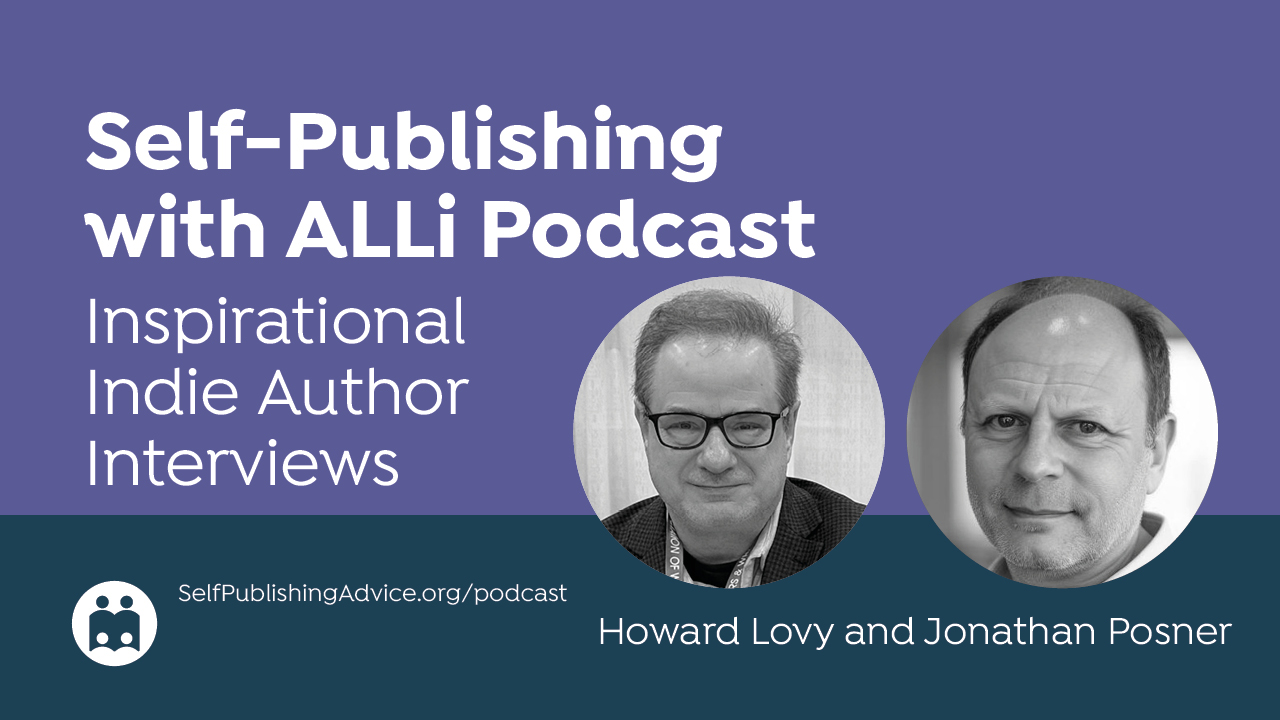
My ALLi author guest this episode is Jonathan Posner, an indie author who writes historical action-adventure set in the Tudor period. After years of self-publishing, he used what he learned to build his own imprint, which has grown into a publishing company that guides new authors through the indie process. His goal is to give writers the support he wished he had when he started.
Listen to the Inspirational Indie Author Interview: Jonathan Posner
About the Host
Author Howard Lovy has been a journalist for 40 years, and now amplifies the voices of independent author-publishers and works with authors as a developmental editor. Find Howard at howardlovy.com, LinkedIn and X.
About the Guest
After a thirty-five-year career in marketing and advertising, Jonathan Posner became a full-time writer and publisher based in Exeter, UK. He has written seven action-adventure novels set in the sixteenth century, along with two collections of short stories and articles, and he teaches the craft of writing through the Writing at the Edge collective. In 2023, he founded Winter & Drew Publishing to guide authors who choose the self-publishing route and want experienced support. When he isn’t writing or publishing, he presents two radio programs on Phonic FM: The Thursday Book Club and Lights Up!
Thoughts or further questions on this post or any self-publishing issue?
If you’re an ALLi member, head over to the SelfPubConnect forum for support from our experienced community of indie authors, advisors, and team. Simply create an account (if you haven’t already) to request to join the forum and get going.
Non-members looking for more information can search our extensive archive of blog posts and podcast episodes packed with tips and advice at ALLi's Self-Publishing Advice Center. And if you haven’t already, we invite you to join our organization and become a self-publishing ally.
If you’re a published indie author who would like to be interviewed by Howard for the Inspirational Indie Authors podcast, you need to be a member of the Alliance of Independent Authors.
Then contact Howard, including your membership number, explaining why you’re an inspirational indie author and what inspires you.
If you haven’t already, we invite you to join our organization.
Read the Transcript
Jonathan Posner: Hi, I'm Jonathan Posner. I'm the author of seven action adventure novels set in the 16th century. I'm self-published — I've self-published all my books under an imprint I created called Winter and Drew Publishing, named for Bill Winter, who taught me history, and Stephen Drew, who taught me English. I thought that was a fitting tribute to my teachers back in my school days.
A couple of years ago I realized that the amount of self-publishing knowledge I'd built up meant I could offer it to help other authors. So I decided to turn Winter and Drew into an actual publishing company, offering authors all the benefits of being self-published but with the added benefit of having a credible publisher logo on the back of their books. It gives them the best of both worlds. We've now published several books with a few more in the pipeline.
Howard Lovy: So you're an author and you help other authors too. We'll get to that. Let's go back in time a little and talk about your early life. Where did you grow up, and was reading and writing always a part of your life?
Growing Up and Finding Writing
Jonathan Posner: I grew up in Essex, which is on the east side of the country — the other side from where I now live. I was absolutely one of those children who had his nose in a book 24/7 if I could. I just devoured books and I absolutely loved the action adventure genre — the excitement, the what-happens-next page-turning element. I was always buried in Dick Francis, Harry Flashman, all sorts of action novels. I was also really interested in musicals, so when I started writing, what I actually started writing was a musical. I've now written the book and lyrics for three musicals, and they have all been produced at some point.
When I decided to write a novel, I took the story of one of my first musicals and turned it into the novel — the novel that the musical could have come from. I did it slightly the wrong way around. What I discovered was that when you write a novel, it's a very different process from writing a musical. The musical genre is much more forgiving — if there's a hole in the plot, you can fill it with a song. Jazz hands and everyone moves on. What I discovered is that simply doesn't work for a book. The plot has to be very tight, no holes at all. So although they started from the same premise, they go in different directions.
Howard Lovy: I wrote a novel that came out earlier this year that involves music, and I tried my hand at writing song lyrics — without even writing the music, that's up to the imagination. But it uses a different part of your brain. So what did you study? Did you go to college and what did you do for a career?
From Law School to Marketing to Animal Health
Jonathan Posner: I studied law and sociology at Exeter University — and I've actually come full circle, I now live in the university town I was educated in. I decided that law wasn't for me because I was too creative. I just couldn't remember all those cases you have to remember, so I kept making them up. Not surprisingly I had to resit one exam twice and finally passed it on the third go. I finished my degree but knew I wasn't cut out for the law. And I didn't particularly want a career in sociology, so I decided marketing was going to be my thing.
I had a career working in marketing agencies, working across all sorts of different brands. I spent four or five years working on Kellogg's, creating the promotions that go on the back of their cereal packets. I built my marketing career to the point where I formed my own marketing agency and ran that for six years. Then I've been in various other agencies. And I really got into animal health — for about 20 years I was almost exclusively on animal health brands. So if you want to know anything about fleas on cats, reproduction in pigs, or coughs in calves, I'm your man.
Howard Lovy: I have an elderly dog with arthritis. Maybe I'll ask you after the show.
Jonathan Posner: I have a strong recommendation for that one.
Howard Lovy: So all the while you were in marketing, did you also secretly long to write about the Tudor era?
Jonathan Posner: Absolutely. Writing was my release from being commercial during the day — every creative director I worked with was very clear that creativity was their job, not mine. So writing was my creative retreat, my outlet. Following on from the three musicals, I wrote a novel. I also wrote a play, but that wasn't very good. And then from there I just kept going — roughly one novel a year for the last ten years.
The Tudor Period, Witchcraft, and Strong Female Characters
Howard Lovy: What particularly about the Tudor period was interesting to you?
Jonathan Posner: The reason the Tudor period appealed to me came from a book. I read Legacy by Susan Kay — I can heartily recommend it. My copy is almost completely falling apart I've read it so many times. It's a biographical novel of Elizabeth I, pretty much from birth to death. The way she brought the whole Tudor period to life really caught my imagination. So when I was looking to set my first musical in a historic period, I wanted somewhere that a time traveler would find genuinely interesting and full of jeopardy — a place where saying the wrong thing or not understanding how society worked could have serious consequences.
The Tudor period really appealed, particularly because my main character is accused of being a witch. To be accused of witchcraft you can either set the story in the early 1600s when Matthew Hopkins was doing his witch-hunting — or, much more interesting for me, you can set it in the Tudor period when not everybody believed in witchcraft, and a lot of people thought it was simply benign healing. So my character would have people on her side. If I'd set it in the 1620s or 1630s, she'd have been accused and hanged within minutes. The earlier setting gave me the chance to bring in a much more rounded set of characters who could help her navigate Tudor society.
Howard Lovy: You write strong female characters — women who challenge the constraints of the time. Why is it important to you to center your stories around independent, strong female protagonists?
Jonathan Posner: There's a very good reason for that, and it crystallized for me through a conversation not long ago. When I was at school, I was at a boarding school, and while my father was trying to do the best thing for me by sending me to what he could afford, it wasn't the right school for me. I felt like an outsider the whole time I was there. So when it came to writing stories, I wanted to bring in that experience — talking about people who are outsiders.
The Tudor period was very, very patriarchal. Women were literally property. They couldn't do anything without a man's permission. So when I sent a character back into Tudor England through time travel, she would have been an outsider not just because she was from the modern era, but because she was a woman. That gives you such a strong dynamic for the story. At the time I just thought this was a fun story to write with a woman as the main character, but looking back I think that's the real reason why.
Time Travel as a Device, Not a Genre
Howard Lovy: About the time travel element — do you go into a lot of science fiction explanation, or do you take the approach of ‘it happened, here's what happens next'?
Jonathan Posner: Pretty much the latter. I took the view that if you're going to have time travel, you just have to make it as quick and as easy as possible. I didn't give her a DeLorean or any mechanical means of traveling back. She works in one of these Tudor-era stately homes in the modern day, there's an electrical storm, and the whole house goes back 450 years around her. When the door opens and a man strides in wearing doublet and hose, he really is Tudor. And of course she does what we'd all do — says the wrong thing to the wrong person and gets accused of being a witch. That's the inciting event and that's where the story takes off.
I also made it a one-way trip. She wants to work out how to get back at first, but fairly soon she realizes she's not going back. That puts a very different spin on the story — she has to come to terms with the fact that she's stuck, she has to navigate this Tudor world and become part of it. And by the middle of the first book, she's pretty much settled in. By the second or third book she's very much a pillar of local society and a Tudor woman through and through. I don't really see my books as time travel, because the time travel is just a device to put my character in that historical setting.
Weaving History and Character
Howard Lovy: How do you handle the storytelling and the history? Do you start with historical events and reverse engineer the fiction, or do your characters drive the plot?
Jonathan Posner: My characters essentially drive the plot, but I've tried to weave history in. In the second book, my character discovers a plot to kill Queen Elizabeth and decides she's going to stop it, which brings in Elizabeth and the characters around the Earl of Leicester. In the third book, she comes to the attention of Francis Walsingham — he was Elizabeth's spymaster, a real person — and he realizes, once he's got past the whole time travel thing, that somebody who knows the future could be very useful. So she tells him things that are going to happen and he sends her off on an incredibly dangerous mission involving Mary, Queen of Scots.
Most of my characters are fictional, but I've woven in the occasional real person. I call them anchor points — moments within the story that I know I want to hit because they're real events. In between those, I can be completely fictional.
Howard Lovy: Plus those real people are long gone and can't sue you.
Jonathan Posner: Very true. And I'd like to think that if they did read the books, they might go: no, actually, that could have happened.
Lessons Learned from Indie Publishing
Howard Lovy: Let's switch gears and talk about your publishing journey. As members of ALLi, what are some of the biggest lessons you've learned?
Jonathan Posner: Allow the time for it. Don't rush it. There are so many steps — just creating all the cover files and content files to upload is a long process and needs to be done properly. And one pair of eyes is never enough when it comes to proofing. By all means have a professional proofreader, but I don't allow a book to go out unless I've proofed it as well. And I've always spotted things that the professional proofer, with the best will in the world, has missed. Between two of us, I think you can get close to 100%.
I also learned a lot about cover design. When I published my first book I had a cover design that pleased me and was different. And I just thought, this is my mark, this is where I present my personality. Then I realized that actually it doesn't sell, because people buy the genre they like, and when it comes to a cover, what they buy is something that makes them think: this is like all the books I love, so it's going to be another one I love, and the risk in buying it is minimized. Having a cover that's different doesn't achieve that. My first series has been through two or three different cover iterations as I've learned, and it's probably due another one now.
Howard Lovy: Part of the appeal of being an indie publisher is that you don't have to follow all the tropes. But you're saying that when it comes to cover design, people want something familiar?
Jonathan Posner: I do. And I think you're right that you don't have to follow all the tropes — a traditional publisher might say we need books within whatever genre is in the ascendancy right now. As an indie author and as an indie author's publisher, you're not tied to the same constraints. You can say: write the book you want to write, and if we think it's good, we'll publish it. It might not make the level of sales that a Hodder and Stoughton or a Faber book might make, but it's as much about the author expressing themselves creatively. So yes, I'm very much into giving authors their creative freedom. But where they need to be brought into the commercial tropes — like the cover — I'm absolutely firm on that. It's got to look like a cover that people will buy.
Genre: Action Adventure Historical Fiction
Howard Lovy: How do you define your own work? Is there a particular genre you try to stick to?
Jonathan Posner: Absolutely. I mentioned that I devoured action adventure stories as a boy. The action adventure genre is one I really want to stay in, because I love it — the fact that you turn the page on every page, you get to the end of a chapter and you think, I have to keep reading. So all my books are written with that intent. The sub-genre is historical fiction, and the setting is the 16th century. My other character, Mary Fox, started in England for two books, and I've now sent her south to Italy. The latest book has her as far south as Naples, and in the fourth book, which I'm currently writing, she's got back up to Venice.
Winter and Drew Publishing: A Hybrid Model
Howard Lovy: Tell me more about Winter and Drew Publishing. Are you a hybrid publisher? Do you help authors from start to finish?
Jonathan Posner: Absolutely. The closest definition is a hybrid publisher. We allow the author to keep their rights. What we try to do is create as close as possible the self-publishing experience, but with somebody on your team — literally project managing the whole publication and advising and guiding throughout. I have three other associate publishers, so between the four of us we can offer a fairly broad service. We enable an author who wants to self-publish but doesn't know how to get all the benefits of self-publishing, plus a credible publisher's logo on the back of their book.
Coming from the advertising and marketing industry, where as a commercial person my job was to support a client through the creation of a marketing program — that's how I work. I'm very comfortable in that space, giving advice and help, passing on the knowledge I've gained, and enabling an author who may not know what they're doing — and with the best will in the world, why should they — to avoid costly and time-consuming mistakes. I made a lot of mistakes when I was first publishing, and I've learned from each one. My three associate publishers are all in a similar position — they've all published their own books, and one has an MA in creative writing. Between the four of us we've got different skill sets, but we all understand the publishing business.
Writing at the Edge and The Thursday Book Club
Howard Lovy: Tell me about Writing at the Edge and the Thursday Book Club. Are those part of Winter and Drew, or separate projects?
Jonathan Posner: Writing at the Edge is a side project — the same four of us, but basically we're helping writers become authors. We're providing seminars, webinars, and workshops, and at some point maybe next year a book. We go to festivals and do workshops and various online things as well. That's how Writing at the Edge works.
The Thursday Book Club came about because 17 years ago I sat next to a man who had just set up a radio station. He asked what I knew about and I said I'd written three musicals, and he said: well, we don't have anyone doing musicals, you can do a show on that. This was in Marlow, not far from London. I did a show called The Sound of Musicals for 13 years on Marlow FM. When I moved down to Exeter I made myself known to the local community radio station, Phonic FM, and they welcomed me in. For three years I was doing a musicals show there.
Then I thought: there isn't a book show on this station, there needs to be one. So I set up the Thursday Book Club — two hours about books, once a month. Like a good book club, we read a book and we discuss it on air. We also have a news section where we gather news of local authors, launch events, and new books coming out. We have a discussion, we do a bit of music, and every month I have a guest. What we try to do is have discussions on subjects around how authors view writing, bringing listeners into the world of authors — a peek behind the curtain from the author's perspective. That's the first hour.
The second hour is presented by Kathy Dodd, who does interviews, music, and lots of different elements. It's not just me for two hours — it's me for one and her for the second. Between the two of us we provide, hopefully, an engaging show about books on our local radio station.
Howard Lovy: That's wonderful. In the US, local newspapers are cutting back on their book sections — getting rid of book reviews entirely. It's getting more and more difficult for authors to find coverage. So what's next for you?
What's Next: A New Book Launch and Book Eight
Jonathan Posner: I'm trying to keep both sides going. On the publishing company side, we have a book launching this Friday — a memoir from a lady who's now in her eighties and has been an artist all her life. The way the book is constructed, each chapter is headed up by a piece of her art or a photograph or a memento, and then she's built the chapter around the memory that flows from that piece. There's still an overall narrative arc to the whole story. We're having a launch event at an arts gallery near where she lives. Beyond that I have another memoir project and a cozy crime we're looking at how to publish.
On the writing side, I'm writing book number eight. I've sent my heroine Mary Fox — a very gung-ho, swashbuckling character, almost a Jack Reacher type who rides into town, helps people out, and rides off again — to Venice. She's searching for an assassin she has reason to want revenge on. He was based on a real person. His name was Scaramouche. I shall say no more than that.
Advice for Aspiring Indie Authors
Howard Lovy: You're something of a poster child for indie publishing because it's not just about the books for you — it's about mentoring others and building a career. What advice would you give aspiring indie publishers who want to build a creative and sustainable career in publishing?
Jonathan Posner: Just do it. Write the book. Getting through a first draft is an achievement, and knowing it's just a first draft — that you're going to do another, and probably a third — it's not a quick process, but do it. Because if you don't do it, you never will. Think of the book as being almost complete in your mind before you even start. It's there. All you are doing is filling in the blanks. I think that's a way to overcome the fear of finishing. I've seen a lot of people who say: I've got a book that's been sitting in my drawer for the last three years and every now and then I take it out and tinker with it. That's fear of finishing. Just finish it. Sometimes it won't be as good as you have it in your head, but it's going to be good enough.
And then get an editor. You absolutely have to have a professional editor — and I would strongly suggest both a structural editor and a line and copy editor, who should almost certainly not be the same person. There are people out there who want to help you make your book as good as it can be. Choose one, work with them, and publish your book. Just do it.
Howard Lovy: Sounds like great advice — and one I should follow as well. Thank you, Jonathan. This has been a fascinating look at your life and career and writing. I appreciate you taking the time to talk to us.
Jonathan Posner: Thank you very much indeed, Howard. Appreciate it.
Howard Lovy: Thank you, Jonathan. Bye.