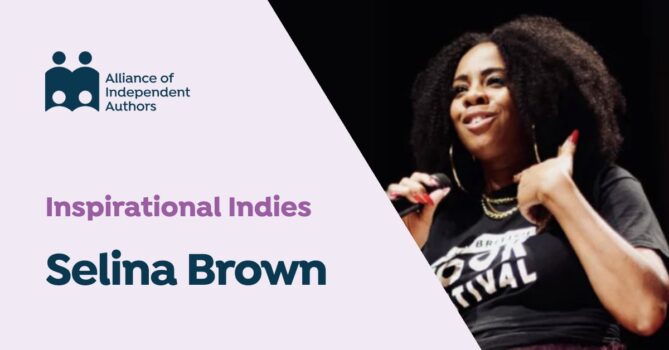
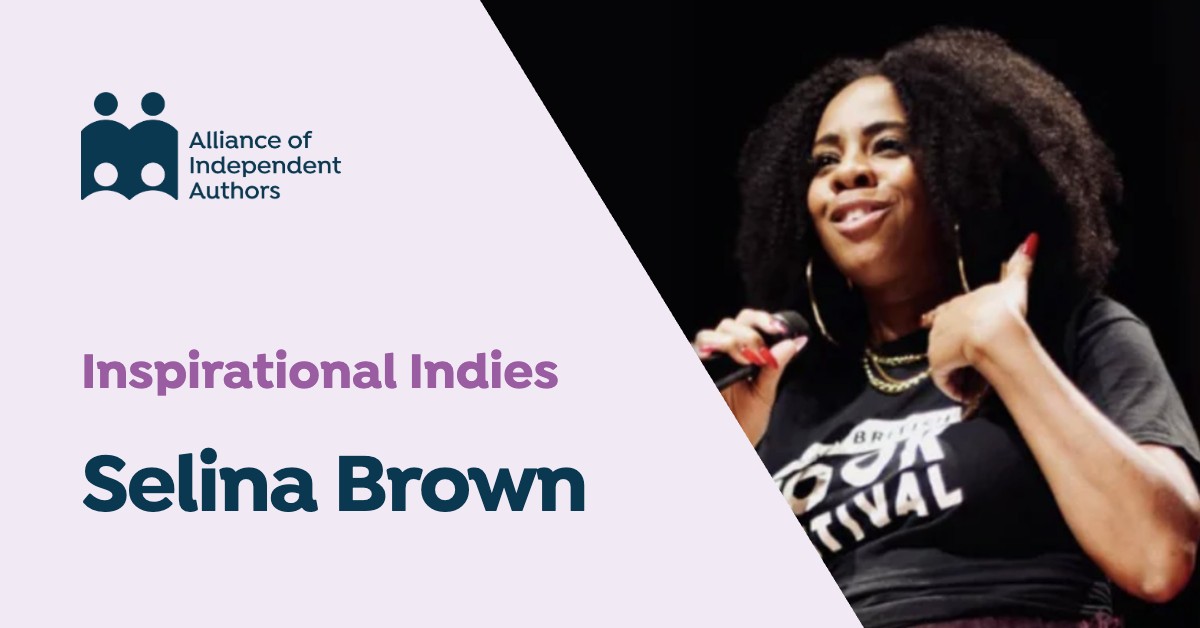
Selina Brown is the founder and CEO of the Black British Book Festival (BBBF), Europe’s largest celebration of Black literature. She was an indie author when she launched the first festival in 2021. She now has a deal with Penguin Random House but still keeps her indie titles available and sells direct through her own shop. Her mission with BBBF is to champion the culture of reading and the work of Black authors on every publishing route, to build pathways to sustainable careers, and to make sure Black readers of all ages see their real lives reflected in the books they read.
In this interview, first published as the cover story of The Indie Author magazine (September 2026), TIA editor Roz Morris talks to Selina about hybrid publishing, selling direct, campaigning for change and how indie authors can get involved with BBBF.
What is the Black British Book Festival?
First, what is the Black British Book Festival (BBBF)? Is it a venue-based event? A set of events around the country?
I love explaining this because it’s grown into something I’m proud to describe.
The BBBF is Europe’s largest celebration of Black literature—but now so much bigger than “just a festival”.
Our big flagship moment is one incredible day a year. This year, that was Sunday 4 October at the Barbican Centre in London, with thousands of readers, writers, families, publishers and cultural icons under one roof. It’s honestly magic.
But BBBF is working all year long. We’re running community libraries, developing authors, doing schools and children’s programming, regional events, workshops, international projects; the list goes on.
So really we’re a year-round literary family with one glorious party at the centre. We put readers, writers and communities in the same room as the industry. That mix is the whole point.
From indie author to Penguin—and back again
And you are an author, so let’s talk about your author journey. You have the Nena books for three-to-seven-year-olds, which have now been picked up by Penguin, and a poetry and spirituality prose book, Before Breath. That’s quite a range of genres. Guide me through the evolution.
My first published book was Before Breath, back in 2015. It was a fusion of poetry, personal revelation and spirituality—following a young woman navigating contemporary life through ancient spiritual principles. Very much from the heart.
Years later, I found my way into children’s books. During the pandemic, I independently published Nena: The Green Juice, and then Nena: Granny’s Magic Fruit Salad. Nena is a little Black girl with a huge, glorious Afro, and I wanted her Blackness to just… exist. Be part of an everyday story, rather than the story having to be about her race.
My traditional publishing journey came after that. I signed a two-book deal with Penguin Random House Children’s UK. My Rice Is Best came out with Puffin in 2025, and Soup Bowl Hunt is coming in March 2027.
So I’ve lived publishing from both sides—fully independent, and through one of the biggest publishing houses in the world. I think being hybrid has made me a much better author.
How did you decide to self-publish?
When I started out, self-publishing gave me something I still treasure: agency. I didn’t have to sit around waiting for someone else to decide I was “allowed” to be an author.
But it also taught me—fast—that writing a book and publishing a book are two completely different jobs. I had to learn editing, design, formatting, printing, distribution, websites, marketing, direct sales, the whole messy, beautiful puzzle. Even with professional help, when you’re independent, you’re still the one holding it all together. That education never left me. It made me a much better CEO.
Why BBBF was born
What triggered the first BBBF? Were any of your experiences as an author—especially an indie author—instrumental?
Completely. I founded BBBF in 2021, and it came straight from my heart as a self-published Black author.
I knew exactly what it felt like to make something you’re proud of, then run headfirst into all the questions nobody prepares you for. How do I get stocked in shops? How do I get reviewed? How do I even get in front of a publisher and be taken seriously? I started talking to other Black authors, and I realised: this wasn’t just me. This was a pattern.
I wanted to build a space where Black writers weren’t the “add-on” to someone else’s program. We were the program.
How did you spread the word and build credibility?
Building something like BBBF takes so much more than loving books. My career has bounced around marketing, communications, events, community engagement, work connected to places like MTV, the BBC, Freud Communications. To build something like BBBF you need to understand branding. Understand your audience. Know how to produce an event. Negotiate. Sell people on an idea before they can see it. Speak publicly. Make a community from nothing.
And you need to be willing to start before anyone else understands what you’re building. That takes a certain kind of stubbornness.
When I began BBBF, I didn’t have the credibility. Nobody hands you that. You create it, delivery by delivery. We made something that felt professional. We talked to our community like real people, we got authors and publishers in the same room and then, crucially, people actually showed up.
Our very first festival was in Birmingham. Over 1,000 people came and this was during the pandemic. We ran from 11am right through to 9pm, and I remember being so full, watching it all happen.
Once you prove something works, every conversation after that gets a little easier.
This year at the Barbican, we had over 80 authors and cultural figures across more than 35 events. Thousands of people through the doors.
From The Indie Author magazine
This interview is the cover story of the September 2026 issue of The Indie Author, ALLi’s magazine for self-publishing authors. The issue also features Jane Friedman on running an author business in the age of AI, seasonal publishing, and our new Authors + The Machine section.
Campaigning for change
The festival obviously has a campaigning element. What changes has it wrought?
I want to be really honest here. I’d never claim BBBF singlehandedly changed British publishing. There have been incredible Black writers, publishers, booksellers and campaigners doing this work for decades before me, and I stand on their shoulders.
But I do think BBBF has become a meaningful part of that pressure for change. The biggest thing we’ve proven, again and again, is demand.
Publishers have sometimes spoken about Black audiences like it’s still an open question commercially. Meanwhile we’ve got thousands of people walking through our doors, discovering writers, buying books, bringing their kids to fall in love with reading. That’s not a maybe. That’s real.
We’ve also built genuine, direct relationships between publishers and community—not just a logo on a banner, but real access: editors, author development, workshops and actual routes to publication. This year we’re launching something I’m really excited about—a new collaboration with Pan Macmillan to create a community-led route into publishing for emerging writers.
What changes are you still pushing for?
There’s still so much I want to see. I want real transparency about who’s being acquired, what advances they’re getting, what happens to them after book 1 or 2. I want more Black people in the room making the decisions about commissioning, editorial, sales, marketing, all of it. And I want the industry to get braver about reaching new audiences. You can’t say “we want new readers” and then market every book through the same old channels you’ve always used.
Some of that can change right now. A marketing budget, a partnership, a commissioning decision—those can shift fast. But it takes much longer to change culture and who holds power. That is structural. I’m patient, but I’m not quiet about it.
You’ve written about Black authors receiving lower advances and about diversity potentially making things less equal. Talk me through that.
I don’t think diversity itself is the problem, it’s performative diversity that worries me.
After 2020, there was this huge wave of pressure on the industry, announcements, initiatives, promises everywhere. And some of it was genuine. But the trouble starts when diversity gets treated like a moment instead of a lasting change in how a business actually operates.
By 2025, I was raising the alarm publicly because BBBF was seeing noticeably fewer Black authors and books being offered by publishers. Some publishers didn’t have as many to bring us as before.
And the latest numbers are quite sobering. In the first 24 weeks of 2026, only 14 Black authors made it into the UK’s top 1,000 authors by sales. Together, they made £2.8m—just 0.9 percent of the revenue generated by that whole top 1,000.
So I don’t think we get to pat ourselves on the back because things looked more diverse for a little while after 2020. We have to ask about longevity. Are Black authors being acquired consistently, year after year? Are they properly supported once they’re signed? Is there real marketing investment behind them? Are their books staying in print? Are they getting second and third deals? Are readers actually finding them?
On advances specifically, the Black Writers’ Guild asked UK publishers to share data like the median and mode of what Black authors are paid. When the Publishers Association looked into author diversity data, they found something telling: very few publishers were even tracking author output by ethnicity. So some of this information simply isn’t being collected.
That’s why I won’t throw around a big sweeping stat like “Black British authors earn X percent less”—we don’t have comprehensive enough UK data for that yet.
But we do have real evidence of the wider gap. Research from the UK Authors’ Licensing and Collecting Society (ALCS), done with the Centre for Regulation of the Creative Economy (CREATe) at the University of Glasgow, found Black and mixed-race writers were among the groups earning less than their peers.
And that’s the heart of it for me: publishing can’t just count how many Black writers it signs. We need to ask who actually gets to succeed, earn and build a real, lasting career.
The thread running through it all
I’d like to refer briefly to your Amazon biography, which describes you as a “success and soul coach and creative entrepreneur”.
Ha! That bio is like opening a little time capsule of a younger me. Back then I was deep into personal development, spirituality, creativity, helping people move from just having ideas to actually doing something with them.
Is that still part of what you do?
I don’t work under that title any more, but none of those principles ever really left me. So much of what I do now is still about developing people, mentoring, opening doors, helping others see what’s possible for themselves.
You’ve also been a youth MP and run an agency called Little Miss Creative.
I became a youth MP for Nottingham at 16, so advocacy found me pretty early. Later I founded Little Miss Creative, an award-winning development agency for girls in schools across the UK.
Looking back at all of it now, none of it feels disconnected. Youth politics was about representation. Little Miss Creative was about opportunity. Coaching was about agency. My writing is about identity and being seen. And BBBF? BBBF is about building platforms and changing who gets access. Different chapters, same thread running right through.
When I started meeting other Black writers asking the exact same questions, something shifted for me. It stopped being “how do I solve this for myself” and became “why is everyone having to figure this out alone?”. That question is where BBBF was born.
More in this issue
Alongside Selina’s interview, the September 2026 issue of The Indie Author also brings you John Doppler on choosing the right self-publishing services, the results of ALLi’s member survey on AI, and how to make the most of holiday titles and seasonal sales.
Selling direct: Nena’s World
You have a shop on your website. That’s a very indie move.
Selling directly to readers was part of my journey long before I had a Penguin deal. The Nena books and products live on Nena’s World, where people can buy the books, the Nena doll, and a few bundles.
One of the best lessons independent publishing taught me is the value of a direct relationship with your reader. A shop might sell someone one copy of your book. But through your own platform, you get to know what your readers want, build bundles, try new ideas, grow a whole world around a character.
You also learn that revenue and profit are not the same thing. Once you’re holding stock and paying for fulfilment, every product has to make sense. That’s the entrepreneur in me talking.
How does that fit with the Penguin titles?
My Penguin books sit in Penguin’s own trade publishing and distribution system, out in shops the traditional way. And both systems get to coexist happily.
Tell me about the Nena doll—how did that come about?
Making the doll came from one question: can Nena live beyond the page?
Kids weren’t just reading about her—they were connecting with her like she was real. So a doll made sense.
Were there other merchandise items you considered?
There were, but I don’t believe in making something just because you can slap a logo on it. Every product has to earn its place. Does it genuinely extend the world of the book? Would someone want it? The doll passes those tests, because kids can play with Nena—it deepens their relationship with her.
How did you judge samples, manage stock and fulfilment?
With any physical product there’s so much more to think about than people realise—sampling, look, quality, safety, manufacturing, shipping, storage, packaging, margins, fulfilment. You have to be willing to say no to a sample that doesn’t do her justice. Her skin tone matters. Her Afro matters. Her outfit matters. All of it matters.
What about the illustration rights?
Hugely important. Nena is her own independent IP, separate from my Penguin deal, but visual rights still need careful handling. Just because you wrote a character doesn’t automatically mean you own every illustrated version of her. If merchandise or animation might be in your future, have those rights conversations early. Trust me on this.
Indie authors and BBBF
BBBF is partnered with major UK publishing houses. Might that make indie authors feel they can’t get involved?
I started this whole journey as a self-published author. It would be pretty rich of me to build the door and then close it behind me.
We work with major publishers and I’m proud of those partnerships. But they don’t decide who gets to belong at BBBF. Indie authors are part of our DNA. Self-publishing deserves to be taken seriously. Our very first festival in 2021 had a session called “Self-publishing, is it for you?” This was alongside sessions on traditional publishing. This year’s program had practical sessions on self-publishing, getting a book deal, children’s publishing, building a sustainable writing life. Plus our Black Book Marketplace, where authors and literary businesses meet thousands of readers directly.
What I care about is quality, professionalism and whether something genuinely serves our audience. A big publisher’s logo doesn’t make a book good. And publishing independently doesn’t excuse you from bringing your best either.
How should an indie author pitch an event for the festival?
Pitch an idea, not just yourself. “I’ve written a book, can I speak at your festival?” isn’t a full proposal. Tell us, who’s it for? Why does it matter right now? What would someone walk away knowing that they didn’t before?
We get a huge number of pitches, so specificity helps you stand out. Come with confidence and a strong idea. That’s what we’re looking for.
The missing data on Black indie authors
ALLi’s campaigns and bookstore lead Melissa Addey notes that a lot of Black authors are self-publishing but don’t appear in industry surveys (see the box at the end of this article). Is this something you’ve noticed?
Yes, and I think this is such an important thread to pull on. There are a few different problems tangled together.
First, traditional UK publishing doesn’t have great ethnicity data on its own authors. When the Publishers Association looked into this, they found very few publishers were tracking author output by ethnicity. If the traditional industry can barely tell us who it’s publishing, imagine trying to measure everyone outside it.
Then there’s indie publishing itself. An independent author might sell through Amazon, their own website, schools, festivals, social media, bulk community orders, loads of channels. Not all of those sales flow into the datasets the industry usually relies on.
And then there’s who gets surveyed. If a survey is promoted mostly through networks where Black independent authors aren’t well represented, they’re less likely to appear in the results and that absence doesn’t mean the community isn’t there. It just means they weren’t asked.
The big ALCS research on UK authors’ earnings is genuinely valuable, and it found Black and mixed-race authors were earning less than their peers. But no single survey can capture the whole independent-author economy.
What I’d love to see is more intentional research, going into Black author networks, independent book festivals, community bookshops, writing groups. It should look at direct sales. Talk to authors quietly selling thousands of books who barely register in traditional data. If a whole part of the market is hard to measure, it becomes easy for that part of the market to be undervalued.
What was on the programme this year?
Honestly, it was a lot, in the best way. Over 80 authors and cultural figures, more than 35 events, all at the Barbican on 4 October.
We had major conversations with Candice Carty-Williams, Corinne Bailey Rae, Wretch 32, Maggie Aderin-Pocock—alongside poetry, publishing masterclasses, children’s programming, science, a live book club, a murder mystery, music, our Black Book Marketplace, and hands-on sessions for writers.
For me, literature was never just two people quietly discussing a novel on a stage. Books touch music, food, science, politics, identity, money, history, pop culture, everything. Our program tries to reflect that truth.
Writing life
Are you writing another book at the moment?
I am! My next Penguin picture book lands in March 2027.
How do you fit writing into the rest of your life?
I’ll probably disappoint anyone hoping for a beautifully disciplined writer’s routine. I’m running BBBF and raising three children. Some mornings I don’t get quiet hours to sit and write, no matter how much I’d love to. The best routine is simply the one that gets your book written.
So I write when an idea gets persistent. I jot notes, sit with characters, scribble lines, let things simmer. And I’m a little old-school. I’ve written in purple pen for years. There’s something about writing by hand that connects me to an idea differently, before it eventually finds its way onto a screen.
In your apparently disparate works, what are the common themes that are indelibly Selina Brown?
Identity. Culture. Family. Belonging. Joy. Self-belief. Those show up everywhere, in different outfits. Before Breath explores identity through spirituality and womanhood. My children’s books explore culture through everyday family moments, food, especially.
I’m a little obsessed with food, because food is never just food. It’s memory. It’s migration. It’s rivalry (whose rice really IS best?). It’s how culture travels from one generation to the next.
And I really care about Black characters getting to exist without trauma being the reason they’re in the story. A Black child in a picture book doesn’t always need to be learning a hard lesson about racism. They can just be making juice. Being joyful, funny, complicated kids, nothing more, nothing less. To me, that’s representation too.
Would you self-publish again?
In a heartbeat, if it were the right project. Traditional publishing brings incredible distribution, editorial support and scale. Independent publishing gives you speed, ownership, control and a direct line to your readers. They’re different models, each with their own gifts.
These days, I don’t ask myself “can I get a publisher?” I ask: what’s the right model for this book?
Final thoughts. What else should I have asked?
Here’s something I’d ask myself: what does success look like for the BBBF, long term?
My answer isn’t “a bigger festival”. Earlier this year I became the first-ever recipient of The Queen’s Reading Room Medal and was named National Reading Hero. It meant much more than one event. It was about widening access to books and helping build a real culture of reading.
The festival is the most visible part of what we do, but the dream underneath it is infrastructure. I want Black writers to have real, honest routes into publishing. I want independent authors to have the tools to build careers that last. I want Black children surrounded by books where they can see themselves, always—not just when it’s topical. I want better data, so we’re not guessing any more. I want stronger bridges from community into industry.
And ultimately? I want BBBF to become something so solid, so rooted, that its future doesn’t depend on me being in the room. The festival is the celebration. The real work is everything that becomes possible once everyone’s gone home.
Interview by Roz Morris, editor of The Indie Author magazine. She publishes literary fiction, creative non-fiction and writing craft books.
ALLi’s outreach to Black authors
In recent author income surveys run by both ALLi (globally) and the Authors Guild (in the US), there was a strong sense that self-publishing showed good diversity. LGBTQIA+ authors were earning 20 percent more than their straight peers. The gender pay gap seen in traditional publishing was reversed—in traditional publishing men earn 41.4 percent more than women; in indie publishing women earn 40.9 percent more than men. And many disabled and neurodivergent authors were choosing self-publishing as their preferred route.
But one statistic worried us: hardly any Black authors took part in the Indie Author Income Survey, even though we had more than 2,000 respondents around the world.
Now we think we were not reaching them, because they were developing their own literary communities, such as Selina’s. When our Indie Author Income Survey goes out in early 2027, Selina’s own mailing list will be taking part, which will give us insights to tailor our offerings to give useful support.
Our campaigns work includes Self-publishing for All: a drive to encourage diversity, accessibility and freedom of expression by bringing self-publishing skills to as many authors as possible around the world.
We are also reaching out to writing associations and groups around the world to offer our support and expertise in self-publishing. If you are part of a writing association or group, email our campaigns manager Melissa Addey. And look out for the Indie Author Income Survey in early 2027: the more authors who take part, the clearer the picture of the whole indie economy becomes.
Alliance of Independent Authors
The global non-profit association for indie authors
ALLi members get advocacy on author rights, all guidebooks free, personalized advice, and access to a community of thousands of working indie authors. If you’re serious about self-publishing, membership is your next step.