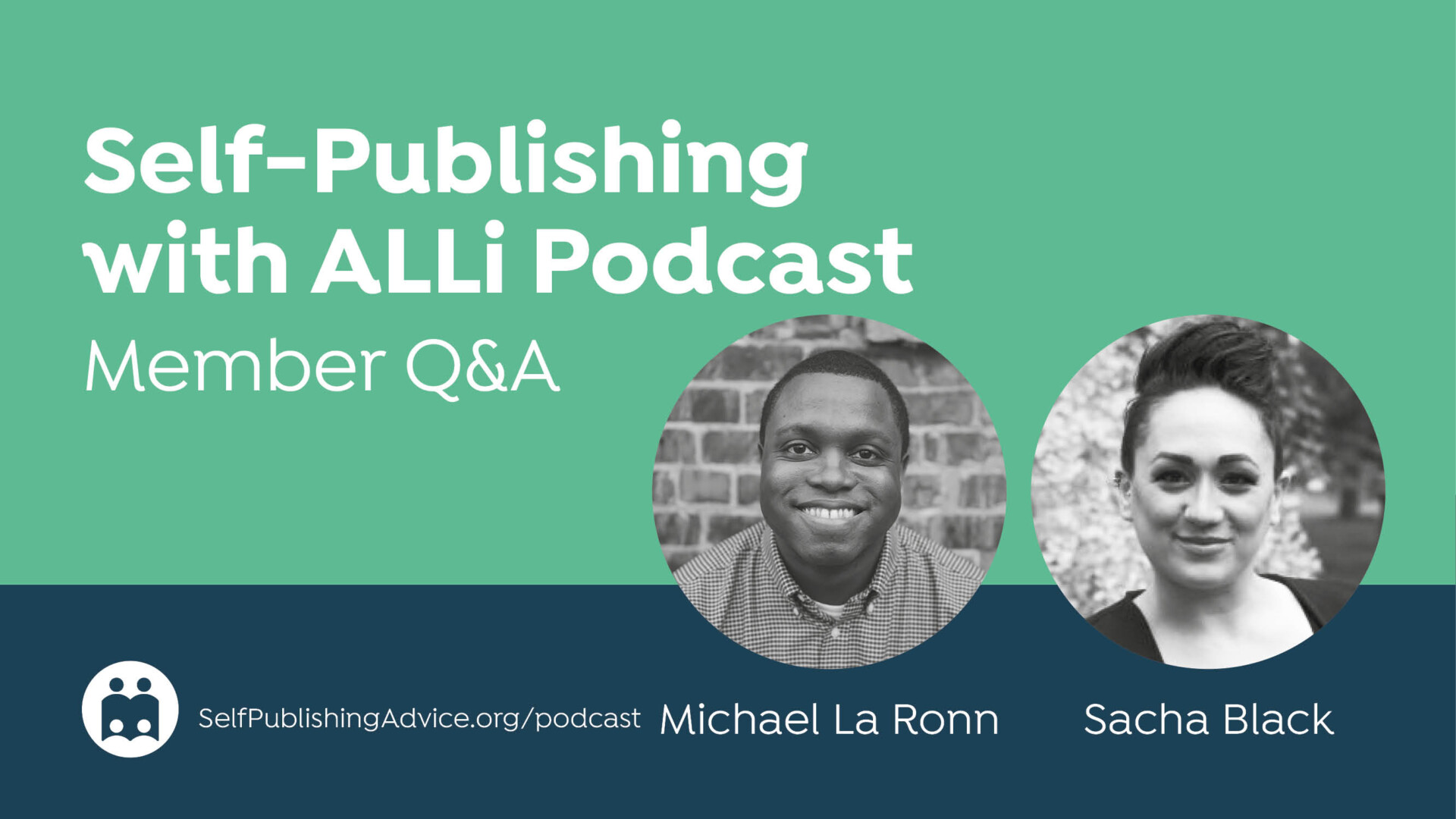
In this episode of the Self-Publishing with ALLi Member Q&A podcast, hosts Michael La Ronn and Sacha Black discuss whether it is legal to use real people's names in nonfiction, including the limits around copyright, defamation, and writing about deceased public figures.
Other questions include:
- How much does it generally cost to have a 52,000-word fiction short story collection edited?
- Where can an author find a cover designer for their next book?
- What should an author do to make the most of a BookBub featured deal they've just been granted?
- Whatever happened to the golden age of author podcasts, and what would be the gold-standard listens for someone entering the industry today?
- Where should an author distribute a professionally recorded, author-narrated audiobook?
- What can ALLi do for a member whose KDP account was wrongly terminated for the stated reason of having multiple accounts?
And more!
Listen to the Podcast: Using Real People's Names in Nonfiction
Have a Question?
If you're a member of ALLi and have a question for the Member Q&A Podcast, you can sign in and ask here!
About the Hosts
Michael La Ronn is ALLi’s Outreach Manager. He is the author of over 80 science fiction & fantasy books and self-help books for writers. He writes from the great plains of Iowa and has managed to write while raising a family, working a full-time job, and even attending law school classes in the evenings (now graduated!). You can find his fiction at www.michaellaronn.com and his videos and books for writers at www.authorlevelup.com.
Sacha Black is a bestselling and competition winning author, rebel podcaster, speaker and casual rule breaker. She writes fiction under a secret pen name and other books about the art of writing. She lives in England, with her wife and genius, giant of a son. You can find her on her website, her podcast, and on Instagram.
Thoughts or further questions on this post or any self-publishing issue?
If you’re an ALLi member, head over to the SelfPubConnect forum for support from our experienced community of indie authors, advisors, and team. Simply create an account (if you haven’t already) to request to join the forum and get going.
Non-members looking for more information can search our extensive archive of blog posts and podcast episodes packed with tips and advice at ALLi's Self-Publishing Advice Center.
And if you haven’t already, we invite you to join our organization and become a self-publishing ally.
Read the Transcript
Michael La Ronn: Hello and welcome to Self-Publishing with ALLi. This is the member Q&A podcast where we answer your burning self-publishing questions. I'm Michael La Ronn, ALLi's outreach manager, and I'm joined by Sacha Black, our communications and strategy manager. How are you, Sacha?
Sacha Black: I'm good, thank you. How are you?
Michael La Ronn: Fantastic. We've got a lot of questions teed up for today's show, and the theme is back to basics — a lot of questions from authors at square one. If you're at square one and want a refresher on the fundamentals, this is a good episode for that. But before we jump in — how are you, Sacha?
Sacha Black: I'm good. I'm recording from my new office — I moved house, and I'm delighted with the new house and the new office. It's in the garden, so for the first time in about seven years I'm not working inside the actual house. It's been wonderful for my mental health to have that bit of friction — I can leave my laptop out here and walk into the house and there's no work. We've got a lot of birds in the garden too, so if you hear chirping in the background, that's just going to be my theme tune from now on. We even had what might have been a parakeet or a budgie the other day, which is very un-British, but it was bright green and very cool.
Michael La Ronn: That's lovely. Congrats on the move.
Sacha Black: Thank you. And you — tell me about you.
Michael La Ronn: I'm doing pretty good. I'm traveling a lot — probably the most I've traveled in my career, and that's saying something. I'm on the road every other week or so. That raises an interesting dilemma: how do I keep writing and keep momentum while traveling that much? Writing on my phone has been huge for me. I'm at the airport with a long layover, and I'll just get my phone out.
Sacha Black: What app do you use for that?
Michael La Ronn: I alternate between Scrivener and Microsoft Word, depending on how I'm feeling. I have Scrivener on my laptop and Scrivener on my iPhone — it's iOS only — and I'll write on my laptop, close it, and it syncs to my phone so I can pick up right where I left off, and vice versa.
Sacha Black: That's amazing — I didn't know you could do that.
Michael La Ronn: It's been a huge game changer. I've used Scrivener on iOS since around 2018. The syncing can occasionally be a little finicky — I've never personally lost data, but I know people who've had issues getting it set up. Once it's working, though, it works great. I've been all over the country, coast to coast, and I've been able to keep writing despite a pretty chaotic schedule. There's honestly no reason I should have written as many words as I have this past month, but it's worked out.
Sacha Black: There's that adage — if you want something done, give it to a busy person. Sometimes I feel like if I don't have enough on my plate, I don't actually do the work.
Michael La Ronn: Necessity is the mother of invention, right? If I don't write, it's bad for my mental health, so I have to find a way — even if it's a hundred words at a time, standing in line at the grocery store or in the back of an Uber. Being able to keep choosing to write, however small the increments, is great. Okay — let's jump into our first question.
How Much Does It Cost to Edit a Short Story Collection?
Michael La Ronn: Our first question is from Richard, who has an editing question: how much does it generally cost to have a fiction short story collection edited? The word count is around 52,000 words.
Sacha Black: Most editors will charge a price per word, and it's usually a small fraction of a cent — it can be anything from about one cent per word up to around nine cents per word. It's very dependent on the type of edit and the length of the book. It also depends whether you want pure proofreading, and whether you're submitting a fairly clean manuscript or a messy one — some editors charge less if your manuscript needs less work. Proofreading is generally a lot cheaper than a developmental edit, because a developmental edit comes with inline comments, critiques, questions, and usually an editorial letter, which makes it more expensive. Honestly, prices range from dirt cheap to insanely expensive — it really is a ‘how long is a piece of string' situation. My own proofs for an 80,000-word manuscript typically run anywhere from $300 to about $1,100, depending on how much work is involved, which I know is a wide range. You just have to look around and see what you can find.
Michael La Ronn: That's about in line with what I pay too. It depends on the length of the book, your relationship with your editor, your genre — a lot of factors apply. What I always tell people is that there's an editor for every budget. Sometimes authors reach out to an editor, get sticker shock at the quoted price, and think they can't afford it — but there are a lot of editors out there, and you can find someone who fits your budget. It's a matter of searching.
I'd also expect a short story collection to potentially cost a bit less than a novel, because — depending on the quality of the stories — there's technically less for the editor to track. They still have to do everything they'd normally do, but they're not following one large plot line the way they would for a novel. I've generally found my short story edits run a little lower, though not dramatically, since it still takes up the majority of the editor's time.
Finding a Cover Designer for Your Next Book
Michael La Ronn: Next question, also from Richard, who gives us a double-header: ‘I have one book published on Amazon. I want to publish another. Can you recommend a place that will do me a cover?'
Sacha Black: Yes — and again, it depends on the genre. A lot of designers will cover a range of genres, but there are also designers who specialize. You might find more of an illustrator-type artist doing bright, cartoon-style, pop-arty covers, versus a designer doing Photoshop blending with stock photography that looks more like a mafia book or a dark romance cover. So it depends what you're looking for. I can't recommend one specific designer because I hunt for very particular styles myself, but there's a lot you can do.
First, go look at ALLi's partner database — log in at allianceindependentauthors.org and go to the services section to see all our partner providers. There may also be discounts and deals in there, so do check. We'll pop the link in the show notes. Those partners have been through a verification process with ALLi, so they're trusted and good quality, ethically sound designers — a great place to start.
The other thing you can do, if you've done your research and know the style and type of cover for your genre, is look at the copyright page of books you admire — authors will often credit their cover designer there, and you can find your way to that designer's website, portfolio, and pricing. There are also a lot of designer Facebook groups now where designers post pre-made covers. You could search there. And you can always ask fellow authors — in the ALLi member forum, or in author Facebook groups — who they've used.
Michael La Ronn: You hit all the points I was thinking of. As with editors, there are designers and designer products for every budget. Some authors want a fully illustrated cover — just be careful that it suits your genre and isn't something you're doing only because you want an illustrated cover for its own sake. There's the standard composite Photoshop work, which is probably the default for around 90 percent of covers out there, and then there are pre-mades. There's nothing wrong with a pre-made if that's what you can afford — just make sure it matches your genre, and think about branding and series consistency so your covers don't end up mismatched if the book becomes a series. There's a product to meet every budget.
You Got a BookBub Featured Deal — Now What?
Michael La Ronn: Next question is from Todd, who has some great news: he was recently granted a BookBub featured deal and wants to make the most of it, but isn't sure how. Any advice?
Sacha Black: There are a few things you can do to help yourself. First, understand that BookBub has a long tail — a bit shorter than it used to be, but you can help extend it. Tell your mailing list, because there will be people on it who haven't actually bought your books yet. Put it on all your social channels too — help the sale as much as you possibly can. If you're lucky enough to get an orange flag during the featured deal, share that, because it encourages people to support you further — be excited about the ranks, that kind of thing.
Another way to extend the BookBub halo is newsletter stacking. BookBub is one of the holy grails, but there are similar services — Written Word Media, Robin Reads, and a number of others worth Googling. It really depends on your goal. If you want clean data on exactly how BookBub performed for you, don't do any newsletter stacking. If you want to maximize read-through, reviews, or sales, then stack — pay for other newsletters to go out two or three days apart from each other, so instead of one massive spike followed by a crash, you get a big high followed by a shorter low, then back up again. It's like a shallow wave instead of a tsunami. I haven't run a BookBub recently myself, so I don't have great data on exact spacing — my gut says maybe three days apart — but Michael, you may have more recent experience.
Michael La Ronn: I had one last year. Just to clarify what Sacha means by newsletter stacking: we're talking about paid services that specifically do this, not paying other authors directly. Services like Book Barbarian or The Fussy Librarian — they have reader lists they send newsletters to.
My BookBub last year — and BookBub is definitely not what it used to be — gave me a halo effect that lasted about four to five months. What was funny is that at first I didn't think I was going to make my money back. People say if you don't recoup within 24 hours you've failed, and I got through that first day thinking, is this going to work or not? But within a week I'd made my money back. My BookBub was for the first book in a six-book series, so I started seeing read-through and other book sales as a halo effect well beyond the initial bump. Don't give up hope.
On timing: it can help to stack a couple of smaller newsletter services a few days before the BookBub, let the BookBub be the spike, and then ride the wave down on the other side. A lot of it depends on each service's own calendar and availability, since most are self-serve and you're tied to their open dates. Just try to pack things together as much as you can, and find something different to do every day to extend the effect. I also reached out to a few prominent author friends and asked if they'd mind sharing the title during that window, and they timed it so I could ride the wave as long as possible.
Sacha Black: I want to add one thing. The first time I got a BookBub, I was so high off seeing the orange flag, the reviews coming in, and the sales dashboard climbing that nobody had warned me about the crashing low that comes afterward. It's not to be sniffed at — I'm very competitive, and I was gutted when it came back down. I'd convinced myself this was it, that I'd stay up there — and no, you're not that popular yet, Sacha. It crashed and burned afterward. Just prepare yourself, because the sales will drop again.
Michael La Ronn: Like I said, it's not what it used to be. Ten years ago, a BookBub featured deal genuinely launched careers — you'd climb the charts and stay there, see sales on Kobo and Google Play. Those were the good old days. It was in some ways easier to get a BookBub ad back then, and in other ways harder. Algorithms have changed, attention spans keep shrinking, and you're going to settle back toward your pre-sale baseline. But you'll likely come out with more readers and some real sales to show for it — it's still a valuable tool that shouldn't be discounted.
Whatever Happened to the Golden Age of Author Podcasts?
Sacha Black: I have a couple of questions of my own to throw in here. I'm a heavy audiobook listener — I think I've read about 65 books this year, and roughly 50 of those were audiobooks. But before I became such a heavy audiobook listener, I used to listen to a lot of podcasts, especially back when I was podcasting more regularly myself. Now I've kind of fallen off the podcast train. Do you still listen to podcasts? And if you were coming into this industry fresh today, what would be the gold-standard podcasts to listen to?
Michael La Ronn: That's a great question, and unfortunately I can't fully answer it, because I'm in the same boat. I overdosed on podcasts — there was a period from about 2012 to 2014 where I was listening to them all day, every day, partly because I was early in my career and wanted to learn as much as I possibly could. Something shifted for me over the last six years or so, and like you, I found myself listening to more audiobooks instead, since that became my way of reading and consuming content. I still watch some podcast-style content on YouTube, so I haven't fully given it up — but beyond The Creative Penn with Joanna Penn, which you already mentioned, I don't have a great answer.
Sacha Black: I'm just craving the old-school days of podcasting, trying to figure out what I'm missing from it. I didn't know if you still listened — sounds like we've had pretty similar journeys on that front.
Michael La Ronn: We have. I'd say it's such an interesting landscape now, because I think a lot of what we used to listen to podcasts for, people are now getting from chatting with AI to learn. My hunch — and I could be wrong — is that podcasting is going to evolve to be more intermediate-focused than beginner-focused.
I think that's true across a lot of things. Remember the old write-short-Kindle-books trend, years back — people like Steve Scott writing these short treatises on skills like time management or focus, 20,000 to 30,000 words each? People jumped on that bandwagon, and a lot of it — not Steve Scott specifically — was authors gathering information you could have found with thirty minutes of free Googling. I think that's exactly the kind of content AI now lives in. If you were one of those authors writing surface-level books on things people can find for free, I think you're in trouble. And I think that's true of information generally — people are going to hunger for things AI can't tell them.
Sacha Black: Isn't that interesting — when you said that, what popped into my head was Rachel Heron and Joanna Penn's old podcast together. I think it was the friendship between them that I loved, just wanting to listen in on that every week. That's human.
Michael La Ronn: Exactly — there's a human component. You're not just listening to a podcast for information, you're listening for the interaction, maybe for the validation of someone saying, ‘oh, I went through that too.' AI can't replace that. That's why I think podcasting is going to shift toward the intermediate and advanced end of things. I'm just as curious as you to see where it goes.
Sacha Black: Maybe there'll be a chat in the member forum afterward where people can suggest some.
Michael La Ronn: There we go.
Is It Legal to Use Real People's Names in Nonfiction?
Michael La Ronn: Next question is from Tom, who wants to know: is it legal to use people's names in nonfiction? I can take this one. The short answer, taking it from a couple of angles — if you're asking whether it's okay to use a celebrity's name, say writing about Gandhi or Mother Teresa, the general answer is yes, you can use their names and write about them. You just can't use copyrighted content, and you can't write anything defamatory. So if I wanted to include an anecdote about a celebrity in one of my books, I'm free to do that as long as it doesn't infringe on anyone's copyright and isn't injurious to their reputation.
So yes, you can. Whether you should is a separate question. There's a gray area in nonfiction where writers sometimes want to write about real people, and I'd encourage some caution, especially if that person is still living. There's a myth that you can't defame the dead — that's not quite true; you can say something that harms a deceased person's estate, and their heirs could potentially sue. So just be careful. Ask yourself whether you really need to include a specific celebrity or public figure — nine times out of ten, the answer is no. Sometimes it can't be avoided, in which case make sure what you're writing is factual.
There are other situations too, not involving celebrities. I know of a writer who took it upon themselves to investigate a cold case true crime in their own neighborhood — got personally involved, started writing about it, and began making accusations against someone they believed had committed the murder, without solid proof, just based on evidence that seemed to point that way. They ended up sued and hit with a cease-and-desist order. Just be very careful about putting real people in your stories — honestly, it's almost always better to make it up.
Sacha Black: My advice: if you're going to do that, go get a traditional publisher, because they carry all kinds of insurance. Let them take the risk.
Michael La Ronn: Exactly — be an additional insured on their policy.
Sacha Black: Top tip from Sacha — the one and only time I'll ever encourage someone to go get a traditional publisher.
Michael La Ronn: And even traditional publishers get skittish about this kind of thing. I'd encourage people to be careful generally. If you're writing memoir, true crime, autobiography, or biography, those are the genres most likely to spawn lawsuits. Sometimes these questions are completely innocuous, and sometimes they involve something you already suspect you shouldn't be doing. It could be as simple as: can I put Coca-Cola in my story? Can a character have a can of Coke? The answer is yes, but it's generally better writing to use a generic ‘cola' rather than a trademarked name. Can you put Barack Obama in your story? Yes — but do you need to? Most of the time it's not necessary. There are genres and stories where you genuinely can't avoid it, so just be careful and follow best practices, and you'll generally be fine.
Where Should You Distribute a Professionally Recorded Audiobook?
Michael La Ronn: Next question is from Rip, who has a professionally recorded, author-narrated audiobook of their published book and wants to know the best platform for distribution.
Sacha Black: I might hand this one to you — I've only done a couple of nonfiction audiobooks myself, which I distribute exclusively through my own website, and the rest of my novels went to publishers who hold those audio rights. I'm not really in the know on this one.
Michael La Ronn: I've done pretty much everything except sell rights to a publisher — narrated some of my own audiobooks, including one for ALLi, worked through a royalty share with a couple of narrators early in my career (wouldn't recommend that route), and paid narrators upfront for production (would highly recommend that).
On distribution: there are really a couple of key questions. First, do you want to be exclusive to Audible or not? Audible recently changed their royalty structure, and I haven't had a chance to dig into the new terms in detail, so take what I say with a grain of salt. But broadly: Audible is still the largest audiobook market, the 800-pound gorilla in the room. Being exclusive to them typically gets you a higher royalty under their model, but limits where else your book can appear. Going non-exclusive gets you a somewhat lower royalty but lets you distribute much more widely. Audible, via ACX, gets you onto Amazon, the Audible platform itself, and Apple — that part is essentially non-negotiable.
At ALLi we generally don't recommend exclusivity, because putting all your eggs in one basket can be risky long-term. Other distributors worth considering: Voices in Audio, formerly known as Findaway Voices and now owned by Spotify — a major distributor that can get your audiobook into Spotify and a range of other outlets. Kobo also accepts direct audiobook distribution and is a major player. Voices in Audio can also get your audiobook into OverDrive and libraries — an increasingly significant part of the audiobook market, and a growing source of my own sales each year. There's also Authors Republic, which does something similar to Voices in Audio, getting your audiobook into many places you couldn't reach on your own. Google Play also has a direct audiobook upload option.
And as Sacha mentioned, your own website is part of this too. BookFunnel — which is really best described as a book sales fulfillment service — has an audiobook hosting feature, so you can sell your audiobook directly to readers, host it there, and they can stream or download it through the BookFunnel app. I'd consider all of that together as part of a wide distribution strategy. If your audiobook performs well, going wider with additional publishing partnerships can also become an option down the line.
Sacha Black: I think you've nailed it.
My KDP Account Was Wrongly Terminated — What Can ALLi Do?
Michael La Ronn: Our final question is from a member whose KDP account was terminated for the stated reason of having multiple accounts — which isn't true, since they've published from a single account since 2022. They've emailed Amazon to appeal the termination and are asking what ALLi can do.
Michael La Ronn: If you're an ALLi member, which I assume this questioner is, ALLi does have a relationship with Amazon KDP. We can't make any promises, but if you're a member running into an issue like this — a termination that seems unwarranted — please write to us in confidence at [email protected] with details of your case, and we'll do what we can to reach out and advocate on your behalf. I want to set expectations clearly: at the end of the day, it's Amazon's call, and we can't guarantee an outcome. But we have, in the past, been successful in helping mediate disputes like this with Amazon. So do write to us if you're not getting anywhere on your own.
Closing
Michael La Ronn: That brings us to the bottom of another episode. You've been listening to Self-Publishing with ALLi, the member Q&A podcast, where we answer your most burning questions. If you're an ALLi member, log in at allianceindependentauthors.org and submit your question through your dashboard — you just might hear it on the air. We're not at the bottom of our queue, but we're always looking for more questions, so please keep sending them in. Just know that we record a few months behind, so if you have a more urgent question we may not get to it in time — but we will still answer everything that comes in. We'd love to hear from you, and we look forward to seeing you on the next show. Thank you, and talk soon.
Sacha Black: Bye.