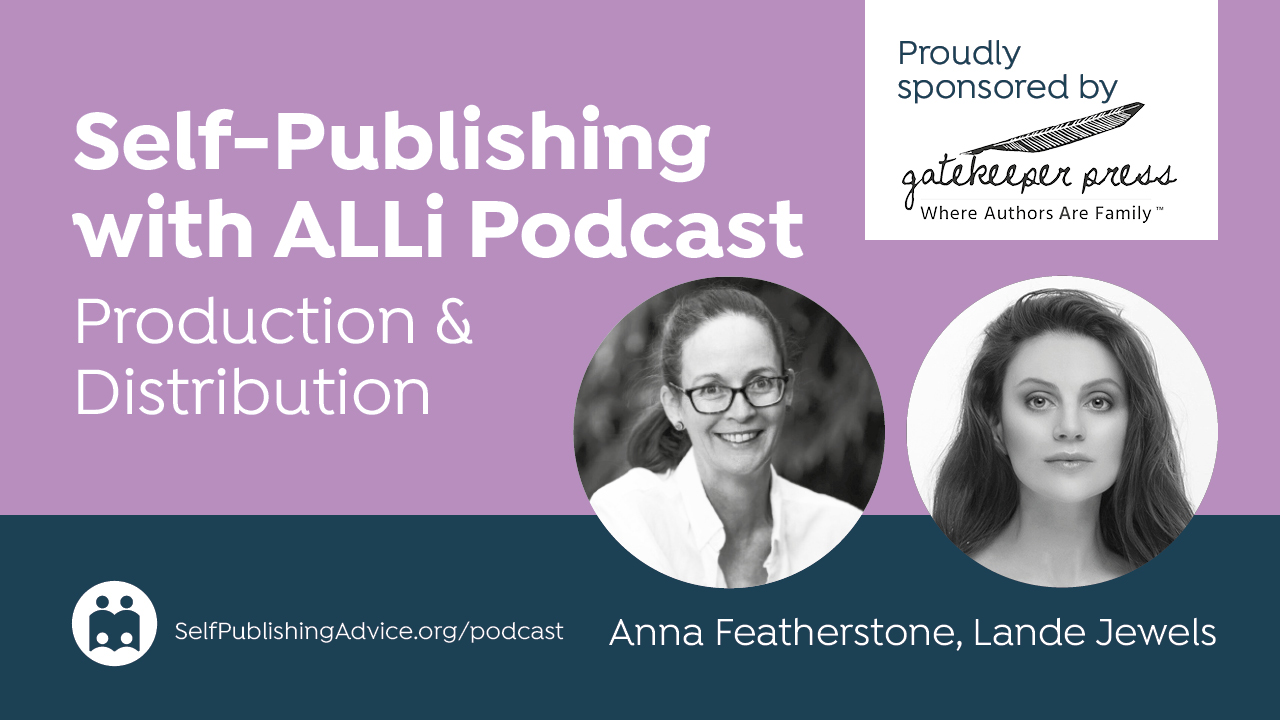
On the Self-Publishing with ALLi podcast, Anna Featherstone explores with author Lande Jewels the many decisions that surround and extend beyond writing a book. They discuss form, illustration, publishing models, and the broader impact of how a work is produced and shared. The conversation covers writing in verse, working with illustrations, choosing a pen name, producing special editions with an emphasis on quality, using Kickstarter, and considering social responsibility in authorship. Along the way, Lande reflects on what she has learned through experience, offering practical insights for writers and creators interested in publishing choices beyond the manuscript.
Listen to the Podcast: Verse, Visuals, and Special Edition Decisions
Sponsor
This podcast is proudly sponsored by Gatekeeper Press — your partner in premium independent publishing. Empowering authors with expert guidance, 100% rights, 100% royalties, and global distribution. From editing to marketing, their all-inclusive services help you publish professionally and confidently. Gatekeeper Press — Where Authors Are Family.
About the Host
Anna Featherstone is ALLi’s nonfiction adviser and an author advocate and mentor. A judge of The Australian Business Book Awards and Australian Society of Travel Writers awards, she’s also the founder of Bold Authors and presents author marketing and self-publishing workshops for organizations, including Byron Writers Festival. Anna has authored books including how-to and memoirs and her book Look-It’s Your Book! about writing, publishing, marketing, and leveraging nonfiction is on the Australian Society of Authors recommended reading list. When she’s not being bookish, Anna’s into bees, beings, and the big issues of our time.
About the Guest
Author Lande Jewels rediscovers local treasures and shares them through verse and illustrations. A Londoner and a graduate of the London School of Economics, she studied philosophy and economics and later lived in Eastern and Western Europe and the United States, working in business, corporate, and nonprofit sectors. After earning a postgraduate qualification in the arts in New York and Los Angeles, she began an authorpreneurial journey with original book series and advocates for socially responsible authorship. You can also find Jewels on TikTok and YouTube.
Thoughts or further questions on this post or any self-publishing issue?
If you’re an ALLi member, head over to the SelfPubConnect forum for support from our experienced community of indie authors, advisors, and team. Simply create an account (if you haven’t already) to request to join the forum and get going.
Non-members looking for more information can search our extensive archive of blog posts and podcast episodes packed with tips and advice at ALLi's Self-Publishing Advice Center.
And if you haven’t already, we invite you to join our organization and become a self-publishing ally.
Read the Transcript
Anna Featherstone: Welcome and thanks for tuning in from your special part of this beautiful planet. I'm Anna Featherstone, joining you today from the Lands of the Gadigal people, the original storytellers of this land, in Sydney, Australia. Today we're looking at publishing and distribution choices through one author's experience — and what you as a writer and creator might take from that for your own work, including how to think beyond the writing itself and consider a book's wider impact. Welcome, Lande Jewels.
Lande Jewels: Hello, Anna. It's lovely to be here with you today.
Anna Featherstone: It's great to see you. Where are you joining us from today?
Lande Jewels: I'm in London. It's evening here and it's been raining all day, so I've been really looking forward to our conversation.
Anna Featherstone: I'll bring the sunny vibes — it's a beautiful day down here. How long have you lived in London?
Lande Jewels: I'm going into my third decade, so over 25 years. By far the most part of my life has been in London, more or less in the same area.
How Writing Began: Rhyming from Age Three
Anna Featherstone: Where did your creative journey begin? How did you come to writing?
Lande Jewels: My writing journey begins pretty much in my really early childhood. I started rhyming as soon as I started talking — my parents would say from about age three — because it gave me a way to put my impressions of the world into an interesting, melodic, organized form. Then I picked up journaling and that took me through adolescence. Throughout my career it was something I loved doing at the end of the day, to put my thoughts in order and share my ideas. Journaling, in a rhyming form, has been with me pretty much my whole life.
Published authorship began much later. I never really considered becoming an author because it seemed like a side of me that wasn't connected to earning money — it was just for me. My background was in finance and later philanthropy and the corporate world. When I became a parent, that had to change. I could no longer travel at the same rate or work 14-hour days in the office. So I adjusted. I was used to being busy and out of the house all the time, so what that meant was I'd leave in the morning with a pram and my journal and just take notes of everything along the way. I've walked all around London gathering impressions of the city.
Then my daughter became interested in what I'd written. She was just curious, looking at my scribbles. I started reading it aloud and realized that hearing it myself was useful. That became the motivation to put it into more edited writing. I added pictures to make it more interesting for her, and at some point there was a need to print it nicely so we could take it with us. I found on some blog that you could print it through KDP at no cost if you're not trying to sell it. That was my first book — I didn't put a high price on it because I thought maybe someone will benefit, and I just left it up there.
Anna Featherstone: So you really started writing for your own daughter, and got it printed for her, then thought: I'll just leave it up there for others as well.
Lande Jewels: Initially it was even more just for me — keeping sane in the new world of motherhood, keeping my mind busy, making sure I had enough intellectual stimulation. If I came across something interesting I'd go to the library, pick up books on the subject, and make it into more of a story. It built from there. People around me became interested, they shared it with the local library, the library invited me to talk there, and it grew from that very natural, organic beginning.
The London Baby Series: Not Quite Children's Books
Anna Featherstone: How many of the children's books have you produced?
Lande Jewels: In fact none of these books are really children's books. I called it the London Baby Series because it was born in London, conceived in London, by a Londoner, and mostly about London. That seemed to make sense. I then realized it might be a bit confusing, so I'm working on the branding a little. But the language got really complex — the earlier editions were simpler, and then I made them a lot more complex with historic facts, observations, and conversations I had with specialists. So it's still in rhyming form, but it became more encyclopedic, more educational and informative. My youngest readers would probably be around nine or ten, but they'd be the minority. The majority are adults.
Anna Featherstone: Is Lande Jewels your real name or a pen name?
Lande Jewels: It's my pen name, or artistic name. It's made from my real name but with an addition. I arrived at it by natural accident. My previous project was in diamonds and jewelry, and I'd created a company called Eland Jewels, incorporating both my name and that element of jewelry. I had the website and company all set up, then things changed and COVID came, and I realized I wasn't going to pursue that route. But the infrastructure was already there, it had my name in it, so I kept it as my artistic name. Now I'm known as Lande Jewels.
EA: A Poetic Guide to London's Museums
Anna Featherstone: Your latest book, EA, is a poetic guide to London's museums, written entirely in rhyming verse with illustrations. Who do you see as the audience, and how did you come up with the concept?
Lande Jewels: EA is actually number 15 in the series. All the previous books were also mostly about London in the same style. I started with Christmas, then there were books on streets, bells, sites, urban wildlife, stations, infrastructure, bridges. Depending on the subject, it would shape the book. There's one on graves — cemeteries and crypts — which took a whole summer of visiting graveyards, an interesting choice of summer, but it produced one of my favorites. So naturally it led to museums, because that's such a big part of London.
There were so many museums that I thought I'd break it into a couple of books, but once you start one you might as well do it properly. EA covers 175 places — museums and historic houses considered museums — within the London and greater London area. I'd known about maybe 20% of them before I started writing. Like most Londoners, I wasn't aware of the majority. As I started writing, I discovered more, consulted different guides, and went further and further afield.
Anna Featherstone: What guides did you use — human guides at the places, or guidebooks?
Lande Jewels: Both. Here in London we have something called the Art Fund, which is an organization where you buy membership and get a list of museums and historic places. Between the Art Fund, Historic England, the National Heritage, and others, you can put together a comprehensive list. Plus Google Maps for finding your way around. I cycle everywhere, so it had to be within about two hours each way.
I went to every place, some of them more than once, some of them many times. I'd speak to the volunteers — museums here tend to have volunteers who are very keen to talk about the place. The actual text was born from my own impressions, what my daughter thought about the place, conversations with volunteers, and the little booklets given out. If I wanted to add more, there'd be a trip to the library. We have a good selection there and can order all kinds of subjects. It was really created based on experience.
Anna Featherstone: How long have you been working on the museum book?
Lande Jewels: If I'm completely honest, taking everything into account, it would probably be the whole time I've been in London — all those initial impressions formed by going back again and again. I've been to the National Gallery and the Tate so many times I know them by heart. The majority of the 175 places I'd visited in the last year or two, and about a quarter I'd visited before and came back to just to check my memory and get the angles right for photos.
Anna Featherstone: Tell me about one of the quirky standouts.
Lande Jewels: The medical museums are generally quite interesting because they sometimes go borderline with things that aren't usually shown to the public. We have the Bart's Pathology Museum and the Hunterian Museum — both have vast collections of specimens in jars. And there's the Crime Museum, which is generally off limits to the public because it's used to train police. This year marked 150 years of the Metropolitan Police, and there was a special exhibition at the Police Museum that included specimens from the Crime Museum. Very quirky. And the local history museums are always interesting because they tend to be small and very particular and very interactive.
Anna Featherstone: Were you discussing the book with the museums when you visited, thinking about them as a distribution channel?
Lande Jewels: Some of them. There are so many, and some have shops and some don't. The V&A has four locations now — of course that's a conversation we're having. Others are just one room, open by appointment, with no shop. Those that have shops, yes, that's a conversation. Those that don't have shops may have libraries attached — the Cricket Museum, for example, has specifically asked me to send them a copy for their library or display. It really depends on the museum.
Production: Illustrations, Design, and Distribution
Anna Featherstone: When you visited the museums you took photos. How do you work with the illustrations and get them into the book?
Lande Jewels: My illustrations are a collage of photography, sketches, watercolors, and sometimes some scribbles layered on top. I don't use generative AI tools. I use basic Photoshop brushes if I need to adjust the light or something like that. Generally it's a mix of photographs I take on the day, drawings I do, and then I put them in layers on top of each other and might add some small watercolor brushes in Photoshop. That gives me a particular style I've used consistently across all the books.
Anna Featherstone: Are you designing the book layout yourself as well?
Lande Jewels: Yes. I use Photoshop to tidy up images and make sure they're in a consistent format. Then I use either Pages or Microsoft Word to create the actual book layout, then convert to PDF. Most of my files are in PDF. I create a template with the margins, positioning, and fonts set up — the fonts are consistent across the books — and then I just input the text. Once the template is done it's fairly straightforward.
Anna Featherstone: And for distribution?
Lande Jewels: Most of my books are on various platforms — KDP and Amazon, IngramSpark, and BookVault. My website is connected to BookVault, so they handle fulfillment for orders coming from there. BookVault has the highest quality printed materials and a better choice of paper. However, Amazon tends to prioritize its own published titles, so I've had problems with BookVault titles not displaying on Amazon, which is why I publish on multiple platforms to make sure the books are available everywhere.
For the museum book, I'm looking into a small print run because the quality I want for this book simply isn't available through print on demand. It's over 400 pages, quite thick, and it wants that extra quality — it needs to lay flat, it needs to be durable.
The Special Edition: Printing in Ukraine and Social Impact
Anna Featherstone: Let's talk about your thoughts around a special edition and around social responsibility. You've said that authors don't seem to be expected to show wider social awareness compared to what would be expected of other businesses — that there's an assumption the writing of a book is automatically a good thing, and that's where authors leave it. That seems to have led to some of the decisions you're making around the production of the special edition.
Lande Jewels: The special edition is special in the sense that it will be much better quality, and also it will be produced in a very particular way. The book celebrates places that have been protected by time and by people, so it's important that the production of it also reflects a willingness to protect cultures — especially cultures that are at risk. For the printing of the special edition, I went to Ukraine.
In 2024, the biggest printer of books in Ukraine received a missile attack. Seven people died, 22 were critically injured. That facility alone printed about 40% of all school textbooks for the country, and books for over 30 publishers. It was a tragedy. Within a year the facility recovered and the book artisans bravely came back to work. The work is still disrupted because of what's going on in the region, but they've opened back up to business as much as they could.
My background in philanthropy and the nonprofit sector always pushed me to look for projects with wider social impact. So it was an obvious choice to look into those printers and try to work together to create a format that would be both manageable for them — they usually focus on much bigger print runs and more standard editions rather than cloth-bound books with ribbons — but would reflect that special connection between the places protected here in London and the culture that was not protected and is still at risk. I wanted that edition to be produced in a beautiful and meaningful way.
Anna Featherstone: What are the special features of this edition?
Lande Jewels: The premium materials — the best you could probably get. Fine cloth cover, G-silk acid-free paper, headband and tailband, a ribbon. Full color offset printing, so a full palette of colors. And it's Smyth-sewn, so it will be very durable — however you bend it, it will last, like the museums do. I'm hoping it will be an edition that ages really well. The color palette, the type of cloth, the paper — these are all selected to age well. That concept of continuity and passing on is something I want reflected in the book.
Anna Featherstone: Off the top of your head, do you know the GSM of the paper?
Lande Jewels: 115gsm. It's relatively thick. You could go thicker, but because it's already over 400 pages, it would become enormous. Better to keep it at this weight.
Anna Featherstone: Will you be doing a proof copy?
Lande Jewels: Because the printer does offset printing straight away, they wouldn't produce a single copy to show first. However, I've seen other books of this caliber that were sent to me and to others I know, and we looked at them very carefully — the corners, the edges, the binding. The quality has been consistently good. I'm pretty confident they will produce something beautiful.
The Kickstarter: Learning as You Go
Anna Featherstone: So it's all well and good to write and publish, but it's distribution and marketing that gets the book out there. Why did you decide to go the Kickstarter route?
Lande Jewels: I'd looked into different ways of launching the book. I launched the paperback at the end of November last year — very recently — and it was around that time that the printers in Ukraine confirmed they could do it. So it was a quick, momentum-type decision. Kickstarter usually advises three to six months of pre-launch preparation, but for this book and for the geopolitical situation right now, it felt like I had to push the button now. Whether that was the right call we'll see, but waiting might not have been better.
Whatever happens with the Kickstarter, it gave me the push to develop the Ukraine manufacturing idea further. And luckily, the UK and Ukraine now have a free trade agreement, which means all goods I import from Ukraine are duty-free, and in the UK books are VAT-free. So there's a window for the next three years of importing from Ukraine in a very tax-efficient way. That's opened up a big list of opportunities for books, related printing supplies, and merchandise — the quality can be good, the manufacturing is strong, the shipping is much closer than Asia. As long as there's no language or cultural barrier, which I don't have, it could be an interesting opportunity.
So with the Kickstarter, yes it was about the museum book, but it's also opened a window to potentially encourage other indie authors to join in this socially impactful printing, perhaps bulk orders together, develop new partnerships, have art prints or other products to work with. That's the plan to develop.
Anna Featherstone: I think it's interesting for authors to think more broadly — it's not just your book, it's how you produce it, the artists you use, whether you can save paper by adjusting margins. There are so many ways to apply a socially conscious lens to our work. And even thinking about where you put your advertising dollars — is that a platform you actually believe in?
Lande Jewels: Absolutely. And what I'm finding is that most of the people I know who were willing to support me had no idea how Kickstarter works. They thought they'd be notified somehow. The real people around me — who come to my events at the library and my talks — they don't necessarily know how it works. So there's a whole educational aspect, which raises the question of whether it's even the right platform for my audience. It might bring extra backers from channels I wouldn't have thought of otherwise, and it gives you something to talk to the press about. But it might not work on this particular platform, and that doesn't mean you should drop your goals. It just means that at that point, a different way of completing them is needed.
Anna Featherstone: And there's so much you learn just by doing a Kickstarter. It almost forces you to have a marketing plan — when you have to put in different reward tiers, you start getting creative about what else you could offer.
Lande Jewels: Absolutely. I launched with just early bird, one copy, three copies, ten copies. Then I joined the Kickstarter community and asked for feedback, and people said: you need more tiers, more rewards. Now I have a whole page of different rewards — a coloring book, art prints, archival-quality art prints, postcards, accordion prints, a donor option. All kinds of things I hadn't thought of. And even beyond Kickstarter, these are things I'll probably be doing anyway. Some will be signed and numbered, others will be higher-volume items.
Anna Featherstone: And if you ever attend a book fair or a historical festival, you'd have extra things to add color and creativity to your table. Not everyone wants to buy a big book, but they might pick up a beautiful postcard or print to support you.
Marketing: What Has and Hasn't Worked
Anna Featherstone: What else are you looking at for marketing?
Lande Jewels: Early on I adopted a strategy of writing more books to market myself. The overriding advice I kept reading was: get the next book out to promote your previous ones. And that's basically the approach I've taken. Fifteen books later, I'm pretty much thinking that was the right way to go. Up until about two years ago, I simply didn't have time to go out and face the public — I had other commitments, so I focused on the writing and on a real local community. People I'd have coffee with, people who would say, oh, you should go and speak at that club, there's a ladies club that would like to hear you. That community feel felt more secure at a time when so much was becoming virtual.
Then I tried paid marketing. I ran a campaign with the Fussy Librarian and another service for my Christmas book — I made that book free, as the first in a series, and marketed the series that way for just over $100. The number of downloads went through the roof and it hit the Amazon top 10 for two days. However, I saw no impact whatsoever on the other books in the series, which was the whole point. And I only got about three reviews from thousands of downloads. It felt like people downloaded it just because it was there, without really committing. So I stopped paid advertising after that. When the museum book came out, I looked into Amazon ads, but by the time I'd refined the targeting so precisely, it only generated about 20 clicks over four weeks. The return on investment wasn't there.
Where my sales mostly come from is author events and direct sales. That feels right for such a personal type of project.
Anna Featherstone: And it feels right for 2026, when people really do need to get out and be in person where possible. With so many books out there and uncertainty about what's AI-generated, it's all about real people and real projects and real passion. The fact that you've visited that many museums that many times, done the illustrations, written it all in rhyme — this is what's so wonderful about being independent authors. We can do what we care about and bring it to the world.
Future Projects: Socially Responsible Authorship
Anna Featherstone: Have you got another project planned?
Lande Jewels: In relation to the museum book, I'd like to develop more partnerships between Ukrainian manufacturing and the UK, or potentially other international ones, to take advantage of the free trade agreement. I'll be looking into that this year.
Preparing for this conversation and working on the special edition also made me think about socially responsible authorship as a topic to develop. There's a lot written about corporate social responsibility, and I've worked with that in the past. There's also the social business model pioneered by Professor Muhammad Yunus, whom I had the pleasure of meeting personally. But in terms of authors specifically, there really isn't much written about it — it seems to concern mostly scientific or academic writing. What I'm trying to say is more about calling authors not to bury their heads in the sand, to concern themselves with the condition of the world today.
I think most people right now are afraid to put out their actual concerns about certain subjects because they fear they'll lose sales or be seen as too sensitive. But the responsibility of the author is to put that message across. That's what authors have been doing for centuries — they were social pioneers, leaders in wordsmithing, they shaped public impressions and assimilated messages. Unless we bring that back into the conversation, authorship risks becoming a little bit socially insignificant, a bit removed from what's going on in the world. So that's the topic I'll be writing about — probably out sometime this summer or autumn.
And beyond that, I'd like to get my existing series more widely distributed. I've just recorded audio books for all fifteen titles, so they're now on Audible. But wide distribution is probably better eventually, and there are good platforms for that now.
Anna Featherstone: Oh my goodness. Well, it's been absolutely lovely. Thank you so much for joining us, Lande. Where can people find your books?
Lande Jewels: I have an author website at www.landejewels.com. I have a TikTok where I put out snippets of my work. And there's the Kickstarter, which we'll see how it goes. But the author website is the best way to contact me — there's a contact form and a newsletter signup. Signing up for the newsletter would be the first step, because that brings all the announcements, news, and offers.
Anna Featherstone: Wonderful. Thank you again, and to everyone out there listening as part of our ALLi podcast family, thank you for joining us. I always learn something on this podcast and I love being a part of it. Sending you all the best writing and publishing vibes. Until next time.
Lande Jewels: Thank you, Anna. Bye.