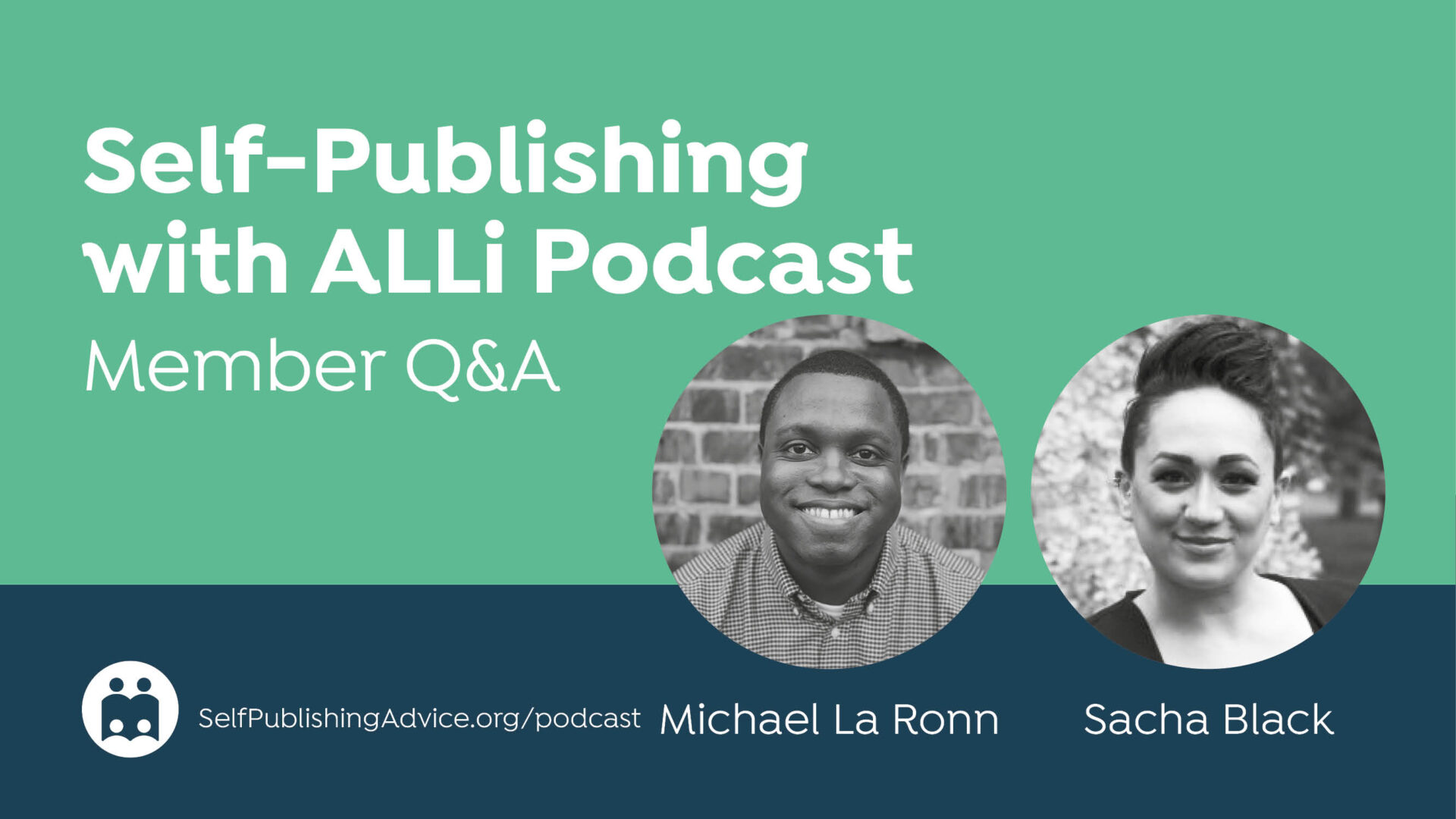
In this episode of the Self-Publishing with ALLi Member Q&A podcast, hosts Michael La Ronn and Sacha Black discuss how to evaluate the legitimacy of marketing companies approaching authors, particularly those claiming to feature books in book clubs for a fee.
Other questions include:
- Can Amazon print author copies in Australia for local book tours, or must they be shipped from the US
- How can authors get their print-on-demand books into independent bookshops when distributors list them as “firm purchase”
- Where can authors find reliable ratings for contests and awards to determine which are reputable
- What should authors consider when planning their year, including setting achievable goals and maintaining flexibility
- How can authors balance business growth with personal health and sustainable creative output
And more!
Listen to the Podcast: How to Spot Scam Book Marketing Services
Have a Question?
If you're a member of ALLi and have a question for the Member Q&A Podcast, you can sign in and ask here!
About the Hosts
Michael La Ronn is ALLi’s Outreach Manager. He is the author of over 80 science fiction & fantasy books and self-help books for writers. He writes from the great plains of Iowa and has managed to write while raising a family, working a full-time job, and even attending law school classes in the evenings (now graduated!). You can find his fiction at www.michaellaronn.com and his videos and books for writers at www.authorlevelup.com.
Sacha Black is a bestselling and competition winning author, rebel podcaster, speaker and casual rule breaker. She writes fiction under a secret pen name and other books about the art of writing. She lives in England, with her wife and genius, giant of a son. You can find her on her website, her podcast, and on Instagram.
Thoughts or further questions on this post or any self-publishing issue?
If you’re an ALLi member, head over to the SelfPubConnect forum for support from our experienced community of indie authors, advisors, and team. Simply create an account (if you haven’t already) to request to join the forum and get going.
Non-members looking for more information can search our extensive archive of blog posts and podcast episodes packed with tips and advice at ALLi's Self-Publishing Advice Center.
And if you haven’t already, we invite you to join our organization and become a self-publishing ally.
Read the Transcript
Michael La Ronn: Hello and welcome to Self-Publishing with ALLi. This is the Member Q&A Podcast, where we answer your most burning self-publishing questions — from coming up with the idea for your novel all the way through to marketing and money and all that fun stuff. My name is Michael La Ronn and I'm joined by Sacha Black. What's up, Sacha?
Sacha Black: Hello! How are you?
Michael La Ronn: I am fantastic. What's new in your world?
Sacha Black: For viewers, I am in my warehouse today, which is absolutely freezing, which is why I'm wearing a coat. I've been packing, I've been planning — just living the dream, basically. How about you?
Michael La Ronn: I am also living the dream. I'm doing some end of year planning, been doing a lot of reading, trying to get back into the swing of writing, and figuring out what my writing goals are for 2026. It's been a fun process.
Sacha Black: Hopefully we can talk a little bit about that.
Michael La Ronn: Yes — that is actually our theme for this month. We're recording this episode a little between episodes, so we're going to catch up on a lot of the questions that have come in so far, and then we thought it would be a good idea, since we're early in the year, to talk about new year planning. It's never too late to plan — in a way we're being rebels, because everybody plans their new year in January and we're doing it a little later. It's never too early and never too late. So let's start with some questions and then jump into our new year discussion after that.
Question 1: Where Does ALLi Publish Award Ratings?
Michael La Ronn: The first question is from Lois, who asks: is there a place where ALLi publishes award ratings — for different contests, whether they're reputable or not?
Sacha Black: Yes, we have our ratings page and it is updated semi-regularly, so it's always good to go and check. There are some awards that are rated higher than others — they're all checked and validated inside ALLi.
Michael La Ronn: Just go to selfpublishingadvice.org and in the navigation click on Awards — that'll take you to the database.
Question 2: How Do You Spot a Scam Book Club Approach?
Michael La Ronn: Our next question is from Becca, who asked about a specific service provider — we can't comment on individual companies, but let's turn it into something more general. Let's say you're approached by a book club company. They want to feature your book, they claim global distribution, they'll talk about your book every day for six weeks — and all they need is $700. How do you determine if it's legitimate?
Sacha Black: The first thing you said was that a company approached you — and I was like, no, I'm out. It's very unusual for a legitimate company to approach you out of the blue like that. My hackles would immediately be up.
In 2025 there were a lot of spam approaches where people were setting up Gmail accounts, claiming to be book clubs, and asking for $200 or $700. The book club pitch is just very, very unlikely to be genuine. Most book clubs do their own internal sourcing — they just pick a book and everybody goes and buys it. Unless you're being approached by a book box company, in which case you can go and check their website, look for evidence on social media that the company exists, and try reaching out to a different address on the website to verify. But honestly, I would take any approach like this with skepticism. I get one of these multiple times a week and I just ignore it.
Michael La Ronn: Yeah. It's become the method of the day. It feels like the Nigerian prince emails evolved — back in the nineties you'd get those emails from a prince in some foreign country saying they needed money. That kind of went away and now it's come back, except now the Nigerian prince is using AI. These emails are very clearly written by ChatGPT. Like you, Sacha, I get three to five a week, and the interesting thing that wasn't true twenty years ago is that they're extremely well written — so well written that it almost feels like they've actually read your book. I've had them refer to specific scenes.
Usually there are two giveaways. First: your name in brackets. Any time you see your name in brackets in an email, get out of there — that's a mass spam thing. Second: it comes from a Gmail address. I'm not saying using Gmail is automatically a red flag, but a company trying to appear reputable is not going to approach you from a Gmail account. And often there's no website — they'll say this is the XYZ Book Club, we're super famous, but if there's no link to a website, that's a red flag. If you're as good as you say you are, why don't you have a website?
Follow your gut. If it feels too good to be true, it probably is. And it boils down to what you said at the very beginning, Sacha: if they're a really good company, they shouldn't have to approach you. That's generally not how business is done in our space — unless it goes through an agent, which is a different situation entirely.
Sacha Black: Right — and if a company does approach you because your book is already knocking it out of the park, that's a completely different kind of approach. You're being approached because you're already successful. If it's your first book and you don't have a track record yet, that's when you have to be careful.
Question 3: Will Amazon Print Author Copies in Australia?
Michael La Ronn: Next question is from Trevor, who is planning a book tour to Australia and asks: does Amazon print author copies in Australia so that they don't have to be shipped from the US?
Sacha Black: I think they do have printers there.
Michael La Ronn: I'm fairly sure they do. As long as you have an Australian address to ship to. Ingram definitely does. I would go into KDP Print, open one of your books, and just click around ordering author copies to see what the options are — I'm pretty sure Australia is one of them. Best of luck to you Trevor. Fingers crossed you'll be able to save some money and logistical hassle.
Question 4: Best Program for Formatting a Research Bibliography?
Michael La Ronn: Next question is from Laura, who asks: what is the best program for formatting a research bibliography?
Sacha Black: That's a question and a half.
Michael La Ronn: It is, and honestly, we have to admit when we don't know. I know there are apps designed for academics and have come across a few through my YouTube tutorials, but I don't remember them off the top of my head. Sorry, Laura — we can't fully answer that one, but it's worth searching specifically for academic bibliography software.
Question 5: Getting into Independent Bookshops
Michael La Ronn: Next question is from Julia, who writes: I'm struggling to get my novel into independent bookshops. My local bookshop was very unfriendly and said they don't stock Gardners books listed as firm purchase. I contacted Gardners and asked why, since I show a 45% wholesale discount. They've replied that any print-on-demand book is listed as firm. Is there any way around this? My indie bookshop won't stock it, and others show it as five weeks out.
Sacha Black: So my experience is that indie bookstores order through Ingram, and Gardners sources from Ingram. I wonder if Julia is still in the earlier stages of her sales journey, because when I was earlier in mine and people were trying to get my books into bookstores, they experienced some of this — and as the sales and request volume increased, those issues shrank. I don't hear many problems now.
Michael La Ronn: Yeah, and I'd also say — the bookshop being very unfriendly: do you really want them to carry your book anyway? It sounds like they're coming up with reasons. You've done everything right — you're in wide distribution, you have the proper discount, you have returns enabled. Maybe this is just a case where if you went to a different indie bookshop they wouldn't give you any trouble.
I would also recommend checking out our guidebook on this topic. It's called Your Book in Libraries Worldwide and it's available free for ALLi members on your dashboard at allianceindependentauthors.org — just log in and go to the guidebooks section. It's also available to non-members at selfpublishingstore.com, with proceeds benefiting ALLi. That should have some additional tips about bookstore distribution and how to work within their ecosystem.
Sacha Black: I basically try to ignore it unless bookstores contact me. But what I am finding is that my books are appearing in Waterstones more and more — usually because they've ordered through Ingram via Gardners. I think it's one of those things that actually tends to happen naturally.
Michael La Ronn: Yeah — make your book available and if they want to purchase it, they can. You can't force it, but there will be a certain number of bookshops you can approach who will work with you.
New Year Planning: Sacha's Approach
Michael La Ronn: Let's transition into our topic. We were chatting after our last episode and thought new year planning would be a great thing to talk about on the show. Can you talk about your approach to planning a new year?
Sacha Black: Shameful chaos is what I would actually say. I'm finding it quite difficult to do planning at the moment. That said, one of the things I've gone back to is using a Clever Fox planner. This one is a thirteen-week planner — I get a lot of energy pennies from starting and finishing things as a cycle, and these planners are focused on just one quarter. They get you to focus on maybe one project a month. Each day has space for your wins, what your priorities are, activities for your spirituality, relationships, fun and recreation, family, health and fitness, personal development. It also has space for affirmations and gratitude. And it does weekly reflections — did you get your stuff done? If not, why not, and what could you do better next week?
I've used six or seven of these over the years, coming back to them and then finding something else and then coming back again. I like using a planner to provide structure because I don't have the skillset to create structure myself. I'm actually very good at using a structure that's given to me, but not at creating one from scratch.
The other main thing I do is shy away a little from setting financial goals, because I really like to hit goals, so I try to be conservative. I use the good, better, best system. For any tangible goal, I'll set a baseline — good — then an increment up — better — then another increment up — best. And then a golden egg goal, which is the real stretch target that feels almost unachievable. Sometimes I hit it. What I love about this is that if I hit the bottom one, I win. By having those staggered goals, I get to win multiple times on the journey to achieving a single goal.
I do this for monetary goals, word count goals, engagement goals for social media — anything that's numerical. For goals that aren't numerical — like some of the calisthenics things I want to achieve, like an L-sit to a handstand — I can't measure those numerically, so they stay as they are. But anything numerical gets the good, better, best treatment.
And then I have a custom-printed whiteboard — an undated annual calendar. I'm very visual, so I like being able to see multiple colors: each book has a different color, with the main stages — outlining, drafting, editing, launch — marked on there alongside school holidays and family holidays. The physical planner handles the day-to-day, and the whiteboard gives me the big picture of dates. Because it's a whiteboard, if plans change I just wipe it off and redo it. I don't care if things change because the planner hasn't been wrecked.
Broadly speaking, I'm usually doing a trilogy per year, so what I write is already preset. The big thing I'm planning is when I write, not what I write. I tend to know years in advance what's coming, and that tweaks if the market shifts. But I write what I love and want to write — the market might shift the tropes, but the story is already chosen.
The Clever Fox Planner: Pros and Cons
Michael La Ronn: I might be in the market for a planner myself. With the Clever Fox, what would you say is the biggest pro and the biggest con?
Sacha Black: The biggest pro of the brand is that they have a ton of different types — a Planner Pro that covers the whole year, monthly versions, and so on. For me, I really like the fact that it's only thirteen weeks. It means I stay really focused. I love that I get to change planners four times a year — I don't like sticking to the same one for a whole year. And the structure of each day is one I really like and haven't found in any other planner.
As for a weakness — honestly, I'm not sure it has one for me. Because it's undated, you can skip days and start it whenever you want. You could start it on the seventh of February and that becomes your day one.
Michael La Ronn: That's nice. With daily planners there's always a poison pill if you miss a few days, and with weekly ones you lose the daily capture. Finding the right balance is tricky.
Sacha Black: Exactly. And I also keep a separate reading tracker — I have a little printer called a Sprocket that prints on sticky paper, so I print each book cover and stick it in. I also track the formats I read in. So far I know I've read 103 or 104 books, with 49 being audiobooks, only six paperbacks, and the rest all Kindle. But I also put stickers in — because I'm a child and stickers give me energy pennies. I trash these planners too. You know how some people buy a notebook and are afraid to use it? That's not me. I'll stick a giant sticker on the front and be like, well, it's ruined now — might as well be messy.
Michael's Approach: One Goal, Planned in October
Michael La Ronn: I used to be a lot more structured in how I approached year planning. I had a friend who always did her end-of-year planning in October, and when I asked why, she said it gave her enough time to come up with a plan before the holidays. That way, once the holidays hit she already had a plan in place, and when January arrived she was already ahead. Most people wait until that last week of December to figure things out and find themselves at a disadvantage when the year starts.
So I do all my planning in October. I sit down and figure out what I want to focus on for the coming year — financial goals, using a good, better, best system — and what I don't want to do. I dedicate an entire weekend to it, then kind of let it sit. I come back to it after Thanksgiving, make some tweaks, and by December I'm already starting to act on it. Getting a jump on your goals and building that early momentum is the big thing.
In the past I used to set twenty goals for a year — writing goals, finance goals, business goals, conferences I wanted to attend — to the point where it was absolutely insane. And I would hit most of them because I'm very motivated. But the problem was that so many goals scattered my focus. Over the years I've learned to minimize. I went from twenty to fifteen, then ten, and now I'm really down to one or two goals for the year.
Sacha Black: I have one.
Michael La Ronn: That's it. Just one or two. And the reason is that saying: it's easy to underestimate what you can do in a decade and overestimate what you can do in a year. There's a lot more that happens in ten years than you can plan for, but in a single year things can change very quickly. So I've learned to be flexible.
For reading, for example — I have the attention span of a squirrel. I think I read about a hundred books in 2025, mostly audio. But I don't plan what I'm going to read. I'll see something on YouTube and want that book immediately. I know the majority will be fiction with some nonfiction. And honestly I don't even set a reading goal anymore, because reading is such a habit for me that I know I'll be doing it anyway. Why set a goal for something you're going to do regardless? I can put that mental energy into a goal I actually need to work on, like writing.
My goals have to be quantifiable, within my control, and big enough to take the majority of the year to accomplish. I don't like setting goals I can knock off in January. I'm thinking bigger picture. I manage them in Microsoft To Do — just to-do software. I've tried about a dozen different to-do apps and it doesn't really matter which one you use; you just have to find the one that's right for you. I put my yearly goals in there with a deadline of December 31st, and they sit next to my daily tasks so they're always in front of me. And if goals change midyear, that's okay. I've learned to be kind to myself and not worry too much about blowing things up.
Sacha Black: So what's your one goal for next year?
Michael La Ronn: In 2025 I spent time just existing. I'd been running and running for ten years, never took a real vacation, just did too much. So 2025 was the year where I focused on doing very little. My book output was pretty small. I really focused on my health — I've lost about forty pounds.
Sacha Black: That's amazing — congratulations.
Michael La Ronn: Thank you. Diet, health, just all the things I'd neglected because I was doing too much. So for 2026 it's about getting back to a place of harmony — continuing the things from 2025 that made me healthier and happier, but also working writing back in and finding harmony between my full-time job, my writing, and my own health. That's my goal.
Sacha Black: I love that. Mine is to get ahead of the publishing schedule. I basically need to give my team more time in the production timelines, and the only way to do that is by focusing on getting the words done — not doing things like spending time in a warehouse.
Michael La Ronn: The irony. And you know, nobody's going to hold you to your goals either. Here we are at the beginning of the year talking about them — a year from now we'll look back at this recording and think, oh, that was so cute. For me it's always a moving target.
Sacha Black: Oh, totally. I'm probably going to have to move warehouse and move house next year — both of those are going to throw a real spanner in the works. But all I can do is my best and keep trying.
Michael La Ronn: Exactly. I had a surgery last year that I wasn't planning on that completely wrecked several months. Life happens. People who are good at goal-making and hitting their goals are good at flexibility. It's easy when you've made your goals to cling to them — ‘I have to do this, I have to do that.' But you don't really have to do anything. Stay flexible, stay open, and good things will happen.
Closing
Michael La Ronn: Alright, I think that's a good place to end it for this month. Remember, you can submit your questions at allianceindependentauthors.org. If you're a member, we would love to answer your question on the show. This has been Self-Publishing with ALLi, the Member Q&A Podcast. We will see you next month.
Sacha Black: Bye-bye.