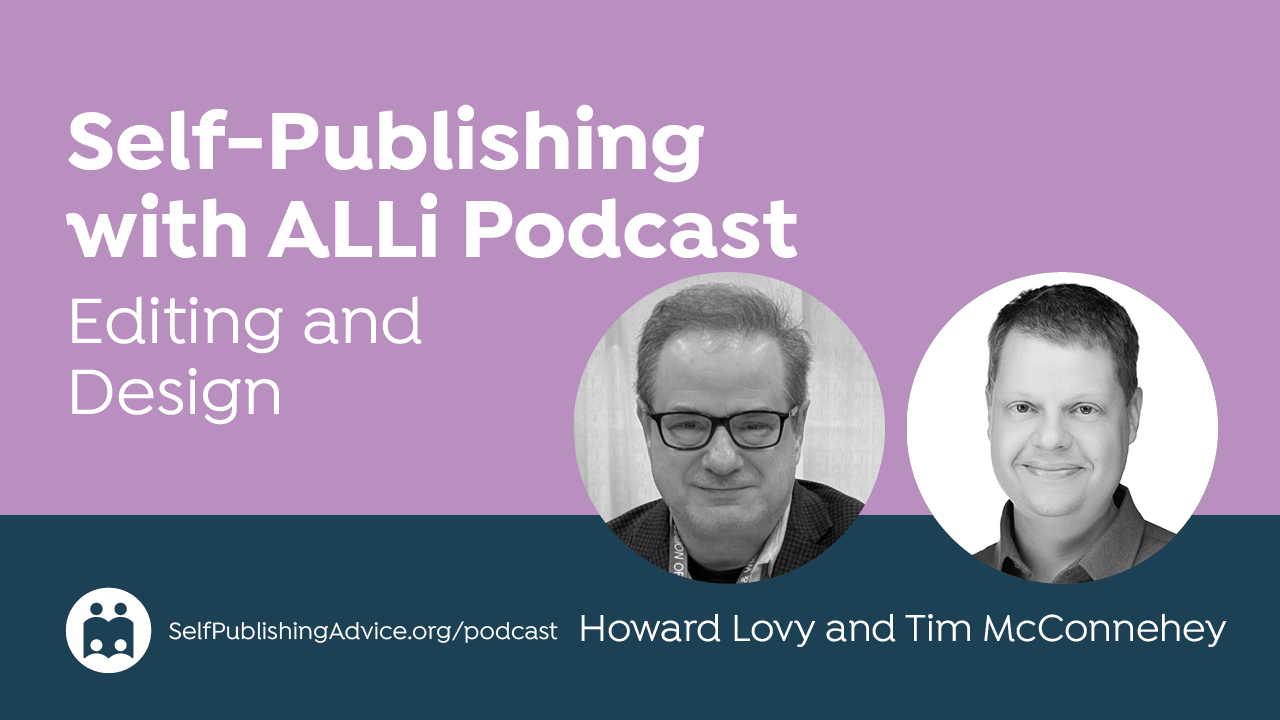
On the Self-Publishing with ALLi podcast, host Howard Lovy talks to Tim McConnehey, founder and CEO of Izzard Ink Publishing, about why a manuscript assessment can be a crucial first step before a full developmental edit. They discuss how clear, practical evaluations help authors focus their revisions, save time, and make smarter decisions about editing and publishing. The conversation also looks at how early feedback on structure, voice, and market fit can strengthen a book’s long-term prospects.
Listen to the Podcast: Why a Manuscript Assessment Can Save Authors Time and Money
About the Host
Howard Lovy is an author, developmental editor, and writing coach with a long career in journalism and publishing. He works with writers at many stages of their careers, with a focus on helping them develop their ideas and strengthen their work while preserving their unique voices. He lives in Northern Michigan.
About the Guest
Tim McConnehey is the founder of Izzard Ink Publishing and a Harvard Business School alumnus. He has contributed to U.S. discussions on AI and small-business policy and has been featured in The Wall Street Journal, Forbes, Fox News, and The Star. At Izzard Ink, he helps independent authors publish at a professional level, from manuscript assessment through editorial, design, production, and full launch and post-launch support.
Thoughts or further questions on this post or any self-publishing issue?
 If you’re an ALLi member, head over to the SelfPubConnect forum for support from our experienced community of indie authors, advisors, and team. Simply create an account (if you haven’t already) to request to join the forum and get going.
Non-members looking for more information can search our extensive archive of blog posts and podcast episodes packed with tips and advice at ALLi's Self-Publishing Advice Center. And if you haven’t already, we invite you to join our organization and become a self-publishing ally.
Read the Transcript
Howard Lovy: Hi, I'm Howard Lovy and this is the editing and design stream of the Self-Publishing with ALLi podcast. I'm taking over hosting duties for this stream from Maddie Dalrymple, who's done a terrific job shaping these conversations, and I'm glad to be stepping in.
A bit about me: I'm an author, a developmental editor, and a writing coach. I work with authors at different stages of their careers, often helping them sort out an early and sometimes confusing question: what kind of editorial help do I actually need right now? One issue that comes up again and again is whether a manuscript calls for a full developmental edit, or whether an assessment or evaluation makes more sense as a first step. That's what I want to explore today.
My guest is Tim McConnehey, founder and CEO of Izzard Ink Publishing. Tim works with authors on a range of publishing services, including manuscript evaluations, and he's thought a lot about how assessments can help authors make clearer, more practical decisions before moving forward with editing and design. Hi Tim, thanks for joining me.
Tim McConnehey: Thank you so much for having me. I appreciate it.
Background: How Izzard Ink Began
Howard Lovy: Before we go into the topic, can you talk a little bit about your background and how you came to Izzard Ink?
Tim McConnehey: We've been in business for over a decade. I just happened to know an author — this was way back when ebooks were taking off. We converted everything to ebooks, things started to sell, and then I thought: there's got to be a better way for publishing. It started looking like there were cracks in the structure of how traditional publishing worked, and that's where things started. We just worked at it and worked at it, and here we are today running Izzard Ink, which is a company I really love.
Howard Lovy: What kind of services do you offer?
Tim McConnehey: Izzard means Z, so we offer everything an author needs from beginning to end — we encompass the full process. We have a strong creative structure, and then we build the team around that, drawing on people with specific genre experience. Number one bestsellers in fiction or nonfiction — we build the team around the project.
Starting with a Manuscript Assessment
Howard Lovy: When an author first comes to you and says, here, I've been working on this for ten years — or a month, or however long — how do you help them figure out what services they need?
Tim McConnehey: We like to start by thinking: how would an acquisition editor handle this? So we ask them to come in and we look at where the manuscript is — what are the strengths, where are the weaknesses, what areas do they want help with? Is it landing? Is it connecting with the reader? We usually start with the manuscript assessment stage, and that dovetails into our action plan, which gives a clear path on how to move forward.
We try to do this before someone gets in too deep and realizes, maybe I don't want to spend thousands of dollars on publishing yet, because I'm not sure where my content is. We want to make sure the content is great first — that's where we start.
Howard Lovy: So a manuscript assessment is necessarily a first step before a full developmental edit? Or do you decide based on the quality of the manuscript?
Tim McConnehey: What we've found by doing a manuscript assessment is that it helps get into the author's head a little bit: where does this go in the marketplace? How does this work? Over 90% of our authors actually revise the manuscript before working with a developmental editor. And our assessments are a little different from others we've seen — we don't just point out the problems, we point out how to fix them and what needs to be done. We've found that authors use this as a chance to revise before enlisting an editor's help, which means they get the most out of hiring that editor.
Howard Lovy: And is that a separate service you charge for?
Tim McConnehey: Yes, that is a separate service.
Howard Lovy: I approach it a little differently. A lot of beginning authors are eager to jump straight into a developmental edit, but they're not always ready for that kind of work yet. What they often need first is a clear, big-picture assessment to understand where the manuscript stands and how to focus their efforts. At the same time, I've also seen more experienced authors choose an evaluation because they just want a fresh set of eyes and practical recommendations without committing to a full deep edit. I handle both ends of that spectrum.
Tim McConnehey: I think you're dead on there. That's exactly where I was thinking about what value I could add.
Howard Lovy: Do you find that even experienced authors — people who've written half a dozen books — still get a lot out of a manuscript assessment?
Tim McConnehey: Yes, we really do. Over the last four or five years, since we changed our business model and really pushed doing the assessment first and building a strategic plan around it, 83% of our authors land in the top ten to fifteen percent of literary reviews. We just had a first-time author come through — we did the assessment, matched him with an editor who has worked on number one bestsellers — and today I got word that Kirkus is going to feature his book in the March 15th issue. That's a very consistent story. I think the under-told message in publishing is that authors should look at the assessment more like a strategic plan: what are my goals, and how do I assemble a team to get there?
What an Assessment Actually Involves
Howard Lovy: Sometimes the editor needs the viewpoint that an acquisition editor would bring — the guardrails that are set. Would a manuscript assessment help with your editorial process? What are your thoughts on that?
Howard Lovy: I think it would help, personally. I recently published a novel and got wonderful assessments from people I trust in the business, including Orna Ross at ALLi. They gave me clear feedback — this works, this doesn't, what about this character — and it gave me clear marching orders. That's what I try to do in my assessments too. I look at big-picture issues and then move through the manuscript chapter by chapter with critique and recommendations. Before I do any of that, I also interview the author to understand their voice and what they're hoping to accomplish. What message are they trying to get across, and in what voice? Can you tell me about the nuts and bolts of what your assessment involves?
Tim McConnehey: We have an assessor who's been in the industry twenty or thirty years, working at high levels. Their passion is storytelling, and they love making a difference with individual authors. It's a tough love phase — we really try to showcase what works, but we want to help authors understand where it doesn't work before they go through the process of seeking publication.
I have a business background — I'm a Harvard Business School alumnus and have done quite a bit in strategy — and I try to bring that into the action plan. We've found that's where it's a little different. We have an assessment, and then the question is: so what? What do I do now? And that's where the action plan comes in. Here are the areas you can rewrite before hiring an editor. Here's where your mission or vision isn't coming across. We even have the cover designers review these materials so they understand where the book is going. And it all becomes key in the marketing campaign.
It really sets the foundation for serious authors who want to put in the work to have genuinely great content.
Howard Lovy: And because you have a business background, you're also looking beyond the content — at the audience and how the book is going to sell. Is that part of the assessment?
Tim McConnehey: Absolutely. The marketplace is very competitive, and we want to find where the differentiation is. If we find the gap in the market and identify the top ten books this competes against, we can make sure the team knows exactly where it fits. We can't just copy what's already out there.
Tough Love and the Value of Clarity
Howard Lovy: I'm glad to hear you say ‘tough love,' because that's one of my mantras too — I'm never mean, but always honest in my feedback. I recently had a client who wrote a memoir that was more like an autobiography: I was born here, and right up to their current life, half of which nobody really cared about. The memoir part was what people cared about. So I gave them a roadmap for how to turn an autobiography — and unless you're a major celebrity, nobody is going to read your autobiography except your family — into a memoir that more people would find compelling. Within days of getting the assessment, the author said he'd cut thousands of words and merged chapters. He told me he did more work in four days than he had in the previous six months, because he finally knew what to work on and in what order.
For me, that's the value of an assessment. It's not just a critique. It gives authors clarity, confidence, and momentum, and it helps them make smarter decisions about what kind of help they'll need next.
Tim McConnehey: You just hit the real big reason to get a manuscript assessment first — it's the time saved. That's the repeatable scenario it offers. Not everyone has access to someone like Orna Ross who will sit down and give that kind of feedback. The quality of the person giving the assessment really matters. I see this as such an important step for authors to take before hiring an editor — even experienced authors. It's a much more cost-effective way to revise and refocus. I can't tell you how many times the vision has changed or the messaging has changed, and we're able to say: change this section, this section, and this section, and you've got your goal. It saves so much time.
What the Assessment Document Looks Like
Tim McConnehey: On our website, izzardink.com, there are manuscript assessment examples — typically running fourteen to sixteen pages. It's more than just ‘does this need a developmental edit.' We cover what's working well, what the purpose and impact of the book is, why this book and why now, whether readers are likely to be engaged, and what the narrative voice and style are.
Then there's a section I really love: manuscript readiness and publishing potential, where we give it a score out of one hundred on genre demand, note whether it needs a developmental edit and why, cover the current proofreading needs, and assess the current state for publishing. And then we forecast: if you put an elite editor on the project and make the changes outlined, where do we realistically expect it to end up? After that we list the primary issues, the top priorities for revision, and then the specific things to revise. It closes with a final assessment overview — next steps, let's get going.
Howard Lovy: Is there a significant difference between assessing fiction and nonfiction?
Tim McConnehey: Yes, and actually we run our assessments by genre — not just fiction versus nonfiction, but by specific category. If we're assessing a young adult historical fiction novel, we look at what's working in that particular genre: character development, pacing, things like that. With nonfiction it's more about fact-checking and making sure claims are supported. But at the end of the day, everything is really genre-based.
Howard Lovy: What about balancing content versus writing quality? Do you assess them equally?
Tim McConnehey: Yes, we assess both equally. And they both have to work together.
Author Pushback and What Makes Authors Succeed
Howard Lovy: Have you ever faced a situation where the author completely disagreed with the assessment and said, you don't get me?
Tim McConnehey: Sometimes it's been an issue, though never a complete breakdown. The real pushback we've seen has been when our assessors mixed up a character or a detail — that's a human error and it's gotten much better over the last few years. But we also look for soft skills in the authors we bring in. It's less about raw writing ability and more about willingness to take direction, build a team, and bring the humility that I think it takes to see a book through. Those are the authors who almost every single time land in the top literary reviews. And the team works harder for them too.
Howard Lovy: Those are the authors you want to work with.
Tim McConnehey: They are, and for some reason they just get you to work harder for them.
What Happens After the Assessment
Howard Lovy: What about the next step? I've had clients who after getting an assessment say, great, I'm going to disappear for three months, rewrite it, and give it back to you. And others who say, that sounds great, but I don't want to do it alone — can you help me? Is there room for both kinds of authors?
Tim McConnehey: Exactly. For those who don't want to revise independently, we go right into editing. We put together a proposal listing three editors, explaining why we like each one, customized for the project — what they can bring to the table, other projects they've worked on, what authors have said about them. Sometimes we'll even note why a particular editor might not be a good fit — maybe they're three to six months out and the author doesn't want to wait that long. So we really try to customize the proposal and present their options clearly. Then we sit down together, have Zoom calls, and make sure there are milestones and goals along the way.
Howard Lovy: It's a matchmaking service, really. Finding the right editor for the right author is awfully important.
Tim McConnehey: Exactly. It's a matchmaking service — who's going to pull through with the deadlines, who's going to be there when you have questions. Some authors like face-to-face; others would love to just do it all in tracked changes in Word. Figuring those styles out is something we try to do as we go.
Howard Lovy: I do a combination of both. Just today I was editing something for a client and started writing a really long memo inside Word, and then thought, no — let's have a Zoom call about this, rather than writing an essay about everything the chapter needs.
Tim McConnehey: Exactly. It's just meeting the author where they're at in a way that you can make a difference. We believe everyone now has the ability to create a really well-written story. There are so many tools out there to help writers, and I think the quality of self-published work is going to increase significantly over the next few years. We're already seeing it.
Full-Service Publishing and Distribution
Howard Lovy: Where are you in the ecosystem? Do you do everything, including publishing, or do you get the manuscript ready for authors to self-publish?
Tim McConnehey: We do everything, including the publishing itself. We have two different distribution methods: a hands-on model where the author can take it and run it themselves, and a full-service model where we run it with them for a small fee. With full service, the author gets one tax form at the end of the year instead of a stack of statements, and we handle automated royalties. We also connect authors with some of the best marketing people and teams — we had a nonfiction author come through and matched them with the same person who has done New York Times number one bestsellers.
So we create great content, and then when Kirkus or Publishers Weekly gives a great review, it's time to show that it's worth putting money into marketing. We build the platform accordingly — depending on whether the author is doing one book or two or three, that changes how we approach it. But none of that's possible without a clear plan moving forward. That's where the assessment and action plan really set authors up for long-term success.
When Is an Author Ready for an Assessment?
Howard Lovy: What's your advice for authors who have a manuscript or a draft and aren't sure if they should send it to you for an assessment yet? How do they know if they're ready?
Tim McConnehey: If they're asking that question, I think they're ready. If they want somebody who truly cares and wants to help them — and it's not just another rejection pile — they're ready. Everything about us is about solutions. Here are the problems, here's how we get there. We really try to take a top front-list approach to every book we work on.
Howard Lovy: I've taken things written on napkins in prison to people already on their fifth draft, and everything in between.
Tim McConnehey: If you're asking that question, and you've hit a roadblock and you don't know where to go, that's the perfect time to get an assessment.
Howard Lovy: Well, Tim, thank you so much for the conversation. I appreciate how clearly you talked about the role of manuscript assessments and evaluations, and how they can help authors make smarter decisions, especially early on. Thank you for appearing on Self-Publishing with ALLi.
Tim McConnehey: Thank you so much, Howard. Really appreciate it.
Howard Lovy: Thank you, Tim. Bye.