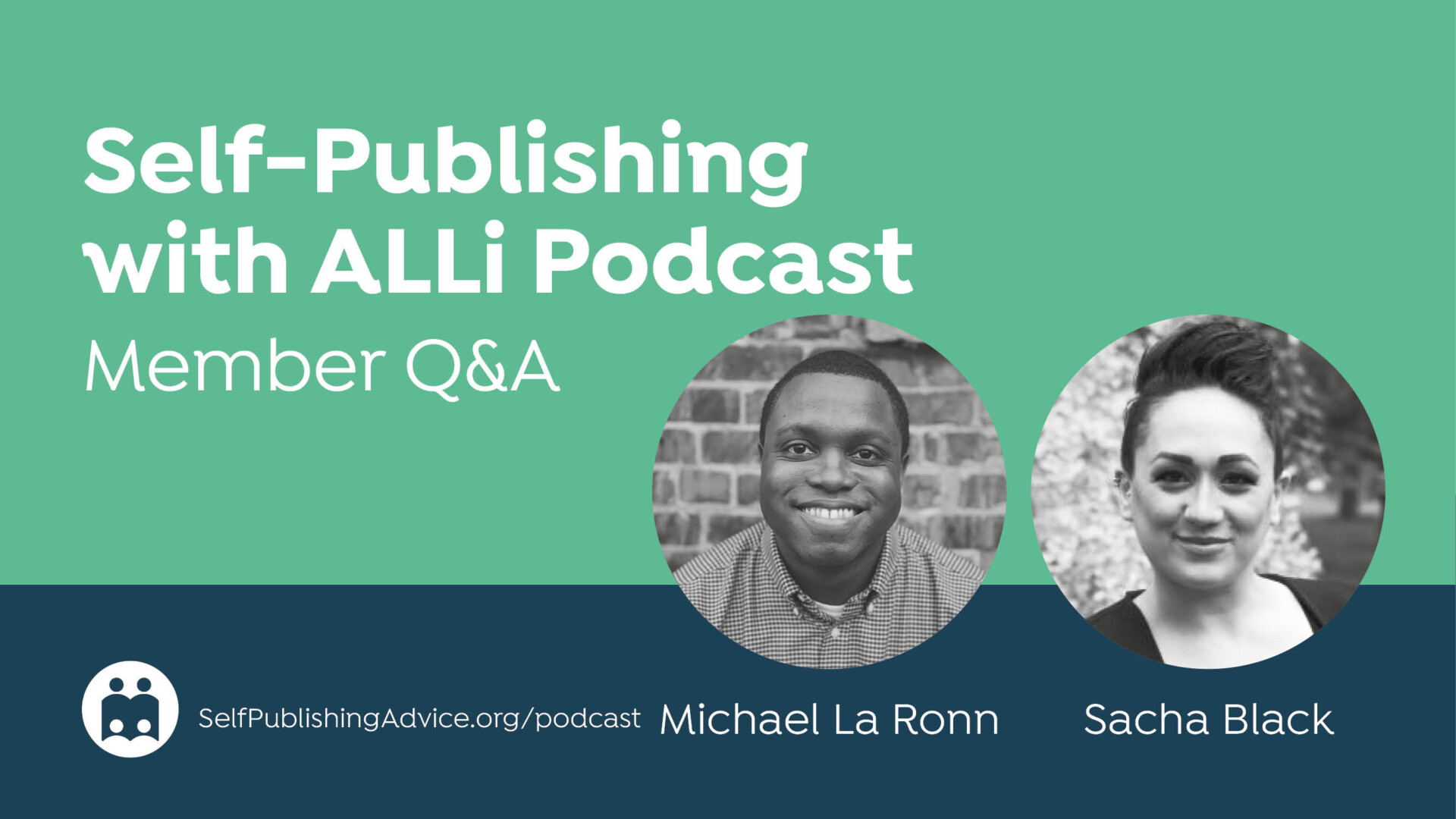
In this episode of the Self-Publishing with ALLi Member Q&A podcast, hosts Michael La Ronn and Sacha Black discuss whether authors of memoir and creative nonfiction should invest in a legal review before publication.
Other questions include:
- Should you agree to a publishing services contract that assigns your ISBN to the company?
- When is the right stage to add references in a nonfiction manuscript?
- Are Goodreads giveaways worth the cost compared to other marketing options?
- What is the simplest way to build a functional author website with email capture and reader magnets?
- Should you revise and republish a bestselling book with low reviews or focus on new work?
- What should you do if you are about to miss an Amazon pre-order deadline?
And more!
Listen to the Podcast: Legal Reviews, ISBN Ownership, and Pre-Order Pitfalls
Have a Question?
If you're a member of ALLi and have a question for the Member Q&A Podcast, you can sign in and ask here!
About the Hosts
Michael La Ronn is ALLi’s Outreach Manager. He is the author of over 80 science fiction & fantasy books and self-help books for writers. He writes from the great plains of Iowa and has managed to write while raising a family, working a full-time job, and even attending law school classes in the evenings (now graduated!). You can find his fiction at www.michaellaronn.com and his videos and books for writers at www.authorlevelup.com.
Sacha Black is a bestselling and competition winning author, rebel podcaster, speaker and casual rule breaker. She writes fiction under a secret pen name and other books about the art of writing. She lives in England, with her wife and genius, giant of a son. You can find her on her website, her podcast, and on Instagram.
Thoughts or further questions on this post or any self-publishing issue?
If you’re an ALLi member, head over to the SelfPubConnect forum for support from our experienced community of indie authors, advisors, and team. Simply create an account (if you haven’t already) to request to join the forum and get going.
Non-members looking for more information can search our extensive archive of blog posts and podcast episodes packed with tips and advice at ALLi's Self-Publishing Advice Center.
And if you haven’t already, we invite you to join our organization and become a self-publishing ally.
Read the Transcript
Michael La Ronn: Welcome everybody to the inaugural 2026 Live Self-Publishing Answers — or Self-Publishing with ALLi, the Member Q&A. We've changed the title of this show so many times. We thought it would be a great idea to do these quarterly, jump on, and answer everybody's questions live. If you have questions, please ask them in the chat. For those who are new to the show, my name is Michael La Ronn — I'm ALLi's Outreach Manager, I've been with ALLi since around 2012 or 2013. And I'm joined by Sacha Black. How are you, Sacha?
Sacha Black: I'm okay — I have a bit of a headache this evening, but I'm all right. I am at home, not on the road.
Michael La Ronn: Sorry to hear about the headache.
Sacha Black: Thank you. Behind me there are 40,000 tip-ins, and I've basically been in the same position signing over and over and over again, so that's why. But none of that is answering questions.
Michael La Ronn: We've got Alyssa Desire Brinker calling in from Michigan, and Dina Santorelli watching from New York. Let us know where you're watching from and please start asking your questions. In the meantime, Sacha, I want to mention something briefly. There are the usual buzzings around AI and everything that's going on. I want to reemphasize that ALLi is proponent of being AI-curious, though we have serious concerns around a lot of things happening. I'd encourage folks to check out our AI code of conduct and our stance on AI — around protecting yourself, being careful while being curious, and understanding the risks and where we should push back on industry actors. Just a public service announcement. Okay — let's jump into our first question.
Sacha Black: And let's remind everybody who's here to drop us questions. This session is for you, so please keep chucking them in the comments and we'll get to them.
ISBNs and Publishing Services Contracts
Michael La Ronn: Our first question comes from Catrina. She asks: should I agree to a contract with a publishing services company that gives my ISBN to that company? I've read that this is not a good idea as one loses control of the ISBN. What is your advice?
Sacha Black: No. Don't. Why would you give away an ISBN that you've paid for and own?
Michael La Ronn: I don't think you can actually transfer an ISBN. Once you register one, whoever registers it becomes the publisher of record. Maybe that works differently outside the US, but generally speaking once an ISBN is registered it's fixed. If you ever wanted to change your ISBN on a print book, you'd typically have to unpublish and republish. Ebooks are a bit different — on Amazon they don't really care about the ISBN for ebooks, it's mainly based on the ASIN. There is a nuance in Catrina's question I want to call out: she mentions it's a publishing services company, so it may be that she's contracting with someone to help her publish. In that situation, the publisher typically registers the ISBN — that's standard. They'll usually register the copyright in your name, but the ISBN is theirs. If there is any way to transfer an ISBN, we would not recommend it.
When to Add References in a Nonfiction Manuscript
Michael La Ronn: Next question is from James. He says: I'm writing my first book, a lengthy 400-page nonfiction book that's been through its first edit. My editor commented that he would have liked to see the references. I was reluctant to invest the time knowing that entire chapters might be eliminated or heavily revised. I preferred to wait until the draft was more settled. Is there a recommended process and timing for adding references?
Sacha Black: I would do it at the point of drafting, so you don't lose them and risk plagiarism. I personally think it's worth sitting with the editor on that, just for comfort in terms of legalities. Maybe I'm being too cautious. What do you think?
Michael La Ronn: I agree. It's just good editing hygiene to have all your references teed up so your editor can check them. Kudos to James for finding an editor who's willing to check references — some editors won't even do that. Give it to them now, because they might charge you more later, or may not be available to check them if you wait too long. More broadly, gather your references as you write. With nonfiction especially, it becomes very easy to forget where you found something the longer you go. If you can't remember where you got something, you can't cite it, and then you may have to materially change your text. That could degrade your argument. Use OneNote or Evernote or whatever you prefer to keep references organized as you go, so you don't have to chase them down later.
Were the Goodreads Giveaways Worth It?
Michael La Ronn: Next question is from John. He says: I spent around $1,000 on Goodreads giveaways — $200 on giving away 100 ebooks through KDP, and then $300 for special placement plus $500 to print and mail 48 paperback copies. Three months on, it's generated maybe two confirmed sales and three Goodreads reviews, one of which was negative. By comparison, with Meta ads I can generate a sale for $12 and would have produced at least 60 sales with that same $1,000. This seemed like a big waste of money. What do you think?
Sacha Black: I would agree. Sorry, that sounds brutal — but we have all made mistakes in our publishing careers. We've all tried a bit of this and a bit of that, and some things worked and some didn't. And the strange thing is that over time you go back and sometimes what didn't work does work, and what did work doesn't work anymore. So it's always good to try things. A thousand dollars does seem like a lot for a Goodreads giveaway though. In my mind, giveaways should cost as little as possible — sweat equity rather than cash. BookFunnel often has giveaways where you can pick up mailing list signups. StoryOrigin is another. Book Sprout possibly as well — though do check whether they're reputable. Facebook reader groups are another good option, though you have to check the rules for each group. When I started my Ruby pen name in 2023 I spent five or six hours digging through Facebook groups finding ones I could post in, and it worked. That's a lot cheaper than a thousand dollars.
Michael La Ronn: I agree. I'd consider that a cost of tuition. The learning for next time is: don't spend that much to determine whether something works. Once you're getting into four figures, you're taking high-risk, high-reward bets. How could you run that same experiment with 10% or 25% of that? Spend a couple hundred dollars, get your learnings faster, and iterate. When I started with Facebook ads, I set aside $350 and said: I am okay if that money goes up in flames, because I'm buying the education — learning the platform, the targeting, how to run ads. That's the cost of doing business. I burned through it in a few weeks, didn't lose all of it, learned what worked and what didn't, and adjusted from there.
Sacha Black: Although I'd add that this also depends on the market. In fantasy and romantasy right now, we're seeing that books don't really break out until a series is complete. The first book might do okay, but when the last book comes out, it can explode. If you commit to a four-book series, you may not know whether it's working until book four. A lot of successful authors are saying they don't see the real income on a series until it's complete.
Michael La Ronn: Which raises the question — how do you determine if you've got a winner as early as possible? Without committing all your time and money?
Sacha Black: It's really difficult. If it's not your first series, are your pre-orders on book two higher than they were on the previous series? Are the review averages better? Is it being shared on social media more? Did the launch hit the sales figures you wanted, even modestly? One thing I do is always set a pre-order date a year out and then announce the actual release date early — that's when pre-orders tend to spike. There are just so many variables. And it also depends on your model: I'm very wide and I might make £20,000 through my own website on a pre-order that only gets a thousand pre-orders on Amazon without breaking the top 10,000. Because I'm not in Kindle Unlimited. I'm bank over rank — I care about the income coming into the business, not the rank number.
Michael La Ronn: If you're just starting out, learning to write quickly and well is a skill that will serve you. If you're in a genre where you have to commit to five books and you don't know if they'll work, it would be easier if you could get those five books out as fast as possible. The sooner you can get them out and learn, the better. Fast is whatever that looks like for you — not unhealthy, just getting the information faster.
Creating a Professional Author Website
Michael La Ronn: Next question is from Michelle, who has a cluster of questions. First: I've been struggling with Squarespace to create my author website. I'm finding it counterintuitive and not fun. What is the easiest and fastest way to create a basic author website with an email newsletter and the ability to offer reader magnets?
Sacha Black: I use Shopify. I used to use WordPress but I've moved entirely to Shopify. It's a lot of drag and drop. I've also just moved from MailerLite to Klaviyo — Klaviyo is the best thing we've ever done, it's absolutely phenomenal. But that's more of an advanced tactics conversation. Shopify integrates with MailerLite, MailChimp, Kit (formerly ConvertKit), most mailing list platforms.
Michael La Ronn: Shopify is good. WordPress has a learning curve — if you can commit to it, you can build something simple and integrate anything. But it's not everybody's cup of tea. Ghost is another one some people have put together relatively quickly. Wix is another option. No matter which one you pick, it's still going to be a little painful. You're going to have to commit to watching some YouTube tutorials, grin and bear it, and get over the learning curve. Once you're over it, it does get easier.
Sacha Black: Or outsource it.
Michael La Ronn: Yes — or outsource it if you have the cash. One important warning about outsourcing websites: be careful with developers who will build something for you and then expect you to pay them indefinitely to maintain it. If you outsource, get the developer to agree upfront that this is a one-time thing. Then have them teach you how to use it when they're done. Authors have simple business models and simple websites — you really should not be paying someone to maintain and update it for you on a regular basis. Pay once to have it set up, learn it, and take it from there.
Getting a Legal Review Before Publishing
Michael La Ronn: Also from Michelle: I'm preparing to publish my first book, a creative nonfiction personal narrative. I'd like to have a lawyer review it before final editing and proofreading. Does ALLi have anyone who can help with that?
Michael La Ronn: Unfortunately, no. We don't have a network of lawyers we can recommend — we're a global organization, so it becomes a logistical challenge. Where I'd start is by looking for an entertainment lawyer or copyright attorney in your area. Entertainment law firms that have experience with this usually charge a flat fee to read the manuscript. It's usually expensive and takes time, so be prepared. Before you embark on this, make sure you genuinely need a legal review. Typically people want legal reviews on creative nonfiction, autobiography, or true crime when there is someone in the manuscript who could claim to be portrayed in a damaging light. Sometimes authors are more worried about this than they need to be, and sometimes they're not worried enough — I genuinely can't know without more context. A consultation is usually free: explain the situation, let the attorney ask questions, and see whether their ears perk up. If this is your first book and you're just starting out, four or five thousand dollars on a legal review is significant money that could go toward marketing, your website, or other parts of your business.
Editing and Proofreading Before or After Formatting?
Michael La Ronn: Also from Michelle: does final editing and proofreading usually take place after formatting into ebook and print formats?
Sacha Black: No — that's a nice easy one.
Michael La Ronn: Yes, easy. Editing and proofreading before formatting. If you do it the other way around, it's backwards.
Cover Design and Interior Formatting: Where to Start
Michael La Ronn: And the last question from Michelle: where should I start with figuring out how to create a professional cover and interior design for ebook and print?
Sacha Black: If you want to do it yourself, for formatting I'd recommend Vellum if you have a Mac, or Atticus if you have a PC. If you don't want to do it yourself, look in the ALLi member website under the discounts and deals section and the services directory — we have a lot of designers and formatters there. Or ask other authors. I'll often go onto Amazon and look in the copyright pages to see who other authors have used as designers.
Michael La Ronn: I agree with all of that. Formatting is not something you typically need to hire out anymore. Vellum and Atticus handle about 95% of formatting needs. The remaining few percent can be handled by Adobe InDesign if you choose to accept that mission — it's not hard, it just has a learning curve, and at a certain point you realize you've spent hours on something you could have paid someone to do better. Outside of a truly unusual edge case — I once had an omnibus that IngramSpark wouldn't accept, so I hired someone to fix it — I've formatted 105 books without ever needing a formatter. For cover design, start with self-published authors in your sub-genre who are selling well. Look at their copyright pages. You should be good to go.
Should You Publish a Second Edition?
Michael La Ronn: Next question from Alyssa, who's watching live. She says: one of my top sellers also has my lowest average reviews. I want to make a second edition, smoothing out the plot and removing a subplot. The general plot and characters will remain the same but it'll change significantly. Should I make an entirely new listing or update the existing one? She's also in KU.
Sacha Black: I want to answer the question with a question first. What is the review rating, how does it compare to your other books, and how many reviews do you have? Because that changes my answer.
Michael La Ronn: She says it's 3.2 on Amazon, 765 ratings and 632 written reviews. Her average across other books is closer to 3.8.
Sacha Black: And how many books have you published overall?
Michael La Ronn: Probably seven.
Sacha Black: You are right on the line for me where I would say: just keep going forward. Sometimes you get more bang for your buck by writing new books rather than going back. If you think the edits won't take long and won't derail your publishing schedule, I'd consider it. But I'm always one for letting my journey be visible — I haven't unpublished my young adult books, which sold very little, because I like the fact that people can go back and see the development. The irony is I now sell more of those YA books as Ruby than I ever did as Sacha, because once readers love your writing they want to witness that journey. And with seven books out, my mind keeps saying: keep writing, keep going forward. If those books are making you, say, a thousand pounds a month at a 3.2 rating, you'd have to sell a huge number of new copies and get a ton of new reviews just to move that average. I think I'm actually talking myself out of recommending it. Just write new stuff.
Michael La Ronn: I agree. There's something to be said for letting books stand as a monument to your talent at the time. And practically: Alyssa has 600 to 700 reviews on that book. That's significant social proof. Write more books, send readers to the older ones, and your average may creep up over time.
Sacha Black: What I would actually do is go through those reviews with a scalpel. Pick out every element that was rated highly. Maybe pay some readers in your genre to go through the book and identify the tropes or moments they loved most. Deconstruct what you did well. Was it the pacing, the dialogue, the characters, the character archetypes? Then take all of those elements and put them into a new book with a new storyline — but written with your current more developed skill level. That's what I would do rather than editing the original.
Michael La Ronn: Bonus points if you can do it in the same genre, so you can send people from the new book back to the old one. Really good advice.
Missing a Pre-Order Deadline on Amazon
Michael La Ronn: Next question from Julia. She says: I have a first in series on pre-order on Amazon and I'm not going to be able to hit the deadline. It's already been a full year so I can't extend it further. Do you know if Amazon might let you have another pre-order instead of banning you for a year?
Sacha Black: Technically, per their terms and conditions, they will ban you. However, if you have a justifiable reason — a medical situation, a personal loss, a serious difficulty in your life — and you email them and explain, they can sometimes extend by one to three months. How far away is the deadline? She says it's the end of April and she has 150 pre-orders. That's a meaningful number to lose. When do you think you can finish the book? Because Amazon typically only grants about a month's extension, and if you don't think you can hit it within that window, it gets trickier.
Michael La Ronn: Here's what I would do: put together a formal plan and email Amazon. Don't just say please help me — explain what happened and give them a specific date you can hit. Say: I'm sorry I won't make the original date, here is my concrete plan to deliver by this date, I'm working hard to make sure customers have a great experience. Can you work with me? A plan may make them more inclined to help. I don't know for certain it'll work, but that's what I'd try. Either way, contact them and let them know.
AI Tools on Subscription for Nonfiction Writers
Michael La Ronn: Next question, submitted online from Mohamed, who asks: which AI tools on a subscription basis are best for writers of nonfiction?
Sacha Black: I'm hearing a lot of good things about Claude at the moment, but I think this is something you have to experiment with. Try a month of each and see what you prefer. A lot of people flip-flop between tools — I don't think many stay on the same one forever. So it's hard for us to answer definitively; you have to run your own experiment.
Michael La Ronn: For nonfiction specifically, I'd say having a general-purpose large language model is probably your best investment. Whether that's Claude, ChatGPT, or Gemini — those are the big three. Start there, because they give you the most flexibility: acting as a sounding board, helping with research (with appropriate caution), data analysis, all the kinds of tasks that come up in nonfiction writing. I'd also mention that for writers of all types, an AI-assisted editing app can be useful. Edit GPT, for example, uses ChatGPT to recommend edits and delivers them as track changes — so you're still in the driver's seat deciding what to accept. And of course Grammarly and similar tools. On the question of privacy: most tools will do some form of training with your data. If that concerns you, there are local models you can download and run offline, but they tend to be more technical and most authors don't have the time or inclination for that.
Strategy for Second Editions: Kickstarter, Pre-Orders, and Delisting
Michael La Ronn: Last question, from Laurel. She asks: what's your strategy for second editions? How do you fit together Kickstarter, long pre-orders on Ingram and retailers, and unpublishing the first edition — or not?
Sacha Black: I like Kickstarter for second editions if you're doing something genuinely different — a special edition, for example. You get access to a different audience and can get pre-funded to produce something more special than the original. On long pre-orders: I like them for books that have never been published before, but for a second edition I'm not sure of the benefit. You'd block people from buying the first edition and just lose potential sales in the meantime. I'd either swap the editions over directly or perhaps do a couple of weeks of pre-order so you have some marketing runway to announce the change.
Michael La Ronn: As I said earlier: if you're going to do a new edition, go hard. It's a full rebrand — new cover, new copy, new marketing assets, all new everything. It's not something you just dip your toe into.
Sacha Black: Which is exactly why Kickstarter might work well — it's a new audience, a chance to get pre-funded, and an opportunity to do something more special than the original edition warranted.
Closing
Michael La Ronn: Okay, we're at the bottom of the queue. Thank you everybody for your questions. You can always submit questions online by logging into the ALLi dashboard and going to the Member Q&A form. We'll answer questions as they come in. Our next live session will be in the third quarter — we haven't settled on a date yet but we'll publicize it. We'll also be back next month on our regular podcast schedule. Thank you Sacha for joining today, and thank you everyone for your questions. We'll see you next time. Bye-bye.
Sacha Black: Bye.