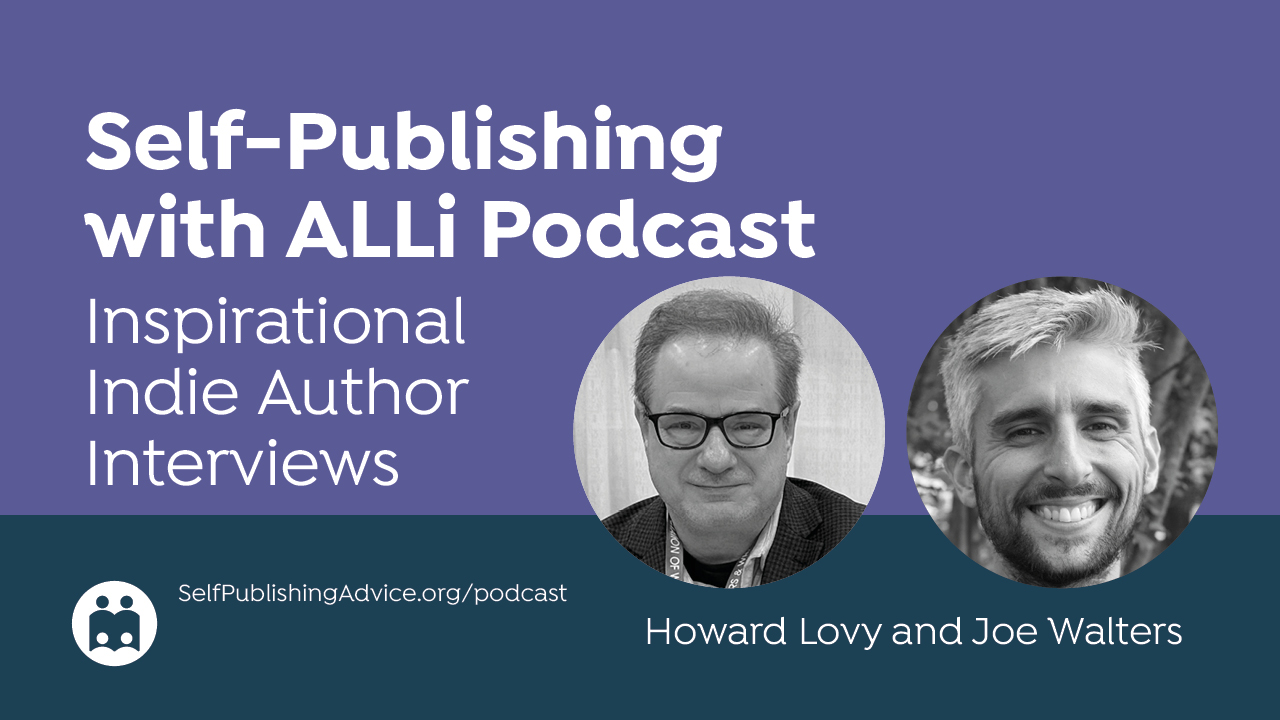
My ALLi author guest this episode is Joe Walters. He’s the founder and editor-in-chief of Independent Book Review, a platform devoted entirely to indie and self-published books. He’s spent years working in book marketing for small presses. He recently published The Truth About Book Reviews, a practical guide for indie authors on making sense of reviews and using them well.
Listen to the Inspirational Indie Author Interview: Joe Walters
About the Host
Author Howard Lovy has been a journalist for 40 years, and now amplifies the voices of independent author-publishers and works with authors as a developmental editor. Find Howard at howardlovy.com, LinkedIn and X.
About the Guest
Joe Walters is the founder of Independent Book Review, a platform celebrating the best in indie books. He has worked on the marketing teams of indie presses including Sunbury Press, Paper Raven Books, and Inkwater Press, and is the author of The Truth About Book Reviews: An Insider’s Guide to Getting and Using Reviews to Grow Your Readership. When he’s not writing, assigning, or editing reviews in a Pennsylvania Panera Bread, he’s playing with his daughters or reading indie books by Kindle light.
Thoughts or further questions on this post or any self-publishing issue?
If you’re an ALLi member, head over to the SelfPubConnect forum for support from our experienced community of indie authors, advisors, and team. Simply create an account (if you haven’t already) to request to join the forum and get going.
Non-members looking for more information can search our extensive archive of blog posts and podcast episodes packed with tips and advice at ALLi's Self-Publishing Advice Center. And if you haven’t already, we invite you to join our organization and become a self-publishing ally.
If you’re a published indie author who would like to be interviewed by Howard for the Inspirational Indie Authors podcast, you need to be a member of the Alliance of Independent Authors.
Then contact Howard, including your membership number, explaining why you’re an inspirational indie author and what inspires you.
If you haven’t already, we invite you to join our organization.
Read the Transcript
Joe Walters: Hey, I am Joe Walters. I'm the publisher of Independent Book Review — a celebration of indie books. I run a website where we review indie books, self-published books, indie press books. We've reviewed 2,000 plus since 2018. And this year I've tried to put my expertise to the test and published my own book, The Truth About Book Reviews. That's been a really fun venture for me. I used to be a marketer at small presses and I saw how difficult it was to get coverage for indie books. So when I left those jobs — because I couldn't stay in Portland, Oregon anymore — I decided to start my own company and make it easier for indie authors to get coverage. That's where Independent Book Review was born.
My book basically takes readers through what I did as an indie press marketer: how I prepared books for submission before we went out, and then how I succeeded in getting different kinds of coverage — media reviews, trade reviews, blurbs, and customer reviews. The whole book is about how to get those reviews and then how to use them once you do.
Howard Lovy: Reviews are an important part of the publishing process, and an important part of an author's life. We crave feedback, and it's especially hard for indie books to cut through the noise. But before we go into that, let's start at the beginning. Tell me where you grew up and was reading and writing always part of your life.
Growing Up and Finding Writing
Joe Walters: I grew up right outside of Philadelphia, and I would rather have been outside playing sports than reading or writing for the most part. I read some Matt Christopher — as many basketball books as I could find — but then I kind of disappeared into my own activities. It wasn't until high school that I realized I liked English, saw a possibility there, and decided to go into high school English teaching. That's when I started taking books more seriously and taking my time with them.
Once I got to college I majored in secondary education English. Before I started my education classes, I took an uncredited writing class. My advisor asked me as a freshman if I was good at writing and as an insecure guy I just said no, so they put me in this uncredited class where I didn't know I could string some sentences together. The job of the whole class was just to write a book. That stirred me onto the path and ignited my love of it, because I wrote a pretty unsuccessful book about my basketball career. And then I started writing every day — just tested myself and tried getting better at this thing. I started writing, reading books about writing, and reading a ton of fiction. That's basically where it went from there. I fell in love with writing and then instead of teaching, I did other stuff. I tried to spend my time writing and reading.
Howard Lovy: What did you do for a career? Did you eventually find work as a marketer for indie presses, or did that come later?
Joe Walters: I was a substitute teacher for about three years, but all I ever really did was sit behind a desk, read, write, and hand out worksheets. I knew my heart wasn't in it. So I decided to move. We moved from Pennsylvania up to Rhode Island because I knew I didn't want to teach anymore, and I'd just take any job I could so I could spend my free time writing. I ended up a server at PF Chang's in Rhode Island, spending my nights serving chicken lettuce wraps and my days writing in the Providence Athenaeum. Then after Rhode Island we had no ties there really, me and my eventual wife, so we moved to Portland, Oregon. I served food there and wrote there. That's where I found a small press, Inkwater Press, hiring just outside of Portland. So I put away my apron and got a job as a marketer.
Learning Marketing on the Job
Howard Lovy: Tell me about your work as a marketer for several indie presses. How did you get into that side of the industry?
Joe Walters: I wanted to be an editor at a publishing house — that was my dream job. I thought of myself as a Max Perkins at a big house and I knew it was kind of difficult to get, so I kept my eye on Indeed and Craigslist for publishing jobs. All I found was one at Inkwater Press: a marketing director position. I did not know what marketing was, so I had to Google it real quick before my interview. I got the job and learned on my way. They published about 75 books a year and I was the marketing director for authors I hadn't figured out how to sell for yet. I just knew I wanted to do it for them, because I knew how much writing meant to me and it probably meant a whole lot to them to find readers.
I was in charge of everything — getting reviews, writing descriptions, talking authors through interview queries and how to do interviews. I learned a ton on my feet. It was an in-person job, 7 AM to about 3 PM taking calls from authors and pitching reviewers. But I couldn't stay in Portland anymore. I was running out of money and it was way too far from home. So my wife and I traveled back and moved into her grandfather's house. I found remote work for two different publishers: Sunbury Press based out of Pennsylvania, where I was a marketer, and Paper Raven Books, where I did book review and metadata work — targeting customer reviews and doing keyword and category research. In my free time I was reviewing books for Independent Book Review and building that platform. Eventually Independent Book Review got so big that I got to only work for it. That's where I am now.
Why Independent Book Review Was Born
Howard Lovy: So tell me about why you decided to launch it while you were trying to get these authors some attention.
Joe Walters: The main reason was I wanted to stay in the industry and I didn't want to quit my job. I loved it so much. All I knew was that at the press we needed guaranteed reviews. We needed ways to get reviews even for the books that were hard to sell. I saw that some review platforms offered paid guaranteed reviews they would post only on their own platforms, but we could use those as blurbs on book covers, on Amazon's editorial review section, on graphics. We had so many ways to use these reviews to get future sales.
There were paid services out there focused only on writers trying to get people in. I wanted to be a platform that focused on readers — one that got authors sales. I would read books very carefully and give them my time and effort and care, and eventually hire people who did the same. Eight years later, here we are.
Paid Reviews: Addressing the Misconceptions
Howard Lovy: Are you a paid review service?
Joe Walters: Yes. We do paid reviews and free reviews. You have the option to guarantee a review in a certain amount of time, or you can submit for the chance of a free review.
Howard Lovy: I was former executive editor at Foreword Reviews, which had a separate paid reviews service called Clarion Reviews alongside the free magazine reviews. Do you get pushback from writers over the idea of paid reviews?
Joe Walters: Yeah, mostly from misunderstanding, and more so earlier on. They'd heard from Facebook groups that you're never supposed to pay for reviews. That information is partially right — you shouldn't be paying for customer reviews. But paying for blurbs and media reviews is just another way to advertise, and it is another way to guarantee something in a field where you can't guarantee very much. As indie authors you'll find out quickly how difficult it is to place your book in major outlets. You're fighting with giants, trying to get notoriety with other people's names saying your book is doing a good job, but you're sending 200 pitches and only four are answering.
It's still possible to get those reviews and learn from the process if you're able to pay for it and have it in your budget. You can learn about your publishing process in a way that's just not available if you're only submitting for free over and over again. You might be curious why it's not working for you, and if you don't get reviews telling you why, then you might just be fumbling around in the dark for a long time.
Are They Always Honest?
Howard Lovy: Are they always honest reviews? What if a reviewer doesn't like the book?
Joe Walters: Of course. That's part of our job. We have to be speaking to readers, and in order to gain their trust we need to write honest reviews. One of my things, as a writer, is to make sure that we see the good in every book too — we don't have to lie and say it's amazing when it's not. We can say the world-building is impressive, if it is, followed by the criticism it deserves. We need to be honest and share with our readers, gain their trust so they buy books from us, because we earn affiliate income. So if we build a strong reader base with honest reviews and at the same time help authors get blurbs, then we're doing two things at once.
Honesty is really important to me, but so is kindness. My reviewer document — the one I send to everyone — states that my motto is that we're always honest but never mean. I think it's a really important piece. We need constructive criticism in writing groups and we need it in book reviews too.
Howard Lovy: That's funny — that's also what I tell my clients. I'm a book editor and I use those exact same words.
Joe Walters: Yeah. We're teammates.
AI and the Review World
Howard Lovy: You've been doing this for a while and the world of book marketing and reviews has probably changed a lot, especially in the last couple of years with the advent of AI. Do you feel like you're competing with machines now?
Joe Walters: The thing we run into most with AI is that authors are more skeptical than ever that reviews are written by AI. That does suck. I hate that you even have to have that consideration — that we didn't read the full book, that we didn't give it the care it deserves. Sometimes you get reviews in and if they stay kind of surface level for too long it can feel like someone read the description and asked AI to provide generic feedback on it. That is just not what we are about. So that's in my reviewer document as well — it's super important that reviewers read every word on every page through to the very end.
We do get submissions that use AI. Some books come in that are written by AI, and that's a trickier thing to navigate because we're still focused on readers. If a book is written by AI or largely by AI, it's just about whether the book is good to read. I don't think AI is good enough yet to really impress us in that way. We're not going to say this book didn't work because it was probably written by AI — we don't even know that, and we won't claim it. But we are going to point out the issues where it didn't work. And if it happened to be the best AI-written book of all time, our reviewers probably wouldn't even know it, and they'd tell readers it's a pretty darn good book.
Howard Lovy: I've developed my own AI detector over time. I can't put my finger on exactly how or why, but I just know when something was written by AI. It just seems so —
Joe Walters: Sure. Yeah.
Writing The Truth About Book Reviews
Howard Lovy: Tell me about why and how you decided to write your book, The Truth About Book Reviews.
Joe Walters: I always wanted to publish my fiction novel first, but 11 years later I still don't have it out yet. So we got to last year and I knew that I had book marketing experience and a perspective that other people didn't have — as a book review publisher but also as a marketer. I had been writing blogs on these things since 2023, pumping out a book marketing series on Independent Book Review that you can still find. I really loved spending the time doing that — I used pictures, I made jokes, I fell in love with talking people through these things in a conversational way.
Then 2024 hit and Google started using AI as its immediate response to queries rather than blogs, and our numbers on those posts went down. We weren't getting the same readers because Google was just answering it for them. So instead of stopping writing those blogs, I compiled them into a book, updated them, did probably too much research, spent way too much time on it, but finally put it together and came out with it in July.
What Not to Do with Book Reviews — and What to Do Instead
Howard Lovy: The book is called The Truth About Book Reviews, implying there are a lot of misconceptions. Can you tell me some tips about what not to do?
Joe Walters: The main one is that you don't use them. Book reviews as publicity are beneficial — you get a review, they put it on their platform and share it with their readers, maybe you get a few follows, maybe a few sales. If it's on a huge platform, maybe it spikes things for you. But not every book review is going to do that for you. Most of them will not. The most important thing is for you to use it after you've gotten it. Take a quote from that review, if it's from a notable platform, and put it on your Amazon editorial review section. Create a graphic. Post it on social media and share it with your newsletter followers. You can put a piece of it on your cover if it's the best quote you've gotten and it's from a notable person or place. There are so many ways to use reviews — I've filled my book with them.
Howard Lovy: You have sample pitch letters and practical steps. How did that come about — through trial and error from being on both sides of the equation?
Joe Walters: That's exactly it. I thought I was doing a pretty good job when I was pitching, but it wasn't until I started receiving hundreds and thousands of review pitches that I started to see what elevated some books above others. Subject lines, for instance — I really did not appreciate subject lines when I was pitching back in the day. I'd use something generic: ‘Review Request, Title of Book, Author Name.' Very cold. It included information, sure. But once people started putting hooks, taglines, and major accolades in their subject lines, I was thinking about saying yes before I even opened the email. And then once I saw the cover, I was in. So I realized how important the cover is, how important the subject line is when the platform allows flexibility there.
And inside the pitch letter, I've always been a big fan of personalization. I worked for publishers who before me were sending out mass emails for reviews — I understand why, it saves time. But there was no personalization and the numbers weren't high. I asked if I could spend a little more time personalizing the first paragraph of pretty much every pitch letter for the most important platforms, the most important bloggers, reviewers, and BookTubers. And the numbers went up pretty quickly. These people want to be seen for what they're doing. If you want customer reviews, bloggers, or BookTubers, they want to be seen. Tell them how you see them, why you see them, what they're doing that impresses you — but in a genuine way.
AI is unfortunately getting good at fake personalization. I get a lot of emails that say ‘I see what you're doing at Independent Book Review' but then they're trying to sell me on a list of a hundred books to review, or trying to get me to pay for customer reviews, which is a scam. You have to be human when you're pitching. You are pitching to another human and you need to sound real. And have a good book while you're at it.
How to Get an Influencer's Attention
Howard Lovy: A lot of authors dream about some influencer on BookTok or Bookstagram discovering them. Is there any special way to get an influencer to pay attention to what you're doing?
Joe Walters: If you're hoping they're going to find you, it's a few years down the line for sure. You are going to have to find them first. It's not easy, but creating some sort of personal relationship with these people is really helpful. On Instagram in particular: if you find someone who has 50,000 followers and posts book reviews in your genre, you've found a potential reviewer. Follow them first. Take your time — give them months, like their posts, maybe comment on them. Don't say a thing about your book for a long time. And on your own profile, start making it professional. Don't only be pitching your book. Be a human on there. Maybe even start doing things for them — sharing their posts. Do they have books? Have you considered reviewing them? It's a give and take. Get them to notice you in some non-pushy way. And if they eventually follow you back, you're one step closer — because now your Instagram DM is going directly into their primary inbox, not their message requests. That makes a big difference.
That pitch also cannot sound like an email. It needs to be personal, shorter, and non-pushy. Figure out what your strongest hook is and why that influencer's specific audience would be interested in your book — not why readers in general are, but why their particular followers are. Recognize who their people are and how your book speaks to them. Then send that pitch. I'd probably recommend not sending the book right away. Don't send a PDF. Just send the pitch, maybe with a link to your website or a picture of your cover, and if you have a press page with a quote from another notable reviewer, include that. Give them just a little bit to show that your cover is interesting and that others have said something nice about the book.
Howard Lovy: That sounds like an awful lot of work — I'm getting exhausted just thinking about it. But it sounds like you have to know your genre and who the influencers are practically while you're writing the book.
Joe Walters: Yeah, and it is a ton of work. I say it a lot in my book: it takes time — real time that you could be spending writing. But it's a slow game. It's like chipping at ice a little bit over time. You have a writing career, not just one book. Keep writing, because over time if you get somebody to review book two, the next time you have book three out you have a better chance of getting that same person to review it again, as long as they liked it. It just takes time, and it's okay not to spend all of it marketing. Breathe, keep writing, but also spend whatever time you do have available to market. That includes reviewers and everything else.
What Keeps Him Energized About Indie Publishing
Howard Lovy: You said somewhere that you spend a lot of time reading indie books by Kindle light. What keeps you energized about indie publishing, and where do you see your own work going?
Joe Walters: I read a ton of books. A lot of it is from Independent Book Review — I'm not reviewing all of them myself anymore, but I look at them to separate the starred reviews from the rest of the pack. When a reviewer submits their review and says this thing is amazing and should be considered for a star, I go in and read through it to figure out whether we should give it the final company star. I read a lot of those. And then at night — from eight o'clock when my kids go to sleep until ten, I'm just reading.
I feel no real difference in quality between indie books and Big Five books. You can absolutely find the best book you've ever read published by someone who did it themselves. They could have gotten help from an editor, plenty of beta readers. These people do a ton of work and it shows. Some indie books don't, and you can find that out. But if you give them the time, you can find the stellar ones. I've read Big Five books that are not as good as indie books I've read. The difference is gatekeepers — how publishers think something is going to sell, how they're going to put money into it and get it into bookstores in ways that indie authors just don't have access to. But it doesn't mean quality.
I'm proud to publish my nonfiction book as a self-published indie. But for my novel, whenever it comes out, I want feedback from a small press or indie press. I think it's important to make sure other people are reading it, giving you feedback, helping get the book to where it needs to be. There's room for both.
The Novel in the Virtual Drawer
Howard Lovy: You have your own novel in your virtual desk drawer. Do you have a timeline on that?
Joe Walters: Whenever it's good and done. I started it around 2015 and it was one thing, then turned into something different in 2018. I wrote that version four times and realized two years ago it's not the right thing, so I had to completely revamp it. It's been revamped twice now. Now we're in 2025. I should be finishing a draft in January if I stick to this writing schedule.
Howard Lovy: All right, well now that you've said it on a podcast, you have to finish it.
Joe Walters: Okay, sure. My mom has been telling me the same thing. Yeah, I agree.
Howard Lovy: I hope you do it. Alright, thank you Joe. I appreciate you taking the time to talk to us about the important subject of getting book reviews, how to do it, and your own book. Thank you for your time.
Joe Walters: Yeah, absolutely. Thanks for having me.
Howard Lovy: Okay, bye Joe.
Joe Walters: Yep. See ya.