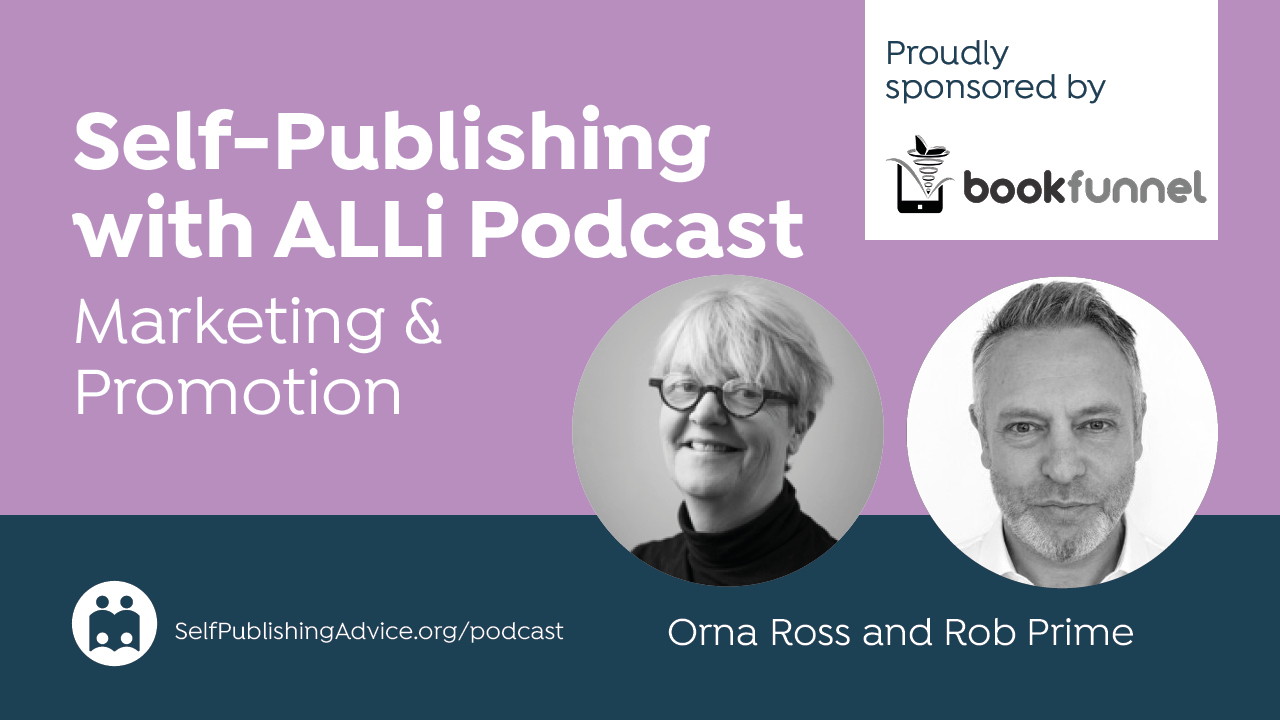
Artificial intelligence is changing how readers discover books, and few people have a broader view of that shift than Rob Prime. An indie author, founder of Publishing.co.uk, co-owner of LoveReading, and head of an Amazon marketing agency, Prime joins Orna Ross on the Self-Publishing with ALLi podcast to explain how AI-powered search is reshaping book discoverability. They discuss Amazon’s evolving search tools, AI-friendly metadata, author websites, direct sales, and the practical steps authors can take to make their books easier for both readers and AI to find.
Listen to the Podcast: How to Make Your Books Discoverable by AI
Sponsor
This podcast is proudly sponsored by Bookfunnel. Do you have reader magnets, ARCs, and direct digital sales? Want to join multi-author promotions? Thousands of authors trust BookFunnel for seamless delivery and real human support. Visit BookFunnel.com.
Find more author advice, tips, and tools at our Self-publishing Author Advice Center, with a huge archive of nearly 2,000 blog posts and a handy search box to find key info on the topic you need. And, if you haven’t already, we invite you to join our organization and become a self-publishing ally.
About the Host
Orna Ross launched the Alliance of Independent Authors at the London Book Fair in 2012. Her work for ALLi has seen her named as one of The Bookseller’s “100 top people in publishing”. She also publishes poetry, fiction, and nonfiction and is greatly excited by the democratizing, empowering potential of author-publishing. For more information about Orna, visit her website.
About the Guest
Rob Prime is an author, entrepreneur, and book marketing specialist. He is the founder of Publishing.co.uk, which helps authors improve book formatting and AI discoverability, and co-owner of LoveReading, the book recommendation platform that supports schools through book purchases. He also runs Mr Prime, an Amazon marketing agency that works with publishers and brands. Drawing on his experience as both an indie author and a publishing professional, Prime advises authors on Amazon marketing, metadata, AI search, and direct-to-reader strategies. His book, Google, Panic, Repeat, is a memoir about overcoming health anxiety.
Read the Transcript
Orna Ross: Hello everyone, and welcome to Self-Publishing with ALLi. We have a treat for you today — I'm talking to Mr. Rob Prime. I'm not going to tell you what he does because he does a lot of different things, and he's going to tell us about that himself. Rob and I have been having some really interesting discussions lately about book marketing and book promotion and where it's all heading for authors. Hi, Rob.
Rob Prime: Hi there. Nice to meet you. Nice to see you again.
Orna Ross: Welcome to Self-Publishing with ALLi. So first of all, tell us a little bit about yourself. You wear more than one hat — you've got LoveReading.co.uk, you've got Publishing.co.uk, and you're also an indie author. Let's slow that down a little. For those who don't know, what is LoveReading.co.uk?
Rob Prime: So LoveReading.co.uk — we took over in 2016, though it's been around a lot longer than that. It's a book recommendation site with a charitable angle: we give back 25 percent of the retail price to schools when people buy books there. We've also got LoveReadingForKids.co.uk, which is one of the better-known children's book sites — it's actually bigger than the adult one now. Both sites are built around book recommendations.
Orna Ross: I've been aware of LoveReading since ALLi started in 2012. Really interesting to hear the kids' site is now bigger. And of course that's one of the things we've been connecting around — we've been talking to Debbie at LoveReading about attracting readers to the ALLi bookstore and bringing our members' books to LoveReading. That's a project people will be hearing more about as we go forward. Then there's Publishing.co.uk — tell us about that.
Rob Prime: Just briefly on LoveReading first — we are actually going to be opening it up very soon, because one of the things I've found both in writing my own books and working with clients is that getting your books read and reviewed is really difficult. So I'm excited to be sharing that we'll be doing something about that. On Publishing.co.uk: I had the domain name for about eight years and never had a reason to start it until I wrote my own book in September last year. I realized what the gaps were from my own experience, and thought that was a great opportunity to build on. It's effectively about discoverability of books and formatting of books — things I personally had problems with. Making it simple is the premise.
Orna Ross: And what you bring to that is your experience with your Amazon agency — which isn't an actual website, it's an agency in the background. Am I understanding that correctly?
Rob Prime: Yes. I come at it from a few different angles, just to be confusing. We have mrprime.com, which is an Amazon agency — we have book clients there and physical product clients. Then there's the LoveReading angle, which is the reader angle; that's a separate business and Deborah McLaren runs it brilliantly. And then there's Publishing.co.uk, which is mine. And I'm also an author — in inverted commas — so I come at it from a rounded view, from a load of different angles.
Orna Ross: You most certainly do, and that's one of the reasons I wanted to talk to you, because your combination gives you unique insights that no single author could ever have. You're coming at it from so many different angles — the agency, the reader-facing platform, your own experience as an author. Before we get into the marketing advice, tell us about that book, and what you did wrong yourself as a debut indie.
Writing Google, Panic, Repeat — and What Went Wrong
Rob Prime: I've been wanting to write a book for about ten years — procrastinating, second-guessing it. Then truthfully AI allowed me to actually write it — not by writing it for me, but by helping me get my thoughts down and handle things like formatting that had been a headache. The book is called Google, Panic, Repeat, and it's about health anxiety, something I had in my twenties. I'm 50 now. I always wanted to write the account of the book I wished had existed back then. It felt almost like an obligation, because a lot of people have health anxiety quietly.
In terms of mistakes — I made a lot. The biggest one was trying to use AI to write the book, and ending up losing my own voice. The rawness I wanted was polished away. I ended up not using AI to write it at all — I just used it to help with things like chapter headings and to give a second pair of eyes. Loss of voice through automation was the thing, and it's really put me off using AI beyond the specific ways I'll talk about.
Orna Ross: That idea of polishing the warmth and humanity away — I think a lot of authors who go into AI thinking they're going to love it as a tool come back out saying actually I don't. Though there are those who do become very expert with their prompts and setup. It's a story we hear over and over again. Interesting that it's yours as well.
Rob Prime: Exactly. And that's where AI gets confusing, because as soon as you mention it, people think about using it to write — which isn't something I'm behind. What happened was I'd get AI to write a chapter, it would rate it ‘seven out of ten, eight out of ten,' then offer to rewrite. But before long it sounded too cold and clinical, and what I wanted was something people could empathize with. The book got caught between genres — was it a self-help book? A manual? It lost its way. I look back now and think I could have written a much better book, even though it was only September — but the reviews are good, so maybe I'm being too self-critical.
Orna Ross: Reviewers are not kind. If the reviews are good, you can trust them. And I do think that almost as soon as you've written a book, you've learned so much in the doing that you're ready for the next one. That's what keeps us going. But anyway — carry on.
Rob Prime: The second mistake was formatting. I spent so long trying to get the book formatted — used Fiverr, tried to do it myself. There were quicker ways I didn't know about. But they were the two main mistakes, because marketing is what I'm good at. So the writing and getting it to manuscript was the harder part where I made the most mistakes. I'm fairly pleased with how I marketed it.
Orna Ross: That makes you very interesting, because that's the complete reverse of most authors. Most authors get on top of production eventually, but marketing never gets easy — it's very creative, it keeps changing, you keep changing, the audience keeps changing. So let's get into the nitty-gritty of what's going on in marketing right now. We'll start with Amazon and then go wider.
Amazon: How Rufus and Alexa Are Changing Book Discovery
Orna Ross: You run an Amazon agency that lets you see across many real accounts — things the rest of us would never get to see. Things have changed a lot in terms of getting seen on Amazon in the last year or so. Can you bring us up to speed on what's happening?
Rob Prime: The same things I saw with Google years ago, actually. With our clients — one client alone has around 300 books, and we run PPC across all of them, so we see a lot of different genres and different changes. What's happening more and more on Amazon, and I believe will keep happening, is that keywords are still important but becoming less important over time. It's becoming much more about context.
Amazon brought in something called Rufus — an AI you can interact with on Amazon, rather like asking, ‘I'd like a book in historical fiction for someone who likes this and this.' It's much more chat-oriented, and they've recently rolled that into Alexa as well, so everything is moving toward voice search, conversational search, longer search. Millions of people are now shopping this way.
What that means from our agency perspective is that it's much more around context and the formatting of your listing. It's much more about conversion rates, what people say in reviews, and having A+ content that is readable by AI. You're essentially building to feed a machine now as well. If you have a number one book and someone asks Rufus, ‘What's the best book in this genre?' — it will only cite your book if it can actually read and extract structured information from your listing. So structure is becoming more important, and yes, controversially, keywords will become less important.
Orna Ross: I want to get into that distinction a bit, but first — just to be clear about Alexa and Rufus. My understanding is they were separate and have now been integrated. Is that right?
Rob Prime: Yes. They've had Rufus for a long time, working on it a lot. Rufus is the AI brain that you can interact with on Amazon — more chat-oriented, conversational. They recently embedded it into Alexa as well. So everything seems to be leading towards more voice search, more conversational search, longer search.
Orna Ross: So if you were ordering a book through Alexa, you'd literally be getting into a chat with Alexa about the kind of book you want — starting with historical fiction, but specifying Irish, or similar to a particular author — and the AI search would pick out the most likely match.
Rob Prime: That's correct. And I don't want to put anybody off keywords — they're still relevant. But I said a year ago in an interview that I believed they would become less and less relevant, and I'm definitely seeing that. You can do both. But building things structured properly, filling out every possible area, A+ content with alt tags readable by AI — that's really more important now. And actually it's just good housekeeping anyway. The things that make your listing work for AI are the same things that make it work for humans, which is the best news of all.
Amazon Ads: Why Most Listings Aren't Ready for Them
Orna Ross: Most authors have given Amazon Ads a go. Some have made them work; others have poured money in and seen it go nowhere. What's going wrong?
Rob Prime: A few things. Most of the listings I look at are not what I'd call ready for ads — not ready to have low ACoS (advertising cost of sale) and to be profitable. By ready I mean: does the cover stand out? Is it the correct DPI? Is the title attention-grabbing? Do you have reviews — because running ads with no reviews is a lot more expensive. Is the A+ content filled out correctly and showing off your book? All these things add up incrementally.
And why would someone buy your book versus another? If you can't answer that, you're basically using ads for feedback, discovery, and reviews — which is a different metric, and an expensive one. The biggest thing before even setting up the ads correctly is having a listing that's ready to convert. After that you need to match the ads to the right user and find them. In an ideal world: listing is strong, you have reviews — ideally some five-star reviews — your cover stands out, and then you run ads in categories, on the listings of comparable books, specifically targeting a well-defined audience.
The other metric I'd say to focus on is TACoS — total advertising cost of sale — rather than just ACoS. ACoS tells you what you're spending on ads, but TACoS tells you what percentage of your overall sales is going on advertising. Sales from ads also grow your organic rank, so that matters. The bottom line: the listing has to be fit for purpose. That's the biggest thing.
Orna Ross: Is there one good tip for people who feel they've done everything right and still aren't moving the needle?
Rob Prime: Check every field. Do good, solid A+ content. Make sure your cover really stands out. I'd say you need at least 15 reviews — especially those first 20, which are the most important. Then: look at the simplest possible approaches. Which books in your category do you feel you're a genuine fit with? Run ads on those comparable listings, work those specifically, start with small budgets, treat it as learning and discovery. Look at your search term report and see what's worked and what hasn't. Keep it simple to start with. And get some honest feedback from people about your listing, because most listings — if I pulled up ten on Amazon, probably eight and a half of them wouldn't have everything I'd consider Amazon-ready.
Beyond Amazon: Author Websites, Direct Sales, and AI Discoverability
Orna Ross: Let's zoom out to the rest of the writing world. Our most recent income survey compared to the previous one showed a drop of about 5 percent in authors who are Amazon-exclusive or in KU, and a gain of almost exactly that same percentage of authors now publishing direct. We've seen even more of that in the last six months. So how do you go about marketing direct? How do you get readers to come to you and buy from you on your author website?
Rob Prime: I see Amazon as a customer generator, but you're renting those customers. What you want is to own the customer, and that's becoming more and more important. I see it as building a brand. You need your own website — give information about yourself, the passion behind your work, hooks for people to sign up to a newsletter. That could be an excerpt of a chapter, something genuinely valuable you're giving away in exchange for their attention. That's the first thing: having that hub, that presence, so that when you write more books you have a captive audience and don't have to start again.
Orna Ross: And getting the basics right there is presumably also important for search engines and the AIs that are trying to match books to readers.
Rob Prime: Absolutely. And you can even ask AI to help. If you have a website, just put it into Gemini or Claude and say, ‘Can you look at my site as an author and rate it for search engine optimization and structure?' It will probably tell you exactly what to do. None of it is that complicated. And the same applies to Goodreads — having that completely and properly structured, metadata all good, title clear. Structuring everything to be readable by AI means going into the detail around the fundamentals more, rather than just having a site. Asking AI to look at your site and give advice is genuinely useful — it will feed a lot of that back to you.
Google Zero: How Conversational Search Is Changing Everything
Orna Ross: Talk about how search has changed. You've talked before about Google Zero, zero-click search. Can you explain the background?
Rob Prime: Google Zero is what's happened as Google now gives you the answer directly much more often. If you search for the best five books on something, before it would take you to a book site — now it's likely to give you those five books directly, stopping the click. Zero-click. What it's led to is people searching in longer, more conversational ways than they used to. They might say, ‘I liked this documentary from this particular person, have you got any more from the last five years I could read?' — longer queries that bring up structured data before any click.
So people with websites are losing out a lot more on the click. What becomes more important is being visible in the AI's answer. That's already important, but I personally believe it will escalate very quickly over the next one, two, three years until it's the most important thing. If you're not visible in the conversation AI is having, your visibility will gradually decline. That's my view.
The AI Audit Tool at Publishing.co.uk
Orna Ross: You've built a platform that measures all this and helps an author get in the right place to be found. How does it work, and how can authors use it?
Rob Prime: The tool does a daily scan of most major book genres, finding the main sites to be on, the main lists, the main impactful places to have your book for visibility from AI. For each genre there are core things — Goodreads, Reddit conversations, Wikipedia if you're lucky enough to have that level of exposure — that are top across every genre. But there are also what we call kingmakers: specific sites, articles, and resources in every niche that really move the needle in terms of getting your book recommended.
You put in your ISBN or book title, run the scan, and it asks four large language models — things like Claude, Gemini, Google, ChatGPT — the relevant questions about your book, very specifically relevant to that book. It shows you whether you appear in the answers or not. If you don't, it shows you who does and why, and then shows you the citations the AI used to arrive at that answer — essentially what it used to make its determination. With that information, the goal is to replicate those things: get yourself into those conversations by being on those sites, reaching out to them, structuring your core information on Goodreads properly.
So it's a playbook: what's your ideal world to be recommended, how much are you being recommended, and if you're not, how do you get there? After that it's outreach and hard work. There's no easy shortcut. But the best free takeaway from the site is how to structure your Goodreads — just look at that, then look at how you structure the main sites you control, and make sure you're readable. Then ideally look at the list of kingmaker sites for your genre's conversations and try to get on as many as you can. It won't be easy, but even a few makes a real difference.
Orna Ross: So the tool gives very specific answers by genre — a historical fiction author gets a completely different list from a how-to nonfiction author.
Rob Prime: Absolutely — and not just the sites, but the specific articles and guides that AI used, in order of importance. For each audit it sends out around 200 queries across the LLMs, gathers all the answers, finds the most common citations, and ranks them by importance. It's a graded list of where you need to be to potentially get your book more visible in AI. And the great thing is that the places it's pointing you toward are places you should want to be anyway — if there's a ‘Best Historical Fiction for Irish Author Readers in 2026' article and you get on it, you'll likely receive direct sales from people visiting that article, and long-term it helps your AI visibility too. So it's all logical, and nothing tricky.
Myths Worth Busting — and Why Writing for Humans Serves AI Better
Orna Ross: Is there a piece of received indie wisdom about marketing and promotion that you think is now outdated or just wrong?
Rob Prime: The biggest one is: if I write an amazing book, people will find it. That's the first thing that isn't quite true in my experience. The second is that getting a deal with a traditional publishing house is a great guarantee of success — it can work for people, but it's definitely not a guarantee. And probably the biggest misconception I wanted to get across today is that marketing doesn't have to be scary. I can't write one line of code, and yet if you have the audacity to ask AI, and if you learn from YouTube tutorials and follow the right people, all the information is out there. You can be a complete novice and still do these things if you just keep asking. That's absolutely possible now in a way it wasn't even two years ago.
Orna Ross: You're a proponent of using AI to help with this — but is there anything here for authors who are AI-resistant? Does being found by the LLMs actually depend on engaging with AI tools?
Rob Prime: You don't have to touch AI if you want to be more visible. All the sites — Goodreads, Amazon, your own Shopify store — have best practices about how to set yourself up as an author, how to tag things, how to structure things. Those are nothing to do with AI, they're just best practices that have always existed but are now more important. If you're skeptical of AI, just consider it SEO — structuring things in the right way, getting into the right conversations. Where are the groups talking about your books? What articles come up when you search ‘best historical fiction'? How can you contact the author of those articles and potentially submit your book for inclusion? It's all just visibility. AI just happens to value those same things.
Orna Ross: And for multi-genre authors — is it possible to have a website that doesn't confuse the LLMs when you're writing across very different genres and readerships?
Rob Prime: Absolutely. It's about how you're structured. Does your bio include all the genres you write? And then: is the site cleanly structured, with a clear category for historical fiction with your books in it, and a separate category for poetry, and so on? With context — who it's written for, why you write it, when you started. You can absolutely write across as many categories as you want. Just categorize it clearly and give the context and information for each. And crucially — whatever makes things cleaner for the human reader also makes it easier for the AI to recommend you. That's the rule of all of this.
Orna Ross: I think that's the key thing authors haven't quite grasped — that pleasing the AI and pleasing the human are actually the same thing.
Rob Prime: So untrue is the assumption that they're in conflict. If I describe my book as being for people who've tried CBT and other things and it didn't work, and who want an everyday account and memoir from someone who experienced the same thing — that gives so much more, without me even thinking about a keyword, than saying ‘this is a book for people with health anxiety to help overcome it.' The emotional description actually serves the robot better than the robotic description. That's kind of the reverse of what people expect.
Publishing.co.uk: The Tool, the Offer, and Where to Find Rob
Orna Ross: You're now an ALLi partner member, and you've very kindly put together an offer for ALLi author members. Can you tell us about that, and where people can find you?
Rob Prime: It's publishing.co.uk. There's a formatting service there — I realized when building it that not everyone had the same problems with formatting that I did, so if you've got good tools already, ignore that part. But if you've struggled with formatting, we can work together to get the book correct for KDP upload, with EPUB and so on.
The other part is the AI audit, which is normally $29.99, and I've made it 20 percent off for ALLi members. It's more detailed than you might expect at that price point. Some people have said it's a lot to take in, and I get that — there is an element of technical structure information in it. But if you just look at it as: here are the most impactful places for my book to be, and use the links for that, that on its own is very valuable. It also visits your website and tells you if it's structured correctly to be read by AI. Purely for discoverability — knowing where the conversation is happening in your niche and what will move the needle — that's the main value. I don't want it to be overwhelming.
Orna Ross: I would testify that there's far more depth there than you'd expect at that price point. And I'd say: it's incumbent on us as publishers — we're not just writers, we're publishers — to do the work, whatever it takes, or to choose not to. The tools make it far less overwhelming than it could be. And no matter how much is in them, you don't have to do everything at once. It's great to know what best practice looks like.
Rob Prime: I'll leave a guide to structuring the main sites — hopefully that can be added to the show notes. But really: look at how to structure the main sites for your genre, consider your own website as a nurturing journey rather than just ‘here's my book, please buy it,' make it easy for someone to read a chapter, find out about you, sign up to hear from you. That journey, made as clean as possible, is the goal. And if you have a website, just ask AI to take a look at it and tell you how to structure it better. That's free and genuinely useful.
Closing
Orna Ross: Fantastic. Thank you so much, Rob, for coming and telling us about the new search landscape. We look forward to our members getting all their pages structured so they can be found by AI. Thank you.
Rob Prime: Thank you very much. Appreciate it.
Orna Ross: Take care now. Happy writing and happy publishing, everyone. Bye.
Rob Prime: Bye-bye.