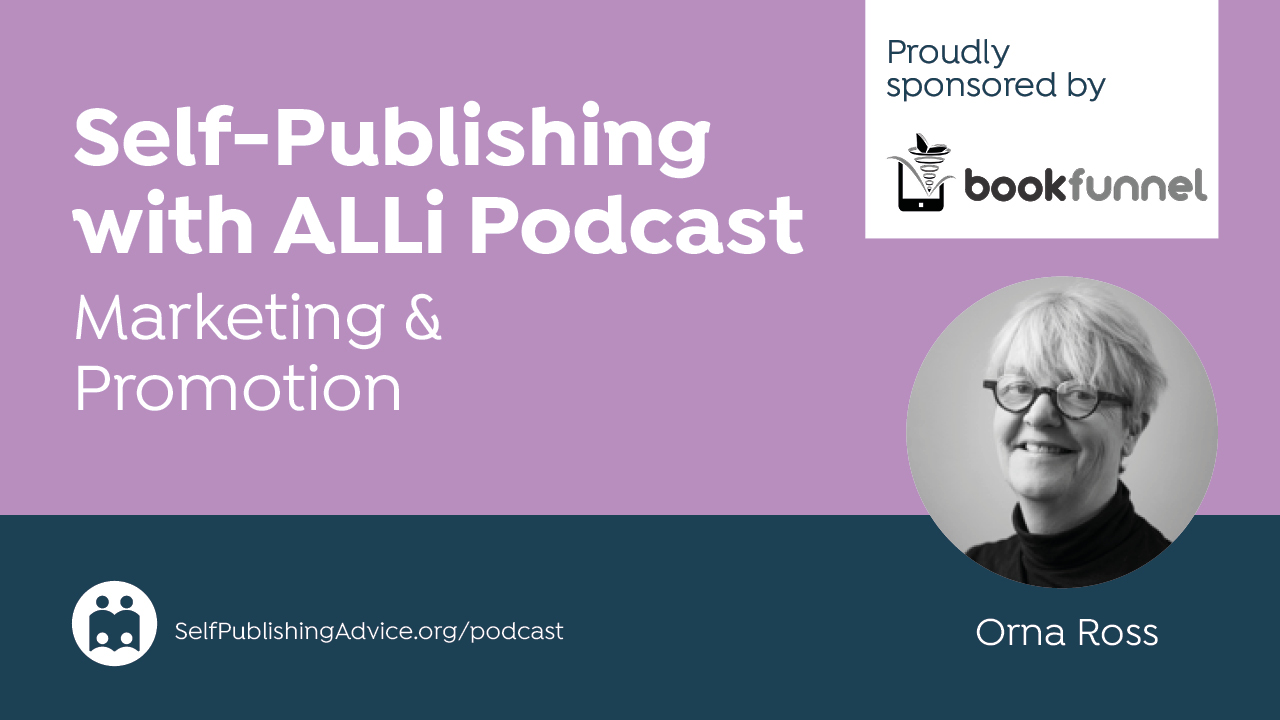
In this episode, Orna Ross explores guided selling for authors: how indie authors can help readers find the right book or next step into their ecosystem without overwhelm or decision fatigue. Drawing on research into the ‘paradox of choice’ and online book-buying behavior, this episode asks how we can use our websites, stores, newsletters, book pages, and reader links more consciously to take readers by the hand, reduce friction, and make the buying journey feel less like a maze and more like a good bookseller’s recommendation.
Listen to the Podcast: Guided Selling for Authors
Show Notes
This episode grew out of conversations around the ALLi bookstore and the question of how readers discover books when faced with abundance.
Research: The best-known research here is Sheena Iyengar and Mark Lepper’s study, “When Choice Is Demotivating.” Their work challenged the assumption that more choice is always better, showing that large choice sets can attract attention but also reduce action when the decision becomes too demanding.
Later research adds useful nuance. Chernev, Böckenholt, and Goodman’s meta-analysis found that choice overload is most likely when four factors are present: the choice set is complex, the decision is difficult, the person is uncertain about their own preferences, and they are trying to minimize effort.
That maps very well onto online book buying. A reader may click with interest, then suddenly have to choose between an ebook, a paperback, a hardback, an audiobook, a signed copy, a bundle, a subscription, a direct store, Amazon, Apple, Kobo, Google Play, a library, or a local bookshop. Each extra decision can introduce hesitation.
There is also book-buying research that supports the need for guidance signals. A 2024 Books & Consumers survey summary points to subject or genre, recommendations and reviews, cover design, special offers, character appeal, extracts, and gift suitability as influences on book purchase.
ALLi members are encouraged to tick the box in their profile, which allows us to upload their books to the ALLi bookstore.
Sponsor
This podcast is proudly sponsored by Bookfunnel. Do you have reader magnets, ARCs, and direct digital sales? Want to join multi-author promotions? Thousands of authors trust BookFunnel for seamless delivery and real human support. Visit BookFunnel.com.
Find more author advice, tips, and tools at our Self-publishing Author Advice Center, with a huge archive of nearly 2,000 blog posts and a handy search box to find key info on the topic you need. And, if you haven’t already, we invite you to join our organization and become a self-publishing ally.
About the Host
Orna Ross launched the Alliance of Independent Authors at the London Book Fair in 2012. Her work for ALLi has seen her named as one of The Bookseller’s “100 top people in publishing”. She also publishes poetry, fiction, and nonfiction and is greatly excited by the democratizing, empowering potential of author-publishing. For more information about Orna, visit her website.
Read the Transcript
Orna Ross: Hello and welcome to the Self-Publishing with ALLi podcast. I'm Orna Ross, and today I'd like to talk about something I've just started thinking about in the last few weeks here at ALLi — the principles of guided selling. We've thought about it loosely before, but this episode is about bringing it together.
It began with a conversation with Melissa Addey, who runs the ALLi Bookstore. For those who don't know what that is, it's essentially our showcase of members' books — a whole section on our website — and it is going really well. We started it earlier this year and lots of members have their books up. Some do not. So if you are a member and you haven't yet ticked the box in your profile that allows us to show your books to the world, please log in and do that — it will only take a moment and it will put your books live on the bookstore. Or you may want to take the opportunity to refresh your catalog on the ALLi store.
Melissa and I were chatting, as we do, about the bookstore. We're both passionate about it — we're bringing readers, reviewers, booksellers, librarians, influencers, and all sorts of people to see the richness of what indie authors are actually creating in 2026. It has a really abundant feel. But we're also conscious that that very abundance, which is so exciting, can for a reader be a little overwhelming. One of the things we've been working on at ALLi is the categorization of books and presenting them in a way that is reader-friendly. The rest of our website points to the author; this subdomain points to the reader.
Reader Link Tools and the Choice Paradox
During that conversation, the issue of reader link tools came up — many of you will be familiar with these. Click one link and all the different places where you can buy an author's book pop up. On our bookstore we've asked authors to provide one preferred link, and a number of people are choosing to use one of these universal link services. BookLinker is one such service — among the best of those available, we think — and it is an ALLi partner member. The idea is that one universal link takes you to a page full of buying options: Amazon, Apple, Kobo, the author's own website, Bookshop.org, Barnes and Noble, whoever the author wants listed there.
What that conversation sparked was a recognition that while this may be a good strategy for some authors, it may not be for others. As always, it depends on the kind of author you are, the kind of book you're selling, the kind of reader you have, and the result you want from that click. That one click on the ALLi store — which represents the one clicks you're putting out all over the place — is a really important moment.
A wide author may feel that giving lots of retailer choice is the right approach, and it certainly is what has generally been recommended: make it easy for the reader to buy wherever they normally read their books. That idea is not a bad one at all. For some authors it is exactly the right thing to do. However, a direct sales author might want to foreground their own store. A series fiction author might want to bring people to book one. A nonfiction author might want to guide their reader by problem, outcome, or reader level. A poet or literary author might want to guide by mood or gift occasion. The point is it's not always the same.
The Research: Choice Overload and When It Stalls a Purchase
The question for all of us is: if a reader clicks through to our website or sales page, are we helping them complete the purchase easily, or are we sending them into a maze? There is consumer research behind this. It's often called the paradox of choice, or choice overload, or the choice paradox. The essential finding is that while choice is good, more choice is not always better. When people are offered too many options, they may delay or feel uncertain — and that uncertainty may mean they fail to act at all.
The best research on this shows that the sense of overwhelm that can stall progress is most likely when the choices being offered are complex and when the reader is uncertain about their own preferences. This is really relevant to book buying. At the purchase moment, we often ask readers to choose between multiple retailers, multiple formats, different pricing, a bundle, a special edition. Guided selling is the author-publisher's answer to that problem. It's not about removing choice, but about organizing the choices available so the reader knows clearly what to do next — helping them make the best buying decision through prompts, pathways, recommendations, and clear next steps.
What Guided Selling Looks Like in Practice
Guided selling might mean helping readers choose where to begin in a series, which format is likely to suit them, or whether a book is right for their reading mood. The approach shifts from how do I convince the reader to buy? to how do I make it easy? What do they need next? It's about breaking down the part of the reader journey between landing on your page and knowing what to do next. All the research shows that readers need guidance at that moment — signals, context, prompts that help them answer the question they're subconsciously asking: is this book for me? Is this author for me? Guided selling is how we consciously provide those signals. I think of it as reader care — taking the reader by the hand and leading them through, helping them make a good buying decision through clear pathways and clear next steps.
To be clear: reader link tools are not wrong, and they are particularly useful for wide and international authors. If you don't have a direct sales setup and you are wide, they are a good option. But essentially, a universal link says to the reader: you decide where to buy. If a reader knows exactly what they want, that's really useful. But for another reader, it might be one decision too many.
Wide is a sound distribution strategy and ALLi's recommended approach — we don't recommend exclusivity, though we understand why some authors choose it. But guided selling is your marketing strategy. Just because your book is available everywhere doesn't mean the reader needs to experience all those distribution choices as equal marketing messages at the first moment they meet you. A better primary message might be: buy direct from the author, or start with book one, or get my signed gift edition, or read a free sample, or join my reader club first. It will always depend on you, your book, your reader, and your goal.
Auditing Your Reader Purchase Pathway
If guided selling is something you'd like to think about, the first step is to audit your reader purchase pathway using the following questions.
First: what is the main action I want this reader to take? Sometimes it is to buy the book, but sometimes it's to capture their email address. Many highly successful authors will say they would rather have the newsletter sign-up than the sale as a first point of contact — and I include myself in that group. Bringing a reader into your ecosystem, where they can get to know you and understand your writing philosophy, is the most valuable thing you can do and will automatically lead to sales over time. As a first ask, it's less than an outright purchase — the reader doesn't have to open their wallet, just give you their email address.
Second: am I offering too many options too soon? A reader who has just landed on your page for the very first time, who doesn't know you and has never purchased anything from you — what are they confronted with? Are you offering so many options that they simply leave?
Third: do you have a preferred buying route? I do — I'm direct first. Everything I do points toward my website. I still am widely available on all retailers; wide distribution is the strategy. But my marketing preference is for readers to purchase on my own website, and I use the platforms to bring them there. At the end of all my editions there's a pathway toward my site to purchase the next book, sign up for the newsletter, or whatever is most relevant. If you are selling direct, do you need to explain to the reader why buying direct matters to you? Readers often want to support authors, particularly if they've already read one of your books and are a fan. Explaining why buying direct is important to you is worth thinking about.
Fourth: do you need to guide by format, series order, genre, or outcome? What do you want your most right reader to do as a first point of contact?
Fifth: where might a reader hesitate? At what point are you making it difficult for them? Where might they fall off?
And finally: what one decision can I remove for the reader without affecting anything from my own perspective?
Some Examples
For a direct sales author, you might have ‘buy signed copies direct from the author' as your main button, with ‘also available from other retailers' as a less prominent option beneath. For a wide author, you might offer ‘choose your favorite retailer' with the top three sales outlets listed and others available on a second click or in smaller type underneath. For a series author, making book one a clear and obvious pathway on your website is important. For a nonfiction author, something like ‘choose the book that fits where you are now' — addressing the reader directly around their needs and starting point. For a poet or literary author, guidance around mood — grief, hope, reflection — can be a useful organizing principle. For a gift campaign, a simple seasonal prompt like ‘books for Valentine's Day' or ‘a book for bereavement' can do the work.
The Core Principle
The overarching principle to take away is this: the best research does not say fewer choices are better. It says choice becomes a problem when the reader is uncertain, the options are hard to compare, the task feels effortful, and the buying goal is unclear. Those are the things you want to clear away. Your reader may be very willing to buy — there are many ways in which you can make that easier for them.
I'll put the research links in the show notes for anyone who'd like to go deeper on this. And if you've waited all the way to the end — may I remind you again: if you are an ALLi member, please visit your profile, log in, and tick the box that says we have permission to upload your books to the Indie Author Bookstore. We would love to have them there and show them to the world. Thanks for listening, everyone. Until next time, happy writing and happy publishing. Bye-bye.