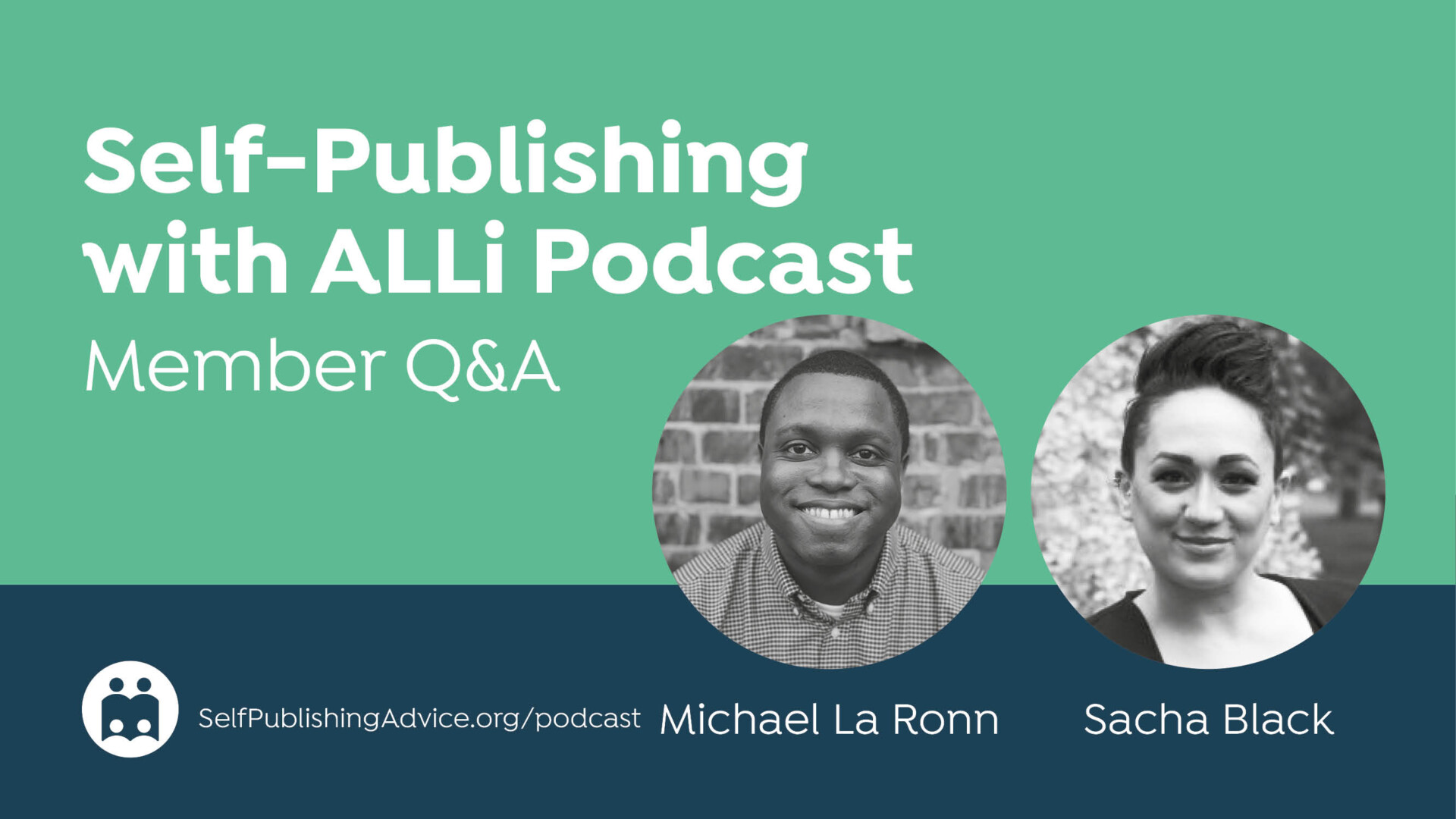
In this episode of the Self-Publishing with ALLi Member Q&A podcast, hosts Michael La Ronn and Sacha Black discuss whether an author can safely use a real band's name in a novel title, including how to check for trademarks, why disclaimers won't shield you from lawsuits, and when it's worth consulting an intellectual property attorney.
Other questions include:
- What is the best platform for publishing a professionally recorded, author-narrated audiobook, and should you go exclusive with Audible or distribute wide?
- What should you do if your KDP account has been terminated?
- Is it a sound strategy to sell direct through your website first and go wide only after those sales dry up?
- How do you find and evaluate printing companies for your book?
- From a marketing perspective, how should you approach a series that can be read in any order versus one that must be read sequentially?
- Should you use a copyrighted quote without permission and hope it qualifies as fair use if the licensing fee is too expensive?
And more!
Listen to the Podcast: Can You Use a Real Band's Name in Your Book Title?
Have a Question?
If you're a member of ALLi and have a question for the Member Q&A Podcast, you can sign in and ask here!
About the Hosts
Michael La Ronn is ALLi’s Outreach Manager. He is the author of over 80 science fiction & fantasy books and self-help books for writers. He writes from the great plains of Iowa and has managed to write while raising a family, working a full-time job, and even attending law school classes in the evenings (now graduated!). You can find his fiction at www.michaellaronn.com and his videos and books for writers at www.authorlevelup.com.
Sacha Black is a bestselling and competition winning author, rebel podcaster, speaker and casual rule breaker. She writes fiction under a secret pen name and other books about the art of writing. She lives in England, with her wife and genius, giant of a son. You can find her on her website, her podcast, and on Instagram.
Thoughts or further questions on this post or any self-publishing issue?
If you’re an ALLi member, head over to the SelfPubConnect forum for support from our experienced community of indie authors, advisors, and team. Simply create an account (if you haven’t already) to request to join the forum and get going.
Non-members looking for more information can search our extensive archive of blog posts and podcast episodes packed with tips and advice at ALLi's Self-Publishing Advice Center.
And if you haven’t already, we invite you to join our organization and become a self-publishing ally.
Read the Transcript
Michael La Ronn: Hello, and welcome to Self-Publishing with ALLi. This is the ALLi Member Q&A podcast. We are here to answer your most burning self-publishing questions. My name is Michael La Ronn, I'm ALLi's outreach manager, and I'm joined by Sacha Black, ALLi's strategy and communications manager. How are you, Sacha?
Sacha Black: Hello, hello. I am good, thank you. How are you?
Michael La Ronn: I am fantastic. I'm on the road — traveling for business and pleasure, a mixture of both — doing this from an Airbnb. Always fun. I'm in Minnesota right now, and then I'm crossing the border into Canada, which should be fun. Going to Winnipeg.
Sacha Black: Canada's on my bucket list. I've never had the pleasure of going.
Michael La Ronn: Never been either. We'll be there on Canada Day, so that should be fun. Although we're not supposed to date this podcast, so whoever's listening won't know when that is — but it should be fun when I'm recording it.
Sacha Black: Yeah. How are you? I'm good — on the run-down to a holiday, so I'm looking forward to a little vacation. Although to get there, I still have to write an entire novella somewhere between 30,000 and 50,000 words. I have 4,600. And maybe five or six working days to do it, so I'm starting to sweat a little.
Michael La Ronn: Pedal to the metal, for sure. But you can do it. Hopefully you're going somewhere fun.
Sacha Black: Yeah, somewhere hot. A nice little relaxing break — once I've written the novella.
Michael La Ronn: Speaking of hot, we've got some questions. Fresh in, so thank you everybody who submitted over the last few weeks. Keep them coming — that's what we're here for.
Audiobook Distribution: Exclusive vs. Wide
Michael La Ronn: The first question is from Rip: ‘I have a professionally recorded, author-narrated audiobook version of a published print book. What is the best platform to use for publication?'
Sacha Black: There are a couple of options. You can choose whether you want to be exclusive to Audible and get a higher royalty per sale, or you could be wide and publish literally everywhere. There are a few aggregators for audio — Authors Republic and Voices are the two big ones. You could also upload to Kobo direct, or sell on your own website, which will probably generate the highest income. Your first decision is really whether you're going to go exclusive to Audible or be wide. Spotify is another major one.
Michael La Ronn: Those are the big ones. Google Play also allows direct audiobook upload now. And if Kobo doesn't allow direct audio anymore, you can get there through an aggregator. ACX is the gateway to Audible — what are your thoughts around exclusivity there, Sacha?
Sacha Black: I only have audio through my publisher — I've thought about doing it myself but don't have the capacity to manage another thing. I think you have to decide what your goal is: is it to maximize the opportunity for readers to find you? To maximize income? That goal should determine which model you choose.
Michael La Ronn: I'm a big fan of paying per finished hour for your audiobooks. Pay the full production cost upfront and then make the decision on exclusivity separately. Where you run into trouble is with a royalty share arrangement, because if you later decide to leave Audible exclusivity you have to buy out your narrator — draw up a contract, agree a price, both email ACX. It's a hassle. Per finished hour is definitely the way to do it.
I prefer to maximize distribution. Not everybody's on Amazon long term, and there are readers all over the world on other platforms. But everybody has to make that decision — it's the same conversation as Kindle Unlimited, just on a different scale. And there are the new Audible royalty structures to factor in as well, which include an all-you-can-listen subscription model. ALLi has covered this on the blog — we'll put a link in the show notes. I'd encourage everyone to follow ALLi for developments in this space.
Help, My KDP Account Has Been Terminated
Michael La Ronn: Next question: ‘Help, my KDP account has been terminated. What do I do?'
Sacha Black: If you're an ALLi member, email us — ALLi may be able to help, though there are no guarantees. We can certainly try to lobby on your behalf. It's really important to read the emails and explanations as to why it happened, and gather any copyright proof or documentation you have. Generally speaking: don't give up. Keep pushing and replying and escalating with Amazon until you can get through to a human, because quite often these decisions are being made by bots. Then email ALLi and make the case with all the evidence you have, and we'll see what we can do.
Michael La Ronn: Persistence is the most important thing. If you haven't done anything wrong, continue to maintain that. If you have done something wrong, learn from it and make sure you don't repeat it.
Should You Sell Direct First, Then Go Wide?
Michael La Ronn: Next question is from Sarah, who is publishing a historical fiction novel. She says her target audience is limited and almost all reachable personally through email, social media, or her website. Her aim is to maximize profit by selling direct and at in-person book launches first, and then go wide once that dries up. Is this a sound strategy?
Sacha Black: I think that's a good strategy, but why would it dry up on her website? I think the author might be underestimating the market. What I would suggest is to plan to publish wide anyway, and just keep a period of exclusivity on your website. What we try to do is announce a public launch date and then ship all website pre-orders to arrive two weeks before that date — it encourages people who want the book first to buy direct, especially because they get added bonuses. But I wouldn't wait for things to dry up before going wide. Set up the wide launch at the same time and just set it to go live a month or six weeks later. What do you think, Michael?
Michael La Ronn: I honestly don't think there's any harm in publishing everywhere at the same time. But the key benefit of the website-first approach is exactly what Sacha described — if you want to encourage people to shop direct, one of the incentives is getting the book before everyone else. It's a pre-order tactic. And with in-person events: if you're going to do them, go hard. Gloss covers look so much better than matte at in-person events because of the way they catch the light. Have a banner, table spread, merch — make your table look as good as it can. In-person sales aren't for everyone, and I've learned that about myself over the years.
Sacha Black: People come up and say, ‘Pitch me your book, why should I read it?' And I'm like — I don't know, don't?
Michael La Ronn: Yeah, maybe you shouldn't read my book. But if you're going to show up, go hard. That's my advice.
Finding and Evaluating Print Services
Michael La Ronn: Also from Sarah: ‘ALLi lists almost no printing services on our ratings directory. How do I find and evaluate printing companies? There are too many results online and I'd love to see a more honed list of ALLi's partner printing companies.'
Sacha Black: Do we have printing partners? I know BookVault and Ingram are—
Michael La Ronn: We do have some partners. I think we list them as production and distribution services rather than printers specifically. If you go to selfpublishingadvice.org/ratings and look under production and distribution services, that's the category. The big ones we see a lot of members using are IngramSpark, KDP Print, BookVault, and Lulu. Those will take care of 90 to 95 percent of your needs. For the remaining 5 percent you have to decide if it's worth it.
Sacha Black: Did they specify whether they want a standard or special edition, or print on demand? Because that's probably the first decision. If you want a handful of copies for in-person events, you could probably just do KDP author copies or BookVault author copies. For a special edition it's a different conversation. I can't imagine for a standard book you'd need to print 500 copies upfront.
Michael La Ronn: Either you go offset printing — printing books upfront in a print run — or you go print on demand. I would argue that if you're going wide through Ingram or BookVault, print on demand is probably the better choice anyway.
Sacha Black: Unless you need more than 500 copies, I don't know why you'd do anything other than print on demand — except for a Kickstarter campaign. And even then, BookVault is starting to offer different pricing schemes for larger orders.
Michael La Ronn: With Kickstarter you'd turn to BookVault for things KDP and Ingram can't do. But print on demand really is the answer for most authors. If it's not, you'll know.
Getting a Wraparound Cover: Jackets, Spines, and Pre-Made Covers
Michael La Ronn: Next question is from John: ‘Any recommendations on getting a wraparound book cover? Ideally I'd like to learn to do it myself, but for the moment I'll settle for buying one.'
Sacha Black: Do you mean a dust jacket? If you're going to hardcover, you have two options: KDP doesn't do jackets, so you adapt the template into what's called a case laminate cover; or you have your jacket as a separate file. BookVault and Ingram both give you three upload sections — the interior file, the case laminate, and the jacket. Download the templates, give them to your designer, they put the designs on and you upload. It's literally a matter of going to your designer and saying, ‘I want you to turn this into a hardback design.' And it's nice if there's a simpler design on the case underneath with a more complex design on the jacket — but you can do whatever makes your bookish heart sing.
Michael La Ronn: What if your designer is unavailable, or you have a pre-made cover without the source files?
Sacha Black: Do you have your PSD files?
Michael La Ronn: No.
Sacha Black: Then I would just get a new designer.
Michael La Ronn: Early in my career I got a pre-made cover and the designer didn't do wraparounds. I had to go find another designer just for the spine and back cover — huge pain, and it didn't look great. But if that's what you have to do, you can hire a designer on Reedsy, Upwork, or Fiverr just for the back cover and spine. The problem is if you only have a JPEG and no PSD file, it's hard to blend everything. Or you could invest time in learning Canva or Book Brush to create the template and try to color-match as best you can. Not ideal, but doable. With Photoshop and Firefly, AI tools can help blend the tough patches more easily than ever before.
Marketing a Series: Sequential vs. Interconnected Standalones
Michael La Ronn: Next question is from Steven, who is publishing the second book in a loose series. He wants to know: what's the difference, from a marketing perspective, between a series that must be read in order and one that's best read in order but not essential?
Sacha Black: I have an interconnected standalone series, so I can speak to this. It really depends on what you've done with the connection. Small-town romances featuring, say, the same five brothers are easy to market individually — you just market each book's tropes. An interconnected standalone fantasy with an underlying villain running through all the books is a different situation — even though technically you can read them in any order, readers tend to go in order because there are mini subplots that spoil things.
If they truly are interconnected standalones and can genuinely be read in any order, market them just as you'd market a standalone book one — put in as much effort per book. And on the metadata side: if you don't want readers to assume a specific reading order, consider not putting order numbers on the series in the distributor stores. That can reduce the impression that there's a required sequence.
Michael La Ronn: I've talked to a bestselling author with both a sequential series and a standalone series. She said no matter what she did, people always bought book one first. It either works really well or people just default to starting at the beginning. I agree with the numbering point — sometimes people see a number on the cover and assume they can't jump in. You might put a small note on the cover or in the back-cover copy saying ‘Read in any order.' Beat it into readers' heads. And if you have direct sales, print a reading order card.
Sacha Black: Reading orders are one of my most frequently posted videos on social media, even though I have it as a pinned post on all my profiles. I also do it in replies — little reels explaining the order. It never stops being useful.
Can You Use a Band Name in Your Novel Title?
Michael La Ronn: Next question is from Anna, who is preparing to self-publish a women's fiction novel that uses references to a real band as cultural and emotional touchstones — not as characters, not fan fiction, just as part of the setting and themes. She wants to know if using the band name in her title could create trademark or endorsement concerns. Let's use Hanson as the example band, and call the book Hanson Girl.
Sacha Black: I'm not a lawyer, so this one is for you, Michael.
Michael La Ronn: There's a lot to unpack. First: check whether the band name is trademarked. Sometimes band names are trademarked, sometimes they're not. The database to check in the US is TESS — the Trademark Electronic Search System. If the name is trademarked, using it in your book title could create a problem. Start there.
On the disclaimer: disclaimers don't necessarily help you avoid lawsuits. They demonstrate good faith, but a court will ultimately decide whether something infringes, not the disclaimer. On cover design: avoid using the band's logo, colors, or anything suggesting the band endorsed the book. And on whether to consult an intellectual property attorney: it probably wouldn't hurt to at least do a free initial consultation, summarize the situation briefly, and see if they flag anything worth digging into.
What works in your favor is that you're writing a fictionalized story and the band members themselves are not characters. It's a cultural touchstone, not a portrayal of real people. From a textual perspective you're probably okay — it's the title that wants the most care. I recognize this isn't a complete legal answer, but I think you've identified the right issues.
Can You Use a Quote Without Permission If You Can't Afford the Fee?
Michael La Ronn: Next question is from Sarah: ‘If I apply to a publisher for permission to use quotes and the result is a fee I cannot afford, should I go ahead without permission on the hope that my use will qualify as fair use?'
Michael La Ronn: I would strongly recommend you do not do that. Fair use can only be determined by a court — and by the time a court has determined it, you've already spent the legal fees. That's a lot of money to spend to find out if you're right. And there's another problem: you asked for permission, were given a price, and then circumvented the process by claiming fair use. That would not look good if there were ever a lawsuit.
Ask yourself honestly: do you really need that quote in your book? Nine times out of ten, the answer is no. Is there another way to convey what you want? Could you use a quote you make up yourself? Could you find something in the public domain that serves the same purpose? In my current book I wanted to use a Rumi quote — and then discovered the specific translation I'd found was still in copyright. I went and found the same quote from a public domain translation. It wasn't quite the same, but it achieved the same effect. So that's another option.
Sacha Black: Whenever I've included quotes, I've emailed the rights holder, explicitly stated the context — ‘this is a for-sale, for-profit book' — and kept a full email trail of the permission. I save those emails carefully.
Michael La Ronn: That's good practice. The one weakness is that someone could email the next day and revoke permission. What truly protects you is a formal written contract stating the license is irrevocable. That's what memoir and true crime writers often do. An email permission is revocable; a signed contract that specifies otherwise is much stronger. It sounds formal, but it does protect you.
Fair use is essentially a defense that allows you to use copyrighted material without the owner's permission under certain conditions — non-commercial use being one criteria, but if you're selling a book you can't really argue it's non-commercial. Don't walk into the minefield unless you're prepared to step on a mine. Only go in if you're prepared for the legal cost of defending yourself.
Duplicate ISBN Error on Draft2Digital
Michael La Ronn: Last question, from Simon. He's getting messages from Draft2Digital saying his ISBN is already associated with another service, and things aren't going well as he tries to go wide. Any ideas?
Sacha Black: I once had an ISBN issue and never quite got to the bottom of it. What I'd suggest is to contact the company you bought your ISBNs from and check whether the ISBN in question has already been registered to a product. If it has, you'll know what happened. If it hasn't, the problem is inside Draft2Digital's system and you can contact their help desk directly. PLR is another place to check registration if your country has a PLR scheme. But first port of call is always to contact customer service.
Michael La Ronn: There's additional context here — the book appears to also be on KDP and possibly Ingram or Barnes and Noble, so there are multiple platforms involved. The short answer I don't see in the question is whether Simon has actually contacted Draft2Digital's customer service. I'd start there — they deal with this all the time. Be persistent with their support team and work through it with them. Sometimes systems flag the same ISBN as already associated with another format, and you just need someone to accept it on their end.
Closing
Michael La Ronn: And we are at the bottom of another session. Thank you everybody for submitting your questions. This has been Self-Publishing with ALLi, the Member Q&A podcast. Keep those questions coming — you can submit them by logging into your ALLi dashboard and going to the question submission form. You just might hear your question on the air. We'll see you next month.
Sacha Black: Bye.
Michael La Ronn: Bye.