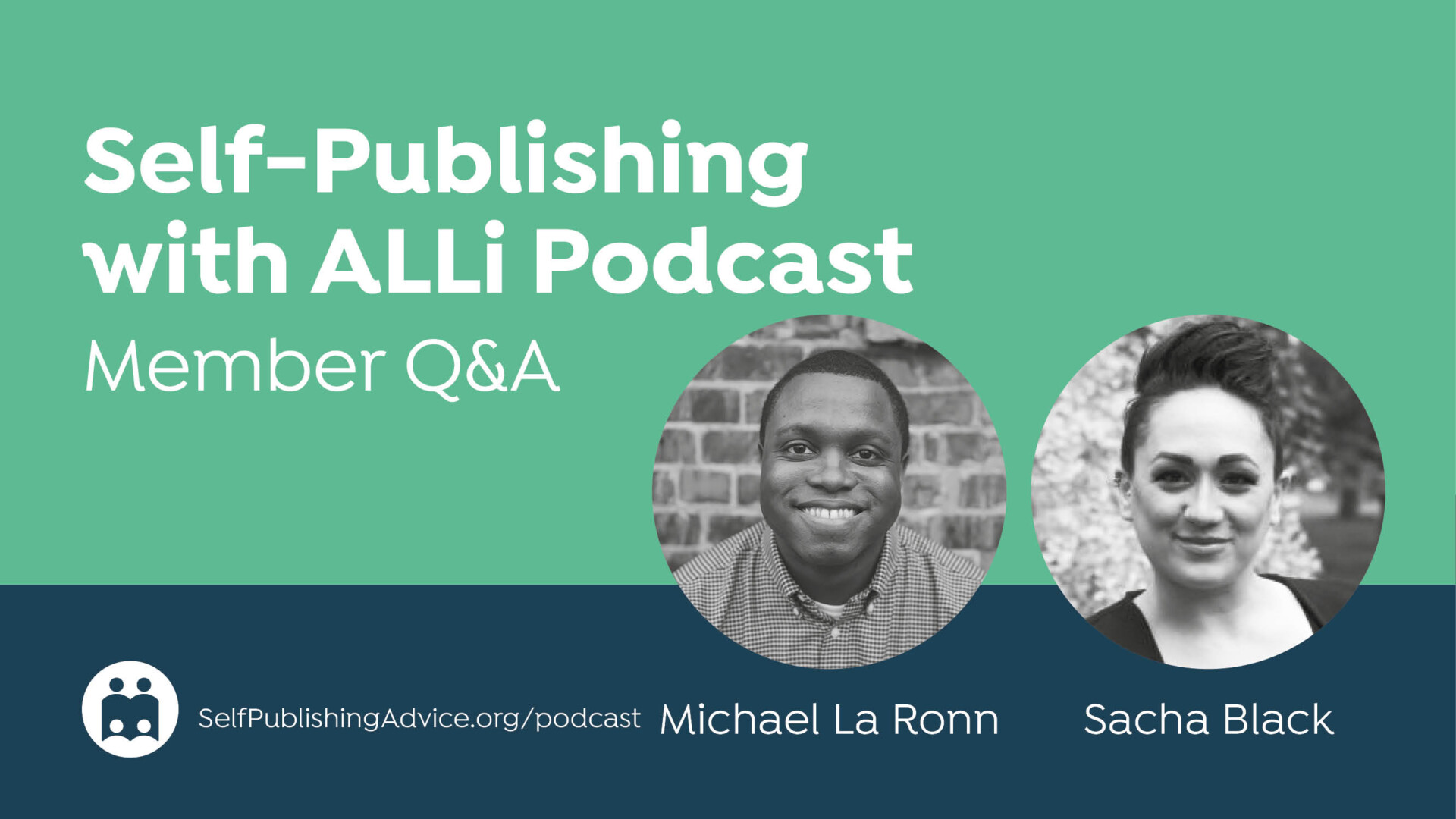
In this episode of the Self-Publishing with ALLi Member Q&A podcast, hosts Michael La Ronn and Sacha Black discuss whether it's acceptable and safe for an author to use AI in place of a $2,000 line edit, and where to draw the line between supplementing a human editor and replacing one.
Other questions include:
- What platforms are available for book reviews, and should you submit a digital or hard copy?
- Should you allow returns on IngramSpark, and how costly are they really?
- Is it sensible to price the same book a dollar higher on Ingram than on Kindle?
- What marketing steps should an author take to promote a general fiction novel before launch?
- What can you do when your audiobooks aren't selling but your e-books and paperbacks are?
- Do books in a linked series need consistent covers, and what happens when you have to switch designers?
And more!
Listen to the Podcast: Can AI Replace Your Editor?
Show Notes
Alliance of Independent Authors AI Policy
Have a Question?
If you're a member of ALLi and have a question for the Member Q&A Podcast, you can sign in and ask here!
About the Hosts
Michael La Ronn is ALLi’s Outreach Manager. He is the author of over 80 science fiction & fantasy books and self-help books for writers. He writes from the great plains of Iowa and has managed to write while raising a family, working a full-time job, and even attending law school classes in the evenings (now graduated!). You can find his fiction at www.michaellaronn.com and his videos and books for writers at www.authorlevelup.com.
Sacha Black is a bestselling and competition winning author, rebel podcaster, speaker and casual rule breaker. She writes fiction under a secret pen name and other books about the art of writing. She lives in England, with her wife and genius, giant of a son. You can find her on her website, her podcast, and on Instagram.
Thoughts or further questions on this post or any self-publishing issue?
If you’re an ALLi member, head over to the SelfPubConnect forum for support from our experienced community of indie authors, advisors, and team. Simply create an account (if you haven’t already) to request to join the forum and get going.
Non-members looking for more information can search our extensive archive of blog posts and podcast episodes packed with tips and advice at ALLi's Self-Publishing Advice Center.
And if you haven’t already, we invite you to join our organization and become a self-publishing ally.
Read the Transcript
Michael La Ronn: Hello, and welcome to Self-Publishing with ALLi. This is the Member Q&A podcast, where we answer your most burning self-publishing questions. My name is Michael La Ronn, ALLi's outreach manager, and I'm joined by Sacha Black, ALLi's strategy and communications manager. How are you, Sacha?
Sacha Black: Hello, hello. I'm good, thank you. How are you?
Michael La Ronn: I am fantastic. I don't even know what my update is for this podcast episode. I'm just, like, brain dead.
Sacha Black: Yeah, we're both a little brain dead. It's coffee morning for me. I am utterly exhausted. I've just gone through a really intense few weeks, and I'm off on a vacay tomorrow. So, yeah, I'm pretty tired. I just finished my first novella. It's a prequel novella for my new series, and I think it's my favorite thing I've ever written. So, yeah, I'm pumped for the series.
Michael La Ronn: Yay, that's exciting. Well, I hope you enjoy your vacation. It's well-deserved. Especially, you just wrote your most favorite thing in the world, and now you get to go on vacation and enjoy.
Sacha Black: I know, right? It was such a different writing experience. It was so fun. I enjoyed the whole experience. I even didn't moan about editing, and I always moan about editing. So it's quite nice.
When the Writing Flows Like Butter
Michael La Ronn: Yeah. Every once in a while — I've written so many books, and you have too — every once in a while, there's just that one book that's just easy. It's just a joy. It's happened to me twice in my career, and every time I start a new novel, I always think, “Okay, is this gonna be one where writing it is like butter?” You know? Everything is easy. You feel really good about it. You don't get the writer's block, and then, the next thing you know, the thing is done.
Sacha Black: I've written, like, 30 books, and I think I've been lucky enough to have four like that. But one was a novella, one was a very short novel, and the other two were full-length books.
Michael La Ronn: Yeah, I've had one novel and then one nonfiction book that were that way. I mean, don't get me wrong, some of my books were easier than others. Some of them were just absolute pains in the neck to write. But there's just something about those novels.
Sacha Black: I just came off of the back of having finished a duet that I thought would have me sweeping off this mortal plane, it was that hard to do. It was absolutely savage. I thought it was gonna be the book that broke my career. I thought that I would never get it finished. So to have gone from that to then writing something that, like you say, literally wrote like it was butter — it was just such a different experience. I've got, like, whiplash.
Michael La Ronn: Yeah. It's your reward for finishing that savage one.
Sacha Black: Yeah. 100%.
Michael La Ronn: We all get the cosmic award every once in a while.
Can AI Replace a $2,000 Line Edit?
Michael La Ronn: All right. First question is from Rocco, and — okay, this is gonna be somewhat of a polarizing question, so FYI. Rocco asks, “Rather than spend $2,000 for a line edit, is it acceptable and safe to use AI?” Okay. So before we answer this, we just encourage everybody to go and check out ALLi's AI policy. We'll link to it in the comments. We just wanna caveat the answer with that. Go ahead, Sacha. What do you think first?
Sacha Black: I think that each individual has to decide what they feel about AI, and then move in accordance with their own morals, values, and ethics. I think this is one of those things where it's very difficult to give a black-and-white answer. So here's the thing, right? I feel like if you were pro-AI, then I don't see why you wouldn't do that. If you're anti-AI, then I think there are lots of ways and means in which you can get forms of copy edits without a $2,000 price tag.
So there are lots of books out there that teach you about sentences and how to write good sentences. You could do beta reads. You could do author swaps, where you do that kind of a read for somebody else, and then they do it for you. You could use beta readers for more of a developmental-style edit, and then you could pay for, for example, one month's subscription to ProWritingAid and do a kind of line edit in there.
I have the lifetime ProWritingAid, and I think I paid around 400 in whatever currency it was. Now, the thing is, obviously, ProWritingAid does have AI built into its software. So again, I don't know that there's any way to completely get away from it. I think that you have to examine what you feel about AI, and then, if you do decide to use AI, please look at ALLi's policy. And please make sure that you are working in an ethical way and — what's the word?
Michael La Ronn: You're transparent.
Sacha Black: Yeah, you're transparent about how you've used it.
Michael La Ronn: Yeah. Our AI policy is at allianceindependentauthors.org/ai. Here's what I would say about this. Okay, so first things first: AI cannot replace an editor. I've used AI a lot. I use it in my job. I kinda know what the models can and can't do. These are not substitutes for human editors at this point. I honestly don't know that they ever will be. And so I wouldn't be thinking about replacing an editor. I would be thinking about supplementing a human editor. So how can you use AI to help you go further and faster? Now, $2,000 for a line edit — I don't know, that seems a little expensive to me, but it depends on how long your novel is. It could just be that you need to find an editor that's in a different budget, right? But I would not be thinking about AI as a replacement, especially if you're using something like ProWritingAid or Grammarly. I would be thinking about it as a supplement. Even if you're using something like Claude or ChatGPT, I would still be thinking about that as an augmentation to what your editor is doing.
So I would be thinking about how you can use those tools to send your editor a cleaner manuscript, okay? Or, after the editor has edited your manuscript and you've gone through, how can you use it as, like, a last line of defense before you publish your novel? And then I would make sure that you're making ethical decisions about transparency and all that.
But my general opinion — this is Michael La Ronn's opinion — AI for editing and typos and things like that is, I think, one of the more innocuous uses of AI. I think it's when you start using it for things like creating the novel, writing the novel, that's where I think it gets a little bit more dubious. But again, I would not replace your editor with AI. But if you wanted to use it to improve the cleanliness of your novel and maybe to catch some plot holes, by all means, I think you could do that.
Where to Find Legitimate Book Review Platforms
Michael La Ronn: Okay. Our next question is from Floyd. And Floyd asks, “What platforms are available for book reviews? Do I submit a digital or hard copy of my book?”
Sacha Black: Well, I don't know if I would call them platforms, but there are certainly companies that can help with both digital and physical. I would say it depends on what your goal is. For digital ones, there are more well-known places like NetGalley, which are quite expensive, and they are a little bit more trad pub focused, so the reviews can be a little bit harsher there, and they're also not cheap. Then there are other places, such as Hidden Gems and BookSprout and places like that. Please check all the terms and conditions. Check all the reviews, for want of a better word, of the review websites, et cetera. And then there are, I wanna say, BookTok-like tour companies. Nerdy Book Fam, for example, is one of them. They're quite often tailored towards one particular genre or niche, so it is worth a good look at past authors and stuff — and that company in particular is extremely expensive. They're looking for quite a significant investment. They work wonders, but they are expensive. But there are other versions of companies that do things like that.
So I would say it really depends on what your goal is. Is your goal just to get reviews? If it is, have you thought about joining Facebook groups, for example, that are genre-related and checking to see what the terms and conditions are in those groups as to whether or not you can post in those? Because that's sweat equity then, rather than having to pay. I think that's everything I've got on that.
Michael La Ronn: Yeah, I agree with that assessment. This is one area where, increasingly over the last couple weeks, I would just encourage people to be a little careful. There are a lot of websites out there — all the ones that Sacha listed are legit. They've been around a long time, no problem. I would add Book Sirens to the list. Those are websites that are legitimate. They're acceptable to Amazon's terms of service and other retailers' terms of service, no problem.
But I have, anecdotally, just personally, people emailing me, and I'm just seeing things. I've seen some websites that look suspiciously like AI, where someone will email me and they'll say, “Hey, I wanna help you get book reviews.” And the email looks like it's written by an AI, and then you click on the link, and you go to the website, and it looks like it was created by an AI as well. So I don't know whether or not the person behind it is legitimate or not, but I would just be a little cautious about a book review website that's brand new, doesn't have a track record. I would just be very, very careful, and I would really only use platforms that are vetted, because the one thing we talk about a lot on this show is that you really want to make sure that any book review website you use is copacetic with Amazon's terms of service.
In other words, you never want to pay for a review. You're only paying for access to the reviewer, and the only thing you can give them in exchange for a review is a copy of the book, and there are some places that kind of skirt the line a little bit. So definitely use our services directory at selfpublishingadvice.org/ratings. If you're a member, you can log in and access that on your dashboard. But just be very, very careful here if you decide to use something that's not a generally approved service by ALLi, I should say.
Should You Allow Returns on IngramSpark?
Michael La Ronn: Okay. Our next question is from Daniel, and Daniel says, “My book is anecdotes about a small spiritual group with a sassy teacher, plus spiritual quotes, and it's 108 pages long. I would appreciate advice from other self-published authors regarding their experience of having a no-returns policy limiting sales versus the costliness of allowing returns.”
Sacha Black: On Ingram?
Michael La Ronn: On Ingram, yeah.
Sacha Black: Well, I'm gonna log in now, 'cause I actually enabled returns recently. I think it's probably been two or three months since I enabled returns, so I should have a good amount of information. But obviously, I think it is also predicated on how many sales you are doing. The more sales you are doing, the more likely you are to see some returns. What I will say is it's quite hard to get bookstores to buy your books in any way. Okay, so what I need to do is go to compensation. Right, sorry for me just doing this. Okay. So last month I did 2,708 sales and 30 returns. I don't know what that is as a percentage.
Michael La Ronn: It's not huge. It's, like, less than 1%.
Sacha Black: Less than 1% returns, yeah.
Michael La Ronn: Or about 1%. Yeah.
Sacha Black: So I hope that helps. I mean, look, for me, I certainly have enabled returns because I am now at the point where I'm looking at bookstore distribution. So I'm actually doing wholesale from my website. I'm sending care packages to bookstores. I've actually brought somebody onto my team with the specific goal of getting me into more independent bookstores. So for me, it's a big part of a wider strategy. Whether or not it's worth the time and effort if you're not doing a significant number of sales, I don't know. There are months where I've had hardly any, like maybe two returns. And then there are months where, like last month, it was a bigger month, as I had a launch. There were up to 30. It hasn't been a big thing. What I would say is to make sure that you're watching your sales, 'cause as long as your sales are outselling the returns, then you're okay. You're still in profit. So I would say to just watch it for a month. I'd go in once or twice a week, just check the dashboards, make sure that you're not seeing more returns than sales. But yeah, I hope those numbers help.
Michael La Ronn: Yeah, that's great. Thank you for sharing that. I have never had an issue with returns through Ingram, either. I think a lot of people get really afraid because they're scared of being underwater. You hear these stories every once in a while, it's like once or twice a year, about this cabal of readers that go and buy a bunch of self-published books and then return them. Although that might be on the e-book side. But people are just afraid of that, and I completely get it. And, like you said, if you turn it on, just watch it like a hawk and you'll be okay.
Sacha Black: I gave you wrong numbers. So last month I sold 1,316, and I had 22 returns. So 22 divided by 1,316 equals 1.6% returns.
Michael La Ronn: Yeah, it's a lot lower.
Sacha Black: So it's nothing. You don't need to worry about it.
Michael La Ronn: So when you get returns, do you have Ingram send them to you, or do you have them destroy?
Sacha Black: Unfortunately, because I'm UK-based, I have to have them destroyed because of the cost of shipping. If they did it in the UK, I would have them ship them to my warehouse, 'cause I could resell them. But unfortunately, I'm not US-based. Like, weirdly, even if books are returned in the UK, they get shipped to America. Can you imagine?
Michael La Ronn: Oh, wow, I didn't know that.
Sacha Black: Yeah. It's wild. So, unfortunately, I have them destroyed, which is deeply upsetting, 'cause it's such a waste.
Michael La Ronn: Yeah. I mean, it's each author's individual choice on what to do, but one thing — if you have the books returned to you, at least you could do something with them, right? I mean, you could give them away. I have overflow books all the time, and what I like to do is drop them off at little libraries. You know those little free libraries that people put up in their yards? I think they have them in the UK. That's something you could do. You could do giveaways. You could sell signed editions on your website. I mean, there are lots of things you can do with overflow books or overstock books, so you could be creative. But I understand why people would also wanna have them destroyed, or have to have them destroyed, like in your case, Sacha.
Should You Price Ingram Books Higher Than Kindle?
Michael La Ronn: All right. We get our next question from Daniel as well, and Daniel says, “I am unhappy with how flimsy Kindle Print On Demand books are, and assuming that IngramSpark allows one to pay for 70- versus 50-pound paper, that their product will be more substantial. Does anyone know if it's sensible to have the same book, which is distributed to bookstores, be priced a dollar higher on Ingram than on Kindle?”
Sacha Black: I heard about the paper, but I don't understand why. Is that to get a similar amount of profit?
Michael La Ronn: I think it could be to get a similar amount of profit, but also I think he has concerns about the quality, and also because the paper is cheaper.
Sacha Black: The paper's cheaper on Amazon?
Michael La Ronn: That's what the question presumes. I don't know if that's actually the case.
Sacha Black: I just think we're splitting hairs. Just price it the same, 'cause otherwise you're gonna get yourself in a right pickle. It's all good and well when you've got one or two books, but when you've got, like, 30, and there's three different formats for each of those books, that's all of a sudden 90 different assets that you've got. You're not gonna be able to keep track of that. What I do is I try to price so that I always get £2 or $2 profit, minimum. And that's it. So that's how I price. And there will be some pennies or some cents difference between Amazon and Ingram, but broadly speaking, it is what it is. And then people pick and choose where they want to order from, and I don't care where they order from. I don't try and control that or worry about that.
Michael La Ronn: Yeah, I agree.
Sacha Black: Well, people that order from Amazon know Amazon quality, don't they?
Michael La Ronn: Yeah. I mean, at the end of the day, it's the quality of the book that really matters, right? So as long as you have a good cover, the book presents itself well, you've got it formatted correctly, I think readers have demonstrated over and over, over the years, that they just don't really care.
Sacha Black: I totally agree.
Michael La Ronn: When I pick up a self-published book that's printed directly off Amazon, is there some part of me that's like, “Oh, I wish my own books could look like a publisher's books”? Sometimes, yeah. But at the end of the day, I don't think it matters as much as people think that it matters. I think it's an author thing, not a reader thing.
Sacha Black: Yeah. And lots of readers, when they love a book, will have the e-book, the audiobook, and the special edition, or the paperback and the special edition. Like, the number of books that I've got in multiple formats is insane.
Michael La Ronn: Me too. So, yeah, I wouldn't worry about it so much. And in regard to the quality of Kindle versus Ingram, this debate has gone on for a long time. I think it depends. There's a couple of different things it depends on. I think Ingram's books are a little bit better quality, but I've heard some situations where KDP might be a little bit better as well. So I think it really depends on what you're printing and how you're printing it.
Sacha Black: Well, yeah, and there's also the big old debate — like, some people love a floppy paperback and some people hate it, you know? So what is quality, really? Like, one person's floppy heaven is another person's nightmare.
Michael La Ronn: Yeah. Exactly. It's in the eye of the beholder.
Match Your Marketing to Your Personality
Michael La Ronn: All right. So we got a question from Larry, and Larry says, “I'm eager to chat about next steps I should take to promote my general fiction novel, which will launch later this year, and here's what I have lined up. I'm doing formal interviews and reading at a local art center. I'm reading at a local writer spotlight. I'm recording the audiobook right now, and I'm using Ingram and KDP to publish all formats, and I've entered a few book awards. I think I should be recruiting readers through BookBub or Hidden Gems, where I've got the book up awaiting release, though I'm still waiting on that. Any advice on other steps I can take?”
Sacha Black: Yeah. So I think all of these are great. I think these are really good first steps. But I also think that what you're doing is you're looking predominantly at quite small visibility levels. So anything in person, whilst it's going to help you to build up really rabid fans, so to speak, because they buy into you as the author, you're not going to get mass numbers of eyes on your book, which means you are less likely to generate a large quantity of sales that will mean it becomes profitable and pays for your next book, or whatever.
So what I would say to you is, what kind of marketing appeals to you? That's the first question. I think too many of us try to look at doing marketing that isn't suited to our personalities and that we don't actually enjoy doing, and then it becomes very hard and exhausting to actually do that marketing. So are you a data person? Do you like maths or numbers? Are you comfortable with analyzing clicks and things like that? If so, maybe advertising might be for you. If you are good on camera and you like the visual aspects of social media, social media might be for you. If you're hell-bent on, “No, I wanna do in person,” there are ways and means to make in-person work, but you probably wanna block book back-to-back events to make sure you're getting enough eyes on your book.
Then there are other quite standard things, I would say, like, can you get some advanced people to read your book and give you reviews? We talked earlier on about Hidden Gems, NetGalley — Facebook groups that are genre-based are fantastic for finding people. I actually did that with my first Ruby book, and I still have people reading the books that I release now, you know? So those are really, truly genuine readers. No, my brain has gone. That's it. I've run out. Your turn.
Michael La Ronn: Yeah, I love everything you said. I wouldn't forget about advertising — paid advertising as well. Your book hasn't launched yet, but once you do launch it, don't forget that, because I think that's an engine that will help generate sales and continue to get the book visible, and it's also something you can test to confirm if your cover is working, if your book description is working. You can get a lot of data from paid ads as well.
Tell People Your Audiobook Exists
Michael La Ronn: Okay. Next question is from Todd, and Todd has produced audiobooks with the assistance of a studio in Wales, and he couldn't be happier with them. The feedback from friends is that it's very pleasant to listen to and they're excellent quality, but he hasn't sold any. He's literally sold less than 10 books, and he's sold hundreds of e-books and paperbacks, though. So what should he do? It sounds like there's some traction on the e-book and paperback side, but not on the audio.
Sacha Black: Well, that's a good question. I mean, ultimately, you have to just tell people that you have audio. That's the first thing. Like, have you actually done an audio release? Could you try and recruit, like, an audio listening street team to kinda help you more formally launch it? Have you tried a sale? Have you put the e-book on sale? Is it on your website? Could you do a combo, a bundle, where you're like, normally the e-book is 4.99, but today you can get the e-book and the audiobook for 6.99? What could you do to entice people in? If you're on Audible or Spotify or places like that, are there any ways and means of, like, advertising on there?
I know that Chirp is a US-based audiobook promotion platform, but I know that your audiobook has to be wide, so it can't be exclusive to Audible. So it depends on what business model you've chosen for that. But that's one. And there are also a ton of other audiobook promotion websites as well, so I would just do a quick Google and have a look for those and see if any of those you might be able to do a sale or a discount on.
But you know what? Nine times out of 10, half of making sales is just telling people that these things exist. You would not believe the number of things that I am like, “Oh my God, we can't possibly say this again on social media or in my newsletter or wherever,” and people still don't know, or they haven't bought it, or they've forgotten. You wouldn't believe. People are very, very, very busy and very involved in their own lives, and we have to relentlessly tell people about what we're selling.
Michael La Ronn: Yeah, I agree. I think the golden rule of audio marketing is ABC — always be communicating that your book is available on audio. So put it in your newsletter, put it on your website, say it multiple times on social media. Our feeds on social media are so customized, right? And social media companies will send you what they think you should buy or should see. That doesn't always include your stuff. So you have to be constantly telling people. People understand that — I don't think it's a huge deal. But there's also the question of distribution. Are you wide, or are you exclusive to Audible? Because if you're wide, then I would look at where you're distributing your books. So, at a minimum, certainly Audible — you kinda can't do this without Audible. I would be on, like, Voices and audio, to get to all the other places that are out there. Make sure your book is available on OverDrive, so you can put the little Libby icon out there to let people know that they can get it from their local libraries. There's a lot of things that you can do from a distribution perspective to make sure that your book is available as wide as possible as well.
And then, if you do all the things that Sacha said, you'll put yourself in a much better position. But another thing that you could do as well — it's more of an indirect — is if your e-books and your paperbacks are selling well, promote the heck out of those too. Because, indirectly, people will be able to find the audio. You'll expose people to the audio at the point of sale, which makes them more likely to buy.
Keep Your Series Covers Consistent
Michael La Ronn: Okay. Next question is from Paul: “My one question is whether two books in a linked series need to have their own covers looking very much in keeping with the look and feel of the series. By this, I mean, should a central character be on both books? I have two books, and each is produced a different way, and I'm just wanting to know if they should be consistent.” I kind of mangled my way through that question, but the question, really, at the end of the day, is: do I need to have consistent book covers with the same character on them?
Sacha Black: Yes. Well, does he say what the structure of the series is? ‘Cause, for example, in romance, if it is a set of five brothers, and each book is a different brother, you need enough consistency across the series for somebody to be able to look at those books and know they're connected. But you don't need the same amount of consistency as you would if it was a trilogy and all three books were the same couple, for example. So if it's, like, a fantasy series, and it's the same protagonist in every book, you would need a fair amount of consistency. Like, could you have other characters on the cover? Well, you could, but why would you? Because they're not the main character.
Michael La Ronn: Yeah. I mean, the character question is outstanding, and I think that's unique to your particular series and your genre. I think, more generally, the answer is, you want readers to look at your series and say, “Oh, that's the second book in XYZ series.” So you wanna have consistent branding. You want your colors and your fonts and just the overall structure of your series covers to be consistent. Now, whether you have a character on them, or whether it's like a cozy mystery and it's a place, that depends on your genre, it depends on your book, but you want them to be consistent enough that readers can visually make the connection in a couple of microseconds. I think the worst thing you can do is have book one designed by one designer and then book two designed by another designer.
Sacha Black: I would not do that. I mean, I have had to do that, though, and I've had to do that more than once. Essentially, what I do is I get an email with written permission from the original designer saying that I can continue to use the design. And then you just have to have a really good eye for detail and make sure that you check things like the spine, to make sure the same information is on the spine and in the same direction. Ask me how I learnt that. And you also need to make sure things like the font — if you've got, like, almost a beveled font, for example, just make sure the font is beveled with the second designer. So you just need to go through it with a fine-tooth comb. You can get away with it — would not recommend. But make sure you get permissions to use the design, because the original designer will own the right to that design.
When You Have to Switch Cover Designers
Michael La Ronn: So, if I could ask, Sacha, what was the situation, or the situations, where you had to do that? Was it because your designer quit, or what happened?
Sacha Black: I have actually had to do this on almost all my series. So the first time it happened, it was because I wasn't treated particularly well. This designer was predominantly trad pub focused. They took over a year to get the design finished, and I knew that I could not do that for every book, 'cause I wanted to publish quicker than that. The second one was basically because — I mean, I was given an awful lot of reasons as to all of the delays, a variety of reasons, and I was not comfortable. They basically lost my trust. I didn't think that I was gonna have a reliable situation there. And then, unfortunately, with that designer, somebody else brought me a cover, which I loved and then used, but it was the same designer, so I essentially got permission to use that design elsewhere. And then I couldn't get in with the designer. So there's been a few different reasons, mostly where the designers are either too busy or they have life stuff going on. So, yeah, I am yet to find a consistent designer that I can work with. Well, we've got one now who's amazing, but, you know, things have taken longer than I would like.
Michael La Ronn: Yeah. I mean, I haven't run into those issues. I'm glad you shared that, 'cause I think it's really helpful for people to hear that when you work with designers, you really have to think about the long term, right? So if you have an ongoing series that you think is gonna go on forever, you're gonna run into this problem at some point. And you also run into this problem if it takes you a while to write books. Like, if you publish book one in 2026, and then book two doesn't come out until 2029, you could potentially run into this problem. I've had, unfortunately — I had a cover designer that I worked with quite a bit. She passed away a few years ago. And that put me in this particular situation, right? So there's lots of ways you can find yourself here, unfortunately, and it's never ideal, but you still want consistent covers, and I think it's worth having a conversation with your designer.
And I also think, if you can do it — not all designers will allow it — but if you can do it, get a PSD file of your designs. Again, not all designers do it, because not all designers use Photoshop. I've had designers that didn't use Photoshop as well, and some designers just don't like to do that because that's their intellectual property. And some designers will charge you more for it. But if you have the PSD, then you can do anything. And it doesn't matter what happens in the future. I've seen designers leave the business. That's been another one. I had another designer that just basically said, “You know, this has been great. I've enjoyed it. I had a successful business, but I just don't wanna do it anymore.” Right? That actually happened to me twice. So it can happen. I think just stay as consistent as you can. If you do find yourself here, I think your advice at the beginning of this, Sacha, is super appropriate, which is, you have to have an eye to detail.
Sacha Black: Yeah, you do.
Michael La Ronn: Yeah. You have to have an eye to detail to try to salvage the situation, because it's quite expensive to have all your covers rebranded. It's very expensive. Ask me how I know.
How to Launch a Travel Book
Michael La Ronn: All right. Let's see. Next question — this will be our last question — is from John. “I'm brand new to this. I have finished writing my travel book, and it's being edited. What should I think about before publication?” So this is just more of a general question. If you were going to be launching a travel book and it's in editing — maybe you don't have a cover yet — how would you be thinking about publication?
Sacha Black: I mean, everything that we've already said for the other person that asked how to launch a book. I think, actually, book launching is pretty similar across every genre, in that your goal is to get as many eyes on your book as humanly possible. Now, there may be things that are unique to travel publishing. Say, for example, are there more podcasts where they have travel as a topic? Are there different types of PR or visibility that you could get from the travel industry? Could you work with companies? Are there still people blogging in that industry, where that might be useful? I feel like, what is it that's unique about the travel industry? What avenues or areas where you could meet people and get eyes on your book are there that aren't necessarily something that we would have as a bog standard genre fiction author? Be that, yeah, audiobooks, or even the radio — like, maybe there's more mainstream PR media that might be relevant. But ultimately, when you first finish a book, your goal is to get eyes on that. So are there different types of ad people on Facebook that you could target? Like, different targets that we might not have access to as just standard fiction writers. Are there different types of Facebook groups? It's all this same thing: how do you get eyes on your book? Well, where are the people that would be reading travel books based? Do you need to try and make friends with local independent bookstores? Is there a travel bookstore near you? What do you think about this?
Michael La Ronn: Yeah. I think you have more options — definitely more diverse options with travel. I would really be thinking about, like, Instagram or influencers, with people that have done videos and have traveled to the place that you're going to. There's just lots of options. And I also think of, like, pictures and social media. If you've traveled to particular places, there's just constant opportunities to be able to be more visual. Because I think the thing with marketing is that marketing is a highly visual thing, and I think fiction authors that figure this out — like, you do a really good job of this, Sacha. You have character art. Your stuff is immediately visual, and it's really easy to get what you're doing. I think that's how you have to think about travel, right? There's just something about traveling and getting away that is really easy to convey with images. And so, in my marketing, I would be highly visual. That's what I would be thinking about. But that's exciting. Good luck, and good luck publishing that book, and hopefully it's traveling to somewhere warm and interesting, and we wish you the best of luck with it.
Sacha Black: 100%.
Michael La Ronn: So, okay, we are at the bottom of another episode, everyone. We are nearing the bottom of the queue, so if you've got questions, please let us know. If you're an ALLi member, you can log into your dashboard and submit questions on our form, and we will answer them on the air. And this has been the Self-Publishing with ALLi Member Q&A podcast, and we will answer your questions on the next episode. Thank you for listening, and we'll talk to you next time. Bye, Sacha.
Sacha Black: Bye.
Michael La Ronn: Bye.