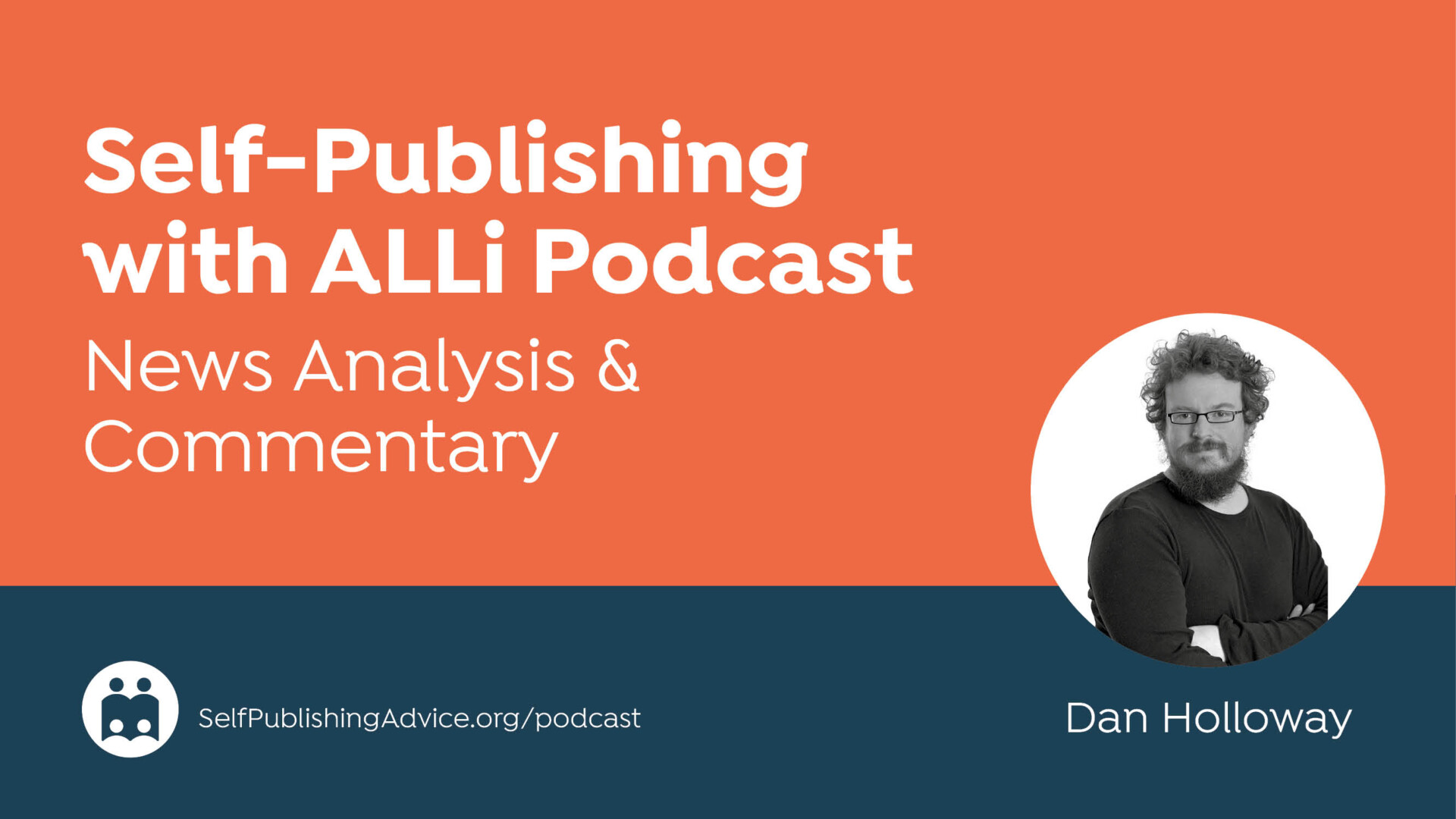
On this week's Self-Publishing News podcast, ALLi News Editor Dan Holloway sorts through new Authors Guild clarifications on the Anthropic settlement: payments should still begin trickling through from November, but rights-reversion disputes are clouding who gets paid what, and authors whose rights reverted by August 10, 2022 are advised to claim their full 100 percent share. He also covers Spotify taking its ElevenLabs-powered audiobook creation tool out of beta for all US authors — free for five titles, with no exclusivity — and a new Frankfurter Buchmesse report finding that only 15 percent of audiobooks are made with no AI at all.
Listen to the Podcast: Authors Guild Clarifies Anthropic Claims
Show Notes
Authors Guild guidance on the settlement
About the Host
Dan Holloway is a novelist, poet, and spoken word artist. He is the MC of the performance arts show The New Libertines, He competed at the National Poetry Slam final at the Royal Albert Hall. His latest collection, The Transparency of Sutures, is available on Kindle.
Thoughts or further questions on this post or any self-publishing issue?
 If you’re an ALLi member, head over to the SelfPubConnect forum for support from our experienced community of indie authors, advisors, and our own ALLi team. Simply create an account (if you haven’t already) to request to join the forum and get going.
Non-members looking for more information can search our extensive archive of blog posts and podcast episodes packed with tips and advice at ALLi's Self-Publishing Advice Center.
Read the Transcript
Dan Holloway: Hello, and welcome to another week of self-publishing news, and we begin with some important clarifications around the Anthropic settlement. So as you know from recent reports, there are currently some disputes going on. There was a claim launched by lawyers that legal fees should make up a larger proportion of the settlement.
Authors Guild Clarifies Anthropic Settlement Disputes
And we have had in the interim period since then some very helpful clarification on several points. I will make sure that there is a link in the description below to a very useful post by Authors Guild with a lot of outlining of clarity on a number of things to do with what are being called allocation discrepancies.
I'll get into that in a little bit more detail in a moment. But on those legal fees, one of the interesting things — and thank you to Jane Friedman for her sense on this — is that any dispute over the extent of legal fees should not actually impact on the date when those claims where rights holders are established begin to be paid.
So it should still be the case that where there is a clear sense of who is the rights holder for a particular title, those payments start to trickle through from November onwards. So that is very encouraging news. However, it seems that that “where rights are clearly established” phraseology is doing quite a lot of work, because it seems that there are significant cases where it is not clear who are the rights holders for a particular title, and there are some disputes, and in many cases, this is because publishers are claiming to be or to have an interest in the rights that authors are saying they do not have.
And the most important of those for indies is around rights reversion. So, it seems that there are several cases known, and many thousands more that are not necessarily known by name, where authors believe that they are entitled to 100 percent of the settlement because they are now sole owners of the rights, because rights have been reverted to them, but publishers are still claiming that they are entitled to 50 percent of the rights, as they would be if rights had not reverted.
Obviously, rights reversion is something that is a sensitive issue always for indie authors. It is something where publishers, many people often feel, tend to drag their heels somewhat. And Authors Guild have issued official — or not official, but helpful — guidance. And what they are recommending is that where rights reverted before August the 10th, 2022, any author who believes that the rights have reverted to them, and they are therefore 100 percent rights holders, should continue to stake their claim on the basis of a 100 percent share of the settlement.
So do go and read in more detail what is said in that post. There is some very useful information there. And there are some tools and forms and things that you can use to play around to work out whether there might be a dispute in your case. But the guidance seems to be that if rights reverted to you by August 10th, 2022, then you should proceed as though you are entitled to 100 percent of the amount of the settlement for that title.
Obviously, some of the issues arise from the fact that there is not always clear paperwork demonstrating at what point rights did revert. So there we go. Definitely some really, really important updates in the Anthropic case and some useful information out there. Please do go and check it out if you are worried about when you think your payments might be due, or whether you think there might be a dispute over the amount to which you are due.
Spotify Opens AI Audiobook Creation to All US Authors
So that brings us on to Spotify. And a big announcement from Spotify this week that they are taking one of their key features out of beta and making it available to all authors in America. And that is their audiobook generation tool — it's called Audiobook Creation Tools. It's available through Spotify for Authors. And this is the ElevenLabs collaboration that they had launched in beta. And it allows authors to submit an EPUB file and have it turned into an AI-narrated audiobook using one of a number of voices of their choice. There are all sorts of features that are tied in.
So as I say, it's English language for the time being, but you can choose various different accents. You can choose different dialects. You can prompt it and teach it in various ways to do things like helping it with the pronunciation of specific names within your book. And most important is it is now available to every author in the US.
There are certain conditions to it. As I say, it's English language only is the first one. You are only entitled to use it for five titles initially. You can get in touch with Spotify if you'd like to use it for more than five titles. But for those first five titles, it is free. And the real thing, and this is something that Spotify have sort of prided themselves on for quite some time, is any e-book or any audiobooks that you generate like this, they will not claim exclusivity over.
So you can generate your audiobook through Spotify for Authors and then make it available on any number of distribution platforms you wish, and do so as the owner of the rights to the title. Finally, they will make it clear on their platform: any audiobooks created in this way will be labeled as AI-generated, and therefore that will enable both authors and listeners to make informed decisions about their use and consumption of AI.
Frankfurt Report Charts AI's Spread in Audiobooks
So, there we go. Very, very big development from Spotify there that is going to make a lot of potential audiobooks available to a lot of authors. And that brings us to, I guess, our last story of the week. It's the announcement of a new report from Frankfurter Buchmesse. This is obviously leading up to Frankfurt — you can sign up for free and gain access to a number of really interesting industry reports.
And one of them is on AI in the audiobook industry. And obviously, this is the wider publishing industry, it's not just indie titles. But there are some interesting stats in here. And one of those is that only 15 percent of audiobooks use no AI at all in their creation. That's not to say that the other 85 percent use AI narrators.
In a lot of cases, this will be AI that's been used either for editing or in marketing or in helping with workflow. But it shows nonetheless that AI is being used, and being used a lot, in the audiobook industry. Also interesting is that respondents from the industry were asked about the barriers to the use of AI, and the survey found that the main one, and this was cited by 50 percent of respondents, is choices, as they put it, made and restrictions imposed by authors, agents, and others within the industry.
And I found that particularly interesting framing, because it is very much framing choices that authors and others make about the use of AI as in and of themselves restrictive. So it feels like there might be a little bit of a value judgment being made there. But whether there is or whether there isn't, it is really interesting now that it's nothing technical.
It's not to do with quality in particular. It's to do with choices people have made about whether and how to use AI. That is now the thing that is shaping whether or not people do use AI. So another sign of the growing maturity of the industry. And with that, I will leave you and very much look forward to speaking to you again at the same time next week.
Thank you.