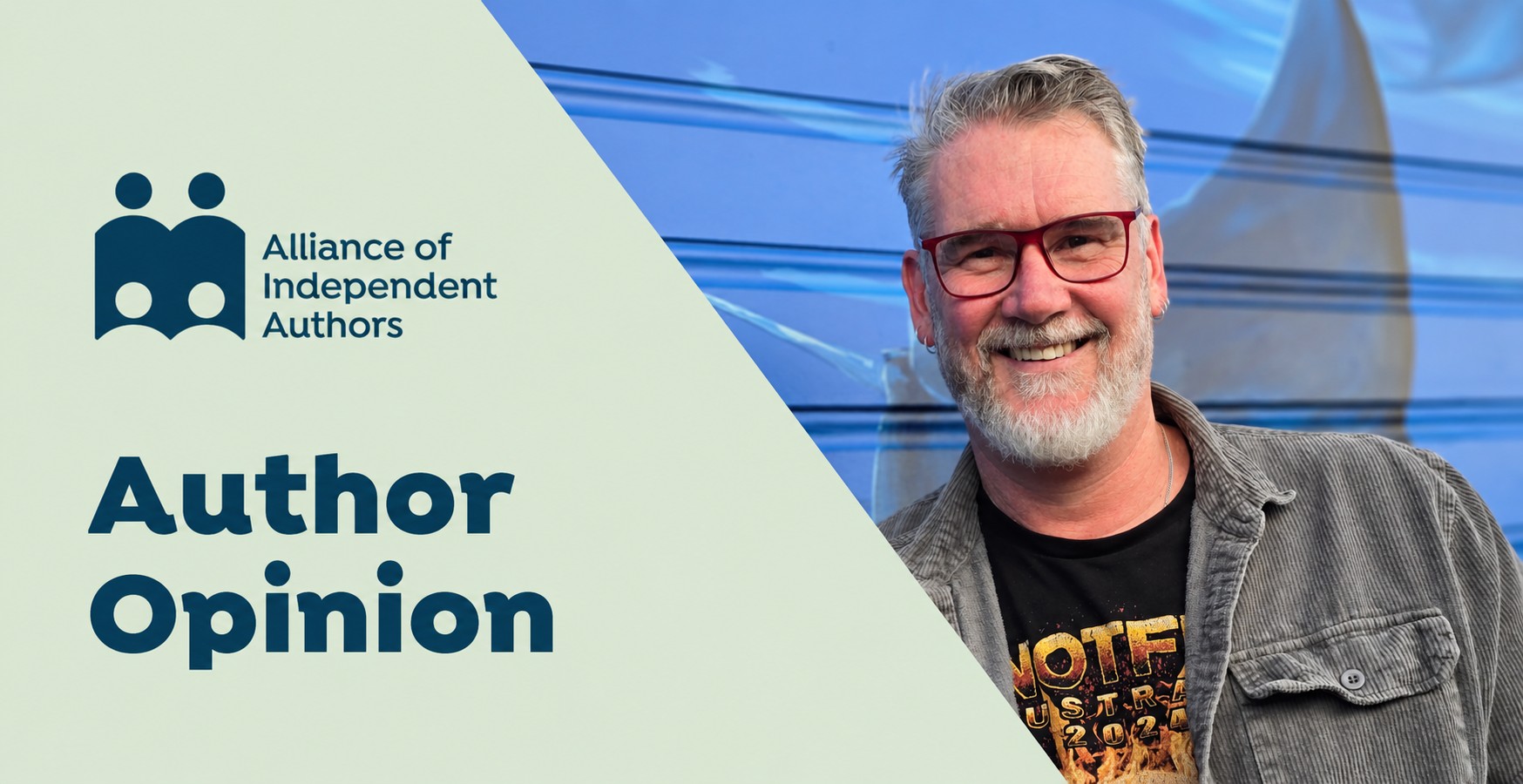
This is an informed opinion piece by Nigel George, an indie author, ALLi Author Member, and the founder of GNW Independent Publishing (indiepublishing.au). He helps writers skip the snake-oil internet gurus and build sustainable careers based on authentic relationships with their fans. A staunch believer in human-first creativity, Nigel advocates for using AI to streamline author business tasks so writers can focus on what matters most: 100% human-created art.
The views expressed are his own, you can read ALLi's position on AI in publishing in our AI Policy. Look out for analysis of our recent AI survey in the next issue of The Indie Author magazine.
“No” is a complete sentence.
It's a frightening time to be a writer. Algorithms that demand endless output for success. Minimal social media reach made even worse by a plague of AI slop. A social discourse that amplifies dissent while marginalising agreement.
The large AI companies would have us believe their AI is the next stage of human evolution and the only way to survive is to jump on their bandwagon. But for writers (and other creatives), AI looks more like a race to the bottom–where the core tenets of human connection and shared experiences are being commoditised for profit.
I count myself lucky that I have a strong technical background as well as a creative side–I like to call them Tech Brain and Creative Brain.
Tech Brain knows something that the large AI companies don't want us to know: for AI to evolve from where it is now, they need us.
You have far more agency in what comes next than you think. We will never get the genie back in the bottle, but collectively, creatives have a far greater capacity to say “no” than the tech bros would have you believe.
The first step is to pull back the curtain.
Putting the Machine Back in its Box
Think of words often used in the media to describe AI. You would likely list things like AI:
- Hallucinates or lies
- Thinks or understands
- Learns and remembers
- Wants and decides
- Creates
How do they make you feel? What images do they conjure in your mind? They're all very common ways to describe humans.
Unfortunately, they have no relationship with what's actually happening inside the box. This is what's really going on (in order):
- Sampling error or statistical misprediction
- Calculating probability and weights
- Context caching and RAG
- Function minimisation and algorithm execution
- Interpolation and diffusion
What are those feelings and images in your mind now? Assuming you understood all those sciency terms, you likely felt little human connection or empathy with the second list.
With apologies to the real computer scientists for bending some definitions to make my point, there is an extremely important takeaway here: by lending human characteristics to a machine, we risk devaluing the very real human intelligence that made such a machine possible.
To start, John McCarthy coined the term “Artificial Intelligence” in 1955 as a branding exercise, not as a scientific thesis. It is also an oxymoron because an AI is not intelligent.
True intelligence requires lived experience, temporal awareness, an understanding of causality, and intent. AI is an enormous box of numbers massaged and interrogated by complex algorithms.
The current frontier models have absorbed the entire corpus of easily accessible human knowledge–something that would take an individual human about half a million years to read.
Ignoring the fact that this represents the biggest theft of human intellectual property in history, and the plague of AI slop it generated, think of what that has achieved in real human terms.
An average four-year-old knows it's not OK to lie. Show the toddler a picture of a seagull and they have a pretty good chance of identifying any kind of bird in any context.
Despite millions of lines of code and rules written, AI still generates false information because the corpus it absorbed also includes every lie humans have put in print. Despite digesting billions of photos, AIs are pretty hit and miss at identifying anything with human-level accuracy.
AI companies' current response to this limitation is to build bigger models. But even if they succeed in building datacentres big enough to house even larger models without destroying the planet, it's still just a box of numbers emulating thought, reasoning and intent.
An AI can mimic Shakespeare, but it will never be Shakespeare.
AI's do have one significant advantage over humans, however. AI's capacity to analyse data and recognise patterns and relationships far exceeds anything we could achieve as an individual, or even as groups. This is not just a technological change like the invention of the printing press or computers; it is a complete paradigm shift, and one that writers and creatives are in a unique position to take advantage of.
The Second Great Paradigm Shift: Externalising Cognition
AI is not just another technological innovation like the printing press, or the motor car, or computers. While it is a technology, the impact it represents for humans goes far beyond its utility as a tool.
The first great paradigm shift was the invention of writing itself. When we created writing, we created a system where we didn't have to remember everything important about our lives, the world as we saw it, or the myths and norms of the society we lived in. Once something was written down, we didn't have to keep it in working memory. By externalising memory, we created the conditions for human advancements like formalised philosophy, science, mathematics, and literature.
AI represents a second great paradigm shift because it allows us to externalise cognition. With AI, not only can we externalise memory, but we can also offload a lot of the cognitive processing that comes with research, summarising, testing ideas, and problem-solving.
The operative word here is “offload”. Unfortunately, the vast majority of what is problematic with AI generation is closer to delegated or outsourced cognition. Once we shift human reasoning, judgment, and emotional truth to the machine, the creative function collapses.
I find it a delicious irony that, in arguing against writing in Plato's Phaedrus, King Thamus states that writing gives us “the appearance of wisdom, not its reality”. If there is a better definition of AI slop, I haven't found one.
Claiming Your Creative Agency
In a world where we are bombarded with information and surrounded by people shouting conflicting messages, it is natural to go looking for simple answers. Unfortunately, there are no simple answers in a landscape where technology is advancing far faster than human reasoning, moral philosophy, and politics can keep up.
Writers and other creatives are in an incredible position to influence what comes next with AI because communication and shared human experience is our raison d'être. To succeed, we need to come from a position of strength.
To me, creative agency comes from three core philosophies:
Know your “No”
Do you remember the last time you just said “no”? That little spark of self-confidence you got, even if it was only to light a dark corner in a cavern of fear?
Knowing where you draw the line is incredibly powerful. I have a “no” when it comes to creative writing–AI does not make the page.
It's simple and informs everything I do. I work full-time. I also coach other authors, write fiction and non-fiction, and publish articles online. Somewhere in there I still have a life I enjoy. I could not achieve half of this without the AI toolkit I have built to support that level of output. It will continue to help me innovate and grow my writing business. But for all my creative output, AI doesn't make the page.
Copyright is for Humans
Having organisations like ALLi advocating for author rights is fantastic, but ensuring copyright remains in human hands is a torch we must all carry high.
I mentioned previously that the big AI companies need us. This is not a philosophical argument, but a scientific fact. There is so much AI slop online now that frontier AI models are now risking devolution of outputs unless they get more clean, human-generated data.
That is why the tech bros are working so hard to water down copyright laws because they need our creative output to improve further. We must resist this with our every breath.
Not just by resisting the dilution of copyright, but by ensuring our companies and governments enact and enforce laws ensuring there can never be copyright for AI-generated content.
We should also support any “Human Generated Content” marks as they develop, and petition online platforms to remove or clearly mark AI-generated content.
It's Just a Machine
We're writers; we know words have power, so we need to be vigilant not only with the words we use when talking about AI but also with how we interpret its outputs.
While terms like “hallucinate” and “create” are convenient shorthand in communication, we must be careful not to define them as intrinsic attributes of AI, rather than artifacts of an imperfect facsimile of creative intelligence.
As uncanny as the outputs can be, an AI is an extraordinarily sophisticated statistical calculator. It has no moral compass, no intuition, no experience, and no understanding. All the capabilities it exhibits are a reflection of its human creators.
Writers Can Thrive With AI
There have always been winners and losers with technological changes. AI is not just a technology, but it also represents an exponential shift in how we can access, interpret, and synthesise the corpus of human thought.
The path ahead is complex, but complexity is the nature of all things. Since the advent of writing, writers and creators have provided a way to navigate complexity, to find meaning and connection, and to explore what it is to be human.
Unfortunately, AI for writers is most often framed between either championing the inviolate sanctity of human creativity, or as supporting the commodification of all that it is to be human in the name of profit.
I am lucky to have Tech Brain and Creative Brain because I've never had to consider the either/or argument. I do truly believe that there is an incredible opportunity for writers to demonstrate AI's capacity to augment human creativity, not replace it.
We just have to stand up for our work, be confident and remember:
“No” is a complete sentence.