Updated July 2026 | Originally published March 2025 | By ALLi Editorial
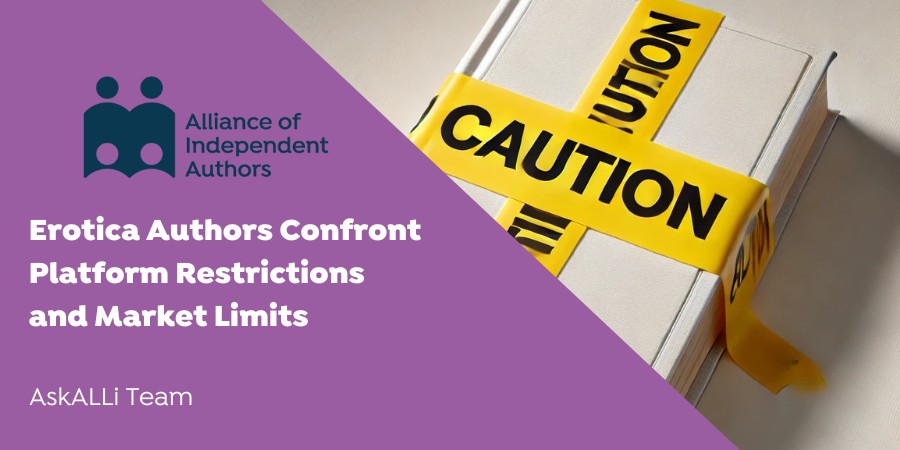
Erotica authors have always worked on the margins, pushing boundaries of taste, acceptability, and publishing norms. For many, the genre offers a space for freedom, identity, and creative expression. But that space keeps shrinking. Algorithms quietly bury books. Platforms impose vague restrictions. Advertising is nearly impossible. And since we first published this piece, the pressure has moved up a level: payment processors and card networks are now shaping what erotica authors can sell, not just how they can market it.
This piece is about erotica, not romance. The two overlap and plenty of authors write both, but platforms increasingly treat them differently, and one of the clearest developments below is exactly where that line now sits, in the platforms' own words.
At a Glance: Where Erotica Stands Across Platforms in 2026
| Platform | Erotica allowed? | Ads permitted? | Key 2026 development |
|---|---|---|---|
| Amazon KDP | Yes, as its own category | No | The “dungeon” flag remains opaque (see below) |
| Barnes & Noble | Yes, hidden by default | Limited | Readers must opt in via account settings |
| Kobo / Google Play | Restricted sampling | No | No free samples of sexual content in first 20% |
| Draft2Digital | Yes, with certification | No | Must certify against a prohibited-themes list; new $20 account fee (Apr 2026) |
| IngramSpark | Yes, with GPSR metadata duty | No | EU General Product Safety Regulation now applies to metadata |
| Kickstarter | Text only, no explicit art | N/A | Briefly banned erotica outright in May 2026; reversed within a week |
| Ream | Yes, explicitly | N/A | Negotiated a rare direct carve-out with Stripe |
| Substack | Yes, text only | No discovery | Excluded from search/discovery; UK 18+ labelling applied |
What is “the Amazon dungeon”? It's the nickname authors use for Amazon's internal Adult content flag. A dungeoned book sits in an 18+ section that doesn't appear in normal search results, reachable only by readers who've manually switched on 18+ search in their account settings, which is off by default. Dungeoning doesn't remove a book from sale, but it makes it nearly unfindable, even for readers who already own another book by the same author. Being categorised as erotica does not by itself trigger the flag: erotica simply loses access to Amazon ads while remaining searchable. There's no published list of what triggers it: reported causes include suggestive cover art, certain keywords, and even the phrase “content warning” (which is why many indie authors now write “content notes” instead). Since June 2023, authors can also voluntarily flag their own book as explicit during KDP setup, so not every Adult flag is punitive.
Build a Marketing Plan to Reach More Readers
13 Foundational Basics You Need to Get Your Marketing Right.
What Is Erotica, Really?
Ask ten writers to define erotica, and you'll get ten answers. For Regina Kammer, a librarian, art historian, and multi-published author of provocative historical and contemporary romance, erotica is a literary form in which sexuality is central to the story, not just present but driving the plot, themes, and character arcs.

“Porn does not conform to dramatic story: the main character gets what they want with zero effort. Erotica means there is a story, the main character has setbacks, things are not easy.” — Steve Turnbull
“Erotic romance has all the elements of erotica,” she explained, “but includes the conventions of romance, those conventions being a Happily Ever After or a Happily For Now.” Strip away the sex, and the story no longer holds.
Steve Turnbull, a writer of fantasy, science fiction, steampunk, and steampunk erotica, takes a slightly different view. For him, erotica is best defined as “sexual discovery,” and it doesn't necessarily require on-page sex. The key distinction, he argues, is structure.
“Porn does not conform to dramatic story: the main character gets what they want with zero effort,” he said. “Erotica means there is a story, the main character has setbacks, things are not easy.”
His work, often set in a queer, historically grounded steampunk world, includes explicit scenes but always centres on character development and narrative depth. “I can't write that short and without a real story,” he said.
Despite these thoughtful definitions, platforms and readers often lump everything under one broad, often misunderstood label. Writers who include any kind of intimacy risk being miscategorised or filtered. Some avoid the label entirely out of fear that their books will be hidden or flagged.
Platform Challenges and Censorship
Turnbull summed up one of the core issues in two words: “Fake prudery.” Current platform policies make it nearly impossible to promote erotica through traditional channels. “Amazon won't let you create ads for a book labeled as any form of erotica. Same for Facebook,” he said, adding that Meta-owned Instagram and Threads apply the same restrictions.
Of the major social platforms, “only Mastodon and BlueSky are essentially unrestricted, but they don't run adverts.”
Kammer has watched platform policy shift for over a decade. “Around 2013, Amazon started cracking down on what it considered erotic content,” recategorising books without author input and, in some cases, banning them outright. That mostly hit romance titles, including from mainstream publishers: “For a time, choosing any romance category could get that book tossed into erotica categories even if nothing erotic happened in the story.”
Amazon's approach has since improved. “They now allow erotica categories to exist alongside non-erotica categories for the same book. Still, authors are wary about words in blurbs and titles, and images on covers, as there are some undefined triggers that place romance titles into erotica.”
Barnes & Noble introduced an “erotica content” designation that hides flagged books from its public site by default; readers must log in and opt in to see them.
Google Play bars free samples of sexual content in a book's first 20%, even for logged-in users.
Kobo briefly tested a similar filter and backed down under author protest: “but Kobo showed they have the technical infrastructure to reinstate this at any time.”
Smashwords, now part of Draft2Digital following the March 2022 acquisition, runs three separate erotica filters based on whether “Erotica Themes” is checked at upload. Draft2Digital's own certification has tightened further: authors must now certify erotic titles against a defined list of prohibited themes (underage characters, incest and pseudo-incest, bestiality, and rape or “dubious consent” framed for titillation) before distribution. Kammer has had two books blocked from Hoopla and a short story collection rejected over its title alone, “even though no other retailer had an issue with the collection.”
IngramSpark has introduced language under the EU's General Product Safety Regulation that Kammer says could be read as covering “the safety of consumers' mental health,” placing the burden on authors to keep metadata accurate. “There are no such filters for violent content, including ultra-violent content,” she noted. “Most retailers are obviously targeting erotic content only.”
Why Draft2Digital Is Tightening Up
D2D's certification requirements aren't really about erotica: they're about AI spam. In April 2026, D2D introduced its first-ever direct author fees: a one-time $20 activation fee for new accounts and a $12 annual maintenance fee, waived for accounts earning $100+ in net royalties a year. Co-founder Kris Austin told ALLi members the platform has, in some months, rejected over 70% of submitted titles, the bulk of it AI-generated spam from single-use accounts. The $20 fee breaks that economics: a hundred spam accounts now costs $2,000 rather than nothing. Austin was candid that D2D won't be the last platform to introduce fees like this: if Amazon, Apple, or Kobo follow, erotica authors, who already carry ad restrictions, could face a second layer of cost.
Build a Marketing Plan to Reach More Readers
13 Foundational Basics You Need to Get Your Marketing Right.
Payment Processors: The Real Chokepoint
Retailers aren't the only gatekeepers any more; payment processors increasingly are, and this matters even if you sell direct from your own site. PayPal's policy restricts digital sexually-oriented goods outright. Gumroad banned all sexually explicit content platform-wide in March 2024, citing pressure from Stripe and PayPal, with roughly 24 hours' notice to creators. Payhip and other Stripe- or PayPal-based storefronts inherit the same restrictions.
The clearest sign this pressure is escalating rather than settling came via the games industry in 2025: after the advocacy group Collective Shout lobbied Visa and Mastercard, the card networks pressured Steam and itch.io into pulling adult content, and itch.io's own postmortem admitted the sweep caught far more than pornography, sweeping in suggestive and queer-themed work too. The pressure has since gone international: Japanese doujinshi retailer Melonbooks lost card processing entirely, and at least one archive site shut down after losing all payment options. Organised pushback is building too, including the ACLU's public petition calling on Mastercard to end the policy. Book retailers haven't been directly hit yet, but this is the mechanism worth watching.
Crowdfunding: The Kickstarter Warning Shot
In May 2026, Kickstarter, under pressure from Stripe, published new “Mature Content” guidelines that drew this exact line explicitly. Romance and “spicy” literature, including comics, remained allowed; content “created for sexual pleasure” did not. Creators reported being told they could describe a sex scene in text but not depict or suggest it in cover art, and that projects “where the primary value offered is access to explicit content” would be rejected outright, aimed squarely at erotica rather than romance-with-heat.
The backlash was immediate enough that Kickstarter reversed course a week later, on May 19, reverting to its older, vaguer “no pornographic or illegal content” rule. But Kickstarter also warned that Stripe can still freeze or suspend a campaign's funds mid-drive regardless of Kickstarter's own written policy, so the underlying risk hasn't gone away even though the policy softened. If you're weighing Kickstarter for a box set or special edition, treat this as unsettled ground. BackerKit (adult content allowed behind an 18+ label, subject to its payment partners' rules) and the newer IndieCrowdfund, built on a non-mainstream processor, have both positioned themselves for creators displaced by this shift, though neither is proven at Kickstarter's scale.
The Legal Landscape
The UK's Online Safety Act is fully in force and has already pushed sites like Pornhub out of the UK market, with fines of up to £18m or 10% of global revenue for non-compliance. It's aimed at video and image platforms rather than ebook retailers, but Ofcom has signalled it will keep reviewing scope.
In the US, the Supreme Court upheld Texas's age-verification law (HB 1181) in June 2025, and more than twenty states now have similar laws requiring age verification on commercial sites where over a third of content is “sexual material harmful to minors.” Several of these state statutes define that material to include written descriptions of sexual acts, not only images or video, meaning a direct-sales website built around explicit text erotica could, in principle, fall within scope in some states. No one has tested this against a pure-text erotica seller yet, but it's worth knowing before you build a business entirely around your own storefront.
LGBTQ+ Erotica: An Extra Layer of Restriction
LGBTQ+ authors, including many not writing erotica at all, face suppression on top of everything above, simply for using queer-identity language. On TikTok, both reporting and academic research point to a documented pattern: automated content review restricts recommendations based on keywords like “gay,” “queer,” or “trans” appearing in a post, independent of whether the content violates any actual guideline. Entirely non-sexual, fully clothed content has been flagged as sexual for using the word “trans,” while comparable content from straight creators wasn't touched. TikTok has itself acknowledged intentionally suppressing LGBTQ+ creators' visibility in the past, framed as protection from harassment.
This affects book discovery directly: a queer romance or erotica author posting non-explicit BookTok content about a “sapphic” or “MM” title can still see reach suppressed for using perfectly ordinary genre terms. The category miscategorisation and dungeoning covered above compound for LGBTQ+ titles too, enough that Pride & Pages Book Club, a dedicated promotional service, now screens out dungeoned titles before accepting a book into its newsletter roster.
If you're a queer erotica or romance author, worth knowing: Pride & Pages Book Club for newsletter promotion, Gay Book Promotions for LGBTQ+-focused blog tours, and review networks like The Lesbian Review, LGBTQ Reads, and Love Bytes Reviews. LGBTQ+ small presses, including Bold Strokes Books, Interlude Press, NineStar Press, and Bella Books, are a hybrid path worth considering, bringing a built-in audience self-published authors don't automatically have.
Mislabeling and the Market
Kammer has lived the cost of miscategorisation directly. “Before Amazon's category overhaul a few years ago, a number of my romance books were placed in erotica categories, and I could not get them recategorized,” she said. A cover change even shifted her adult-filter status once: “A second edition I published in 2013 on Amazon was adult-filtered for nudity on the cover, when the first edition (2009) with the same cover was not. I changed the cover a couple of years later, and the filter was removed.”
Turnbull sees the market itself narrowing. “The increasingly striated kink structure means you cannot expect to sell anything unless it features a very specific kink, and nothing else,” he said. “My erotica does not fit into that broader landscape kink. And since I can't sell it, I haven't been writing it, which is a shame.”
Author John Straughn captured the confusion many writers feel at the boundary: “I'm confused about where the line is between erotica and a hot scene. My book, like many, has some intimate scenes. But they're classy scenes, not trashy, cheap sex. The focus is more on emotional connection. I don't consider it erotica, not at all.”
AI-Generated Content Is Crowding the Shelf
One more pressure has entered the picture since we first covered this: AI-generated content competing directly for the same shelf space. Purpose-built tools now market themselves straight at erotica and romance writers, generating full drafts by “heat level” in minutes. Kindle Unlimited's wider AI-spam problem (flooding categories, diluting sales, review-bombing) increasingly touches erotica specifically. That's a different issue from authors using AI as a tool responsibly in their own process; the threat is the industrial content-mill version crowding out human-written work, not AI assistance itself.
Build a Marketing Plan to Reach More Readers
13 Foundational Basics You Need to Get Your Marketing Right.
Strategies for Survival and Success

“Find community with your erotic romance colleagues! Passionate Ink is one such specialized organization for erotic fiction authors.” — Regina Kammer
Faced with platform restrictions and market limitations, authors are adapting. Turnbull pointed to Cornelia Quick, who has “embraced the striation, writing multiple kinks and distributing everywhere but also sells direct from her website” while maintaining a strong social presence.
Subscription platforms. “Patreon and Ko-fi are another way successful kink-based erotica writers have gone, not just erotica either,” Turnbull said. Both still permit adult content, though with escalating requirements around age verification and consent documentation, so check current guidelines before building a paid tier around either.
Eden Books, recommended by Kammer, remains active in 2026 as a direct self-publishing platform founded in 2019 in response to Amazon and other retailers blocking romance and erotica. No aggregator required, no exclusivity clause, authors set their own pricing from a dashboard, with its own consumer-facing storefront and app.
Kindle Vella, Amazon's serialised-fiction platform, closed in February 2025. It's worth naming specifically because Vella's catalogue leaned heavily erotica (several authors and readers described it as having “nothing on it but erotica”) so its closure was a genuine loss of venue. Authors have migrated to Radish, Tapas, and newer entrants, though none currently match Amazon's reach.
Ream (reamstories.com) has filled some of that gap: a subscription and serialisation platform, co-founded by a romance author who left Patreon over content takedowns, that negotiated an explicit carve-out with Stripe to process payments for erotic literature and NSFW art, a genuinely rare arrangement, since Stripe, PayPal, Adyen, and Checkout all technically prohibit adult content in their terms. Ream's guidelines permit real erotica (explicit sex scenes as the primary plot driver, not just background heat) under a reader-optional “Mature” tag. It still excludes the same “big four” themes as everywhere else (bestiality, snuff, necrophilia, incest) and treats rape or sexual-slavery-for-titillation as a grey area.
Substack explicitly permits “erotic literature” in its content guidelines, distinct from the visual pornography it bans, but excludes that content from discovery and search, and now applies UK Online Safety Act 18+ labelling. It's a real option for reaching an audience you already have; it won't help you find new readers.
Genre-bonding matters more in erotica than almost anywhere else, precisely because so many conventional routes to visibility are closed. Where paid ads and mainstream algorithmic discovery are off the table, the practical alternatives are the ones working authors already use by instinct: newsletter swaps with genre colleagues, ARC teams built through BookFunnel or BookSirens (reviews are one of the few discovery signals ad restrictions can't touch), box sets and multi-author bundles that pool existing readerships, and, since erotica readers tend to be high-volume Kindle Unlimited readers, pacing series around page-read behaviour rather than per-copy sales. Genre-specific promotional newsletters such as Written Word Media's romance-focused lists and Book+Main Bites accept “spicy” and erotica titles where general-market services like BookBub are far more restrictive.
Kammer's advice for community holds as true now as ever: “Find community with your erotic romance colleagues! Passionate Ink is one such specialized organization for erotic fiction authors.”
Conclusion: Creativity, Censorship, and the Future
For authors like Kammer and Turnbull, the path forward is far from simple. “Publishing platforms… are incapable of listening because their policies are driven by PR and profits,” Turnbull said. Kammer's read is blunt: “most retailers are obviously targeting erotic content only,” despite no equivalent restrictions on violence.
Neither writer has turned away from the genre. Kammer continues writing erotic romance “because I enjoy writing stories where the protagonists find a Happily Ever After.” Turnbull, despite shelving some steampunk erotica, hasn't given up: “I love my characters and there's so much to say about them.”
The past year has sharpened this picture rather than changed it. Platforms and payment processors are drawing the romance-versus-erotica line more explicitly than ever (Kickstarter did it in writing, if only for a week) and the pressure is coming from card networks and AI-flooding as much as from any single retailer's taste. But the same period has handed erotica authors a small handful of platforms, Ream chief among them, built with this genre in mind rather than tolerating it as an afterthought.
Sources
- Kotaku: The War Over Credit Cards Censoring Games Is Just Getting Started
- Aftermath: Inside the Mass Call Campaign to Stop Video Game Censorship
- The Gamer: Mastercard Breaks Its Silence on the Collective Shout Controversy
- Storytellers Rule the World: On Payment Processing for Steamy Romance Authors: A Message from the CEO of Ream
- Engadget: Kickstarter Rolls Back Its Mature Content Policy After Outcry
- Bleeding Cool: Kickstarter Reverse Ferrets, Apologises Over Mature Content Guidelines
- Ream Help Center: Payment Processing for Mature Content on Ream
- Slashdot / Engadget / Jane Friedman: reporting on the Kindle Vella closure, February 2025
- EFF: Five Things to Know about Free Speech Coalition v. Paxton
- Supreme Court opinion: Free Speech Coalition, Inc. v. Paxton
Interviews with Regina Kammer, Steve Turnbull, and John Straughn originally conducted for the March 2025 edition of this piece.
Build a Marketing Plan to Reach More Readers
13 Foundational Basics You Need to Get Your Marketing Right.
Alliance of Independent Authors
The global non-profit association for indie authors
ALLi members get all guidebooks free, personalised advice, a range of benefits, discounts and deals–and access to a community of thousands of working indie authors.
If you're serious about publishing well, membership is your next step.