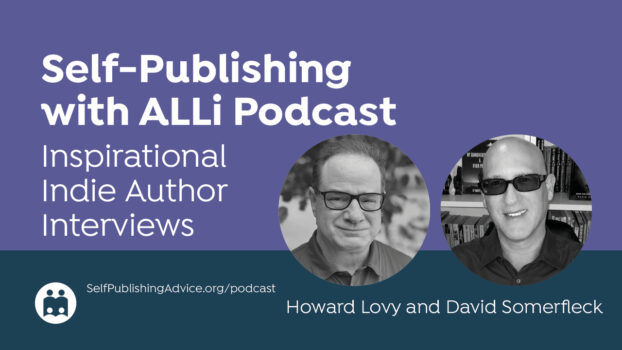
My ALLi author guest this episode is David Somerfleck, who spent decades in digital marketing, journalism, and politics before returning to his childhood passion for science fiction. He moved to Portugal, where the stormy weather and isolation provided the perfect setting to write his first novel, a chilling vision of America's future. Now, he draws on a lifetime of experiences to build a new career as an indie author.
Listen to the Inspirational Indie Author Interview: David Somerfleck
About the Host
Howard Lovy is an author, developmental editor, and writing coach with a long career in journalism and publishing. He works with writers at many stages of their careers, with a focus on helping them develop their ideas and strengthen their work while preserving their unique voices. He lives in Northern Michigan.
About the Guest
David Somerfleck is a speculative fiction author and poet based in Chesapeake, Virginia. He studied creative writing at Old Dominion University under poet Bruce Weigl and has worked as a newspaper reporter, copywriter, digital marketing agency owner, political campaign messaging writer and adviser, and teacher. His dystopian novel One Grain of Sand, the first book in the Shards of a Shattered Sky trilogy, is set in the United States in 2096. Kirkus Reviews called it “riveting and frighteningly plausible,” while BookLife described it as an “inventive high-stakes thriller.” The novel also won the 2026 NYC Big Book Award for Science Fiction. David is the author of four poetry collections and The Illustrated Guide to Digital Marketing. He publishes through his imprint, Boldly Blue Press, and is writing the second and third books in his trilogy back-to-back. You can find David on his website, learn more about One Grain of Sand, or purchase the e-book from major retailers.
Thoughts or further questions on this post or any self-publishing issue?
If you’re an ALLi member, head over to the SelfPubConnect forum for support from our experienced community of indie authors, advisors, and team. Simply create an account (if you haven’t already) to request to join the forum and get going.
Non-members looking for more information can search our extensive archive of blog posts and podcast episodes packed with tips and advice at ALLi's Self-Publishing Advice Center. And if you haven’t already, we invite you to join our organization and become a self-publishing ally.
If you’re a published indie author who would like to be interviewed by Howard for the Inspirational Indie Authors podcast, you need to be a member of the Alliance of Independent Authors.
Then contact Howard, including your membership number, explaining why you’re an inspirational indie author and what inspires you.
If you haven’t already, we invite you to join our organization.
Read the Transcript
David Somerfleck: Hi, my name's David Somerfleck, and I am a speculative fiction author who also writes poetry and business nonfiction. And I am a recent retiree who owned a digital marketing agency for probably about 20 years. And before that and during that time, I had my own nonprofit briefly and advised six political campaigns, and lived to tell the story.
And I like to leverage that toward whatever I write, whether it's blogs or books.
Howard Lovy: So it sounds like you've had quite a varied life and career, which is wonderful, and like I say, it's all research for your books, right?
David Somerfleck: Absolutely.
Science Fiction Classics Spark a Love of Writing
Howard Lovy: Well, let's start at the beginning. Where did you grow up?
David Somerfleck: Well, I was born in upstate New York in Buffalo, and all I remember is intense winters. And then my father, who was a military guy, moved us to Virginia, and I grew up in Virginia Beach and went to Old Dominion University, where I interned for several community newspapers, and also the college newspapers for the different campuses, at a pretty young age.
Howard Lovy: What drew you to writing in college?
David Somerfleck: My mother was an English teacher when I was very young, and I just always remember her reading to me when I was very young, before I even understood what she was reading. So I always grew up with a real love and respect for books and what they could do.
The knowledge and the sense of wonder and awe that the right book at the right time, kind of fitting with the right person, could really impart. And I got that probably around maybe junior high school. I started reading Burroughs and Bradbury and Harlan Ellison and Octavia Butler, Vonnegut, Frank Herbert.
All those guys, and just always thinking, “I wish I could do that one day.”
Howard Lovy: I read those same authors in junior high school and thought the same thing, yeah.
David Somerfleck: Yeah. That was like junior high school through high school, and in college, of course, you know what my major's going to be.
David Pioneers Digital Marketing
David Somerfleck: And then right before I graduated, I thought, “You know, I should really look at what kind of job opportunities there might be,” and I very quickly realized that there just weren't that many jobs if you wanted to be a writer. Unless you had an MFA or something, you couldn't get very far. So I started studying web design back in the '90s or early '90s or something, when it was first beginning.
Howard Lovy: Pioneer.
David Somerfleck: And yeah, I had to use page kits. That's what we called them back then. And I would create websites and write all the content, and getting a good placement in the search engines was very easy back then, 'cause there was no competition at all, and the search engines were very basic.
So I was the only guy who could create websites that were anywhere decent and write all the content and knew about SEO even back then. So I started working for boiler room marketing and ad agencies as the go-to guy for creating websites, and then later on, it kind of snowballed into a little bit more and a little bit more, and then I started my own when I just figured, like, I can do this.
This is a marketing issue. I can do this and then just promote myself like crazy, and I did.
Howard Lovy: Yeah. Well, digital marketing in the early '90s must have been something. You're a digital what?
David Somerfleck: Yeah. And when I branched out on my own, I was doing everything and anything I could possibly think of to really hype it and be found locally.
And I remember one day I finally knew that it was working, 'cause a competitor, who actually was a very, very wealthy guy from a very wealthy family, but he was a really nice, gregarious guy, and I'd see him every time I went out anywhere. He was always there drinking and having a good time.
And anyway, he called me out of the blue and he just said, “You beautiful expletive, expletive. How did you do it?” And I said, “What are you talking about?” And he said, “Well, you're number one in Google like five different times on the first page for a digital marketing agency, and then again for WordPress,” and on and on.
And I just said, “Well, I kind of have an idea of what I think worked, but it was all organic, and I didn't spend a penny on ads.” So I knew then at that point that it was working.
Howard Lovy: Yeah.
David Somerfleck: And now the irony is, on the flip side of that, I'm trying to do it for myself as a retired author, and it's a whole different thing.
Howard Lovy: Things change.
Loss and Illness Prompt a First Novel
Howard Lovy: So in the meantime, did you always have a kind of secret manuscript in your desk drawer or your virtual desk drawer, or did that come later?
David Somerfleck: You know, I really didn't. I mean, in high school I would write. I loved writing and just trying to create these really lush, beautiful, far-out kind of environments or situations in high school.
But I'd look at them and just be like, there's no beginning, middle, or end. You're just writing all these great scenes that English teachers are telling you they love, but every time I would try to write a short story, I didn't really know where it was going.
And it would just meander and I'd give up.
And it wasn't until maybe three or four years ago, I started outlining my first novel. My mother had died first, and then shortly after that, my father passed away, and I think it was right at the peak of COVID. And I remember him calling me once and just saying how he worried about getting it in the assisted living facility, and he probably did.
In fact, I'm sure he did. And anyway, in the midst of all of that, both parents dying, like one right after the other, and then my wife got breast cancer. All of that in the same time period, really very close together. And I just remember thinking, “What book would I write if I only had one chance, that would be a love letter to my wife, but also a statement on where I think we are as a culture, and what I would want to say to readers without hitting them over the head?”
Howard Lovy: Yeah.
David Somerfleck: And trying to put in all of my experiences in life, and just do the best I could.
And so I started outlining it on napkins, then notebooks, then I discovered Kanban boards and all of this.
And just studying different outline formats, like a mad scientist.
Portugal's Storms Create a Writer's Retreat
David Somerfleck: And so I just did that. And then my wife just came in and told me once, “I really have had it with the parents dying and the breast cancer and all that.” And she just said, “Why don't we move somewhere, and just move out of the US and just try it?”
And I said, “Sure.” We moved to Portugal. I didn't speak a lick of Portuguese, so it was very surreal. But the winters in Portugal along the coast are torrential downpour rains, and extremely windy where we lived. So the funny thing is I found out that it was great for writing.
Howard Lovy: Oh, yeah. Sure.
David Somerfleck: So during that period of time, I'd look out the window, and there was, like, a little stop sign around the corner from where we were renting, and you could see the wind looked like it was going to rip it right off the pole.
And there would be stray cats on the roofs of the homes across the street from me.
But I could see the ocean from where I was, and I said to my wife, “You can do whatever you want with the rest of the place. This third floor I'm taking for my writer's retreat.”
Howard Lovy: Sounds wonderful.
David Somerfleck: Yeah, I just wallpapered it with old movie posters.
And I would just get up in the morning and just walk in place and lift weights, and I'd look out the window and listen to audiobooks in two- or three-hour increments. Then I would go and work on the outline and then the book itself, and just go back and forth.
Odd Jobs Fill the Years Before Writing
Howard Lovy: So let's hold that thought.
Hold that scene. You're in Portugal, the wind and the rain. But earlier in your life, you were telling me about all the jobs that you had, from political campaigns to security guard to a whole lot of things that have nothing to do with digital marketing.
Why did you kind of float back and forth in your career before you discovered writing?
David Somerfleck: Well, I don't want to say it's a funny thing, but it's kind of… I worked for more boiler room-type agencies than I can remember, and I did learn a lot from them.
I really did. But I also noticed that they had a high attrition rate. And in some of the instances, when you were finished with a project, you and the team that were working on it were let go. And sometimes it'd be very unceremoniously, let's say. You would just come in and they'd just say, “Hey, you can clean out your desk.
We don't need you because you finished the project. Have a nice day.” And then it would take maybe a couple of weeks to a couple of months to find something equal to that. And I just sat down and crunched the numbers and realized, if you just had something boring with a stable schedule, you'd probably end up making more money in the long run than if you went from agency to agency and kept repeating that cycle.
Howard Lovy: Yeah.
David Somerfleck: So I tried that. I was a probation officer first, and it was very depressing. I didn't like telling people what was coming down the pike for them and everything. And I actually was a substitute teacher for a while, and I loved pre-K. They were so open to the world.
Howard Lovy: I was going to say my condolences for being a substitute, but then you said pre-K, and I think that's probably the best age.
David Somerfleck: Yeah. And I did special ed. I don't like the title, but I did that for a while, and it was too heartbreaking. I felt really sad for a lot of the kids, and I was just like, “This isn't working.”
So I got a job doing security, and I would do overnights. So it would just be me, usually by myself, maybe one other person, just me in the night. And it was good, after so much, to have a lot of quiet and a lot of solace, and you could just walk around and think. If you wanted to read, you could sit and read.
If you wanted to write, you could write. And you'd just get up and walk around every hour or so and make sure nothing crazy is going on. And so I think that did help me start reading more regularly, or listening to audiobooks while I was walking and whatnot, and getting the language and some of the concepts back into my head.
Obama's Campaign Draws David Into Politics
David Somerfleck: And then the political thing, I don't even know how I found out about that. I think it was during Obama's first run, and there was so much activity going on, and I thought, “Well, I wish I could leverage some of my experience to help this guy.” As if I could make a difference, I don't know.
And I went to a couple of events and talked to some people, and they just said, “Well, you could do this. There's this thing called the Center for Progressive Leadership, and it's a very intense training.” And they told me all about it, and it happened to be right down the street from where I was working as a security guard at that time.
Howard Lovy: Yeah.
David Somerfleck: So it was great.
Howard Lovy: You probably did make a difference. From what I understand about Obama's first campaign, it was very much grassroots.
David Somerfleck: Yeah. A lot of times I would drive people places, and I would work overnight doing security, and there would be a lot of food that they were going to throw away at the food court.
And I'd just say, “Look, guys, give it to me,” and I'd put it in my trunk. And I'd either give it to any homeless person I saw on the way home, or I would take it home, put it in the refrigerator, and then the next day take it with me to the training.
And if anybody wanted it, I'm like, “That's fine. I can't eat a whole extra-large pizza myself.”
Solitude in Portugal Fuels the Book
Howard Lovy: Okay. So you did that for a while, and then you decided Portugal was the place after a number of changes in your life, your parents passing away and your wife becoming ill. Did that kind of do the trick in terms of spurring the creative part of you?
David Somerfleck: Yeah. I would say so. And the winters in Portugal were very helpful to being a recluse, basically.
Howard Lovy: Yeah.
David Somerfleck: And the thing is, I told my wife what I wanted to do, and I just said, “Every couple of days, of course, I'm going to want to go out and have fun with you. Let's say every three or four days, let's go do something and explore Porto or whatever.”
And the other days, if you want to go about, go take Uber or whatever, I think they also have one called Bolt. And I just said, “Just let me know and set it up so I can follow you and make sure everything is okay.” So we did it like that. And when the off day came where the sky cleared, I would immediately put on a full-body raincoat just in case, and then go for a walk.
And it was very, very surreal, and I think that helped write my first novel a lot too, because I really couldn't speak Portuguese at all. I know a little Spanish, but Portuguese is not Spanish. And I was deluded to think it was.
Howard Lovy: Right.
David Somerfleck: It was like Spanish, but sounds like Russian, so it'd completely throw me for a loop.
So I couldn't speak to them, and they couldn't speak to me. And I'd just go walk through the little sleepy downtown, and go walk through abandoned churches. And it really helped me conceptualize things to just be alone with my thoughts. Like, I was working overnights again, but it's actually daytime and I'm wide awake.
You could go walk to the ocean, and en route to the ocean, I would pass a field of cows. So I could watch what the cows were doing on my way to the ocean. So it was very surreal and atmospheric, and you can't really talk to anybody. And I finally found a bakery one day in a sleepy little village called Vila do Conde.
A Bakery Sells His Poetry
David Somerfleck: And I went into this little bakery, and I was tired, and I wasn't thinking, and I just said, “Hey, I just want to get some of that spicy bread with the…” What's that real spicy meat that they put in? I can't remember the name of it now. But they had every kind of bread. So I just went in there and just said, “Hey, I'd like to get this.”
And the young lady actually spoke back to me in English, and I nearly did a double take, like in the old cartoons. And she's, “Oh, yeah, I speak English fine.” I said, “Yeah, you sure do.” And we just got to talking, and I told her, “Yeah, I've written some poetry, and now I'm working on my first novel.
I'm really intimidated by it, and I really want it to be good.” And she said, “Well, look, bring in three or four copies of whatever you've got, and I'll sell them in the bakery.” And she said, “I'll even promote it for you as the local town celebrity, the local English person and everything.” And she actually did.
And as soon as I brought my books there, they were gone the next day.
Howard Lovy: Wow, nice. Was it finished by then?
David Somerfleck: No, these were poetry books that I had written before.
Howard Lovy: Oh, poetry books. Oh, I see. Okay.
David Somerfleck: And she paid me in bread, and cupcakes, and pastries. So that was great.
Howard Lovy: That sounds great.
That sounds almost cinematic, the way you describe it.
David Somerfleck: Oh, yeah.
Grief and Cancer Shape a Dystopia
Howard Lovy: So what came out of your head when you wrote over there was dystopia. Do you chalk that down to kind of the surreal experience you had there?
David Somerfleck: Yeah, they definitely helped me.
The whole time, I couldn't really release the phantoms of both parents dying pretty close together, then my wife getting breast cancer close to that. And while we were in Portugal, I would go see the optometrist, and he would say, “You know, you've got this thing in the back of your eye that's very concerning, but it's not growing, so we should check it every six months.”
So I said, “Okay.” What else can I say? So I had all that going on, and I had my outline, and I started writing it. And every day that it wasn't nice out, which was often, I'd read what I'd written the previous day and just keep going. And I finished it. The first draft was the draft when we returned from Portugal about a year and a half later.
So we lived in Portugal for about a year and a half. And then we moved back to the States, and by then I would say I was about, like, 95% done. And I finished it and just said, “I wouldn't change anything.” So I just was like, “No, that's my first draft. I think it's okay,” and I published it.
Now, my wife later caught some typos, some misspellings, and so I pushed through the corrections as quickly as I could.
Howard Lovy: That's the best way to catch typos, is publish it. And then you see them afterward.
David Somerfleck: I just wanted it out there.
I just felt like this is relevant.
I really felt like it was relevant and important, and I even felt like, even if nobody reads it, this is me, this is how I feel, and this is what scares me. And what would you do if you woke up in 2096 and it was more polar than you could possibly imagine, and technology was taking off in ways that you didn't think would happen, and now you have to cope?
What would you do? And that's the description that I wrote, because it was the most raw, and I wanted it out there. And I submitted it to Kirkus Reviews, and I was terrified, 'cause I wanted an opinion. My wife, of course, she would tell me if, “This is awful.
Don't print this. This is really bad.” I think she would tell me. But when she caught the typos and read it, I remember she, like, threw it down on the ground and said, “You can't leave them like this.” So I said, “Okay, well, you're telling me you want this to be a trilogy,” 'cause I wasn't sure. I wasn't sure if it was enough, just a standalone novel, leave it, that's it.
It says what it has to say. But I felt like it could be a trilogy, that there was enough to build a massive world and reality on. And when she had that reaction, I thought, “Okay, I can plot it out.” And then right around that time, I found out that I had eye cancer.
Howard Lovy: Wow.
David Somerfleck: So God has a sense of irony. So I went through that.
I mean, the eye surgeon said basically, he's like, “Well, you've got two options. You can have it removed.” Well, no, he said, “You have three. You can leave it in and it'll spread, or you can remove it, or you can get the surgery. And the surgery might work.” I forget what the percentage of success was. It's called plaque brachytherapy.
So I had that done, and it took me a while to recover from that, as you could imagine.
And then once I recovered from it, I just felt, “Okay, let me try to map out what I would do in books two and three to elevate book one, and make it so that each succeeding book is more powerful, more emotional than the first one.”
So if you read book one, and you thought book one is going to give you a punch in the gut, well, number two is going to give you an uppercut, and number three is going to take you on a rollercoaster. And that was always what I wanted to do. And I don't remember when the Kirkus review came back.
I know I'm mixing things up a little bit, so please forgive me. But when the Kirkus review came back, I just remember being so scared, 'cause I read that it could be negative, and they have no problem dissing you if your book stinks. And it came back positive. And I was like, “Wow, I guess I was right.
This is good.”
Prisoner Wakes Up in a Polarized 2096
Howard Lovy: Yeah. Well, tell us a little bit more about the premise and the plot of One Grain of Sand.
David Somerfleck: Sure. Well, I wanted it to be as believable as possible. The whole willing suspension of disbelief is a very popular term amongst authors and filmmakers, I think. And I wanted it to be believable technologically, emotionally. And that was even in the review, where they said it was frighteningly plausible, so it meant the world to me. And it's basically about a guy who does whatever kind of odd jobs he can get.
He comes from a family that's fairly poor, with an abusive background, just a beat-up kind of guy. Beat up by life. And he ends up going to court for shoplifting, 'cause he's trying to steal food. And it's set about 20 years in the future. Not a whole lot, just a little bit.
‘Cause I wanted to nudge it forward a little bit so that the next steps weren't too crazy. So 20 years in the future, he goes to court and they sentence him to 50 years in prison for shoplifting. It's a little bit extreme, but I wanted to go toward the polarization angle. So while he's in prison, he sees what's going on, and he finds out about an opportunity.
You can get out early if you volunteer for this experimental program where we're testing a new vaccine candidate for a virus that's similar to COVID, but more intense, with a higher lethality. So he volunteers for it, 'cause he figures, “Well, this is not working, being in prison, so I'll volunteer for this.
And if I live, I'll be a free man.” So he ends up going into suspended animation, and I think it's done realistically, the way that they would do it if they could.
And then he wakes up in 2096, and he finds out that the polar extremes in politics have gone about as far as they can before they could possibly break, and they're right on that borderline of snapping, or you might say they already did in the book.
So you have weekend minority culling passes. You've got people competing in reality TV games for food credits or college credits or for the right to live in a segregated community. They have reality TV shows where you could go hunt immigrants trying to cross the border.
Just as wild as I could imagine it being. And I wanted to do honor to the people I had grown up reading. Harlan Ellison, Ray Bradbury, Octavia Butler, all those guys.
Howard Lovy: And it sounds like you also included your own political experiences.
David Somerfleck: Yeah.
Howard Lovy: Even your own experiences with the criminal justice system, and you took maybe your role as a probation officer and kind of exaggerated it a little bit and brought it forward.
A Marketer Struggles to Market Himself
Howard Lovy: Now, what about marketing? You said you got a positive Kirkus review, but self-published books are really hard to market. And you are a marketer by trade. How do you market your book?
David Somerfleck: I don't. I'm just kidding. The thing is, the book was published not that long ago, first paperback and then the other formats, and then the hardback. So it really hasn't been out very long.
The funny thing is, it's always been so easy for me to take anyone else, you name the business, and I can tell them exactly what they should do, how they should do it, and how to start moving the business forward very aggressively.
Howard Lovy: I mean, you've even written a book about digital marketing, so yeah.
David Somerfleck: Yeah, I had a podcast where I did that for people, and I just said, “Tell me about yourself. I've never read anything about you, and then I'll tell you how to ignite your business.” And it's very easy. I see it right away. But for me, it's harder 'cause I can't look at myself objectively.
And so far I've been running some ads online, and it's tricky because I can't be objective about it. To me, it's a love story. To other people, it's a dystopian novel. To others, it's a thriller, because it's got a lot of action, and I want it like that.
Howard Lovy: So you've got to combine various parts of your career, your marketing career and your writing career, and find the right formula. Sounds like you're still experimenting with that.
David Somerfleck: Yeah, I am. I haven't quite figured that out yet. But I am using online ads, and I've gone to some events.
And I get to talk to cool guys like you, of course.
Howard Lovy: You must have me mistaken for somebody else, but that's fine.
David Urges Late Starters to Find Their Rhythm
Howard Lovy: Now, I don't want to say you're elderly or anything, but you've lived an action-oriented, full life doing many things. What's your advice to other authors who want to start writing careers later in life?
David Somerfleck: Yeah, I would say if you can switch gears, do it, the sooner the better, and find ways that work for you to accentuate your productivity. For me, I really learned in Portugal, as silly as it sounds, because the weather was so… torrential rains, monsoon winds, and you're up on a hill, so you could get forced down to the ground, and you're talking cobblestone is pretty hard.
You could bust a kneecap. So that worked for me, just walking in place, lifting weights, living on one or two meals a day so you stay slim, listening to audiobooks, reading, and then writing, and just doing everything in two-hour increments. It works with that kind of rhythm of what we did in agency life.
And then as soon as the sky clears, go out there and walk through some abandoned churches, and try to do five or six miles every couple of days, and put some weights on you or something so it weighs you down. You get a good workout. For outlining, I really learned to use Kanban, which is like a color-coded board system, to help me organize my outlines into a three-act structure.
So I'm really keen on outlining for structure, 'cause I learned from the past. I can write beautiful descriptions, but if I don't have a tight structure, the novel won't make really coherent sense.
Howard Lovy: Where are you going with it?
David Somerfleck: Yeah, you can always go off the reservation a little bit, but not too far, 'cause the outline will pull you back, and that's what the first book did.
And I look back on that first book now, and I can't really believe it. It's like, how did I write that in one draft? And what was the second draft? Some typos. It's hard to believe I did that, 'cause while I was going through the eye cancer and the surgery and the recuperation, I didn't know what the future was going to be like.
Howard Lovy: Yeah. How is your health, by the way, and your wife's health?
David Somerfleck: Well, thank you for asking. She made a full recovery from breast cancer.
Howard Lovy: Wonderful.
David Somerfleck: And I think I made a full recovery from it. I can see fine. I'm not elderly. I'm 62. I can still lift weights and go hike six miles or so before feeling it.
So I'm very blessed. And I think I'm done with the outlines for books two and three of the trilogy. I've kind of tinkered around with the writing a little bit, but I wanted to really take readers on a really, really wild trip, that every book you just leave like, “Whoa.”
At the end of each book, you just come away feeling, “Oh, my God. What just happened?”
Howard Lovy: Well, that's great that you're doing it at 62. I just turned 61, and I'm starting to feel, what are all the things I haven't written yet, and it's a lot.
David Somerfleck: Yeah, I understand that. I saw some quote from David Bowie, and I printed it up and taped it on my wall with all these movie posters.
And it said, “As you get older, the questions come down to about two or three: How long, and what do I want to do with what I've got left?”
Howard Lovy: Yeah.
David Somerfleck: And for me, it's chasing after my wife and writing down the best speculative fiction that I possibly can in the time I've got left.
So I hope I can live to around 80 and still have good health and still have my marbles.
Howard Lovy: Yeah. That's what we all can hope for. Well, wonderful, David. Thank you so much for sharing your life and work with us. And best of luck.
David Somerfleck: Absolutely. Thank you for having me.
Howard Lovy: Okay. Bye.
David Somerfleck: Bye-bye.