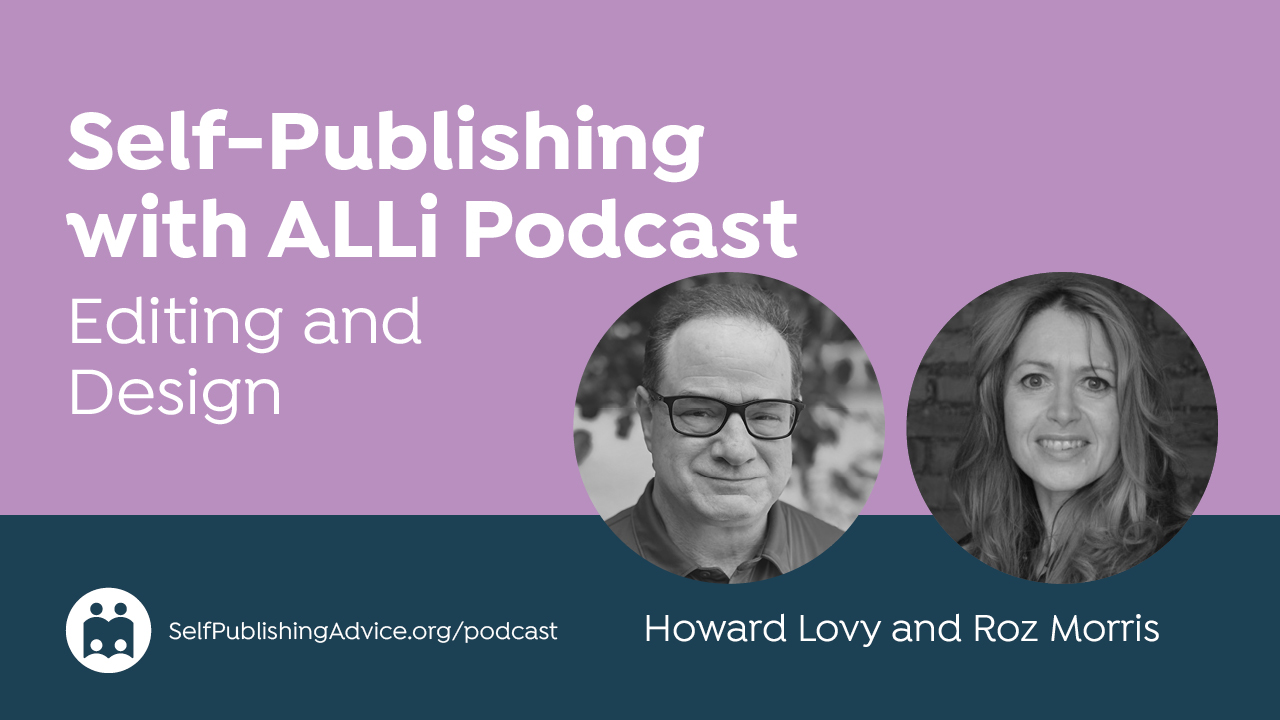
On the Self-Publishing with ALLi podcast, host Howard Lovy talks to editor and author Roz Morris about what professional editing really costs and what authors get for their money. They discuss how editors set their rates, hourly versus fixed pricing, why some manuscripts require more work than others, choosing the right editor for your book, and why using AI before hiring an editor can sometimes prove to be a false economy.
Listen to the Podcast: What Should Authors Pay for Professional Editing?
About the Host
Howard Lovy is an author, developmental editor, and writing coach with a long career in journalism and publishing. He works with writers at many stages of their careers, with a focus on helping them develop their ideas and strengthen their work while preserving their unique voices. He lives in Northern Michigan.
About the Guest
Roz Morris is ALLi’s editor in chief. She is also a novelist, memoirist, and professional story whisperer. She is the author of acclaimed literary novels with big emotional canvases and memoirs that find meaning in unadventures. She is also a developmental editor and writing coach and has helped shape books that have sold more than four million copies, some of them from behind the scenes as a ghostwriter. She is the creator of the Nail Your Novel series for writers and the blog of the same name. She has judged literary prizes, including the Amazon Kindle Storyteller Award and the Vine Leaves Press New Voices Competition, and has taught master classes for The Guardian in London and Jane Friedman’s online academy. Find her at her website.
Thoughts or further questions on this post or any self-publishing issue?
 If you’re an ALLi member, head over to the SelfPubConnect forum for support from our experienced community of indie authors, advisors, and team. Simply create an account (if you haven’t already) to request to join the forum and get going.
Non-members looking for more information can search our extensive archive of blog posts and podcast episodes packed with tips and advice at ALLi's Self-Publishing Advice Center. And if you haven’t already, we invite you to join our organization and become a self-publishing ally.
Read the Transcript
Howard Lovy: Hi, I'm Howard Lovy, and this is the Self-Publishing with ALLi podcast. I'm an author, developmental editor, and writing coach at howardlovy.com, and today we're talking about how much authors should expect to pay for editing, how editors set their rates, and what authors are actually getting for that investment.
And my guest is Roz Morris, a novelist, essayist, writing tutor, and experienced editor. We'll discuss different pricing models, what makes some manuscripts more expensive to edit than others, and where AI might or might not fit into the editing process. Roz, thanks for joining me.
Roz Morris: Oh, thanks for inviting me, Howard.
Howard Lovy: Well, before we get into the numbers, can you tell us a little bit about your background as an editor and the kinds of manuscripts and authors you typically work with?
Roz Morris: I've been in editing in some form or other since the late 1980s. So I've got a load of experience. I've edited all kinds of publications: magazines, newspapers, all kinds of books. And that encompasses guidebooks, directories, how-to books, self-help books, novels. I haven't done poetry, that's the only thing I haven't done.
Howard Lovy: I don't even know how to edit poetry. Orna Ross could help us with that.
Roz Morris: But people sometimes ask me to, and I say, “No, I really don't know how to do that. You need someone who works specifically in that.” But apart from that I've worked with a wide variety of kinds of manuscripts. One thing I did for quite a while was I worked as a developmental editor for Cornerstones Literary Consultancy, and I'd be sent manuscripts that were works in progress by authors.
And I would write reports on how they were working for their audiences, what next things needed to be done, whether they were ready to be submitted to an agent or a publisher. They mostly weren't, but that's fine because there's only so much an author can do on their own. And something that I found with developmental editing particularly is that you are there to spot the blind spots that a writer has not yet been able to figure out, and they've done an enormous amount of work already. I never underestimate what they have done already. They have brought a manuscript to me with an awful lot of research and work, and they've figured out what should happen where. They have generated a lot out of nothing, and they come to me because they can't see what else they need to do. And then I look at it and say, “Ah, now, to get what you want, these are the next things.”
Developmental Editors Spot the Blind Spots
Howard Lovy: And it's not a matter of us trying to rewrite the manuscript. It's trying to help them say what they want to say, and you need an outside person to discover what some of those holes are, and to play the part of the average reader, where sometimes there's a disconnect between what an author thinks is coming across and what actually comes across.
Roz Morris: Absolutely, yes. Because there are so many techniques that are invisible to the reader, and people don't really understand how they work on a reader. But when you get a developmental editor who has a lot of experience, they do know what all these techniques are, and they also know how they're working throughout the entirety of a manuscript.
Something about developmental editing is that you work with the entire work, not just a few chapters. Some people, if they're editing as they go, they might work with an editor, a book coach probably, to get the thing written. But at some point someone has to take the finished work and look at it and say, “Is this whole work doing what the writer intended?” And that's a matter of having a whole structure in your head and understanding all the balances that are going on, and the things that are pulling the reader's strings, and where might be a better place to do something.
Howard Lovy: Right. That's where the storytelling comes in. It's not just a matter of the plot and the characters, but how it ties together, how chapters end on maybe a mini cliffhanger so readers want to go to the next chapter. And there are various techniques you can recommend there. So it's a matter of keeping readers engaged.
How Editors Arrive at What They Charge
Howard Lovy: So yeah, it's a big job. And typically there are various price points for developmental editors, and they range so greatly. I've seen authors tell me, “Well, you charge this much, but if I go through so-and-so, I could just pay a couple hundred dollars and they'll do it for me.” And the question is: Well, what are you getting for a couple hundred dollars versus something a little more in depth? So I guess my first question to you is: How do you arrive at what you charge, and how do you take a manuscript and say, “Okay, here's 90,000 words that I need to improve.” What is that worth to the author?
Roz Morris: Yes. The author has to decide if my charges are going to be worth it to them. I work with a lot of people who are writing either for the first time altogether or they're moving into a genre they're not familiar with. So, for instance, playwrights moving into novel writing. Those are machines that work in entirely different ways. Plays and novels, screenplays, radio plays, all sorts of things. They all work in different ways. So often the work is very deep because I'm having to explain lots of mechanisms that they may not have used before and may not be aware of.
My developmental reports usually involve a very detailed analysis of each scene, almost line by line where necessary. Saying, “This line prepares the reader to think this, so you need to continue that or drop this because it's going to be spoiling an effect that you have later.” All that kind of really forensic detail I go into, and then I also do an overview document that has the main issues so they've got something to come back to if they're thinking, “Oh, God, I've lost track of the big picture. I need the big picture.” There's a big picture document.
There's the absolute forensic detailed document, and then I also write a tutorial, personal tutorial for whatever craft aspects they need to think about more in depth. If they do need to. Sometimes they don't. But sometimes I need to demonstrate how particular techniques work on the reader and how they're using them and how they also can use their own sensibilities and things they are already quite good at and have guessed well at. How they can take those things they are already quite accomplished at, and then learn to use them with more finesse and greater scope. So my developmental edits are a lot of work for me, but I give a lot of work to the writer, and that will also then stand them in good stead for all the other books they're going to write of that kind.
Howard Lovy: So it sounds like you include, I think it's called an editorial letter, along with—do you also go chapter by chapter with the author? Or is it mainly an overview letter?
Roz Morris: It is definitely an in-depth chapter by chapter report. That's the core of it. So I will go through each: right, here we see this. Now, this sets up well. You've got this happening. You've brought this in. This doesn't seem to quite work. This is flagging. Here's why it's flagging. Refer to my note on pacing, and this is what you need to do here. And then also I'll discuss things because I'm not rewriting the book for them. I'm absorbing what they want to do and I'm saying, “This will fit with what you wanted this to be, as we discussed in our original correspondence.” ‘Cause I always write to them to start with to find out what they want the book to be, what their influences are, that sort of thing, so that I know that I'm in tune with what they want to do. And I'll present different options as well. Sometimes there'll be several ways to take something, and I will include all that.
The Condition of the Manuscript Shapes the Price
Howard Lovy: Okay. So that's a lot of work on your end, and I think many authors don't really know, in the beginning, what it is we do. So they might get a little bit of sticker shock when they get an editing quote. How much of what you charge depends on the condition of the manuscript? I take a look at it. I have my base fee, but then I take a look at it and I see how much heavy lifting needs to be done. Whether they're an experienced author or, as you say, maybe they're writing in a different genre. I have a current client who's a screenwriter who thinks very visually but writes as if they were stage directions rather than in full prose. So that's something that I need to work with them on. So how much of what you charge is kind of an art rather than a science?
Roz Morris: It is an art. Yeah. And that's a really good example that you've given there because when I work with people who are used to writing for a purpose, they know that there are certain things you're doing to the reader. They've got a completely different mindset and a different skill set from someone who is doing it for the first time, that's the first time they've tried to write a book. They've really learned from reading other books, but never from actually doing it. So, yes, I vary my developmental rates according to their experience, yes.
Charging by the Word Versus Charging by the Hour
Howard Lovy: Now, you mentioned that for some clients you charge by the hour, and for some it's a flat rate. Can you tell me the difference between those two kinds of projects?
Roz Morris: What's worked for me has been to charge developmental editing by the word count because it is roughly the same amount of work. I can gauge the number of hours it will probably take me. But for things like copy editing and line editing and proofreading, then I have to charge by the hour for that because there's no way I can tell from a sample what state the manuscript is in. There might be a copy paste error halfway through that will cause complete chaos, and I've got to sort it out, and that will take hours more than anyone has bargained for. So there's no way I can tell from looking at the first few chapters whether the manuscript is quite clean. And in fact, the more you get into a copy edit where every detail's really important, you might find that, again, in the middle, that it's a complete mess and all the consistency has completely disappeared and you've got to sort it out. So the fairest way to charge for that, I find, is an hourly rate, and that's how I work with publishers as well. They always pay an hourly rate for copy editing and proofreading and line editing.
Howard Lovy: Well, I have a feeling that if I charged by the hour I'd be unaffordable because I'm a very slow worker. Very methodical. But the one disadvantage of charging a flat rate is sometimes you get into a situation where the author says, “I wanna rewrite this, I wanna rewrite that,” and you get into an endless cycle of rewrites. And occasionally I've had to say, “Okay, we've rewritten this chapter three or four times now, I'm gonna have to charge you a little more for that.”
Roz Morris: Yeah, that's reasonable. And I stay in touch with people as I'm working on their book so they know what's going on behind the scenes. They know what I'm working on, they know what I'm thinking about. They can see that I'm really engaging with their copy. And I think so long as the author feels like you are giving them your best value, then that's reasonable. They'll accept it if you say, in order to do another pass on this, I really need to charge a bit more or charge again.
Specializing at the High End
Howard Lovy: Yeah. And some authors take a look at what I charge and really challenge me on it. “Well, so-and-so offered me half that.” And part of it is I've been doing this long enough that I specialize in certain kinds of manuscripts. I do a lot of work with authors who write about Jewish themes, and I'm considered, like, a top editor in that market, whereas a different topic, not necessarily so. So what they're getting with me is, like, one of the best editors, if I do say so myself, in this particular niche. But that also kind of self-selects. They're like, “I wish I could hire you, but I just can't afford you.” What kind of level of an editor are you in terms of what you specialize in?
Roz Morris: Probably also the high end. But people know what they're getting from me because of the blog posts I write about the writing craft. They know my books. They know the kind of mind I've got and what I'm going to be looking for, and they also know I'm a real perfectionist as well. And that I absolutely love stories and really getting into what an author is trying to do. So they know what they're getting. And I do get people who say, “I wish I could afford you,” or, “You're way too much. You're far more than…” That sort of person. But that's the general life of a freelance, isn't it? You have to know who your ideal clients are, who will value what you do. Because at the end of the day, what I'm giving someone is a book that will be what they really want it to be and the means to make it that. And in the way that I would do it. The people who come to me want the way I would do it.
Where AI Fits Into the Editing Process
Howard Lovy: Yeah. And that's something that, you know, we haven't mentioned the A word yet, AI. That's something that AI can't really get you. I get some clients who say, “Well, I'm gonna give this a pass through ChatGPT or Claude first, and then I'll send it to you.” And I'm like, “Okay, but that really won't get you anywhere.” What AI is looking for isn't what I'm looking for. Have you ever had an author say, “Well, let's run this through AI first”?
Roz Morris: I haven't yet. Most people seem to be quite scared of AI at the moment. But I've done a number of experiments using AI myself and I found it can't do the work for you. It's like a junior employee. It can do lots of work, it can find lots of things, but you've got to know how to judge what it's suggesting.
Howard Lovy: Right.
Roz Morris: So what I would do is I might use it as a final pass once I've… Well, not a final pass, but a late pass. So I will have done the work. I will know what is working, what isn't about the manuscript and what I'm going to discuss with the author and how I'm going to say it. I might put it through Claude to see if Claude notices anything else that I haven't. But quite a lot of the time Claude will notice things and I think, “No, that's not relevant at all,” or, “No, that would be a disaster, you shouldn't do that. No, you've got the wrong kind of model for the wrong kind of book here.” You have to really know how to use the suggestions it gives, I think.
Howard Lovy: Yeah. And know how to prompt it, looking for something specific. Are there repeated words in a sentence? Things like that. More housekeeping kind of stuff.
Roz Morris: It's also quite good if you can… Something I have used it for is if I'm dubious about the accuracy of a sentence, I can just say, “Is this sentence accurate?”
AI-Written Manuscripts Cost More to Edit
Howard Lovy: The bigger challenge I have is when authors come to me with books that were obviously written by AI. The ideas might be theirs but the wording and the cadence seems obviously AI to me. And to some extent I'm tolerant because I get some authors whose first language isn't English, so they feel like they need to get an AI to put it in proper English for me. But that gives me actually extra work to do because then I have to get rid of the AI tells, and I tell them, “This is obviously AI. I would rather you give me your broken English and let me fix it, rather than AI completely rewrite it.”
Roz Morris: Oh, that's so true. Because I can fix broken English much faster than I can fix something that is sort of polished and correct but lifeless. And also has the very, very characteristic modes of expression that AI has. There's something about the way that AI explains things. I find, because I'm quite good at picking up styles, I find that, oh, now I'm starting to think like that. No. It's actually much better if someone gives me something rough. I mean, I've edited manuscripts by people who are very dyslexic and got something really good out of it at the end, and it was much easier working with that than taking something that is, I don't know, really written by a machine and obviously so sort of correct but lifeless, and then also has these constructions that everyone now recognizes. Especially from those emails we all get from the spammers trying to pretend they've read our books.
Howard Lovy: Yeah, those are funny but sad at the same time. So yeah. And when it comes to pricing, and I'm slowly changing this, I'm actually beginning to charge more for AI-written stuff because there's so much that needs to be completely rewritten. And there isn't a lot there. So this is actually affecting my pricing. So if you want AI to do the writing for you, the editing itself is going to be more expensive. And occasionally I just wanna throw up my hands and say, “What exactly am I editing here? There's nothing there.”
Roz Morris: Yes. It's a false economy really.
Base Rates and When to Stray From Them
Howard Lovy: For a full developmental edit, I charge six cents a word. And for a manuscript evaluation, which is primarily an editorial letter, I do three cents a word. But those are just my basic prices. Within that, there's a lot of flexibility. If somebody has a 150,000-word book that they need me to cut down, charging six cents a word is just going to be out of reach for most people. But I don't know if you wanna tell me how much you charge, but kind of what goes into the decision whether to stray from kind of your base fee?
Roz Morris: As I said before, I judge according to the writer's experience. So what they've written before. If they've written books before, and they're in a similar vein, then I charge much less because they already know all the basics. I won't have to explain so much. It will be more of a discussion between people who already know what's going on. So I would charge a lot less than I would charge somebody who is doing it for the first time. And I don't actually charge per individual word, I charge per thousand words, which is how we always did it with the literary consultancy that I worked for. So my top rate, well, actually it again depends on what I'm doing, but my developmental editing rate is £80 per thousand words.
Roz Morris: But I've got a client who asked for a developmental edit and now she's filling in lots of gaps. It's a memoir, and she wants me to rewrite the memoir with all the new material she's added. This will involve actually completely reordering everything. So the original developmental edit is now useless. And I'll have to start all over again with all the new material, which of course will give quite different slants on the characters and the plot. It will suggest an entirely different structure. So I'm charging her quite a bit more because she's also expecting me to do the writing too. So it depends on how long I'm going to have to spend to do a good job for the client.
Roz Morris: But if it's somebody who just needs an editorial letter saying what works with this, what doesn't work with this, and I know I don't have to go through explaining things about pacing and tone, and if I do, it will be the tone's different here, it's not suitable for this, or this tone, yeah, do more in this tone. Those chapters, just rewrite them like that. He already knows what to do if I say that, so that I would charge a lot less.
First-Time Authors Should Look for the Right Fit
Howard Lovy: Yeah. Well, I guess, what kind of advice would you give to first-time authors looking for a developmental editor in terms of how much they expect to pay and how much they expect to get out of that relationship?
Roz Morris: It depends a lot on what you're writing. If you're writing a genre book, it's a much less complex kind of manuscript than a literary book. I tend to specialize in literary fiction and also in quite literary memoirs, and those are much more complex kinds of books. But genre books, if you're writing a romance, if you're writing horror, if you're writing fantasy, they're much more straightforward in what the reader expects. It's not that the readers expect the same thing all the time. They want particular kinds of thrills and pleasures, and they want them presented in the new ways that a new author will bring to them. But they follow far more established patterns. So a developmental edit on something like that is much quicker and you don't have to have such a complex level of work in them.
So look for somebody who is in tune with the kind of thing you want to write and check that they like the kind of… Say it's fantasy, check they like the kind of fantasy you like, the kind of fantasy you are inspired by, the kind of fantasy you want to belong next to. That's really important. The fit is really important. You've gotta make sure you're in tune with them and they're in tune with you. And ask how they'll explain things, how they'll explain craft points and so on. If they've got a blog, you can see from the blog just how they'll explain stuff and whether you understand what they're talking about. So look around for the way they work with people and the way they explain things and how they think they should be improved and rewritten and so on. And see also if you can find other people who have worked with them. There are loads of Facebook groups, for instance, for particular genres. You could ask on a Facebook group for whatever genre you're writing who works with who and who gets them and what worked well for them. So there are lots of ways of finding someone who will really suit what you want.
Howard Lovy: So yeah, and also I've been on Reedsy for a number of years, and they're kind of a good sort of matchmaking service that hooks up editors with authors. And it's all laid out there what their experience is. But if you don't connect with your editor in some way, and that they really get what you're talking about, it's not gonna be a good relationship. And that's one thing that at the end of the process with a lot of my authors, they tell me, “You did a great job, but most of all you really got me. You knew exactly what I wanted to say and helped me say it better.”
Roz Morris: Yes. And that's part of the pleasure of it too, to see something and think, “I know what you want to do with this, and we've discussed it. And right here in the manuscript is a real way to do it you haven't spotted yet, and it will make your book 10 times as good.”
Deciding Whether the Investment Is Worth It
Howard Lovy: Yeah. So, I guess my advice for people who have sticker shock is, determine what you want to get out of the editing relationship. If it's somebody who you can work with or you connect with, who you respect and you think will make your book better, I'd say it's worth it. But I'm a little biased, so.
Roz Morris: Same here. Yeah. But I have had really good editors who have just absolutely raised what I could do. And I want to do that too. And I do have testimonials that say I have. So it depends what you're looking for. If you're looking for a straightforward edit on a book that should be quite straightforward, then you don't have to pay very expensive rates. If it's your first book doing something, you probably should go for somebody who will do more teaching for your first book. But after your first or second or third books, you will know far better what you're doing as well, so the editing costs will come down too, because you won't need so much of the tutoring.
Howard Lovy: Right. Yeah, and for beginning authors especially, that's important. I need to tell them why I'm making certain decisions rather than saying, “Do this and do that.”
Roz Morris: I never say, “Do this and do that.” I say, “If you do this, it will create this impression, but I think what you want to do is this.”
Howard Lovy: Exactly. And that's what I emphasize too, that none of these are commands. Everything's a suggestion. And in the end, it's their book, their voice. And they can always say no.
Where to Find Roz Morris
Howard Lovy: All right, well, this has been fascinating, Roz. First, tell people where they can find you on the internet if they wanna hire you.
Roz Morris: I have a website which is rozmorris.org, and I'm R-O-Z M-O-double R-I-S.
Howard Lovy: Z. Now I have to translate that into American. That's a Z. So yeah. Well, thank you so much, Roz. I appreciate you talking about your work and how you arrive at how much we charge, and what they get for their money.
Roz Morris: Bye.