



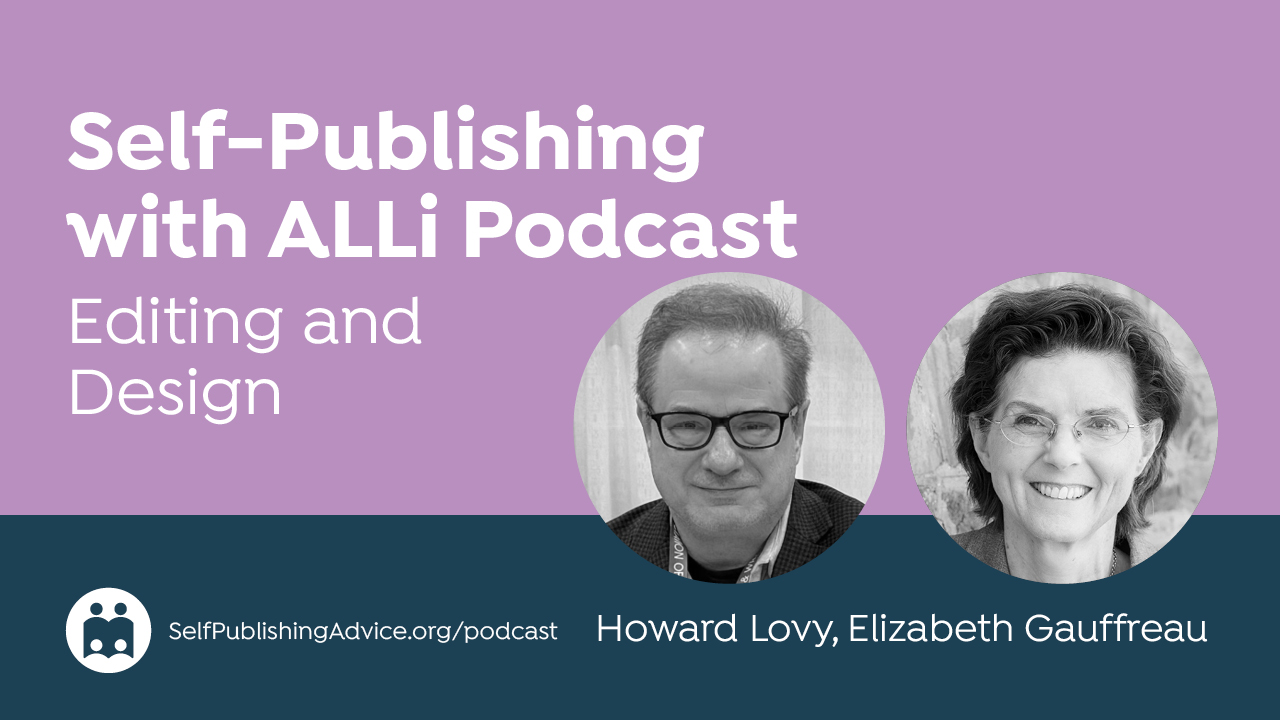
On the Self-Publishing with ALLi podcast, host Howard Lovy talks to novelist, poet, and educator Elizabeth Gauffreau about beta readers — what they actually do, how they differ from developmental editors, and why their real job is reader response, not critique. Drawing on decades of giving and receiving feedback as a writer and teacher, Gauffreau explains how authors can set clear expectations, choose the right readers, sort through conflicting feedback, and know when a reader's gut reaction matters more than being factually right.
Listen to the Podcast: How Beta Readers Help Authors See Their Books Through Readers' Eyes
About the Host
Howard Lovy is an author, developmental editor, and writing coach with a long career in journalism and publishing. He works with writers at many stages of their careers, with a focus on helping them develop their ideas and strengthen their work while preserving their unique voices. He lives in Northern Michigan.
About the Guest
Liz Gauffreau writes fiction and poetry with a strong connection to family and place. She holds a BA in English/writing from Old Dominion University and an MA in English/fiction writing from the University of New Hampshire. She has been widely published in literary magazines and several themed anthologies. Her short story “Henrietta's Saving Grace” was awarded the 2022 Ben Nyberg Prize for Fiction by Choeofpleirn Press. Liz has published two novels: The Weight of Snow and Regret, based on the closing of the last poor farm in Vermont in 1968, and Telling Sonny: The Story of a Girl Who Loved the Vaudeville Show. She has also published two collections of photopoetry, Grief Songs: Poems of Love & Remembrance and Simple Pleasures: Haiku from the Place Just Right. Liz's professional background is in nontraditional higher education, including academic advising, classroom and online teaching, curriculum development, and program administration. She received the Granite State College Distinguished Faculty Award for Excellence in Teaching in 2018. Liz lives in Nottingham, New Hampshire, with her husband. Find her online at linktr.ee/egauff.
Thoughts or further questions on this post or any self-publishing issue?
 If you’re an ALLi member, head over to the SelfPubConnect forum for support from our experienced community of indie authors, advisors, and team. Simply create an account (if you haven’t already) to request to join the forum and get going.
Non-members looking for more information can search our extensive archive of blog posts and podcast episodes packed with tips and advice at ALLi's Self-Publishing Advice Center. And if you haven’t already, we invite you to join our organization and become a self-publishing ally.
Read the Transcript
Howard Lovy: Hi, I'm Howard Lovy, and this is the Self-Publishing with ALLi podcast. I'm an author, developmental editor, and writing coach at howardlovy.com, and today we're talking about beta readers: when authors should use them, what kind of feedback they should ask for, and how to separate useful observations from advice that may pull a manuscript in the wrong direction. My guest is Elizabeth Gauffreau, a novelist, poet, educator, and experienced beta reader. Drawing on many years of giving and receiving feedback as a student, writer, and as an instructor, Liz developed an approach based on comparing the writer's intentions with the reader's actual response. Liz, thanks for joining me.
Elizabeth Gauffreau: Thanks for having me. It's great to be here.
Tracing a Path from Fiction Workshops to the Classroom
Howard Lovy: Let's begin with your background as a writer and educator. Tell me where you came from and how you got into this business.
Elizabeth Gauffreau: I went to college for fiction writing, so I have a degree in English with a concentration in creative writing. When I finished that degree, I really thought that I didn't know everything I needed to know to develop my craft. So I went to a master's program in fiction writing, and at the end of that, I said, “I'm done with workshops. I want no more workshops. I just need to sit myself in the chair and write.” I got into teaching because I needed a day job. I was not going to attempt to freelance. I was not going to attempt to cobble together a living through adjuncting. I needed a steady paycheck — I wouldn't have been able to write at all. I taught the writing process and critical inquiry for college students. I did that for a number of years, and developed curriculum for that as well.
Howard Lovy: Are you still an educator as well as a writer?
Elizabeth Gauffreau: No, I'm not. When I left, I said, “I am not going back to higher education. I'm finished.” But what's happened is that I've been able to use the skills and experience that I gained over all of those years of teaching to help fellow writers. Which has been really, really nice.
Howard Lovy: And that segues into the subject of being a beta reader, because in a way you're acting as a peer, but also a teacher. We'll define these roles as we go along. But how did your experiences receiving and giving feedback shape the way you now work as a beta reader?
Elizabeth Gauffreau: Well, I came up under the workshop system, and it's basically where the students will submit copies of their work to the instructor. The class reads the work for class, and then everybody goes around in a circle, says what they thought, and you're not allowed to say anything.
Howard Lovy: That could be brutal, right?
Elizabeth Gauffreau: Yeah. What became clear to me as an undergraduate was that the only feedback I really paid attention to and that felt actionable was from the instructor. And of course, the reason for that was you have to learn how to give good feedback. Someone who's a sophomore in college who doesn't have that kind of background — they're not going to be as effective.
Defining What a Beta Reader Actually Does
Howard Lovy: Well, let's backtrack a little bit and define our terms. What exactly is a beta reader, and how does that role differ from, say, a developmental editor?
Elizabeth Gauffreau: That's a really good question. When I left traditional publishing after a bad experience and decided to go indie, I had never heard of beta readers. When I came up through college and graduate school, I don't think there was such a thing. There were writers and editors and publishers, and I had to find out what exactly a beta reader does. From what I've seen just reading things online, there doesn't seem to be a whole lot of agreement and consistency among what a beta reader actually is or does. I was able to make a distinction in the last couple of years that I taught that the beta reader's role really is reader response, because that is what we don't know as writers. We finish it, we've done the best we can. We know the audience, we know how we want them to respond, but we can't be inside somebody else's head. That's where the beta reader comes in.
Howard Lovy: I remember I used to be an editor at Foreword Reviews, a book review magazine. And a lot of authors would come back to our reviewers sometimes, or complain to me saying, “Well, they didn't read the book. I answered the question on page 22, paragraph six.” Well, if that doesn't really come across to the reader, then it doesn't matter, right? The only comparable thing I can think of in what I do — I'm a developmental editor, but I also do manuscript evaluations. And that's a little more in depth than a beta read because I go practically chapter by chapter and critique.
Elizabeth Gauffreau: Sure.
Setting Expectations Before the Read
Howard Lovy: But one of the first things I do is I have a meeting with the author and I ask them, “What do you want to get out of this relationship? What do you want me to tell you in terms of what works and what doesn't?” Is it important to do something like that in a beta reader situation — for the author to first talk to the beta reader saying what he hopes to get out of it, here are some problem areas?
Elizabeth Gauffreau: Absolutely. That is absolutely key, that it needs to start with a conversation about, number one, what stage of the writing process are they in for this manuscript, and number two, what kind of feedback would be most helpful for them at this point? And I will add just kind of a cautionary note for people looking for beta readers. Don't ask someone to beta read your manuscript and then tell them it's gonna be published in two weeks. That actually happened to me. The only kind of feedback I could give would be things that could be addressed easily in two weeks.
Howard Lovy: Which is practically nothing. We go at a fast pace in the indie world, but not that fast.
Elizabeth Gauffreau: Not that fast, no.
Howard Lovy: So what questions should authors ask before handing over their manuscript?
Elizabeth Gauffreau: I would want to know what the beta reader's background is — or should I say experience with reading — to see if they're really well read, if they're well read in the conventions of the genre. How do you approach beta reading yourself? Is there a particular process? Do you have a particular philosophy behind it? Those are, I think, the two main questions that I would want to know from a beta reader.
Choosing the Right Reader for Your Book
Howard Lovy: Now, in terms of background, are you looking for fellow writers, somebody — your neighbor, a family member, somebody who is in a field that you write about? What do you look for in a beta reader, and how do you find them?
Elizabeth Gauffreau: Well, I think you've made a good point about making a distinction between fiction and nonfiction. Because a beta reader for nonfiction is going to need to have a background in the subject matter of what your book is about, whereas for fiction, you want to elicit whether this person is a good reader that approaches a manuscript on its own terms and without any preconceived notions of what this particular thing is supposed to be.
Responding as a Reader, Not Rewriting the Book
Howard Lovy: Many beta readers instinctively, I think, focus on what's wrong with the manuscript or suggest how they would rewrite it, and that approach doesn't seem to be helpful. How can beta readers avoid imposing their own preferences?
Elizabeth Gauffreau: I think a clarification of roles would help, particularly if you're a writer who's far enough along in your craft that if a reader tells you, “Oh man, I was really confused here,” or, “I just couldn't believe the character. When I came to this particular section, I said, ‘Nah, she's not gonna really do that.’” That's something that obviously I didn't pick up myself. But I want the reader's response; I know how to fix it. So it depends on where you are in your craft. And what I would tell my students was you don't need to tell this person how to revise it. You just need to respond as a reader, and then a developmental editor or a line editor — that's who the teacher is functioning as.
Howard Lovy: Right. So you're not saying, “I think this character shouldn't say this,” or, “This character isn't believable,” but more like, something wasn't working for me with a character. You decide how you wanna fix it, or if it's something you wanna fix. But do you have any specific experiences that you can relate, either as the author using a beta reader or as a beta reader yourself?
Elizabeth Gauffreau: The example that I can give is I'm facilitating a critique group for fiction. And one thing that I've noticed is that the reader's experience seems to fall off, and the writer's intent isn't taken into account. It's, “I wanted more of this, I wanted more of that, I wanted more of the other thing,” and not, “Well, what was the experience that I had reading this manuscript? And how can I articulate that experience for you so that then you can identify, all right, that wasn't what I intended. All right, I need to do something here.” And it just irks the heck out of me when people will give really prescriptive feedback about how to fix something. That's not the point. And I guess the other thing that I learned from teaching that I think applies to beta reading is to not use judgment-laden language. “Well, this is really bad.” But again, how you responded to it — because if you say, “Well, this is a really weak draft,” the writer is going to tend to shut down. And be unnecessarily upset and go home and cry. That's not what it's supposed to be about. It really isn't.
Howard Lovy: It's a question also of where is the beta reader's expertise. If they're not professional writers, they can tell us how they experienced it as a reader. But for example, if I hire somebody to, I don't know, fix my roof or something like that, I'm not going to tell them how to do it. I'm going to tell him whether my roof leaks or not, but I'm not gonna say, “I think you should use this material or that material.” Maybe that's a flawed analogy, but that's sort of how I see it.
Elizabeth Gauffreau: One thing that you can offer is to say, “Well, I know of some particular strategies that other writers have used successfully. You can take a look at this as a strategy for closing that gap.”
Howard Lovy: How much direction should an author give beta readers before you even start, or should they not give them any direction? Should they say, “Here's the manuscript, tell me what you think”?
Elizabeth Gauffreau: I think you have to clarify roles and expectations. Because I know that from what I've read, there are some writers who are very upset when they don't get a line edit from the beta reader. Well, if you want a line edit, you're gonna have to pay me. So just making sure the expectations are absolutely clear at the beginning.
Sorting Through Conflicting Feedback
Howard Lovy: So let's say I give my manuscript to three or four different beta readers, and they give me such different assessments. One says, “Oh, it's perfect. The characters were believable.” And another one says, “Oh, the characters were so unbelievable that I predicted the ending.” Who do you listen to?
Elizabeth Gauffreau: This is my own experience — I would listen to the people who confirm my gut feeling. If I give a manuscript to someone to read, it's because I have questions that something may not be working. And so I'm looking for the answer to that. So if they just go off on how they would've written it, well, that's not helpful, and I pretty much discount it.
Howard Lovy: Right. So it's not a question of positive or negative, but something useful that they can take out of it.
Timing the Beta Read
Howard Lovy: Where in the process should you hire a beta reader? Sometimes I get clients who tell me, “Oh, I've already run this by a beta reader.” And my feeling is that, well, you should let me give it a developmental edit first. But are there different schools of thought as to whether a beta reader should come in before a developmental edit or after?
Elizabeth Gauffreau: My own thought is that I would bring in a beta reader when I have done as much as I possibly can on that manuscript on my own, and it needs another set of eyes. It makes no sense to me to do a beta read before a developmental editor, because a beta read could demonstrate that a developmental editor is needed.
Closing the Gap Between Intent and Experience
Howard Lovy: A lot of times there's a disconnect between what the author intended and what actually comes across to readers, and to me that's the best use of a beta reader. I wrote a novel a year ago, and my beta reader said, “Well, whatever happened to this character?” And I thought it was obvious, but to the reader it wasn't. That to me is useful information.
Elizabeth Gauffreau: Absolutely. And I just thought of an example from my own experience with my last novel. One of the people who read it said, “No, no, no, no, no. This person would not have been drafted. He's too old.” So I went searching in newspaper archives, military websites, and I had my facts straight with the year. Yes, he could have been drafted at that age. But if that was the reader's gut reaction, even if I'm right — which I was — I need to change it. And so I adjusted his age to make it be more believable. So that was extremely good feedback. Because I was right, and it didn't matter that I was right. I needed to change it.
Spotting the Warning Signs
Howard Lovy: What are some warning signs that maybe a beta reader may not be a good fit for a particular manuscript or a writer? I've sent my manuscripts off to maybe a dozen readers, and I got maybe four or five useful comments. You're asking a lot out of people to read an entire book and critique it. Friendships can be lost, or family members will never speak to you again. What to you is a warning sign that this isn't a good person to read my book?
Elizabeth Gauffreau: They wanna critique it. I'm just asking you to read it and respond honestly as a reader.
Howard Lovy: Is it a bad idea to have friends and family read it?
Elizabeth Gauffreau: Family I would stay away from. I think it can be an advantage if you have writer friends and you know their work and you talk about writing all the time. They can be a good fit because you know them, you know their background, you know how they offer informal feedback. I feel more comfortable giving the manuscript to someone that I know, because I know that person's background, I know how that person provides feedback. But I've seen in various online forums people saying, “I need a beta reader. How do I get beta readers?”
Finding Beta Readers
Howard Lovy: And that's a difficult question. What kind of advice do you have on where to find them? Do you start in your own circle? Do you go to forums? Maybe a book club? How do you find them?
Elizabeth Gauffreau: I would start with my own circle. Another thing that would help is if you're a member of a writers' organization of some kind. For example, I'm in the Poetry Society of New Hampshire, and also the New Hampshire Writers Project, and they're a wealth of information that I can draw on. So finding a good writers' group, I think, can go a long way towards helping people find beta readers that would be recommended and would do a good job for them.
Howard Lovy: How do you approach them? Say, “Hi, I've written this book. Give me your impressions.” Are there specific things you should tell them?
Elizabeth Gauffreau: It probably depends on the writer. I would say, I just want you to respond as a reader. Tell me what your experience was reading the book, in as much detail as you can. I hesitate a little bit to say at the beginning to someone who's going to do a beta read of my manuscript, “Well, I'm concerned about the pacing in this section. I'm really not sure if this dialogue works.” I'd rather have gut reaction and not color someone else's perspective before they even read it.
Howard Lovy: ‘Cause then they'll say, “Oh yeah, you're right, this dialogue doesn't work.”
Elizabeth Gauffreau: Right, exactly.
Doing Your Homework
Howard Lovy: Well, I know it's a nerve-wracking thing to finally give your book — that you've poured your heart and soul into for a few years — to somebody else and say, “What do you think?” But I think it's important to have somebody to act as the average reader. Do you have any other advice for people who are either becoming a beta reader or are looking for one?
Elizabeth Gauffreau: I think what would be most helpful would just be to educate yourself by going online and just cruising around, doing a search of forums and guidelines. There are plenty of guidelines that are available on the internet, and I think doing that amount of research beforehand would help you clarify what you're looking for in a beta reader and how you would go about doing that. The information is out there.
Howard Lovy: And probably ALLi's own forum is a good place.
Elizabeth Gauffreau: Oh, absolutely.
Howard Lovy: That's how I contacted you for this podcast. There's nothing like your peers. Well, thank you, Liz. I appreciate your thoughts and wisdom on beta reading, and thank you for talking to us.
Elizabeth Gauffreau: Oh, you're very welcome.
Howard Lovy: Okay. Bye.

That was really interesting. Well done, Liz and Howard.
Congratulations Liz. This was very informative. Thank you for sharing.
Great interview, Liz, and so true. We can’t give an unbiased view from our own reading, so need fresh eyes and minds to do that for us. Thanks for sharing.
Very informative and timely interview for me as I finish the first draft of my first novel. Thank you for the information.
This was so informative, and there were techniques I had not thought about just as a reader. I like your point that the beta reader is essential for reading the work to give their impressions “as a reader.” Great information and interview, Liz and Howard.
Thank you for sharing this interview. It was insightful and thorough. Both of you are inspiring. Great job!