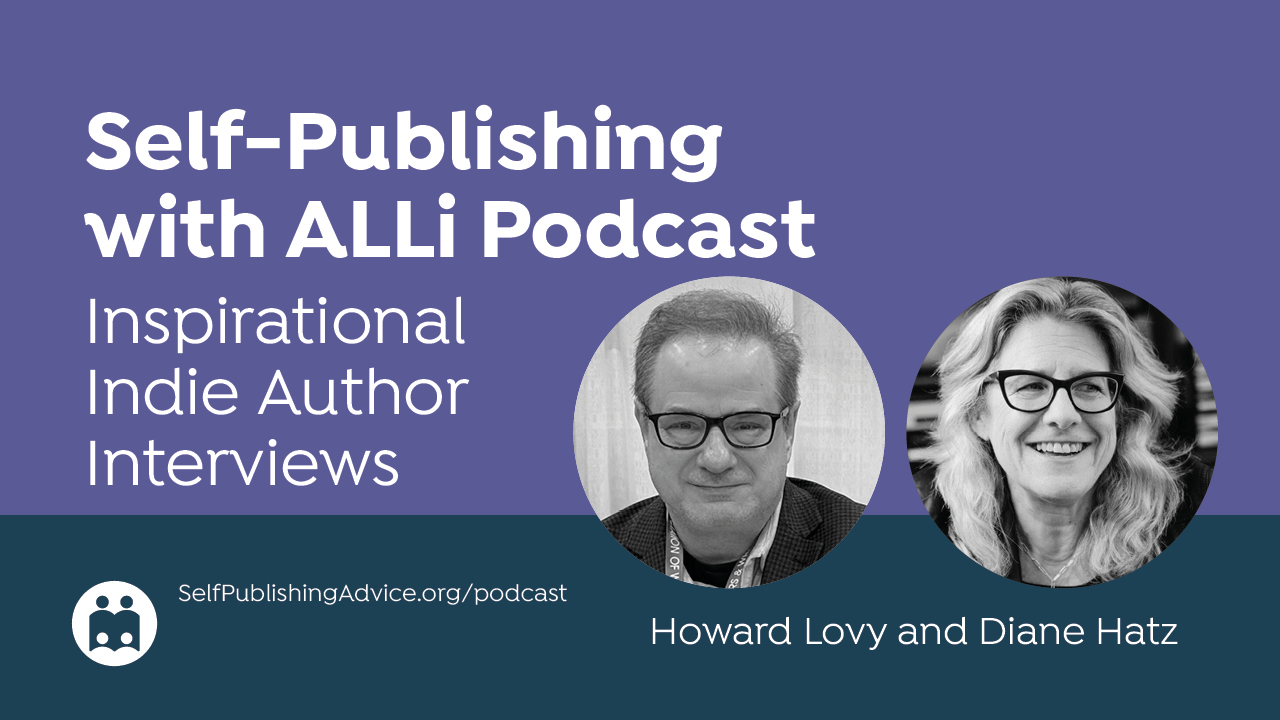
My ALLi author guest this episode is Diane Hatz. Diane spent years in the music industry, working at major and indie record companies, managing a band, and co-founding a fanzine on The Who that ended up in the Rock & Roll Hall of Fame. Years later, she drew on those surreal experiences and turned them into fiction. After decades of putting off her dream of being an author, she published a four-book series in five years.
Listen to the Inspirational Indie Author Interview: Diane Hatz
Bookstore
You can find Diane Hatz’s books in the Indie Author Bookstore.
About the Host
Howard Lovy is an author, developmental editor, and writing coach with a long career in journalism and publishing. He works with writers at many stages of their careers, with a focus on helping them develop their ideas and strengthen their work while preserving their unique voices. He lives in Northern Michigan.
About the Guest
Diane Hatz is an award-winning author, organizer, and inner activist. Her debut novel, Rock Gods & Messy Monsters, earned numerous honors, including first runner-up for the 2024 Eric Hoffer Award and No. 1 Amazon Hot New Release in three categories. She has since written three additional novels, completing the Mind Monsters series. When not working on her next book, she can be found wandering the desert in New Mexico, road-tripping through the Southwest, or helping abandoned puppies find homes. You can find her on her website, subscribe to her newsletter, read her Substack, A Writer’s Life, and listen to her YouTube podcast. You can also check out the Mind Monsters series on Amazon and Amazon UK, and follow her on Facebook and Instagram.
Thoughts or further questions on this post or any self-publishing issue?
If you’re an ALLi member, head over to the SelfPubConnect forum for support from our experienced community of indie authors, advisors, and team. Simply create an account (if you haven’t already) to request to join the forum and get going.
Non-members looking for more information can search our extensive archive of blog posts and podcast episodes packed with tips and advice at ALLi's Self-Publishing Advice Center. And if you haven’t already, we invite you to join our organization and become a self-publishing ally.
If you’re a published indie author who would like to be interviewed by Howard for the Inspirational Indie Authors podcast, you need to be a member of the Alliance of Independent Authors.
Then contact Howard, including your membership number, explaining why you’re an inspirational indie author and what inspires you.
If you haven’t already, we invite you to join our organization.
Read the Transcript
Diane Hatz: Hi, I'm Diane Hatz. I'm the author of a four-book series called The Mind Monster Series — I just released the fourth one a couple of months ago. I also have some news that hasn't been made public yet: I'm launching an indie festival called Sage & Ink for New Mexico indie writers and spoken word artists. Our first event is in November in Rio Rancho, just north of Albuquerque. I decided rather than going out to find people, I'd try to bring them to me.
Howard Lovy: That's wonderful. And Santa Fe sounds like a beautiful place to do that. So you heard it here first — some breaking news from the indie world. And if there are any ALLi authors out there in the area, please get in touch.
Diane Hatz: Yes, especially if there are ALLi authors in the area, please get in touch.
Growing Up in Delaware — and a Mother's Advice
Howard Lovy: Let's go into your backstory. Where did you grow up, and was reading, writing, and music always a part of your life?
Diane Hatz: I was born in — technically Newark, Delaware, but really Wilmington. I think I was about 15 when my mother first asked what I wanted to do with my life. It was for the PSATs. She said, ‘What do you want to do with your life?' and I said, ‘I want to be a writer or a philosopher.' Her response was: ‘You're going to wash dishes for the rest of your life.' So I got a little sidetracked and had to get a business degree. But I was really into music, and I started a fanzine on the rock band The Who when I was about 17.
Howard Lovy: And that somehow got you into graduate school?
Diane Hatz: Yes — this was in the 1980s. Antioch University had an individualized master of arts program in London, and I wanted to go to London. So I moved there for a few years and concentrated in creative writing. Back in the '80s there were only two or three colleges that had degrees in creative writing. My thesis was probably the worst book ever written — it's in a drawer somewhere, I might pull it out one day — but it was a great experience. I will say as a caveat to anyone listening: you do not need an MFA in creative writing. You need writing classes. You need to learn the craft.
Howard Lovy: You need to write and read. Let's backtrack a little — a fanzine on The Who, in the '80s. I went to a Who concert in 1983 — that was going to be their farewell tour.
Diane Hatz: Oh, yeah.
Howard Lovy: They're still going strong, but — why that band in particular?
Diane Hatz: I went to see The Kids Are Alright at the Tower Theatre in Philadelphia in 1979, and I'm like — who are these jerks? These a-holes. But then I happened to see it again, and I just fell in love with Townshend. He's a brilliant songwriter. If anyone knows the music, Quadrophenia is such a piece of art — not just musically but the poetry, the lyrics, everything. As a teenager I wanted to get to know them and be taken seriously. I loved writing and didn't know what to do with it at that age, so I thought: I'll start a fanzine. They didn't have a fan club at the time, so I got connected with them. I actually interviewed Pete's mother for one of the fanzines.
Howard Lovy: Oh, great.
Diane Hatz: And my claim to fame: when The Who got inducted into the Rock & Roll Hall of Fame, my fanzine was inducted too. I don't have a big display in the main gallery — I'm in the library — but The Relay, my fanzine, is in the Rock & Roll Hall of Fame.
Howard Lovy: And you said that was somehow connected to getting into your master's program?
Diane Hatz: Yes — I used it as my writing sample to get in. It was an individualized master's, so we created our own degree. I took writing courses around London and Northern England, did retreats. A great experience. I was very intimidated. When I came back to Delaware, finished the thesis, got my degree, I thought: I'll work in the music industry while I write books. Delaware is only 130 miles from New York, so I literally packed a U-Haul and drove up, thinking I'd be there a year. I ended up staying 30 years.
From London to New York: Island Records, Sony, and the Music Industry
Diane Hatz: I sent out 60 cold resumes. Everyone in college said don't do that, you'll never get a job. The president of Island Records called me — this is a long time ago, U2 were on the label.
Howard Lovy: They were, yeah.
Diane Hatz: He called me and just hired me basically on the spot. He said, ‘I never thought I'd find somebody with fan club experience.' So I was hired to use fans — not in a bad way, but to utilize fans — to help market and promote bands. He eventually left, typical industry stuff, I got laid off, worked at an indie label for a while, then ended up at Sony Music right as it was transitioning from CBS Records to Sony Music.
Howard Lovy: And your first book, Rock Gods and Messy Monsters, is actually about working there.
Diane Hatz: Yes. Instead of the Japanese buying a company, aliens buy a record company — because all these foreign companies were buying out US record labels. I'm not the kind of person suited to a corporate environment. Nobody would listen to my ideas, and in the book I unzipped my head, pulled out my brain, and put it in an urn on the desk — because that's what I felt I had to do every day. I had a boss who would just yell at me every day and pound on the desk. This was the early '90s, pre-Me Too. One day I looked at him and saw this vein pulsating on his forehead. When I started the book, the character Langley explodes blood vessels on the sides of his neck, and Alex the assistant has to sew him up. My writing is absurdist and satirical, but it all has meaning. It is autobiographical.
Howard Lovy: For some reason what comes to mind — tell me if I'm wrong — is A Visit from the Goon Squad by Jennifer Egan. That same kind of send-up of the rock industry. I don't know if you've read that.
Diane Hatz: I started it. Do you know what's really bad about getting a master's degree in creative writing? You lose your joy of reading. Because when I read books now I automatically start critically cutting them up, critiquing them.
Howard Lovy: Picking it apart, yeah.
Diane Hatz: Yeah. And I can't enjoy the story, and it's so frustrating.
Howard Lovy: I try to keep that in mind when I read for pleasure — you're not critiquing this, you're actually reading it. So when did you decide to write Rock Gods and Messy Monsters and enter the publishing world?
The Long Road: Rejection, 2008, and a Second Chance at 59
Diane Hatz: I started it in the '90s. I'm in New York, I'm in my early 30s, I'm going to be a writer. It took five and a half years of real work. Then I started doing the traditional route, looking for agents and publishers. I got so many rejections. There was one form letter that just had boxes, and they just ticked a box — and the box they ticked was ‘give up writing.' I know my writing was a little advanced for the '90s, but that destroyed me.
So in 2008, Amazon had just started KDP. I threw it up online just to prove to myself that I was a writer. I did nothing to market it. Then I ended up leaving music and got into nonprofit, environmental, anti-factory-farm work. Did that for over 20 years.
Fast-forward to 2021. I had recently left New York City and moved to Santa Fe, and someone I had temped with at the Rainbow Room in the early '90s emailed me: ‘Oh my God, I found your book on Amazon, and I was so inspired — I just finished it and I just quit my job.' That helped inspire me. I was 59, getting ready to turn 60, and I thought: it's now or never. I decided I would rather be living in my car with my books than be on my deathbed saying I wish I had tried. These four books are the biggest accomplishment of my life.
The Mind Monster Series: Healing Arcs and Visionary Fiction
Diane Hatz: I started writing the second book and spent months trying to figure out what I was doing. Then I thought: just make it a sequel. The second book is Alex — the main character from Rock Gods — twenty years later, and it's her healing arc. Writing is therapy to me, and I've been on a healing journey for thirty years. I try to put what I know and what I've learned into the work. It's taken four books to sort it out, but I've found my genre: visionary fiction. Absurdist fiction, visionary satire. My hope is to help one or two people in this lifetime who were in a place I've been in — let them know they're not alone. That's what I hope I can do.
Howard Lovy: Let's backtrack a little and go into that. In between writing and your music career, you were into social activism and social commentary. How did that feed into your fiction? And is that connected to your spirituality as well?
Pete Townshend, Meher Baba, and the Path to Tibetan Buddhism
Diane Hatz: I've never been asked that question. I would say the nonprofit world didn't really feed into my writing. One major thing about working in corporate music: I know what goes on in boardrooms, and it's no different in traditional publishing. So I indie published by choice — when I started doing this in 2022 I wouldn't even consider traditional. But I don't want to get into it because there are some really great people in the traditional world.
Howard Lovy: Oh yeah, well, you're preaching to the converted here — we're the Alliance of Independent Authors.
Diane Hatz: With my activism — it was a different track altogether. If anything it veered me away from writing. I was very successful in that work, but there was a kind of coup when I was in my early 50s, and I got pushed out of not just my job but my career. It was horrible. I was in perimenopause. Howard, I have such a book in there.
With my spirituality — the way that started was really through The Who. Pete Townshend — Tommy is a rock opera but it's really about the guru he followed, Meher Baba. So I was interested in that. Then a friend who I managed his band for a while mentioned, ‘Oh, that guy, the Dalai Lama — he just won a Nobel Peace Prize.' I said, ‘Who is that?' I got a chance to see him, and the whole teaching I'm thinking, I don't understand this, what am I doing here? But at the end, when he did a prostration to the audience, a bolt of white light just pierced me. And that was it. Buddhism.
I studied Tibetan Buddhism seriously — was in a school, learning Tibetan, could make a butter sculpture. But I realized my spiritual path is writing these books. My themes are trauma, recovery, and resilience. My Dharma practice is my writing. A lot of people think a spiritual practice means sitting on a cushion and chanting. That's good and it helps focus the mind. But I'm following the path of the mahasiddhas — very realized people who didn't take the conventional route. The key in life is for each person to figure out what they're here to do, what their calling or passion or purpose is. Writing is mine. I might be one of those people who's dead before people really start to read my books, but this is what's coming out of my soul. This is my connection to something bigger than me.
Howard Lovy: I understand that. It was that way for me when I was young, and then life got in the way. Now that I just turned 60 recently, I'm coming back to it — writing for the reasons I originally became a writer. It's a very spiritual thing.
Diane Hatz: Happy birthday.
Howard Lovy: Oh, thank you — it was back in October. I'm more like 60 and a half.
Diane Hatz: October what?
Howard Lovy: October 7th.
Diane Hatz: I'm the 11th. I'm going to be 65, Howard, so I'm your elder.
Howard Lovy: Fellow Libras too. By the way, I went to the Tibetan Freedom Festival in 1999 and saw a whole bunch of great bands — the Beastie Boys, Pearl Jam, all that. That's when I first became aware of the Dalai Lama, because everyone talked about it. But anyway, back to you. We're talking about you.
Diane Hatz: Oh, we can talk about the Dalai Lama if you want.
From Manhattan to Santa Fe: Thunder Road and a Fresh Start
Howard Lovy: In late 2020 you moved from Manhattan — the East Village — to Santa Fe. That must have been quite a culture shock. Why did you decide to do that?
Diane Hatz: It was COVID. I was in the height of my perimenopausal meltdown — they're much more public about what women go through now than they were even ten years ago. I was literally researching psych wards. I'm not joking, it was that bad. When COVID hit, everybody with means left, and I was alone in the East Village. Word was that Rikers Island was being emptied and people were just being dropped off in the neighborhood. It was a little too much trauma. When my grocery store and my laundromat closed, I said: oh, no. Every cell in my body said you have to leave.
I had certain requirements — high desert, four seasons, spirituality, creativity, diversity — and Santa Fe was really the only place. I rented my apartment online. I'd never been here before except for one night on a road trip twenty years earlier, and I didn't know anyone. I moved. I can say with 100% assurance it's tough to do. Anyone who makes a huge change: give yourself a year or two to adjust. Even the altitude — we're at 7,200 feet, and I'm not sure I've ever fully acclimated.
My brother and sister-in-law drove out and followed me. The minute my car wheels crossed the state line into New Mexico — literally that minute — I just relaxed. I got on the walkie-talkie and said, ‘A girl can breathe out here.' I knew I'd made the right decision the minute my wheels crossed into the state.
And when I left the East Village — still COVID, still closed down — I got in my rental car, plugged my phone in, and Thunder Road came on. I'm also a huge Springsteen fan. So I'm like — this is one of my favorite songs. Then I get to the Holland Tunnel and Born to Run comes on as I'm going into Jersey. I'm like: yes, this is a good sign.
Howard Lovy: Absolutely, yeah. Especially going into Jersey. So you've written about battling your own mind monsters — including a voice that told you you weren't good enough. How did writing this series help you face those voices?
Writing Through the Mind Monsters: The Voice That Says You Can't
Diane Hatz: I think each of us has to find our way to get out what's inside us. Since I've been here I've been doing a lot of healing work, including internal family systems therapy — where you look at parts and protectors and essentially split yourself apart. The nagging voice, that ‘you can't do that' voice — meditation can help you key into it. I really started digging into where that voice comes from, what it is, why do I have it. I know exactly the teacher, the parent, the echo it comes from. Ancestral too.
As I wrote the books and got it out on paper, I was able to sort of separate from it. And by separating from it I was able to go: it's just about letting go. The voice is still going to be there, but I sort of laugh and say, I'm in control. I run the show now. I don't ignore it — ignoring can make it worse. I acknowledge it, but then I remind it that I'm in charge, not it.
Writing these four books has been the biggest accomplishment of my life. Not just because the craft is hard enough — editing, getting to the finished version, all of that. But battling the voice that says you suck. Going on Instagram and watching other writers selling millions of books, or going to a conference and having sold four copies.
Howard Lovy: The voice in my head is always: nobody cares what you have to say. And I always have to get beyond that. I care what I have to say — maybe that's good enough.
Diane Hatz: That's true. And there are other people who care what you have to say.
The Practical Side of Indie Publishing: Four Books in Five Years
Howard Lovy: You published four books in five years — quite an accomplishment. What, besides the writing itself, did you learn about the practical side of publishing as you went from book one to book four?
Diane Hatz: So Rock Gods and Messy Monsters was originally the book I threw up in 2008 — I re-edited it for this series. The following three I wrote from scratch. When I did Rock Gods, I had a little money set aside — I called it my PhD in marketing and publishing books, and I'm glad I did. I think it's very normal to know intellectually that you probably won't sell much with your first book, and yet still hold that little hope: I'm going to be Lessons in Chemistry, I'm going to sell millions. I followed what everybody said to do, put money into promotion, and it didn't work. My genre — visionary fiction, genre-bending — has been very hard to find an audience for. So what I did after book one was make a choice: I have to focus on the writing and get the series done, because the second, third, and fourth books follow right after each other. It's really one long story broken into three parts. So I've done very little promotion. That starts now.
Howard Lovy: What did you learn about promotion? What kind of content do you put out to promote yourself and your work?
Diane Hatz: Instagram and Facebook I honestly think are useless unless you have a lot of money to boost posts. So I chose YouTube and Substack. I'm definitely sticking with Substack. YouTube I've done for over a year now and have about 103 subscribers — the algorithm has gotten as bad as Facebook and Instagram, and I'm debating whether to continue. My YouTube content talks about themes in the novels: friendships over 50, whether it's okay to leave a friendship, writing as healing. I'm trying to reach people going into a new phase of life who've had some kind of struggle and want to use the written word to help them heal. I'm not a self-help person — I'm not trying to tell people what to do, just saying here's what I did. I'm still finding my way. Howard, I'm so happy this is audio, because I'd be so nervous on video. I do videos and I'm just so nervous and awkward — which is exactly why I'm doing it.
Howard Lovy: I understand. Well, like they say, I have a face for radio.
Diane Hatz: Oh, that's not true — I'm looking at you.
What Success Looks Like at 64
Howard Lovy: So what does success look like to you at this stage, both as a writer and as an indie publisher?
Diane Hatz: Adult Diane — 64-year-old Diane — can say with assurance that I have achieved what I set out to do with this series. I wrote it, I published it, I have the four physical books in front of me. There is a younger part of me that wants respect — wants to find my niche and my audience and connect with other people so the work has more meaning beyond just me publishing into the void.
Howard Lovy: Right. That long-term community of writers — especially if you live in an isolated area, it's hard to find your people.
Diane Hatz: Yes. It's why I'm putting on Sage & Ink — I just haven't been able to find my community of writers here. I apologize, I forgot the last part of your question — success on the business side?
Howard Lovy: Yes — what success looks like both as a writer and on the business side.
Diane Hatz: On the business side, I set up my own publishing company. And honestly, Howard, success to me is starting the next book. I've already started the next series. Success is that I didn't give up. Writing is like an antidepressant for me. I also volunteer with puppies at a shelter here called Española Humane — I sit in a pen with puppies every week and try to get them adopted. That's my therapy. And writing is my therapy. And it's a really good day when I bring my book into the pen and read to the puppies.
Howard Lovy: That's great, I love it. All right — I have one more really difficult question for you. Are you ready?
Diane Hatz: Yes.
Howard Lovy: What is going on with the drummer of The Who right now? It was Ringo Starr's son who was fired and then not fired — I don't know what's happening. And of course nobody could really replace Keith Moon, but do you have any special insight?
Diane Hatz: I don't. I was actually in Palm Desert last year at their final, final, final, final show. They said they're done. It was something to do with Roger. But I'm honestly happy to say that I'm focused on me now — not following The Who around. Not me in a bad way, but my writing and using it to help others instead of following the band.
Howard Lovy: That's a great answer. Well, thank you so much, Diane. I appreciate you telling us about your journey and best of luck in the future.
Diane Hatz: Thanks so much, Howard.
Howard Lovy: Okay. Bye.