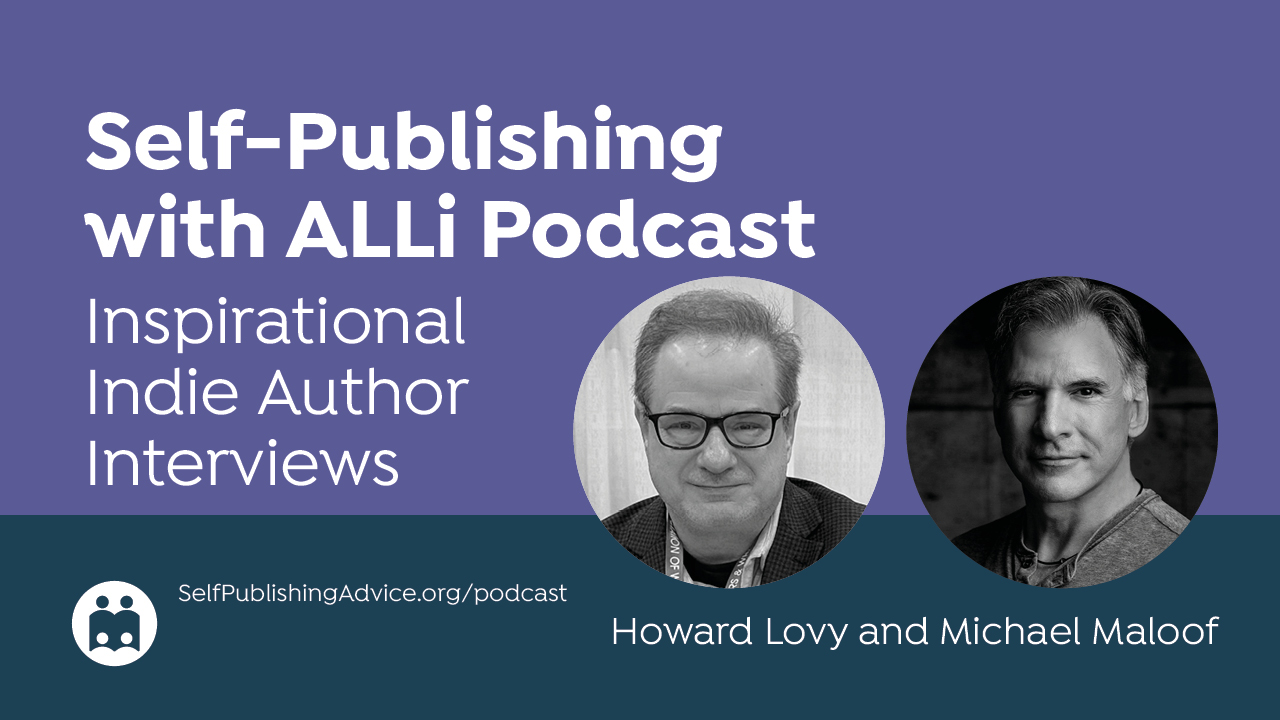
My ALLi author guest this episode is Michael Maloof, author of award-winning thrillers about a former CIA analyst drawn into conspiracies that stretch across continents. Michael brings to his fiction a background in technology, entrepreneurship, global travel, and real-world tactical training. His books combine action, technology, emotional stakes, and a strong female lead who refuses to back down.
Listen to the Inspirational Indie Author Interview: Michael Maloof
About the Host
Howard Lovy is an author, developmental editor, and writing coach with a long career in journalism and publishing. He works with writers at many stages of their careers, with a focus on helping them develop their ideas and strengthen their work while preserving their unique voices. He lives in Northern Michigan.
About the Guest
Michael Maloof is the award-winning author of the Kate Preacher thriller series, including Relentless, Unstoppable, and Defiant. His globe-spanning thrillers blend international intrigue, emotional stakes, and authentic tradecraft, earning praise for their intensity and realism. Having traveled to more than forty countries across six continents and trained alongside elite military and intelligence professionals, he brings a rare level of authenticity to his work. A serial entrepreneur and lifelong adventurer, Michael writes stories shaped by risk, determination, and discovery.
Thoughts or further questions on this post or any self-publishing issue?
If you’re an ALLi member, head over to the SelfPubConnect forum for support from our experienced community of indie authors, advisors, and team. Simply create an account (if you haven’t already) to request to join the forum and get going.
Non-members looking for more information can search our extensive archive of blog posts and podcast episodes packed with tips and advice at ALLi's Self-Publishing Advice Center. And if you haven’t already, we invite you to join our organization and become a self-publishing ally.
If you’re a published indie author who would like to be interviewed by Howard for the Inspirational Indie Authors podcast, you need to be a member of the Alliance of Independent Authors.
Then contact Howard, including your membership number, explaining why you’re an inspirational indie author and what inspires you.
If you haven’t already, we invite you to join our organization.
Read the Transcript
Michael Maloof: I'm Michael Maloof, the author of the award-winning Kate Preacher thriller series. Very proud of the fact that I've picked up a few awards. I've just recently completed the Kate Preacher Origin trilogy.
Howard Lovy: Congratulations on the awards — we'll get to that. But first, tell me where you grew up, and were reading and writing always a part of your life?
Growing Up in Silicon Valley Before It Was Silicon Valley
Michael Maloof: I grew up in the Silicon Valley before it was the Silicon Valley. I lived in a row of houses completely surrounded by apricot orchards — some decades later I got lost trying to find my way back there. It's changed pretty dramatically. But it was a great place to grow up. I got to run around in the woods, and then later be there for the birth of the PC. I think I've owned some equipment that should be in the Smithsonian. I found myself wanting to spend more time with computers than people, and was reasonably successful at that.
Howard Lovy: Is that what you studied in college — computer engineering?
Michael Maloof: I tell people I'm a multi-college dropout. I probably have several degrees' worth of units, but I was always one of these wanderlust types — I'd be on my way to class and head for the library instead. I'm self-taught, both in programming and the tech world. I also had the opportunity to work with some mentors on the writing side. I knew in high school that I wanted to write. My first venture into college was going to be USC to write screenplays and make movies, but I ended up following the tech world instead.
Africa, Guatemala, Navy SEALs, and Living Recklessly
Howard Lovy: You traveled a great deal. Was that for your career or on your own?
Michael Maloof: Mostly on my own. Right out of high school I ran into a friend who was heading to Africa. He was an amateur herpetologist — going to deal with snakes — and asked what I was doing. I said I was writing. He said he could use me, that we should pitch articles to National Geographic. I was an amateur photographer at the time. I was saving up to learn to fly, and instead I spent that money tramping around Africa for about three months — barely surviving.
Howard Lovy: Barely surviving — is this the elephant charge story in Kenya?
Michael Maloof: That is. We had a seven-foot cobra get loose in the car. We had one get loose in the hotel we were staying in. We were in a little rented four-door Toyota Corolla that we took hundreds of miles up into the northern part of Kenya. A female elephant protecting her calf came charging the vehicle. My buddy was driving, smashed the car into a tree, and said ‘Get out.' But as a good seatbelt-wearing Californian, I couldn't quite manage the open-the-door-remove-the-seatbelt sequence at speed. When I finally bailed out of the car, the elephant was standing right there. I was lucky she chose not to smash up the big yellow bug bothering her calf. One of those rather unforgettable moments.
Howard Lovy: You've traveled to more than 40 countries across six continents — searching for Mayan artifacts, surviving elephant charges in Kenya. You sound like a real-life Indiana Jones. Did you realize at the time that this might all become material for fiction?
Michael Maloof: No. These were just crazy things I did when I believed myself to be invincible. I kept following threads — this friend was headed to Guatemala, I followed him there. Another was a librarian, I went there too. Looking back, I had some rather reckless friends. But they led me down some interesting paths.
Howard Lovy: There's also a military side to your travels. You trained alongside Navy SEALs, Army Rangers, Green Berets, and others. What drew you to those worlds?
Michael Maloof: Again, a door opened and I had a chance to walk through it. I met some people doing training in Texas and South Carolina and just became fast friends. I got continuous invitations, and I would bring cigars and warn them that I might be careful — it could end up in a book someday. And it did. I got to train alongside them as a civilian participant, and what you come away with is that no matter how much training you've had through private security, you don't know a fraction of what special operators know. I'd had a lot of weapons training through private resources. Thought I knew my weapons, thought I knew my tactics. You realize very quickly that you don't know a thing compared to what these guys do. They never stop training — it's actually one of the most dangerous parts of the job, since many have been hurt and some killed in training. But they have to be ready when that call comes.
Howard Lovy: Why would you expose yourself to that kind of pain willingly?
Michael Maloof: Their kind of pain is driven by a love of country and a kind of heart that's hard to capture. I hope I do capture it in my writing. Two of the Navy SEALs I've worked with neither of them knew how to swim before going into BUD/S. They entered classes of maybe 220 or 250 men and were among the 20 to 25 who made it through. The mindset required to drive yourself to become that person is just phenomenal. When you're in the presence of it, you realize these are unique individuals. But you'd never know it walking down the street. For the most part they're pretty average-looking men who could probably kill you with a spoon.
Creating Kate Preacher: Being Underestimated as a Weapon
Howard Lovy: When did you decide to take all these experiences and build a character and a series around them?
Michael Maloof: My wife and I built two software companies leveraging our tech expertise — I always tell people I built the products and she built the companies, so I married up. When we sold the second company, I had 20 years of business lessons burning a hole in my brain. That first nonfiction book was called The Startup Survivor. We'd managed to survive — did well financially, but it was two separate companies of ten years each, pushing the truck uphill. A lot of pain along the way.
Knowing I'd always wanted to write, my wife said: now's the time. My social media handle, Michael Go Write, comes directly from her telling me to go write. Her gentle prodding helped me actually reach those two magic words: The End. We were sitting around drinking wine one evening and I knew for business reasons I wanted to lead with a female character. I've had the privilege of working with some really brilliant, strong women — my wife among them — and I saw firsthand how being underestimated is a weapon. When a woman walks into a room in a male-dominated sphere and is underestimated, that can be a fatal mistake. I'd seen that play out enough times to know: that's my character. Together we created Kate Preacher. Our deal was twofold: don't kill any dogs, and she gets to read it first.
Howard Lovy: They say write what you know. You clearly know this world, but you don't know firsthand the point of view of a female protagonist. Was that tricky for you?
Michael Maloof: Honestly, no — and it was great to have my wife as my backstop. I have four sisters, a wife, and some of my closest co-working partners were women. My product manager at the last company was Nicole. I've just had these strong, intelligent, brilliant women around me and I patterned Kate after them.
Kate: Human, Vulnerable, and Inspirational
Howard Lovy: Kate's backstory is that she's conflicted and very human. How important was it that she not be a superhero?
Michael Maloof: That was exactly the aim. I did not want Kate to come off as a superhero. I wanted her to be human and vulnerable. Partly because I wanted to hold up a mirror to women who maybe aren't firearms-proficient or self-defense-trained — to show them there's no reason they can't be. I wanted to inspire women. I got a note from a reader yesterday who was rereading the books and asked if I was going to keep going. I told her absolutely — there's much more Kate ahead. She said she saw Kate as an inspiration to women. That's exactly what I was hoping for.
Howard Lovy: One recurring motif in your books is chess. I think you said in an interview that you don't really play chess yourself, but you like the image of seeing the whole board.
Michael Maloof: Exactly. And it just seemed to fit the arc of this trilogy so well. Kate trying to figure out who the opponent is, with a board that's constantly changing and tactics continuously in play. I learned just enough and vetted it through some friends who confirmed it worked. It was a little risky for me — I was much more comfortable in the tech world and with the SEALs backing me up than I was with chess. But I loved the motif.
Howard Lovy: And part of it becomes a mystery of untangling what the big picture actually is.
Michael Maloof: Yes. There's a game in motion, and Kate has to figure out what game and who's playing it.
Choosing to Go Indie: Uncertainty, Age, and Owning the Process
Howard Lovy: You come from the business world, so launching your own publishing business must have felt somewhat natural. What made you decide to go indie rather than seek a traditional publisher?
Michael Maloof: Being an independent author felt somewhat similar to being a software publisher — there were parallels that made the process comfortable for me. It's a product, and as my wife used to say, shipping is a feature. But the decision was also about uncertainty and age. I'd built two businesses and was watching the clock, and I really didn't want to spend six months or a year looking for an agent, following the horror stories of 40 query letters going out to dozens of agents, maybe landing one, that person spending another year pitching publishers, and then two and a half years later your book appears. I'm told it's better than that now in the traditional world, but I'm not sure I believe it.
Howard Lovy: I'm not sure it is. It's been described to me as a soul-sucking process.
Michael Maloof: And I understand that even in traditional publishing now, the idea that you write a book, hand it off, and go back to writing another one is gone. All authors today have to be involved in their image, social media, and building their lists. I love interacting with my readers. At the end of the day, that's how we keep score: who's reading the book and what are they saying about it?
Craft Development: Stephen James, John Truby, and a Thriller Editor
Howard Lovy: You're not just a lone person behind a computer. You worked with other people, including a thriller author for a developmental edit. How did outside guidance help shape the series?
Michael Maloof: Pretty significantly. I was lucky to have taken a class with Stephen James, and when I was getting through that first draft I approached him about editors. He said, ‘What kind of state do you think it's in?' I said I thought it was pretty good. He said, ‘Well, let me have a look.' I was shocked he was willing to do that. I think he bit off more than he expected, but it was incredibly valuable. I've also got an editor now who I'm under NDA not to name — he does work for publishers and some work on his own — and he's been very helpful. I've been to ThrillerFest, taken some master class courses there.
But probably the cornerstone of my craft training was working with John Truby. He has a couple of books on story structure but he's primarily a story consultant to Hollywood. His structure — the four parts of opposition between characters that drive plot — really resonated with me, perhaps as a software engineer. I call it the Truby story process. I spent about a year and a half working with him on Relentless, and then took the process and broke off on my own for Unstoppable and Defiant.
Howard Lovy: Is John Truby's approach different from others out there in terms of plotting?
Michael Maloof: I think it's broader or even deeper. He gets away from — in fact, he kind of despises — the three-act or four-act structure. He's driven very much by the premise of the story and the main character's desire line, and by what the antagonist is after and doing. It's a fun process for developing great character interactions and complex plot. When people say they notice a lot of things going on in my books and yet still manage to follow it, I look at the Truby structure as the foundation for that.
Tech Thrillers and the Challenge of Staying Current
Howard Lovy: You're a tech person from way back, and you draw on real-world technology — hacking, AI, security threats. Given how quickly things change, are you afraid of your books seeming dated even a year from now?
Michael Maloof: That's partly why I wanted to emphasize the character portion. Some of what's in the books has people saying ‘Wow, that's really leading edge' or slightly unsettling — it's about a quarter step from where we are right now, which is where I tried to keep it, grounded in reality. But more than anything, from my reader responses, they love Kate. They want to be back in Kate's world. The tech was a vehicle to tell Kate's story. It's the Kate-and-Jake relationship, Kate's relationship with the Trident Security team, with Isabella and the others — that character-driven heart is what will keep it alive.
Howard Lovy: Did you say Kate and Jake? Those are the protagonists?
Michael Maloof: Jake is her husband. Jake Church and Kate Preacher. Every church needs a preacher.
Howard Lovy: Interesting — completely coincidentally, the name of my novel that came out about a year ago is Found and Lost: The Jake and Cait Story. I just found them to be really easily remembered protagonist names.
Michael Maloof: Great minds.
Kate's Arc and Michael's Growth as a Writer
Howard Lovy: You've now gone through three books. Looking back, how did your protagonist change from the first book to the finale — and how did you change as a writer?
Michael Maloof: Kate's journey is easier to map. I knew how I wanted this trilogy to end. I took a character thrust into really challenging circumstances — grief, physical trauma, discovering a deeper web she had no idea how far it would go — and she keeps going because she knows she can't walk away from it. Kate's philosophy is: if not me, then who? She stays driven to the end, partly fulfilling a promise to Jake. But when innocent lives come into it that aren't part of her mission, she has to do the right thing anyway. She's not an assassin, not a CIA operative — she can't compartmentalize the way special operators can. Completing the trilogy sets her up as this new woman: she's stopped hiding from her past, she's stopped hiding from her trauma, and now she's in charge of the Trident Security team — former special operatives with an international reputation as an executive security team. There are fun things ahead for them.
As for me as a writer — I was blown away by the reception to Relentless and by the awards. My wife tells the story of reading it for the first time and wondering, ‘Oh God, what if I don't like it?' She laughed, she cried, she loved it. But I genuinely feel that Defiant, the third book, is my best writing. I've evolved as a writer and hope I never stop evolving.
Reader Connection, Challenge Coins, and What Comes Next
Howard Lovy: You've got a reader club and an advance review team. How important is staying in touch with readers?
Michael Maloof: I always tell people when they sign up: I'm not going to spam you. But I love sending updates and running contests, and more than anything I love hearing back from them. If I see a comment from someone who says they love the series, I always jump in to thank them — as an independent author, those super fans are incredibly valuable. They help convince others to give the books a shot.
I just created some challenge coins for the Kate Preacher series. The first set went out to the beta reader team and the special operators who contributed to the books. I got a note from a super fan whose niece had entered law enforcement following her example and just made detective — could she get a Kate Preacher challenge coin? I said: tell me where to send it.
Howard Lovy: Do you have a good sense of who your readers are?
Michael Maloof: Probably a mix of all of the above. Women readers make up the bulk of readers today, and from the data I can see, around 70 to 75% of my readers are women — and they are thriller fans, not the romance reader group. They want the thrills and the chills and they want to be involved. The rest are the classic lone-operative thriller male readers, who are often surprised that they like Kate, but they like the overall weave of the characters and the drama. They'll write and say, ‘I wasn't sure about this, but I really liked it.'
Howard Lovy: What does the future hold? Are you staying in the Kate universe?
Michael Maloof: Kate universe, absolutely. I actually started a prequel set between books one and two — thought it was going to be a short story, but it kept growing. I'll get back to it. I also have a handful of standalone stories modeled around Kate. Every character I haven't killed off is fodder for future stories, and there are a few that people are particularly fond of — trust me, they're coming back.
My editor says he believes I write well enough to attract an agent and traditional publisher, and he really wants me to put together a one-pager on some ideas and talk to some agents. I kinda smile and nod, and I'm saying to myself: the minute I throw something over to an agent, I'm back to work on my universe. I'm pretty comfortable where I am. And honestly — maybe this is pride, but I like the idea that if an agent looks at my success as an independent, the reviews, the awards, the three million Kindle pages read, I'm not an unknown debut author saying I can write a book. I can show I've actually done it.
Howard Lovy: No matter which way you go, it sounds like you've taken a lifetime of experience and put it all into some edge-of-the-seat thrillers that people are enjoying.
Michael Maloof: That was always the goal. The dream was: could I write thrillers that would keep people up late at night, one more chapter, one more chapter? And I did it.
Howard Lovy: Wonderful. Thank you, Michael. I appreciate you telling your story to our listeners, and good luck in the future.
Michael Maloof: Thank you.
Howard Lovy: Thank you, Michael. Bye.