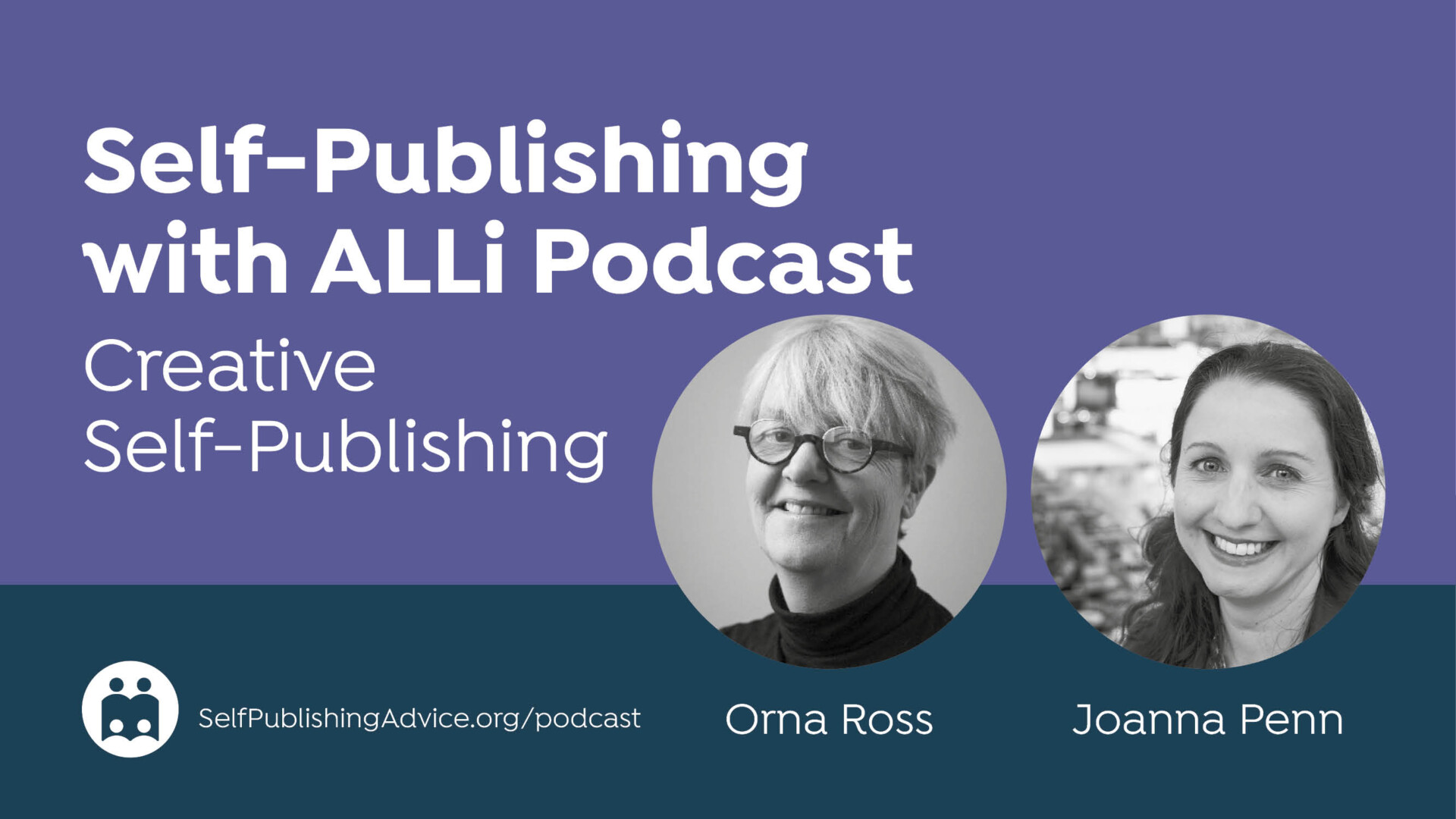
On this episode of Self-Publishing with ALLi, Orna Ross and Joanna Penn explore the concept of friction in the author business — the stuff that stops readers from buying and stops authors from acting. They examine reader friction including decision fatigue, pricing signals, platform fragmentation, and the challenge of buying direct; author friction including tech overload, identity resistance, and fear of judgment; and the counterintuitive idea that some friction — a signed limited edition, a serialized novel released chapter by chapter, a live human conversation — is actually worth keeping, because it creates connection, commitment, and differentiation in an age of one-click AI convenience.
Listen to the Podcast: Where Friction Hides in Your Author Business
Show Notes
Sponsor
Our Creative Self-Publishing stream is brought to you by Orna Ross's Go Creative! program—helping authors harness the power of creative flow in writing and publishing.
About the Hosts
Joanna Penn writes nonfiction for authors and is an award-nominated, New York Times and USA Today bestselling thriller author as J.F.Penn. She’s also an award-winning podcaster, creative entrepreneur, and international professional speaker.
Orna Ross launched the Alliance of Independent Authors at the London Book Fair in 2012. Her work for ALLi has seen her named as one of The Bookseller’s “100 top people in publishing”. She also publishes poetry, fiction, and nonfiction and is greatly excited by the democratizing, empowering potential of author-publishing. For more information about Orna, visit her website.
Thoughts or further questions on this post or any self-publishing issue?
 If you’re an ALLi member, head over to the SelfPubConnect forum for support from our experienced community of indie authors, advisors, and our own ALLi team. Simply create an account (if you haven’t already) to request to join the forum and get going.
Non-members looking for more information can search our extensive archive of blog posts and podcast episodes packed with tips and advice at ALLi's Self-Publishing Advice Center.
Read the Transcript
Joanna Penn: Welcome to the Self-Publishing with ALLi podcast, with me, Joanna Penn, and Orna Ross. Hi, Orna.
Orna Ross: Hi, Joanna, and hello, everyone.
Joanna Penn: We are back. First up, let's talk a bit about what we've been up to, because as ever, we are authors and writers too. Orna, what have you and ALLi been doing?
Orna Ross: For the last number of months I've been settling into Substack, which doesn't sound like a lot but actually there was a lot to it — I'm pretty much transferring everything I do over there. It's done, which is great. Serializing fiction, recording poetry, and going to move the Go Creative stuff there as well. So that has been a big project, which is ongoing now — just filling it, experimenting, trying different things out. The other thing I've been doing is recovering — I have a series of inspirational poetry books which I'm recovering with my daughter. That's a pun, actually, because she became quite ill in the middle of the project. She is recovering now and we're back at it, which is really great fun, because she's an artist. She hasn't done book design before but she's learning as she goes. It's such fun to be working with her on it. Five titles in all, each with a separate cover, and then a box set of three of them. So that's me. What have you been up to? You just finished your Kickstarter.
Joanna Penn: Yes. I finished Bones of the Deep — as we're recording this, it finished last week, so I'm in fulfillment. I really like Kickstarter, you know. For many years we've been talking about it on and off, and after being resistant to it for so long, I now love it as a very creative project. I'm really proud of the hardback — I think it's awesome. I did a lot of the design myself, with AI obviously, and with Jane Dixon-Smith, my designer, and I'm really happy with it. And then I'm excited to get into fulfillment and then it's done. I think that's why I like it — it's this short-term push of marketing, and as far as I'm concerned the book is in the world, even though it's not out on all the retail sites yet. It won't be for another few months. But it's almost like the loop is closed in my own head, and I have the benefit of that book because it's written. I'll do all the publishing stuff later, but that just feels good. And then I'm getting back to my master's dissertation.
Orna Ross: ALLi is chugging along as ever. At the moment we're focusing on the watchdog desk and updating everything really. The core remains the same — looking at services — but that whole area is changing so fast, with AI being a big factor. We're adding what you might call a spammers-and-scammers wing to things, and doing an update on the Choosing Self-Publishing Services book, which is overdue. We kept saying, we'll just wait until this is done, we'll just wait until that — so now it's happening. We always choose something and throw everything at it for a quarter. Now that the bookstore is up and running, it's the watchdog desk's turn. Working closely with John Doppler on that, and the partner team — Philip and Ross are also working away on it, along with Shania on the book update. So it's quite an extensive upgrade all round.
Scammers, Fake Invitations, and What to Watch For
Joanna Penn: On the spammers and scammers thing — a lot of spammers use names of podcasters in their emails. I've had another recent rash of people messaging me saying I'd invited them to pay to be on my podcast. That is not from me — someone using my name, my picture, but not my email address. I think that's important to flag, probably for ALLi as well. And I'm sure you've had emails from famous author names too — I had one from Jodi Picoult the other day: ‘Your book is amazing, I'd love to work with you.'
Orna Ross: Patti Smith is apparently my biggest fan.
Joanna Penn: There you go. They target us very, very well. So everybody watch out. That's certainly not how my podcast works, and it's not how most podcasts work. There's good and bad in every technology — we have to keep an eye out for this one.
Orna Ross: Absolutely. ALLi's badge turns up on all sorts of awful sites, and people send emails appearing to come from us all the time. If you're getting anything, always check — it's usually pretty obvious from the email address. And members can always use the forum to check if they're nervous about an email. We're also in the process of trademarking our email address, which may help to some degree. It's a total pain, but it's the world we're in.
Introducing the Topic: Where Friction Hides
Joanna Penn: That actually comes into our topic today, which is where friction hides in your author business, and when it might be useful. I wanted to do this topic because I love Kickstarter — but Kickstarter itself is friction for people. So what do we mean by friction? It's the stuff that stops people taking action. You might even want to do something, but something stops you — it might be time, brain space, money, technical complexity, or your expectations. Even when someone's interested, a reader said to me recently, ‘I'm interested in your audiobook, but I thought Kickstarter was begging' — that's still going around — ‘and I only listen to Audible.' So the friction was: they really were interested in my audiobook, but they didn't want to overcome the friction of downloading through BookFunnel or buying on Kickstarter. We're not assigning blame here. We need to examine the friction that readers feel, and also the friction we feel in our own business. For years my friction was: I'm not going to do crowdfunding, I don't want all those bosses — I didn't want several hundred people waiting for me. You did crowdfunding years before me. So that's what we're going to talk about today — the bad friction that kills what we want to do, but also good friction, the things that might slow us down for the right reasons. For example, not clicking on that email to pay someone to go on a podcast when that's a scam. Orna, what do you think of when we talk about friction?
Reader Friction: Decision Fatigue and the Buying Moment
Orna Ross: This topic came up for me through the ALLi bookstore. We were looking at the fact that a number of people use reader links — giving the purchaser lots of different options as to where they want to buy the book. That's always been the traditional advice: let the reader buy wherever they're comfortable, be it Kobo, Amazon, Apple, wherever. And some of these reader links on author sites come up with 25 choices or more as to where to buy. The research is showing that with attention spans dropping, this whole idea of decision fatigue is very relevant. We were then recommending to our authors whose books are on the bookstore to choose one single preferred link as a broad recommendation — obviously it's up to everyone what they want to do. We just wanted members to be aware of that research. And it led us to think more generally about friction throughout ALLi.
One kind of friction is what happens when somebody joins ALLi — they get a wall of resources: the advice center, podcasts, different campaigns, contract vetting, member forum, conference guide. There are just so many different things, and what we regularly hear from members is that they couldn't find their way around. So we recently started doing orientation sessions, and I did a podcast on the concept of guided selling — not just giving the reader a link and saying ‘there you are, off you go,' but actually holding their hand depending on what you want them to do, or just making the whole thing easier. Then you and I got talking, and you were thinking about friction from a different angle, so we decided to do this podcast.
Joanna Penn: Let's focus first on customer friction, reader friction, and then we'll circle back to us as authors. Decision fatigue is everywhere right now. So just a few things in terms of finding books. Every time readers are faced with all these different options, what is the easiest thing? That's what we've got to think about as authors — how do we make it easier for our customers? I've been thinking about why people stop at the point of buying direct. Amazon makes it the easiest — you cannot beat Amazon for e-commerce. People often have their credit card saved, and if you're a Prime member you get free shipping. So there are immediately two things that are difficult if you're selling direct or asking people to click through to another store. Free shipping for print books makes a real difference.
Then there's format. I often get questions from authors about whether to push audio or ebook, and we generally say market the book and let the reader choose the format — but then there's where to buy it. And then the international friction, which has been dramatically increased by the tariffs. It's extremely difficult for UK and European authors to ship print to Europe, so European readers will say, I'm not buying a print book from you because of the tariff. And which book do I start with? I get this all the time and I'm absolutely terrible at answering it. If someone says, ‘Oh, you write fiction — which book should I read?' and I have a lot of books, I have to try and figure out what might suit them. It's extremely hard to get readers to the right book. What are some of the other frictions from a reader perspective, Orna?
Orna Ross: There's added friction now even to finding you in the first place. As platforms become more fragmented, it used to be that Twitter and Facebook covered most people. Now we've got TikTok, Substack, YouTube, podcasts — discovering you at all is harder. And then the trust thing: is this author legitimate? Will my credit card be safe? Will the book actually arrive? There's a slight fog of anxiety around buying online that we haven't had for a while. COVID and everyone being locked at home led to people getting very comfortable with online buying, but the spam and scam situation is making people anxious about it again. And then of course, reading itself is too much friction for some people now. Books have to compete with the scroll, with TikTok videos, with AI summaries of books rather than the actual books. All of these things are going on for our readers.
Now, when you put all of that together it sounds horribly pessimistic — but e-commerce is booming, and people are buying books online all the time. There is also a trend of readers buying more directly from authors. So we're flagging all of this not to say it's doomed, but to alert people to think about it and maybe take some action.
Price as Friction — and as Signal
Joanna Penn: Price as friction is interesting because it can go two ways. When ebooks first came in, indies were pricing at bargain-basement prices, undercutting traditional publishing and doing really well. Then traditional publishing started pricing ebooks lower too. Right now, things have swung back — traditional publishers have put their ebook prices right up again. So I think it's worth reconsidering pricing as a signal and where you want to position yourself. If your ebook is in Kindle Unlimited, a lot of those readers will borrow anyway, so price doesn't matter as much. But if you're selling ebooks wide and you have a long series like mine, for many years I had a permafree first in series. My Stone of Fire is now $2.99. And I'm putting my front-list books at £8 or £9, so about $9.99 US. I'm trying to position myself differently. So the friction for the reader is different — but there are also libraries, and lots of ways to get things for free.
But it's almost a positive challenge: a reader lands on my fiction website, jfpennbooks.com — how do I reduce the friction to whatever the next step is? Usually that's signing up for the email list or buying a book. Can I make it more obvious? Do I need all of that on the page? What are some of the ways we can reduce friction for readers, Orna?
Orna Ross: It's so genre-dependent, even down to price — it's going to be different for fiction, nonfiction, poetry. But a ‘Start Here' page, clearly mapped out, can be really useful. If someone's landed on your website for the first time, they might have come in from a side angle — a link at the back of a book, something they found on a podcast, whatever. You never know how somebody's going to land on your website. Having a Start Here option can be a good orientation point. And that whole idea of taking people by the hand a little bit — videos that help them through the site, making your author website feel more like a place to hang out where they're guided in what to do. That sense of hand-holding them through the process you'd most like them to take is something some authors are doing very successfully.
With ALLi, as I mentioned, we're now doing monthly orientation sessions for members. Originally we conceived of them as being for new members, but actually some long-term members are coming too. Just talking to them about where they find friction points has been an eye-opener for us. And I think it's worth doing an audit on your website. If you use AI, this is something it's very good at — finding the friction spots and thinking about it from the reader's perspective. It's very difficult for us to see our own websites clearly. It's great to get an author friend to take a look and pick it apart.
Joanna Penn: Yes. And when you look at your own website a lot, things cache — images and pages may come up really quickly for you because you checked it yesterday, but that's not the experience a new visitor has. Make sure you ask someone to check on a fresh phone, a fresh browser, someone else's device. Go to the website — what happens? At a workshop recently we looked at each other's Shopify stores on our phones, and this guy had a pop-up that kept taking over the screen and he couldn't get rid of it. You know the ones — slightly transparent, you can't find the X, and it just keeps coming back. And he said, ‘That does not happen when I go to it.' So it's always worth having somebody else just test it with a fresh mindset.
Also — for audio. A lot of authors, when I interview people, they don't have an easy-to-say URL. When you do any kind of audio marketing, if you have a long link with lots of forward slashes and dashes, it's really hard. So try and use a short link. For my Kickstarter, the Kickstarter URL is really long, so I created a short link — jfpenn.com/bones — which redirects. Your redirects that you can say aloud are really important for audio marketing. And remember that people who listen might be driving or otherwise occupied, so they're not writing things down — which is why show notes matter. Think about how people are interacting with your content and how you make it easy for them.
Author-Side Friction: Too Many Platforms, Too Many Choices
Joanna Penn: Shall we get into author friction? Because there's a lot of it on our side too. We're always giving you new ideas, right? And what happens is people have their idea list and it becomes decision fatigue — what should I do? One of the biggest immediate frictions is tech overload, language overload. Too many platforms, too many choices, too many things to learn, too many new words, too many new tools. I won't go anywhere near Substack. I won't go anywhere near TikTok. I'm not going near a whole load of things now because I need to focus on what I do. And look, it might actually help your reader too — if I say I'm not on TikTok, that means you can't follow me on TikTok. We all have to practice discernment: what should I do, what do I want to do, and then focus on that. Is this a common thing you hear from ALLi members, Orna?
Orna Ross: Yes, we do hear this. And it's very personal — for you, you won't go near Substack. For me, going to Substack was actually what allowed me to let go of everything else. Now it's really simple: just Substack, just Shopify, and everything else is a distant also-ran. That has been fantastic for clearing space in my head, and creatively it's been really, really good. But for everybody it's going to be different. The core word would be: simplify. Anything that feels like ‘ugh, do I have to do this?' — well, sometimes there are things we do have to do. But most of this stuff is optional. Wherever you're going to put your attention and energy these days is what's going to make things happen. The old days where things took off organically are, for most people, just not going to happen. So if you're the person who's going to bring the reader to the purchase page, you get to do that whatever way works best for you — and forget the rest.
I do think there's a big FOMO element — fear of missing out. There's a better platform. There's a better way of doing this that I'm missing out on. There's some magic automation that's going to bring readers in automatically. None of that is true. If you're finding it hard, it's because it is hard. Make it as easy as you can for yourself.
Joanna Penn: A positive use of AI — and what I've done: about a year ago I stopped doing ads. I stopped Meta ads, I stopped Amazon ads, because it became too complicated. I outsourced it for a bit, but when you pay to outsource ad management you're paying a service fee on top of the ad spend, and it just wasn't making enough. I don't like doing data analysis, I find the platforms too complicated, so I just stopped.
Quite recently I started using Claude — first Cowork, and now Claude Code. I'm using AI to help me do things that became too difficult to do on my own, including showing me how to do stuff that relates to my business, and in some cases actually setting things up and running the analysis, then just downloading the reports and telling me what to fix. That has made so much difference. The friction of doing ads has now dropped away, and for the first time in about a year I'm doing some ads again. Using AI is also a friction for some people, but I overcame that about a decade ago when I first started learning about it. Being able to do things I felt I just could not get my head around has been fantastic, and it's also reduced the financial friction because I didn't want to keep paying someone to manage ads just because I didn't like doing them.
Orna Ross: There isn't enough volume of books and the margins are too tight to make it worthwhile to hire somebody for most of us. And learning yet another thing is a big friction for people too. For some it's a decision not to use AI, or ethical concerns. But for a lot of people it's just: ugh, it's another thing to learn. Over the last 10 to 15 years there has been so much to learn, and things keep changing. The way to cope with that is to choose your thing to learn and go deeply into it — whichever platform is your chosen platform, know it inside out and forget the rest. Trying to stay current across a lot of platforms is becoming really, really difficult.
Identity Friction and the Fear of Judgment
Joanna Penn: Let's talk about the personality elements. I'm not a data person — I never have been. I don't like spreadsheets. I'm very organized, but I'm just not interested in all the data stuff. AI has helped me enormously there. But saying ‘I'm not a data person' is a kind of identity friction — I'm not like that, so I don't want to do that. There's also ‘I don't want to do video' — I'm not into video, so I'm not going to do TikTok, I'm not really going to do YouTube anymore. Many introvert authors and authors who just wanted to write are now being asked in this business to do things they didn't sign up for. And there's the fear of judgment on the writing side — if I write this, what will somebody think about me? What will they say? I'm doing a master's in death, you know — what will they think? Over the years I've let some of that go, but these personality things can put a real point of friction in. Do you recognize elements of that, Orna?
Orna Ross: Yes, 100%. With some of these things it's about facing into them and not letting them stop us — they become growth things. What you're describing there, letting go of the fear of judgment over the years because you just cracked on and did it anyway, and then you fear it less — that's a really good thing. But then there can be other things where if it's really stopping you in your tracks, making you drift, causing… and sometimes these things are unconscious, we're not aware of them. Perfectionism being one that's talked about a lot in our community. Sometimes it's knowing which ones to face into and which ones to let go — a matter of experimenting and being in touch with how it makes you feel.
When it comes to writing the book, I've chosen to serialize my fiction now on Substack — a new thing for me, which I'm really liking. But Substack is a platform that was not built for it at all. It was originally built for essays and newsletters, not for long-form fiction. So there's a lot of friction built in — I had to create an index page, make sure to number things in certain ways, write an article about how to read serialized fiction on Substack. There are platforms like Wattpad where serializing is more native, but the platform was right for me in terms of where my people are. So I accepted that friction because it got me something I was looking for. And serialized fiction is interesting from a friction perspective too — you're asking the reader to wait. We're used to the instant download, the instant gratification of an ebook. Releasing in chapters and saying ‘the next bit won't be out until Saturday' introduces friction for the reader. But the slow read, and the readers who appreciate that, become very connected to the work in a way that just downloading an ebook and maybe never reading it isn't. That's the flip side of friction.
Friction as Differentiation: When Slowing Down Adds Value
Joanna Penn: So the counterargument is that some friction is a good thing and we don't want to remove all of it. Going back to Bones of the Deep — the hardback, the foils, the ribbon, the fact that it's only available signed for a couple of weeks. This friction to purchase actually makes it potentially more special. If it's easy to just click and it appears on your phone, that's a different experience than waiting for a parcel, getting the signed special edition, all of that. It's a kind of commitment. But we can also look at it as differentiation and as a filter — people who buy on our websites, and we appreciate everyone who does because we make more money that way, and people who subscribe to this show — clicking a button is still some friction. When we remove all of that, it's not worth as much.
And you and I — this is human Joanna and human Orna here. Not our AI voice avatars. This is human us, at a specific time of day. There is obviously friction in doing it live and yet that is what makes it more special than just getting our two AIs to discuss the same content. The content could be narrated by AI; we could have given you this as an article. And that is one of the dangers of one-click AI creation — it can remove so much friction that you don't get the benefit of thinking things through, and you don't get the benefit of the relationship — with each other in this case, because of our friendship, but also with you, the listeners. Hopefully you can tell — because of the stumbling and the laughter and the conversational things — that two AIs might not put in.
Orna Ross: As AI convenience proliferates and becomes more and more part of our lives, I think there's a counter-movement toward the analog, the slow, the deeper stuff. What is already clear, and I think we're going to see more and more of it, is this idea of the more considered, premium purchase — readers willing to invest in the human element even more than they already do. The literary festival where you can actually get close to the authors you love and get your book physically signed. These kinds of experiences are going to grow. I was talking to someone recently about a late author, and they mentioned the night that author signed their book as one of the highlights of their life — and it had taken place 25 years ago. So leaning into friction as differentiation — getting rid of the friction that's a stumbling block your reader will stub their toe on, but introducing more of the friction that makes something precious — is worth thinking about in 2026.
Your Call to Action
Joanna Penn: So as we round up, the call to action today is to make a list. Make a list of where the friction is for readers — go look at your website, your social media, your landing pages, wherever a reader might arrive. And make a list of where the friction is for you as an author. What is stopping you from doing things? Then don't rush into fixing everything. Take time to stop and make an active decision about whether it's worth fixing or whether there might be a simpler answer. As Orna said, going all-in on Substack was a simplifying move for her — whereas I've mainly just pulled back and pulled back. Many authors are choosing to pull away from social media. You get to decide. But actually identify where you're feeling the friction, and then make an active decision about whether to do something about it.
Orna Ross: And maybe pick one thing to think about on the friction-as-differentiator side — where you can lean into something you love to do that maybe isn't all that easy for the reader, but might have real value for the truest of your true fans. That might be interesting to think about as well.
Joanna Penn: We'll be back in a couple of months. In the meantime, it's happy writing —
Orna Ross: And happy publishing from us. Bye-bye.
Joanna Penn: Bye.