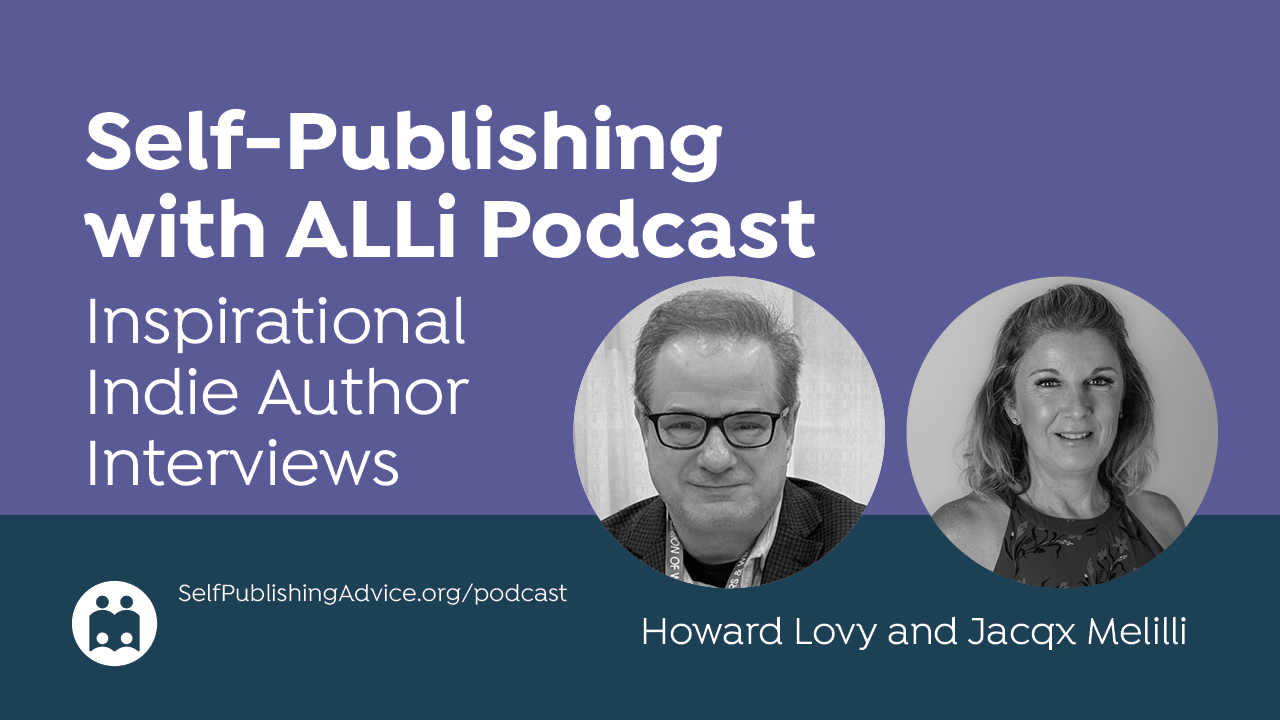
My ALLi author guest this episode is Jacqx Melilli. She is an Australian author, playwright, and writing coach. Her work grows out of a long connection to performance and storytelling. Her novel, When the Glitter Fades, explores Australian entertainment history through fiction. That same interest led her to create memoir-writing workshops.
Listen to the Inspirational Indie Author Interview: Jacqx Melilli
About the Host
Author Howard Lovy has been a journalist for 40 years, and now amplifies the voices of independent author-publishers and works with authors as a developmental editor. Find Howard at howardlovy.com, LinkedIn and X.
About the Guest
Jacqx Melilli is an author, playwright, and writing coach who helps people tell the stories they have carried for years. She holds a Master of Arts in Writing and Literature from Deakin University and has worked across film, television, theatre, and youth drama education. Her award-winning stage plays led to the Lights, Camera, Action educational drama series, and she later produced and directed two of those plays as short films. She is also the author of the Australian historical novel When the Glitter Fades, inspired by showbiz history. Through memoir and creative writing workshops, Jacqx helps writers find their voice and leave a record of their lives. Learn more at https://www.jacqx.com.
Thoughts or further questions on this post or any self-publishing issue?
If you’re an ALLi member, head over to the SelfPubConnect forum for support from our experienced community of indie authors, advisors, and team. Simply create an account (if you haven’t already) to request to join the forum and get going.
Non-members looking for more information can search our extensive archive of blog posts and podcast episodes packed with tips and advice at ALLi's Self-Publishing Advice Center. And if you haven’t already, we invite you to join our organization and become a self-publishing ally.
If you’re a published indie author who would like to be interviewed by Howard for the Inspirational Indie Authors podcast, you need to be a member of the Alliance of Independent Authors.
Then contact Howard, including your membership number, explaining why you’re an inspirational indie author and what inspires you.
If you haven’t already, we invite you to join our organization.
Read the Transcript
Jacqx Melilli: Hi, my name's Jacqx Melilli. I'm an author, playwright, and a writing coach. I started off in film — I wanted to be an actress a very long time ago — but writing was really my gift. I started my writing business in 2002 and I've been helping other people write their stories. My background is in the entertainment industry, but my gifting really is writing, not acting.
Howard Lovy: I discovered the same thing when I was in college. I spent one semester as a theater major and discovered that I'd rather be a starving writer than a starving actor. They're brutal industries, all of them — acting certainly is, but writing isn't easy either. So tell me: where did you grow up, and was reading and writing always a part of your life?
Growing Up Multilingual in Australia
Jacqx Melilli: I was actually born in France — I have a French father and a Spanish mother. We migrated to Australia when I was almost five, which was very fortunate, because you start kindergarten when you're five, so you learn to read and write at school in English right from the start. My brother was a little older, so it wasn't as easy for him. But I always spoke French with my father and Spanish with my mother, so I kept those languages my whole life.
Once I learned English at school, I discovered that was how I could express myself through stories. Technically, the only thing I was really good at at school was writing stories. I've been writing forever — that's always been my main way of communicating. Even at eleven I started what was called a diary back then, and they grew into big A4 books where I would just write to express how I was feeling.
I think that's probably why I'm now so passionate about helping other people write their stories. True stories are what I love — that's my passion. Helping people write their stories, because I understand how important it is to tell your story as a way of expressing who you are and getting through tough times. Writing is a way of making sense of the real world.
Howard Lovy: Early on, though, you were pulled toward performing rather than writing. Was that something you were interested in as a child?
Jacqx Melilli: Yes. I grew up watching all the old black and white movies — Ginger Rogers, Fred Astaire, all those wonderful films. I did have a passion for acting. But I have a very strict father who would never allow me to do dance lessons — I really wanted to do tap dancing, but he just wouldn't allow it. Too much showing of the legs and all that sort of thing.
So I wasn't able to pursue acting until my early twenties, when I was an adult. I did get an agent when I lived in Sydney and started working in television, some small roles. But I found that the industry is a bit of a devil's playground, and I wasn't prepared to compromise or sell my soul to climb that ladder of success.
Howard Lovy: What did you mean by sell your soul?
Jacqx Melilli: I think women were really pushed into the nude scenes and sex scenes, and I wasn't comfortable with that. You'd go to auditions and there'd be a form where you'd tick whether you'd do nudity, semi-nudity, all those kinds of things. And I just thought: I don't want to do anything that I'm going to be ashamed of when my children see it one day. My body wasn't for sale for a director to say, do this and do that for the sake of selling a movie. And I think women are targeted that way — and I think all of that reflects back on my writing, in how I address the way women are commodified and paraded as sexual objects.
Teaching Drama and Writing Australian Plays
Howard Lovy: So you decided to focus on the writing side, and you taught drama and playwriting and scriptwriting.
Jacqx Melilli: Yes. I did teach at some schools where staff wanted to learn how to write stage plays. But mostly what I was teaching — and what I continue to teach in my workshops — is memoir writing and creative writing. Those are my two main workshops.
I did teach drama for a while after I left Sydney, when my children were younger. That was really fantastic because it got me writing my own plays. I found that there wasn't a lot of Australian plays around — this was about twenty-odd years ago — there were a lot of American plays, and I really wanted to capture the essence of Australia, to have more Australian plays out there. So I just wrote plays for my students. Then we put them on at one-act theater festivals and we won awards. It was a really exciting time. And I was very encouraged to publish those plays, so I did.
That led to an educational publisher commissioning me to write books based on the plays — teaching resources for teachers about filmmaking and theater production. So I wrote the Lights, Camera, Action series, very basic introductory guides for teachers on how to put on a production. I would teach my students the difference between working on stage and working in front of a camera. We took two of the plays that won awards, made two short films, put them on at the local cinema — and it was packed out. Just excellent.
You need to be proactive when you're creative and make things happen. And the impact on the students was remarkable. Parents would say to me: my child was so shy and now they've just blossomed. When you can bring joy to others, it brings joy to you.
Howard Lovy: Is there a distinctly Australian flavor to what you were doing?
Jacqx Melilli: I really wanted to bring in the Australian bush. I needed to do it quickly, so I took two fairy tales as my starting point. The first was Little Red Riding Hood, which I turned into Little Red Riding Hood Meets the Dingo — all about internet chat rooms and how this dingo lures little Red to meet up with him because he wants to kidnap her grandmother. And then I did Goldie Socks and the Three Koalas — Goldie Socks because she wanted to play soccer, but her parents wanted her to be famous in theater because her mother was herself famous.
It's funny — people say write what you know, and that's what seems to come out. Then I wrote Foreigners from Australia, which was about an upper-crust English couple who flew out into the Outback and were horrified at the conditions out there. I played with the language — ‘Sharon and Barry' in broad Australian slang — that's how I put those flavors in.
When the Glitter Fades: Preserving Australian Entertainment History
Howard Lovy: Then you wrote a book called When the Glitter Fades. Tell me about that.
Jacqx Melilli: That again came from wanting to preserve Australian entertainment history. When I was teaching drama, I met a woman called Shirley Barnett — her maiden name was Shirley Broadway — who was in her seventies when I met her. She told me how she had been a child performer during the Great Depression, touring Victoria as a vaudeville performer. I was fascinated, because I had always loved those old black and white movies and performers like Bill ‘Bojangles' Robinson and Shirley Temple.
She had also worked in Australian television from its very beginning in the late 1950s, and had worked with Bert Newton and Graham Kennedy. So I thought: I really want to tell her story. I started researching, which was difficult because she couldn't remember many details from when she was very young. Her parents had actually started performing in the 1920s, so I had to go back to where it all began.
In the end, the only way I could really do it justice was to turn it into a fictional story. I wanted to preserve the skits and give a flavour of what they performed, while making it an engaging narrative. So I created a fictional story that starts in the 1920s and ends just before Australian television began — a generational saga with a revenge storyline. Two male characters fighting over the same woman, with one determined to destroy the other's business. It turned into quite a saga. And as I was writing, the characters took over and brought in the things I care deeply about — the exploitation of women, child exploitation, the dark underbelly of the entertainment industry. There's an involvement with the Melbourne underworld that gave it some dark edges too.
All the characters are fictional, but they're all based on people I've interviewed over the years or people I've had connections with. So their stories are true in essence.
Howard Lovy: It sounds fascinating — a bit of everything: history, drama, serious issues. And I imagine that research eventually led you to start your memoir writing workshops?
Jacqx Melilli: Yes, exactly. Because I found it so hard to find information — people just didn't write memoirs or keep detailed records back in the 1920s. That's why I had to fictionalize it. And it made me think: I'm going to try to encourage people to write their memoirs, to write their stories down. Especially as people get older, these stories are going to be forgotten forever. So I thought I'd see if a workshop format would work — and it has. People really want to write their memoirs, but they have no idea where to start or how to shape their story into something engaging.
I find that a lot of people are genuinely keen to write their stories because it's them expressing themselves and saying: this is what happened to me, and I want to share it to help others. And really, every fictional story is based on true events that someone has experienced and turned into narrative. That essence of truth is always there.
Howard Lovy: Sometimes you can tell deeper truths through fiction too.
Jacqx Melilli: Yes, absolutely.
The Australian Indie Publishing Scene
Howard Lovy: Is there a thriving indie publishing scene in Australia?
Jacqx Melilli: There is, actually. I think it's so difficult for people to be traditionally published — there's always a particular flavor that publishers are looking for, what they think is going to sell. That limits what stories get told. So people have begun to self-publish because they want to tell their story, not what traditional publishers think will sell. I think that's really boomed.
But I also love the community that indie publishers have, because they want the standard of their books to be as good as — if not better than — traditionally published books. Books are hard to sell, so you really do need to make your book the very best it can be. That's what I really like about the indie publishing community, and about ALLi — it helps us maintain that high standard and also know how to market our books.
Australia does have a very small population, though, so the market is small. I'm planning to translate my book into French and Spanish to start with, because I can read those languages well enough to check the accuracy of the translation. And I'd love to expand into America eventually, but there are interesting challenges — Australian English uses single quotation marks for dialogue rather than double, and American readers sometimes see that and think the book is full of errors. I suppose the question is whether to create an American edition for a US audience.
Howard Lovy: It depends on what you're trying to accomplish. Is it an Australia-specific story, or can it be universal? And what voice do you want? If you're writing for an Australian audience with an Australian flavour, the Australian conventions make sense. But if you want to reach a US audience, the standard there would be US spellings and conventions.
Jacqx Melilli: We do have an Australian audience, but it is small and you have to constantly push to get seen. Unless you're already a well-established Australian author, you need to keep spreading the word — and that's where the workshops come in very handy. I do workshops booked through libraries, the libraries get to know me, they purchase copies of my books, and it just keeps spreading. The mistake I probably made is that I had a big gap in publishing because I was spending years helping other authors and doing editing work. You really need to keep publishing your own books. It's a career, it's a business, and you need to keep your face out there.
Writing with Purpose: What Jacqx Hopes Readers Take Away
Howard Lovy: You've gone from performance to publishing to teaching others. What do you hope people take away from your body of work in the long run?
Jacqx Melilli: I want people to feel that they can relate to what I'm writing — that it's significant, not just entertainment, but that it has messages that inspire. When I wrote When the Glitter Fades, I had no intention of it being anything other than light and fun, preserving Australian entertainment history. But as I was writing, the characters took over. They say write what you know, and these characters brought out the things I feel most passionately about — child exploitation, the abuse and commodification of women, all those sad and difficult things that happen in life. They came out through my characters.
So when people read it, I want them to walk away having learned something. Maybe be inspired to make a difference themselves. I want them to think, not just be entertained. We all have a purpose in life, and I suppose I just want readers to feel they've walked away with something. I do get feedback saying: I didn't know that about Australia, or I didn't realize these things were going on. People say: I thought everything back then was innocent and fun, and I had no idea there was such a dark underbelly. And that's something I feel I have to portray. Not just to entertain, but to move.
Howard Lovy: It's good to hear you say that the characters should tell the story. That's one of my mantras as an editor — you don't want a disembodied narrator telling you what's happening. You want to experience it through the eyes of your characters. That's more fun to write and more fun to read.
Jacqx Melilli: Yes, thank you.
Howard Lovy: Thank you very much, Jacqx. I appreciate you taking the time to talk to us. I know it's evening here in Michigan and you're just getting up the next morning in Australia — so I hope you have a wonderful day.
Jacqx Melilli: Thank you so much for inviting me, and thank you — you do a wonderful job. I really enjoy listening to your podcasts.
Howard Lovy: Thank you. Bye.
Jacqx Melilli: Bye.