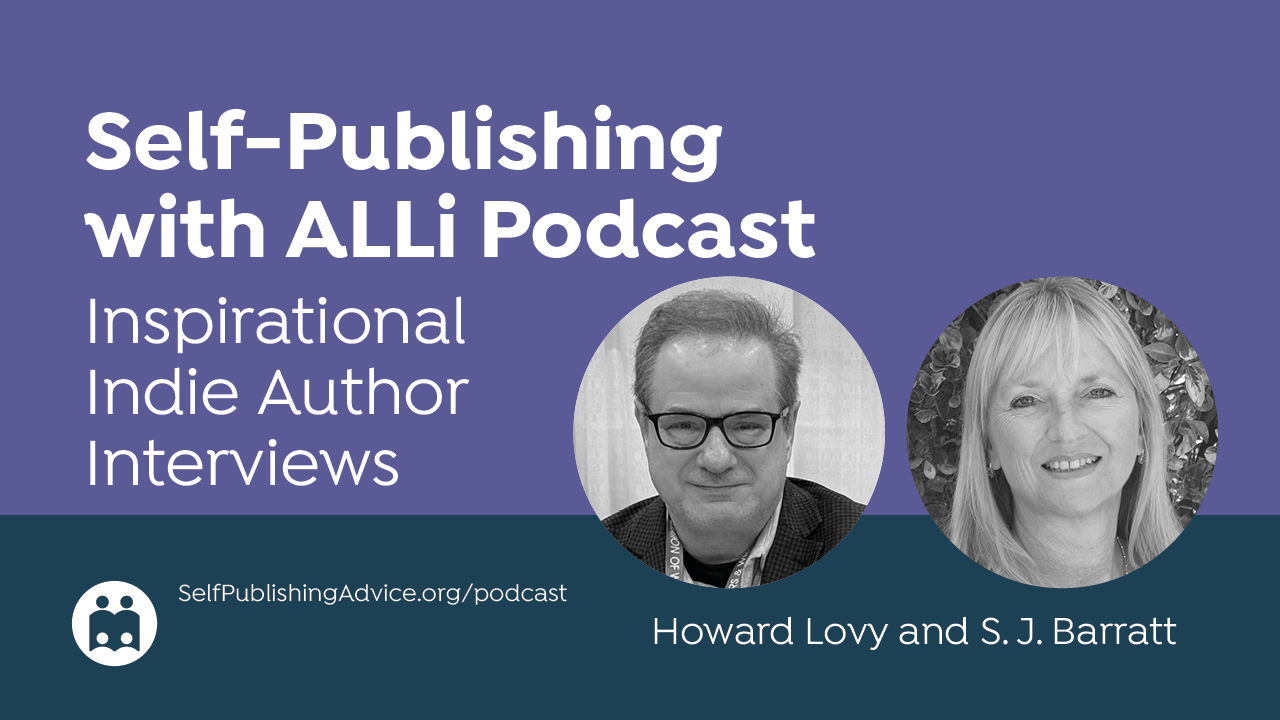
My ALLi author guest this episode is Suzanne Barratt, who writes as S. J. Barratt. She blends her background in agriculture and environmental communications with her love of Scotland and Shetland to create eco-adventure stories for middle-grade readers. We talked about her childhood surrounded by books and nature, how she shaped her writing through research and collaboration with an illustrator and editors, and why the indie path gives her the creative freedom she values.
Listen to the Inspirational Indie Author Interview: S. J. Barratt
About the Host
Author Howard Lovy has been a journalist for 40 years, and now amplifies the voices of independent author-publishers and works with authors as a developmental editor. Find Howard at howardlovy.com, LinkedIn and X.
About the Guest
S. J. Barratt is a self-published children’s author whose eco-themed stories explore the connection between people and the natural world. Rooted in her English countryside upbringing and shaped by a career in agriculture and environmental communications, she brings a practical understanding of rural life to her work. Now based in Lyon, France, she writes middle-grade adventures that encourage young readers to step away from screens and rediscover the outdoors. Her Living at the Edge of the World series reflects this mission. Learn more at S. J. Barratt.
Thoughts or further questions on this post or any self-publishing issue?
If you’re an ALLi member, head over to the SelfPubConnect forum for support from our experienced community of indie authors, advisors, and team. Simply create an account (if you haven’t already) to request to join the forum and get going.
Non-members looking for more information can search our extensive archive of blog posts and podcast episodes packed with tips and advice at ALLi's Self-Publishing Advice Center. And if you haven’t already, we invite you to join our organization and become a self-publishing ally.
If you’re a published indie author who would like to be interviewed by Howard for the Inspirational Indie Authors podcast, you need to be a member of the Alliance of Independent Authors.
Then contact Howard, including your membership number, explaining why you’re an inspirational indie author and what inspires you.
If you haven’t already, we invite you to join our organization.
Read the Transcript
Suzanne Barratt: Hello, Howard. I'm Suzanne — Suzanne Barratt, or S.J. Barratt is my pen name. I write children's eco adventure books, all based in Shetland because I've fallen in love with Scotland and Shetland, and I'm trying to inspire kids to leave their screens — to leave the wifi for wildlife and get back into nature. When I was a kid I spent so much time outside with my dog, on my bike. I just want kids to experience that sort of life again, because so many kids are just in front of screens now — computers, phones, TV. They're so distracting from connecting with people and nature.
Howard Lovy: Yeah. That's what the kids say — touch grass. I think that's a good expression.
Suzanne Barratt: I haven't heard that one.
Howard Lovy: I like that one. Touch grass. I'm going to have to weave that in somewhere. And there's some hope, though — my 21-year-old son is doing everything analog now. He just got a flip phone, so he's not hooked into a smartphone. Which is a little bit annoying for me because then I can't contact him as much as I want to.
Suzanne Barratt: Maybe you contacted him too much and that's why.
Howard Lovy: Maybe that's right. Before we go into your books, let's start from the beginning. Where did you grow up, and was storytelling or reading or connection with nature always a part of your life?
Growing Up in Britain
Suzanne Barratt: Oh, definitely reading. Well, I was born in the US — would you believe — with English parents, but we came back to England when I was about two. I was brought up in Britain near Hertfordshire, northeast of London — the shires, the home counties around London. It's agricultural land basically, lots of farmland and woods and parks, very green. I spent my childhood outside as I said, and reading. I would organize my girlfriends into reading clubs and we'd share books. I remember when I was a teenager I was asked by the local library, because I was such a keen reader, to review books for my age group. So definitely a childhood surrounded by books, encouraged to read and to be outside — a mix between inside and outside.
Howard Lovy: Was that something you thought you might want to do for a living even at a young age?
Suzanne Barratt: Yes. I later wanted to be a journalist, and unfortunately I was put off by adults around me at the time — I was told I was too introverted to be a journalist, so I missed out on that career. But I have worked in communications for a couple of decades now, in agriculture. So the love of nature and wildlife has fed through my career.
Howard Lovy: I'm an introvert too and I spent the first half of my career as a journalist. You get over it — you steel yourself when you're about to call somebody or speak to a stranger.
Suzanne Barratt: It's the same thing in communications really. You have to do a lot of public speaking, you have to put yourself out there. So it was bad advice I had at the time, but there you go.
Howard Lovy: You married both worlds — your love of nature and of writing with environmental communication.
Suzanne Barratt: Exactly. Which is why I took the topic of ecology and agriculture for my children's books. The advice I had when I started wanting a writing project was to write about what you know. What do I know? That's where the agricultural theme came in. I wanted to write for middle grade readers — ages eight or nine to twelve. I thought, I need to find a small farm as a background. And because my son was studying in Dundee, my heart was already in Scotland. We were going to Scotland a lot. The idea of crofting came to mind, and through research I discovered the Shetland Islands and this fantastic island called Foula, where only 30 people live. They live off the land — crofting, self-sufficiency, farming. They have sheep, Shetland ponies, fishing. I thought: what if I bring in a pair of twelve-year-old twins from London and drop them into that culture? What's going to happen? That was the idea for the story.
What Is Crofting?
Howard Lovy: Let's backtrack a little. I'm just a dumb American, so pardon my ignorance — what is crofting?
Suzanne Barratt: Crofting is a small, self-sufficient type of farm. It's an ancient agricultural method that's been in Ireland and Scotland for centuries. The whole of Scotland and Ireland was once made up of crofts. They're becoming less and less common now because of industrial farming, but in Shetland it's like a time warp. There are still crofts where people make a living from working the land — a few fields, a few animals — basically self-sufficient.
Howard Lovy: Great. And obviously a good setting to tell stories as well.
Suzanne Barratt: Yes. And of course in Scotland there's so much mythology and fascinating history. To go back to the island of Foula — they're actually on a different timescale there. They still follow the Julian calendar, which means they celebrate the new year 13 days after the rest of us on the Gregorian calendar. It really is a different world.
Writing for Middle Grade Readers
Howard Lovy: Why did you decide to write specifically for middle grade readers? That's a tough audience.
Suzanne Barratt: It is, and I've discovered how difficult it is when it comes to marketing and selling, because you're talking to parents but they're not necessarily the ones reading the stories. It's probably the most difficult audience in that sense. But it's also the age where you can really inspire kids, and they're so enthusiastic. I've done workshops with children that age — school visits, Q&A sessions. They're just so vibrant about the world still. And if you can manage to spark them into dialogue or questions, it's fantastic.
I did four workshops last spring at a local bilingual school here in France — 80 to 90 kids across four classes in a bilingual situation. The conversations were fascinating. For example, I did not know that ten-year-olds are interested in stories that have a hug and a kiss. I did not think romantic interest would be relevant for their age group, but it is. That was an eye-opener.
Howard Lovy: For young readers in particular, I've heard that protagonists who are a little bit older than the readers themselves tend to work well.
Suzanne Barratt: Yes, exactly. When I did a writing workshop with kids who were ten and eleven, they were writing stories about characters who are eighteen. They really do want stories with protagonists older than they are.
Living at the Edge of the World: The Series
Howard Lovy: Let's talk about Living at the Edge of the World. It's a series organized around the seasons?
Suzanne Barratt: Yes. I started in winter. These twins from London — Tabitha and Timothy — get sent to stay with an uncle they've never met. They're in a completely different world. Tabitha is an unbearable, spoiled brat, and it's interesting to see how living at the edge of the world is going to change her. She does change for the better, but I'm not going to give spoilers. It was interesting to describe how awful she was at the beginning and how she changed over the course of the story.
The second book finds them still there — their parents are off traveling, the mother is an influencer. So I talk a lot about social media as well, because Tabitha wants to be an influencer like her mum. Timothy is completely into the wildlife scene — birds, insects, anything to do with nature. There's a real contrast between the twins, and it's about how they survive in such a remote landscape.
Balancing Research, Accuracy, and Story
Howard Lovy: You do a lot of research — crofting, conservation, Viking archaeology. How do you balance scientific and cultural accuracy while keeping the story engaging for young readers?
Suzanne Barratt: At the beginning, I must admit, we are all on a writing journey. When you do too much research and you have so many nuggets you want to share, you end up info dumping. That's something I learned. In my research I came across, would you believe, a writer on the island of Foula in Shetland — she's a ranger there. I have this wonderful correspondence with her and she checked my first draft to make sure all the agricultural aspects were correct. That was really wonderful feedback for the first and second books.
I've learned how to make dialogue more engaging, how to avoid expository dialogue and info dumping, and how to make it engaging for children. I've made many, many revisions and drafts along the way.
Howard Lovy: I'm a book editor when I'm not podcasting, and one thing I emphasize is advancing the story through the characters rather than through exposition — especially when the subject matter is something like the environment. You don't want an encyclopedia entry.
Suzanne Barratt: Yes. I've really, really learned that.
Howard Lovy: So you've managed to do this effectively. You've won awards for Winter and for Spring?
Suzanne Barratt: Yes, which is great. The first award is amazing — I went straight back to my illustrator and said, can you put the award on my cover, please? I was so proud. And then other awards follow, which is always wonderful, but you want more and more significant awards, that's for sure. And I was delighted to win the poetry competition with ALLi — the Alliance of Independent Authors. That was great.
Howard Lovy: Can you describe that a little bit? That's obviously how you first came to my attention. Tell me about this poem.
The ALLi Poetry Prize and Why She Self-Publishes
Suzanne Barratt: I wasn't even an ALLi member at the beginning. I saw the prompt — ‘Why do you self-publish?' — and it made me think, because nobody had ever asked me that. Everybody just assumes you self-publish because you never got an agent or no publishing house was interested in your work. And that's not really the case. Being a communicator, I'm used to working with words and images together, and that's how I approached the writing project. I had a story, so my first outreach was to find an illustrator — and then I was going to pitch to publishing houses.
Then I realized I was too far ahead. It's normally a publishing house that would choose the illustrator. But I love the creative journey of working with an illustrator to find the right way to depict your words and your world and the island you have in mind. Working with Jenny Nørtoft, the illustrator, was a delight and I didn't want to give that up. So I thought, how do I go forward? I needed feedback on my actual story — I needed an editor. I discovered Reedsy, which was wonderful. I thought: I can hire an editor, get my story into shape, I have my illustrator. And that's how I started on my journey in self-publishing. It really was a way to be free creatively.
Howard Lovy: Reedsy is great. I'm an editor through Reedsy too, and I've met a lot of wonderful authors through that platform. Tell me a little more about your writing habits.
Writing Habits: From Pantser to Plotter
Suzanne Barratt: At the beginning I was definitely a pantser, and I was so inspired by my research that I ended up info dumping. Now I'm working on my third book, Summer, and I really tried hard to plan it — to plot it. I had a template, I used the seven-point story structure, I did real architectural work on the plot and structure. And I think it shows, because I've just got back my developmental editorial report from the editor I'm working with through CIEP — the Chartered Institute of Editing and Proofreading. Thirty-eight pages. I'm processing it at the moment. And she said: no info dumping on the horizon. So I'm learning as I go forward.
My next project for the coming months is to sift through all her advice and do a book map — scene by scene — to see how I can weave in even more subplots and characterization and depth.
Marketing Middle Grade Books
Howard Lovy: Let's talk briefly about marketing. You mentioned earlier that it's a little tough marketing at this grade level because you're actually selling to parents who don't necessarily read the books.
Suzanne Barratt: Exactly — you have to have a hook to interest the parents, but the content has to interest the kids, and the kids can only get to it via the parents because they're not the ones buying the book. The secret, I think, is school visits — you have instant contact with children that way. But it's difficult to get into schools. Every moment of contact I've had with children has been wonderful and precious.
I think as I go forward I'll finish my series and then possibly consider young adult, which would be a shift — I wouldn't be working with Jenny on illustrations in the same way, though she could still be involved in other ways. For advertising, I've been working on BookBub ads recently, which are relatively simple, and I've experimented with Amazon ads though I still need more practice there. I'm on social media trying to build an author platform. I use StoryOrigin to help with newsletters, and also a platform called Booksy Buzz — relatively new, great for getting reviews. They're Australian, so I'm getting Australian and Canadian reviews, which is wonderful.
Howard Lovy: Tell me a little more about your visits to schools. How do you arrange them, and how do you make it not seem like you're just there to sell a book?
School Visits
Suzanne Barratt: I think working with a teacher is the best thing. That's what happened this year with the four workshops at the local bilingual school — it was definitely a teacher who was interested in the content of the books. We talked about what would work best for the different classes, four different classes at different reading and language levels. The youngest started with the teacher reading the first three chapters aloud, and the kids were completely engaged. The more advanced classes had three chapters to read in class beforehand, and the teacher prepared them about crofting, Scottish culture, and the Shetlands. Some of the teachers also prepared questions.
The sessions were three quarters of an hour, packed with questions and discussion. I was asking them questions, they were asking me questions. With the most advanced bilingual class, the teacher had also asked me to talk about language elements — nouns, metaphors, different language constructions. But it was mostly about story. What's amazing is that children are always so astonished that you can spend a whole year working on a story, and that you can rewrite it three or four times. They're flabbergasted.
Howard Lovy: Getting them into the process of writing, having them think about it.
Suzanne Barratt: Yes. And in this day and age of ChatGPT — unfortunately the kids are doing their homework with it. The teachers were saying they now prefer homework to be done in class so they can make sure it wasn't done by AI.
Howard Lovy: ChatGPT is a good helper but a lousy writer.
Suzanne Barratt: Absolutely.
Summer: Ocean Pollution, Selkies, and Genre Questions
Howard Lovy: Tell me more about your upcoming book, Summer. You bring in themes of ocean pollution, and the twins are growing older and their challenges are becoming more complex.
Suzanne Barratt: Yes, they're celebrating their 13th birthday and becoming teenagers. I'm trying to weave in the interesting mythology of selkies. A selkie is like the Scottish mermaid — a seal who becomes human as soon as they touch land, and if you steal a selkie's skin they can't return to being a seal. It's a fascinating mythology. I'm trying to weave that in, but seeing as my story is a realistic eco adventure, can I make it magical at the same time? That's my question.
Howard Lovy: Because it's very science-based — do you combine magic realism?
Suzanne Barratt: That was the idea. But my editor was saying: seeing as you already have two books that are straightforward realistic adventures, if you veer towards magical realism, is it going to upset your readers? You have to be clear about the genre. So I need to think deeply about where I'm going with this story.
Howard Lovy: One advantage of being an indie author is you don't necessarily have to follow all the genre tropes.
Suzanne Barratt: Exactly. And that goes back to the poem — why I self-publish for ALLi. My first book had a little stanza at the end of every chapter. An editor said to scrap the poems. So I scrapped the poems at the end of every chapter, but I kept one poem per book — the one that's the hub of the story — because I enjoyed poems as a child and I'm sure children appreciate different styles. And now that I've won this prize, I feel I can write a poem. Very validating.
Mission and Advice for Indie Authors
Howard Lovy: Finally, as an indie author who blends science and environment and a little bit of myth, what do you see as your mission in children's literature — to entertain, to inform, or a bit of both?
Suzanne Barratt: I really would like kids to finish the book and then get up and go for a walk. Get out in nature. If they've got a dog, take the dog for a walk. Go on their bike. Make a camp in the nearby forest. Just get outside. If I can inspire kids to do that, then I've achieved my mission.
Howard Lovy: Sounds great. What advice would you give to other indie authors hoping to make an impact on young readers?
Suzanne Barratt: As much as possible, connect with the audience directly. We rely so much on adults to validate our work, so the more you can actually talk to children and find out what they think — even though it can be difficult for them to articulate why they like or don't like a story — the better. I remember drafting my first story with my niece. She was the one who put the dog in the story. She wanted a border collie, so the border collie — Wiz — is in the story thanks to her. Talk to your target audience as much as possible and get their feedback however they can articulate it.
Howard Lovy: That's great advice. Thank you, Suzanne. I really appreciate you taking a few moments to talk to us and best of luck with your work.
Suzanne Barratt: Thank you so much. Thank you, Howard.
Howard Lovy: Okay. Bye.
Suzanne Barratt: Bye-bye.