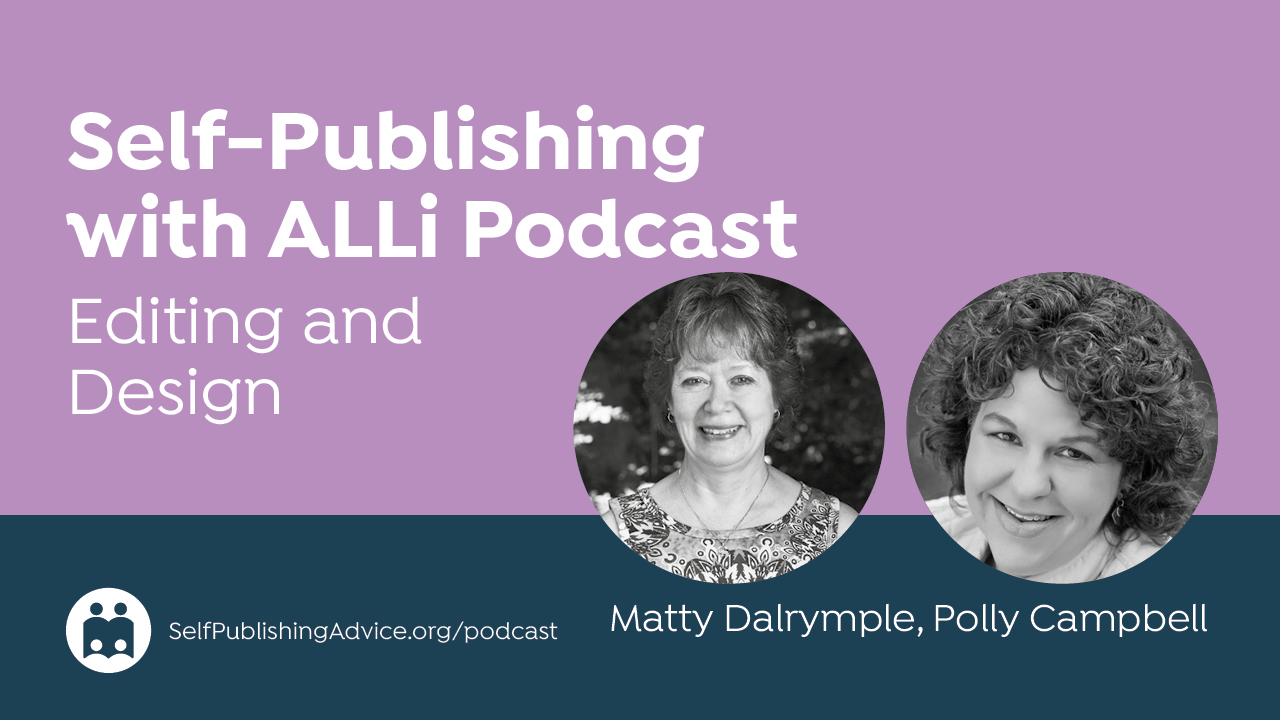
Author and podcaster Polly Campbell joins Matty Dalrymple to explore how writing contests can sharpen a writer’s editorial skills. Polly discusses the fast-paced revision process required for short fiction contests, how to make every word count, and why tight deadlines can lead to more focused, confident writing. She also shares practical strategies for structuring quick edits, choosing impactful details, and balancing creativity with polish—all lessons that can strengthen any writer’s craft.
Listen to the Podcast: The Editorial Process for Short Fiction Contests
Further Reading
Book Prizes & Awards for Indie Authors
Thoughts or further questions on this post or any self-publishing issue?
 If you’re an ALLi member, head over to the SelfPubConnect forum for support from our experienced community of indie authors, advisors, and team. Simply create an account (if you haven’t already) to request to join the forum and get going.
Non-members looking for more information can search our extensive archive of blog posts and podcast episodes packed with tips and advice at ALLi's Self-Publishing Advice Center. And if you haven’t already, we invite you to join our organization and become a self-publishing ally.
About the Host
Matty Dalrymple podcasts, writes, speaks, and consults on the writing craft and the publishing voyage as The Indy Author. She has written books on the business of short fiction and podcasting for authors, and her articles have appeared in Writer’s Digest magazine. She serves as the campaigns manager for the Alliance of Independent Authors. Matty is also the author of the Lizzy Ballard Thrillers, beginning with Rock Paper Scissors; the Ann Kinnear Suspense Novels, beginning with The Sense of Death; and the Ann Kinnear Suspense Shorts, including Close These Eyes. She is a member of International Thriller Writers and Sisters in Crime.
About the Guest
Polly Campbell is the author of You, Recharged: How to Beat Fatigue (Mostly), Amp Up Your Energy (Usually), and Enjoy Life Again (Always), and three other books. She is the host of the Simply Write with Polly Campbell podcast, and her magazine articles about writing and strategies for living a better life appear regularly in online and print publications. She is also a frequent speaker at writers’ conferences. Polly can be found at pollycampbell.com, simplywrite.substack.com, and on Instagram at @pollylcampbell.
Read the Transcript
Matty Dalrymple: Hello everyone, I am Matty Dalrymple. I am the campaigns manager for the Alliance of Independent Authors, and I'm here today with Polly Campbell. Hey Polly, how are you doing?
Polly Campbell: Hey, I'm doing great. Thanks for having me, Matty.
Matty Dalrymple: It is a pleasure to host you.
Matty Dalrymple: To give our listeners a little bit of background on you: Polly Campbell is the author of You, Recharged: How to Beat Fatigue (Mostly), Amp Up Your Energy (Usually), and Enjoy Life Again (Always), and three other books. She's a regular speaker at writer's conferences and is the host of the Simply Write with Polly Campbell podcast. Her magazine articles about writing and strategies for living a better life appear regularly in online and print publications.
In fact, this conversation came about because I read a great article that Polly wrote for Writers Digest magazine called Participation Prize, and it was all about the benefits that writers can gain from just submitting to contests.
The Benefits of Entering Writing Contests
Matty Dalrymple: So, I strongly recommend people check that out, but the question that it raised for me is, backing up a little bit into the editorial process, what can writers do in order to make their chances as good as possible for not only entering, but actually winning these contests?
So, I always like to hear, Polly, what experience did you have or did other authors you know have, that made you think through this idea of prepping stories for short fiction contests?
Polly Campbell: I was really surprised by this idea, which I think is one of the fun parts of writing. I've been doing this a long time, like you have, and like your listeners have, and still sometimes you hear something that you haven't thought about before and it triggers a whole bunch of interesting things. That's how this article came about.
I have a writer's group. I have a group of writer friends, and at different times they were each submitting, they're both non-fiction and fiction writers, they were submitting to contests. Most of them are done online, but they're all over the world. There's a lot of big ones in the United States, but you can really find a contest that originates from all over the world, and the entries come from all over the world as well.
They talked me into doing one, and I was so struck by how I felt during and after entering that contest, that I thought this is an interesting way to access our writing, to take us out of our regular routine a little bit, to maybe think about our creativity and our abilities in a different way, and build a little community.
So, as I looked into it more, a writer is always looking for material, and that's how the article came to be. I'd pitched it to Writers Digest, and they thought it was interesting for all those same reasons too.
What I learned is, for most of these people who are entering, myself included, it wasn't about winning the grand prize. It wasn't about getting money or winning the publishing deal, although that can be part of it for some of the contest, it was more about challenging themselves and having fun writing again outside of their regular projects.
Prepping Stories for Short Fiction Contests
Matty Dalrymple: I think that one thing that's interesting from the point of view of the editorial perspective on prepping the short stories is that on the one hand, you're submitting to a contest. So, even if winning the contest isn't, your ultimate goal, it's certainly great to improve your chances of doing that.
So, on the one hand, I think you'd want to send be sending your absolutely most polished, most refined stories in for these contests. On the other hand, a lot of times these contests are being run on a deadline that may force you to produce more quickly than you'd be otherwise likely to do.
So, in that circumstance, do you take the editing process of the short fiction that you're going to submit more or less seriously than if you weren't being driven by a contest submission?
Polly Campbell: I think that's a good question, and something I really had to think about because many of the contests have a short turnaround.
Editing and Revising Under Contest Deadlines
Polly Campbell: You'll get the prompt, in some cases have 24 hours to get it out, or a week to write 1500 words, 24-hour period to write 700 words or 250 depending on the contest.
I took the editing process more seriously than the writing process, and yet all of it was on fast forward. I didn't have any time. So, what I think happened is my process changed, but I took myself less seriously. I didn't have that sense of panic when I had to submit, that I think really catches up a bunch of writers.
I think we over revise and over tinker sometimes before we hit submit or before we hit publish, and I think writing the way we're doing it is about having a reader, and we get in our own way and prevent that from happening.
So, in this contest, what I found is I wrote very quickly, I got the model down for the story and then I spent time in very quick revision, but I did actually more writing and revision than I usually do. I threw out paragraphs here and there, and lines here and there, because I had the story framed in the first draft in the writing, and from then on it was all revision.
But even saying that, I would take a big pass for the revision and look, is the structure working? Does this even make sense? That was it.
Then the next thing was editing. Okay, are these sentences good? Can I make them better? After that, it was proofreading. I was out time. So, that whole part of it, I spent more time in that, I spent more attention on that part, but it went a lot faster than usual.
Different Approaches for Different Contest Types
Matty Dalrymple: It's also interesting because, I've queued this up as contests in general, but contests are so different, and you and I are both familiar with the Writer's Digest short fiction contest, which is an annual contest, and followers of Writer's Digest know that's going to happen every year, and if they want to put together a 1500 bird story, they have a year to prep for it or more.
So, the gestalt is a little bit different than if you are on a platform where it is this, here's a prompt, you have 24 hours. Would you have different approaches for those two scenarios?
Polly Campbell: Yeah, I think I would in theory. I did a short one. I had 24 hours. I got the prompt at midnight my time. It goes out midnight, east coast time, actually, for the one I did, and I had 24 hours to submit.
If I'm remembering right, it was only 750 words or something like that. I did one that was also 250 words, so that's really short.
Yes, if I were to enter a longer contest, I would spend more time, like I do my regular published work, because I think my intention would be different.
For the shorter contest, I liked that there was a quick structure. I liked that I didn't know what was coming because then I was free to just have fun, let's be creative.
For a longer contest, when I know there's an annual event, when I know the calibre of writers that are showing up and they all have a year, I would assume that the judges are taking this equally seriously, and I want to be a professional in that case.
However, what I learned by doing the shorter contest was that maybe a change in that structure would be better for my writing because there's something very creative about letting the words emerge on the page like that instead of structuring and planning and plotting and outlining and all the things that we can get caught up in.
So, if I were to have a longer term for the contest, I would certainly be playing with it in my mind long before that due date, but I think it's important to also have a moment when you're letting yourself open up to see what will come and then go back in your process and maybe structure that.
I found that to be very creative and it brought some different aspects of my writing nature out that I hadn't touched for a long time, and it was a lot of fun.
Matty Dalrymple: It does seem like that another distinction in addition to at the spur of the moment versus something you can plan ahead for is themed or not themed, because I think themed contests probably lean into the inventiveness and the uniqueness of the responses. Write a story about a day at the beach with your pet iguana or whatever.
Then you're going to get credit for thinking of really inventive things to happen at the beach with you and your pet iguana. Whereas, if it's very open contests, where the only criteria is word count, then I think the polish, the structure, development, things like that; you have to lean on those more than just, here's a clever idea and I hope I'm going to get bonus points for having come up with a clever idea.
Polly Campbell: Yeah, I agree. Writer's Digest and other publications do sometimes a personal essay contest. So, that's going to be a very unique story from first person. A lot of those questions are answered, and then that would put me in a certain structure for my story, but I would be working that during the year.
The short contest I did that I entered, and my friends do many of the short contests, some of them give you no parameters at all except for word count. Others will give you a genre, a key word, a prompt, and an action. So, in one, the prompt was a sleeping bag. I had to figure out how to use a sleeping bag in that.
When you enter one of those contests, you might be writing in a fantasy genre or a mystery genre when you're used to only writing romance or non-fiction. I think that's really interesting to stretch us because what I've learned and what other writers talked about in this article was, listen, good writing's good writing. Your story, no matter how long, still needs to have a character, it still needs to have tension. The words need to be lyrical. They need to make sense. There needs to be a structure that the reader can follow, whether you have 250 words in mystery or a 1500-word personal essay. It needs to be well done.
So, having some structure is useful, but also you need to still follow the rules of good writing, I think, to feel successful in telling the story.
Matty Dalrymple: Yeah. All these mentions of all the different kinds of contests that are out there, I realize this isn't exactly short fiction, but you had mentioned the personal essay and, I think with that, the judges would probably be valuing openness, uniqueness of perspective, transparency, vulnerability, and things like that, as opposed to necessarily very refined stylistic polish, because that's what people are looking for when they go to read a personal essay.
It just highlights for me that, whatever contest you're applying to, you need to be familiar with what the gestalt is of that style, what the expectations are, so that when you're wearing your editorial hat, you're wearing the correct editorial hat. You're not over polishing a memoir. You're not over structuring what's supposed to be a fun throwaway story. So, the familiarity with the genre, I'll say, is very important.
Polly Campbell: Yeah, I agree. I also think that your readers do this all the time because they're thinking of the people who are going to read their material. They're thinking of the market, they're thinking of the readers.
I think, doing a contest, when I was doing the short fiction, I was really aware, because I do a lot of non-fiction writing and I have some facts to build on, I have a little time to get into those books. When I was in short fiction, I was very aware that I have one sentence to get them to read the next, that's it. And I think that's a good lesson for us to remember, particularly in our fiction in short fiction. Each sentence has to be compelling, has to be interesting. It has to pull the reader in, no matter who the reader is.
Some of the contests are peer reviewed, some have esteemed judges who have published many books and short stories and all. So, it doesn't matter who's reading it, we've got to tell the story within the boundaries that we're given, and it was a good lesson for me to remember that you can do it in one sentence if you're really focused.
Matty Dalrymple: Yeah.
Community and Support in Writing Contests
Matty Dalrymple: That's great to mention the community that can form around these contests and that idea that almost by definition you're going to attract people who are interested in that style, that form. You can tap into them in the same way that we advise, if you're looking for beta readers for a novel, look for beta readers who enjoy and are familiar with your genre.
You have more of a built-in community like that with some of the contests where there's both the contest process, but also sometimes communities that are associated with the contest, where people can exchange editorial tips.
Polly Campbell: Yeah, a lot of the people I interviewed for the piece do it for the community. Some of the contests will have a Slack page or a forum where the participants can gather and talk over their prompts, share their stories. Others are more removed from that.
But in the one that I did, there was a Facebook page that one of the members of my group started, and we all just started a community there talking about that day’s prompt. Some of them have gone off to form a writer's group after that contest.
This other group I interviewed for the story, they referred each other to be interviewed because they had all met in a different contest where they were allowed and encouraged to give feedback, gentle feedback. It was very well structured, so nobody felt bad about their experience, but they formed a community just because they had the same sensibility. They liked talking about writing, they were writing similar themes. They were in similar stages in their career, and since then, they're still in this group. They've become beta readers for each other. They recommend other contests. They talk to each other and really support each other during the week.
So, the right contest can provide, like you said, a community, a group of like-minded people that can make a real encouraging environment with all your writing.
Polly's Three-Pass Editing Process
Matty Dalrymple: When we had been exchanging some information in preparation for this interview, you had mentioned that for short fiction, you look at three passes.
You have the quick read, the micro details, which I'm very interested in, and then of course proofreading. Can you just walk us through what those three passes are that you apply to your own short fiction?
Polly Campbell: Like we were talking about, there was a times constraint here, and let's be honest, we have lives outside of this too.
So, when the prompt came down, it was in the middle of the Christmas season. My daughter was on Christmas break. I was going to a Christmas bazaar. I had all these things and I'm like, okay, what can I do? I'm in this contest, I want to give it my best shot, but I also want it to be fun, and to make it fun I didn't want to send out something that I was embarrassed about. I wanted to be proud of my effort and enjoy the process.
I think that's important to think about too. What does it take for you to feel good before you hit send? So, I needed to do the best I could in that day, and it was a different kind of day.
So, what I did was I did a quick pass. I looked at structure. Is this working? Does this make sense? Is there tension? Is there a character that's clear? Are there a couple of character details that the readers could attach to? Was our reason to be interested in the character and did I follow the rules? Was it the right word count. Was it the right genre? Did I use my prompt?
Those were the guidelines for the Quick Pass, and it was amazing. I gave myself a time limit because of my schedule that day. I'm like, I've got 10 minutes to give this the quick pass, and I really reworked things in that moment because the structure, it was very choppy, and so that's really where the bulk of the writing happened. But that was only in 10 minutes.
After that, I went back for the second pass, looking at the micro details. Now, the structure is working, the character's clear, there's tension in the story; what are the micro details? Because word count was a factor.
So, what details, what one thing could I use that would say a whole bunch about the character? For me, it's the difference between talking about red high heels and white tennis shoes. If I show the character wearing red high heels, you're going to have a different impression of her, a different view of that character, than if I put her in white tennis shoes.
So, those were the micro details I looked at. You can't have very many when you're having a tight word count and a time constraint, but I thought, what can I have do double duty? What objects, what elements of clothing can enhance the tension and the characterization in the setting already in the story?
Then the last thing is proofreading. I wanted the sentences to be correct, the grammar and punctuation and word choice to be the best they could be. I didn't want to fill my word count with words like really and actually. I wanted each word to carry its weight.
Again, working with a tight word count was super healthy for me. It really made me get tight, my writing got better. Do I wish I had years to work on it? Of course, we all fantasize. But the reality is by the time I sent that piece, it took me, the whole thing, probably an hour and a half. I came back and forth to it, but by the time I sent it, I had really enjoyed the experience.
I enjoyed the creativity. I was glad it was done. I felt good about what I sent, and that was what I signed up to do. I didn't sign up to win. I signed up to have the experience with my buddies and do something different.
Balancing Details and Word Count
Matty Dalrymple: Yeah, I really like that idea of the micro details and using those to have every word count.
I think that an editorial tip I would offer people is that sometimes people get carried away. They think, oh, I'm going to let the clothing that this person is wearing convey it, but then they get too wrapped up in that. So, in their 1500 words or however many words they have, they're getting not only the red high heels, but also the stockings with the seam up the back, or not only the tennis shoes, but the little pompoms at the back that are under the tennis shoes.
I really like that idea that you only need one detail in a lot of cases to orient the reader and that overdoing it bogs you down much more quickly in a short story than it would no longer work.
Polly Campbell: Yeah, I think that's really important about all our writing. Pick the detail that's going to tell you the most, you don't need all of them.
In the short fiction I wrote for the contest, my prompt was a sleeping bag, and I had a model that had to crawl into the sleeping bag. I'm trying to remember, but I don't think I talked about her dress, but I talked about her high heels because I thought that would be relevant because I thought the reader might think, oh, how would you crawl into a sleeping bag wearing high heels?
So, I absolutely agree with you. What her hair looked like in that story mattered not at all, but how she crawled into the sleeping bag was impacted by those heels and told you something about that character. So, be judicious in the details. Make sure they hold the weight of the story you're trying to tell. You don't need everything.
In my writer's group, we call it throat clearing, and we do it a lot at the beginning. I do a lot at the beginning. I'll tell you everything you need to know, and then it's, oh, I'm just clearing my throat to get to the story, then I go back in and take all that out. I think a contest is a good way to do that; that's a good place to take that stuff away.
Matty Dalrymple: Do you find that, it sounds like this is true for yourself, but would you recommend this to other people that it's best to initially shoot for over what the word count is, on the assumption that then you can take out the least compelling parts? Or do you recommend people shoot for what they think will meet the word count?
Polly Campbell: Yeah, I think it depends on how you work. I'm a very type A rule follower, and so I wanted to be precise, and I ended up going all the way over the top. But because my goal for the contest was just to let it go and see what I could come up with, see how silly I could get with the prompt, I brought a lot of that material back. I took out the more conventional stuff and put the silly stuff that I elaborated on as I went. So, that really worked for me.
Normally, in my writing life, I want to tell the story, and I do whatever it takes, and then I go back. You need to be comfortable with cutting out a big chunk of stuff. To me, that revision is writing. Parsing away the things that don't support the larger image of the story, the larger picture.
You need to decide what you're comfortable with. I like it to have material to work with because I love revising. I have no problem taking it out if it doesn't fit the story, but I do think that's a personal decision.
Matty Dalrymple: One benefit that I think short fiction has is that, if you're getting ready to sit down and write a story, it's much easier to immerse yourself in a bunch of short stories if they're quite short than it is to say, I'm sitting down and writing a novel, so I'm going to immerse myself in a bunch of novels.
The reason I thought of this is that we're talking about quite short, maybe several hundred, maybe several thousand word stories, and I just finished reading Ian McEwan's Atonement. That is a very long book with just pages and pages of beautiful and lyrical description, and I love that book, but I would not want to be reading that, set it aside and then say, now I'm going to submit my entry for the 250-word sleeping bag story. I would just be in completely the wrong mindset to do that.
So, I think the benefit is, if you're writing a couple of hundred-word story, just sit down, and read a bunch of couple of hundred-word stories, especially if they're ones that have been received successfully by the judges and the readers to get yourself in the right mindset for that.
Polly Campbell: Yeah, I think that's such good advice. I went and looked at the winners of previous years from the contest I was in, and what that did for me, Matty, because I don't do a lot of short fiction, what that did for me was show me how much could be done within the constraints of short fiction.
Short fiction writers are a marvel to me. I think writing short is very difficult no matter what kind of writing you're doing. I write a lot of short non-fiction, it's very difficult.
I was immersed in the art of it when I saw what people just like me had created in their 200 words or 1000 words in their 24-hour period. It let me see the possibilities and it absolutely put me in the mindset you're talking about.
I couldn't have read Atonement and felt like I had any hope at all.
Matty Dalrymple: Yeah, the whole story could have made up like a 10th of a chapter or one of those books.
Polly Campbell: Yeah, I don't think I can read Atonement right now and feel like I can ever write again either.
Matty Dalrymple: It is interesting you were saying about writing short is difficult and there's that, I wish I could say the quote more accurately, but the idea of someone saying, I'm sorry, I wrote this long letter, I didn't have time to write a shorter one.
So, there is that back and forth. A lot of times you need to get the short story out there quickly, yet you're sometimes constrained in the very long process it might take to refine it exactly as you would want, which I think just loops back to what we've been saying about sometimes you just have to be a little more loosey goosy about how you approach it.
Polly Campbell: When I went back in that quick pass that I was talking about, that revision, there were places that I had overwritten because I felt like the reader needed more to understand what I was talking about, and they really didn't. That's when I needed to make the verb stronger. That's when I needed to pick those micro details that were going to do the heavy lifting of the story for me, so I don't need so many words around it.
I think in my regular writing I do get a little verbose and I don't think I need to. So, in my revision process, in my everyday writing, my articles and my books, I go back and do a whole lot of revising, taking those passages out. I just got to it faster in the contest for the short fiction.
Matty Dalrymple: Yeah, I think that something that reading other winning articles can help you clue into is that the most recent winning Writer's Digest short fiction contest entry, it was a story that left a lot of questions for the reader to fill in themselves, and it was a story that I had passed on to the finalist judges. It was obviously a story the finalist judges felt very good about selecting as the winner.
So, I think, especially if you're a novelist and maybe you are more trained to not rely on the reader for so much, but in this case, this idea that the reader was able to fill in the details as their imagination encouraged them to do with this story, I think was a real powerful part of it.
If you are writing short stories that are around a certain genre or around a certain approach, a certain format, then that's just another one of those things that familiarity can help you with: is this going to be a venue where that kind of openness is going to be appreciated or is it going to be frustrating for the readers?
Polly Campbell: Yeah, and I think that we can't always know that, but if you are looking at the past entries and the past winners, I think that gives you a good idea, like you said.
One thing I think is really interesting, that I'm exploring in my novel now, is can we leave more questions on the page? And I'm not talking about the big-ticket questions: did she die or not?
I don't know that as writers, we need to answer every question we pose in the scene or on the page, and I thought about that a lot when I was writing this contest. I wanted to make sure it made sense. Does it make sense? If not, I need to go in and fix it. But does it make sense even if I don't answer all the questions, like what is she doing there to begin with, could I get away with it? That challenged me as a writer for sure.
Matty Dalrymple: Yeah.
Applying Short Fiction Lessons to Novel Writing
Matty Dalrymple: You mentioned working on your own novel, so my last question is going to be, were there any editorial lessons that you learned from your experience of writing for short fiction contests that you had to consciously not apply when you returned to your novel writing?
Polly Campbell: I think the one I just touched on, I over explained everything. I had too many details. I was slow to bring in tension. In my novel, that's been a little faster, but my short fiction for this entry in particular and some other stuff I've done, has always been more about character in the beginning, and I felt for this one, because they gave me an action that they wanted included, I needed to make it a little more physical, a little more active in the beginning.
I like the time to overexplain myself in a novel. I like the space to do that because I think a lot of those times, even though I'm very organized in my process, I'm still figuring things out for myself and that doesn't work in short fiction. I don't think that really works in my novel either. I've gone back during revises and weeded a lot of that stuff out, because it is that throat clearing. Now, I'm just telling this story to myself.
In short fiction, you absolutely don't have room for it. Every word has to work. There's no qualifiers. The lyrical language is a lot tighter. The sentence structure I found did a lot for me. At the times of the action, I used very short sentences to convey that instead of extra words. So, I looked at things more structurally on the short fiction part than I do on my novel, and I think it's reworked how I think about the structure of my novel too.
Matty Dalrymple: Yeah, it's very interesting to look at both of them, not try to zero in on one approach that you can bring to both, but take advantage of the places where that overlap does happen, and you can carry forward the lessons you're learning from one into the other.
Polly Campbell: I really liked that. It really inspired me to try other genres, to just be a little more playful when I'm not working on an assignment in my own time, because it made me a better writer.
It also validated my experience as a writer because there were some things I was just good at, and anytime we can get that kind of feedback from ourselves, from the community that I was in on Facebook, I didn't get feedback from the judges, and I didn't win a prize or any of that.
But it was validating like, yeah, I know some stuff and I can make this work. It inspired me actually and picked me up at a time when I was feeling like writing was a real grind. It reminded me what a privilege it is.
Matty Dalrymple: That on its own is well worth the time and the effort and any entry fees you pay to participate in such a contest.
So, Polly, as always, it is lovely chatting with you and please let everyone know where they can go to find out more about you and everything you do online.
Polly Campbell: Sure, you can find my books wherever. Come and listen to the podcast, please. That's called Simply Write with Polly. You can find that wherever you listen to your podcast.
We talk about stuff like this, and Matty's on the show and we've got lots of great authors coming in. You can also join my Substack community, which is simplywrite.substack.com. My website, pollycampbell.com, you can find out what I'm up to, and find links everywhere else.
Matty Dalrymple: Great. Thank you so much.
Polly Campbell: Thank you.