



Indie authors are generous in sharing information and paying knowledge forward which has given us real competitive advantages. The Alliance of Independent Authors is built on such author collaboration. Others are entering formal collaboration partnerships in writing and publishing. Here is your Ultimate Guide to Author Collaboration in Writing and Publishing
Since the Kindle Direct Publishing launch in 2007, independent authors have gained a full menu of global storefronts and aggregators—Amazon KDP for Kindle & print, Google Play Books, Kobo Writing Life, Barnes & Noble Press, and IngramSpark 2.0—as well as one-stop distributors like Draft2Digital (which absorbed Smashwords in 2022), authors have shared tech, tricks, and tools with each other. Together, they reach every major ebook retailer and thousands of libraries.
In traditional, physical bookstore selling, only a handful of titles can be provided for, and the author space is notoriously competitive, but with ebooks, there’s no pressure to sell a certain amount within the first few months. Traditionally published authors may have to compete with each other – for agents, publishing deals, prizes, or co-op as well as shelf space– but self-publishers have nothing to fear from co-operating with other authors. We treat other writers as collaborators, not competitors.
Not just ALLi but the whole self-publishing space is full of entrepreneurial authors opening sharing sales numbers, tools and techniques, promoting each other through blog posts and podcasts, email lists and social networks. When indie authors speak about “author comps”, we mean “comparables” not “competitors”. We enjoy co-optition (co-operating with your perceived competition so that both parties benefit), and know that in working and educating ourselves together, we learn faster, respond and adapt more nimbly. In short, that we do better together than by going it alone.
(As an aside, that's why our self-publishing association is called ALLi and spelled with a small i and big ALL: our members are like the three musketeers in Dumas’s novel, except there are thousands of us, all working for each (i) and each for ALL)
For indie authors publishing digitally in ebook, audio and POD, readers are not a finite commodity, assets to be kept from other writers. We know we enjoy a global marketplace so large that no writer will ever reach all the readers out there, while the right kind of author collaboration in writing and publishing greatly increases the odds of getting discovered, noticed and read – as authors with shared box-sets regularly demonstrate.
Author Collaboration in Writing and Publishing: Project Agreement
“When a writing collaboration works, partners inspire and complement one other. The creative process is less lonely. But when collaborations fail, the drama may be as ugly as a Hollywood divorce. For every successful writing partnership, there are dozens of failed ones despite the best of intentions. Not everyone is a team player, and not every team is a winner.To improve the odds of a successful writing partnership take the time to put the collaboration agreement in writing. Most people resist this idea. Like a prenuptial agreement, it kills the romance. They don’t realize the process of preparing an agreement may be more valuable than the result. If writers do a good job discussing issues at the start, they are less likely to have misunderstandings later.”
So before you jump into any author writing or publishing collaboration, have a thorough discussion about hopes and expectations and include the salient details in a collaboration agreement (see below for an agreement template):
Legal fine-print in 2025
• AI-generated content. The EU’s new AI Act comes fully into force between August 2025 and June 2026, and its transparency rules will ripple far beyond Europe. If either partner plans to use generative text, images, or voice clones, spell out—right now—who owns the outputs and who pays if there’s a copyright dispute.
• Synthetic narration & the Findaway shake-up. Spotify is splitting Findaway Voices into two services on 1 August 2025; wide distribution will run through a new arm called Voices by INaudio, while “Spotify for Authors” handles the platform itself. Decide in writing whether your project may use AI narration and how any narrator (or voice clone) will be credited and paid.
Bottom line: technology moves fast, but a clear contract lasts. Tweak your old boiler-plate to cover these two hot spots before you press “publish.”
-
Set out the Parameters of the Project: Fiction, nonfiction, poetry? Create a short outline. Helen recommends drawing what she calls a “creations box”. Draw a box and write down what creations are inside the project box e.g sequels, prequels, and competitive works, and what creations are outside the box and may be used by the partners individually. What will happen to rejected ideas, characters, scenes, written chapters?
- Agree practicalities. What's the deadline? What happens if it's missed? Will both names appear on the work? In what order and how will they be listed (A “and” B, A “with” B, or A “as told to” B? Will you use a pen name? What about expenses? If one partner pays for research, editing, design, and marketing, does that partner recoup expenses before income is shared? If income never covers expenses, is the other partner obligated to kick in and when? What will happen if one of you gets hit by the proverbial bus?
- Put your Ownership and Percentages in Writing. If you don't have an agreement (see below), all partners own equal shares in jointly-created work. This means a collaborator who contributes ten percent of the work gets an equal share of the revenue unless you agree otherwise. Furthermore, each partner has the legal power to sell or license the work without the other partner’s consent. Draw up a written agreement that no partner may sell, license, or transfer any interest in the project without the consent of the other partner and agree your ownership percentages in writing also. Often the collaborator who had the original idea owns the majority interest, even if only a token amount (51%/49% split). If you were equal collaborators in the writing but one collaborator is handling all the marketing, they might get a larger portion of sales. A and B, A with B, or A as told to B typically receive different splits. Will you use a pen name?Each partner should promise that all work contributed will be original, will not be defamatory or infringing, and will not invade privacy or other rights. State also that the parties are collaborating for a specified project and are not creating a general partnership. And finally, if you are in the US, you might want to register the copyright under all names or a penname. (All of this is covered in our sample agreement below)
-
Set Your Goals for the Project. Each participant should list their goals separately, then come together for a discussion to agree shared goals.
-
Outline the Writing and Publishing Process. How often will you meet… and how? How will the work proceed? Will one of you writes one chapter, the other the next? Or one does the outline while others flesh it out? In publishing, will one individual handle the marketing, another production and design, for example, or all do a bit of everything? How much time will you give over to brainstorming together?
- Assign Tasks: Who will engage editors and designers, do the accounts, negotiate rights licensing contracts, create and manage social media? Get clarity upfront.
-
Set Ground Rules for Feedback and Disagreement. How will you give and receive criticism and comments? Assume you will have disagreements: how will conflict be handled?
-
If the partnership terminates, who owns the work? Who has the right to complete the project?
The Ultimate Guide to Author Collaboration: Writing
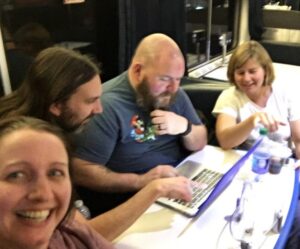
Photo Credit: Joanna Penn
In March 2017, four indie authors—Lindsay Buroker, Joanna Penn, J. Thorn, and Zach Bohannon—got on a train in Chicago and headed south to New Orleans. Within a week, they had the first draft of a novel, published a month later as American Demon Hunters: Sacrifice. While J and Zach had co-written together before, the four writers had different writing processes. They started out writing into the dark without an outline, but because they wrote at different paces, they required an outline to continue, meaning compromise on behalf of those preferring to free write.
Clearly, one author writing alone could never achieve something like this.
Joanna talks to one of her fellow authors in an in-depth podcast dedicated to their collaboration here.
“Putting your ego aside is by far the most emotionally challenging aspect of collaboration. You will have ideas that you think are excellent but your partner might not be as excited as you about them. It can be difficult to remember that story trumps feelings and that criticism of your ideas is not a critique of you as a person or writer. And it is impossible to collaborate without getting your feelings hurt at some point. It is the nature of working with another person.”
“Don't react immediately if you feel hurt or slighted. Often, taking a day or two to respond will give you time to feel the sting and then move logically beyond it. It doesn't mean you have to stay silent or ignore your feelings. But taking a deep breath and allowing the disappointment to process will help you to compromise with your partner and continue to move the project forward.”
Themed Collaborative Books
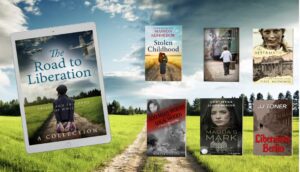 In a similar vein, JJ Toner and five other authors from across the world joined together to release a limited time collection of books. All six authors write WW2 books and have each put one full novel inside their group book. Called The Road to Liberation, the project is intended to mark or commemorate the ending of the Second World War in Europe, 75 years ago, this month.
“The process was instructive, uplifting, and totally exhausting 🙂 All six of the authors wrote knockout books, and a few turned out to be really good at marketing. The process was a little bruising at times, but we never fell out, proofreading and editing each other’s work along the way.”
The book will launched on May 5 and will be dissolved in early August 2020 when the six books will all be published as stand alones. If you're interested in the book, you can read it here.
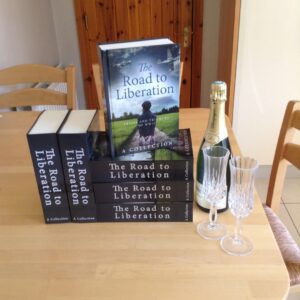
Celebrating the launch
The Ultimate Guide to Author Collaboration: Publishing
Author Collaboration: Shared Email Lists
Companies like BookBub, Written Word Media, and Open Road Media have been building genre-specific mailing lists with hundreds of thousands — even millions — of readers over the past few years. They’ve done so primarily by offering a curated selection of free or discounted books, and then heavily advertising it all to readers on social media. In other words, they’ve run tons of Facebook ads.
Some authors, on their own, have been able to build mailing lists of tens of thousands of readers in a very similar way: offering a free “reader magnet”, offering that magnet or other attractors through advertising on Facebook, Instagram and—to a lesser extent—other platforms. Since 2022, TikTok’s #BookTok and Instagram Reels have joined Facebook ads as top discovery engines. Short video teasers, stitched reaction clips, and duet challenges regularly trigger retail spikes—especially when several authors tag one another in the same campaign.
Reedsy, an organization that has built its extensive marketplace through social media advertising. Recently in his own excellent weekly email to authors, Reedsy founder Ricardo Fayet asked:
“what if a group of four author friends, writing in the same genre, decided to pool together their resources, offer a free bundle of four books (one each), and heavily advertise that on Facebook?”
Based on his own experience of running ads, Ricardo estimated they’d probably be able to build a mailing list of 100,000 readers by spending $15,000 each or so.
Of course, that’d only be part of the job. This group would then need to find a way to keep this co-op list engaged, and regularly offer it free content — not to mention they’d need to pay to maintain that list. There are also legal implications as to who owns the list. This would probably require creating an actual company (or even a brand) to be responsible for the list (and the data protection). But all that extra effort and cost can be split among four people.
And now whenever one of these authors runs a free or discounted promo, they’ve got a list of 100,000 readers to promote it to. In other words, they’ve built their own mini-BookBub list (to which only four people have access). And as they continued to grow the list, with each book from each of the four, they would make back their initial investment many times over.
Crowdfund bundles: Publishing projects on Kickstarter, Crowdfundr, and Ream’s built-in preorder tool are growing fast—the Kickstarter publishing category alone logged a 16 percent jump in funded dollars between 2022 and 2024. A multi-author box set or anthology often funds quicker because each writer brings a ready-made fan base.
Neither Reedsy nor ALLi have seen any authors do this as yet, but it is an idea of one kind of project that becomes possible when authors harness their collaborative power and invest in themselves.
If you're interested in signing up to Reedsy's newsletter you can here.
Metrics matter: since Apple Mail Privacy Protection rolled out in late 2021, “opens” are wildly inflated—up to half your list may appear to open every message. Judge list swaps by click-throughs and sales, not opens.
Data-protection watch-outs: California’s CPRA (2023) and the EU’s GDPR still require explicit reader consent for every list hand-off. When you pool addresses, make sure each subscriber has opted in to hear from every author named in the footer.
Thinking about an audiobook? From August 1, 2025, Findaway Voices is handing its wide-distribution business to a new sister platform called Voices by INaudio, while a refreshed “Spotify for Authors” portal will manage Spotify-only releases. If you and your co-authors plan to try AI narration, spell out in your contract who owns the synthetic voice and how the royalties will be split.
The Ultimate Guide to Author Collaboration: Five apps that take the grunt work out of teaming up
Please note all pricing and feature information is correct at the time of writing.
BookFunnel
Think of this as your shared delivery department. Upload an ebook or audiobook once, and every reader gets a private, water-marked link that works on any device. The service also plugs straight into Payhip, Shopify, WooCommerce, Gumroad, and other direct-sales carts, so a group can run one storefront and split the proceeds through PayPal or Stripe. Plans run from $20 a year (one pen name, ten titles) to $250 a year for high-volume teams.
StoryOrigin
One dashboard handles newsletter swaps, ARC downloads, universal retail links, and even a shared calendar that tracks everyone’s deadlines and word-count goals. Pricing is simple: $10 a month or $100 a year for unlimited promos and links.
Atticus
A writing and formatting app that lets several authors work in the same manuscript at once. Assign Co-Writer, Editor, or Beta-Reader roles, leave comments, and track changes—no more juggling Word files. It’s a one-time purchase of $147 for unlimited books.
Ream Stories
Picture Patreon, but built for fiction serials. Each author runs a paid subscription; the “Author Swaps” tool makes it easy to promote one another’s episodes or bundle finished stories for retail launch. Ream takes 10 percent of subscription income, and Stripe adds standard processing fees (about 2.9 percent + 30 cents per charge in the U.S.).
Prolific Works
A quick, low-cost way to trade free reader magnets when you don’t need the heft of the bigger suites. The Basic tier is free; the Plus tier is $20 a month with autoresponder integrations; a Pro tier at $50 a month adds more pen names and advanced targeting.
Author Collaboration in Writing and Publishing: Other Ideas
The sky really is the limit when it comes to collaboration. So here are a few other ideas you could consider:
- “advertise” a perma-free book in the back of each other’s books.
- Advertise discounts and sales of another author's book in your newsletter or on your social media.
- Share an ad space.
- Target a special-sales outlet.
- Group giveaways, for example, giving away a bundle of ebooks and then creating joint graphics and promoting on instagram. To enter, readers would need to follow all the authors.
- Create a joint or shared universe. Each author writes a different book or series within the universe or from the perspective of a different character.
- Create an anthology of short stories from different authors in your genre and promote together.
- Create an anthology of longer works (novellas or full books) and promote together.
- Use JJ's method and create a time limited collection of books based on a theme.
- Host takeovers on each other's platforms, in the form of live events, interviews or group ‘live' sessions on YouTube, Podcasts, blogs or Instagram.
- Create a singular pen name with multiple authors writing under the same name in order to create a faster pace of publishing.
Digital HQs for your team
- Discord – free “server” with topic-based channels, voice rooms, and live-event stages; perfect for sprint sessions and launch parties.
- Notion – share kanban boards, outlines, and to-do lists in one workspace (free for teams up to ten).
- Slack – still popular in larger collectives; integrates directly with Google Drive, Trello, and GitHub.
Author Collaboration in Writing and Publishing: Respect and Communication
Don't let the big stuff slide
DO let the little stuff slide
Keep Communicating
“Years ago, a friend told me the motto of a happy marriage,” says Helen Sedwick. “‘I can’t read your f**king mind!' The same is true in author collaborations.”
Author Collaboration in Writing and Publishing Case Study: Triskele
 Describe Triskele for someone who hasn’t heard of your company?
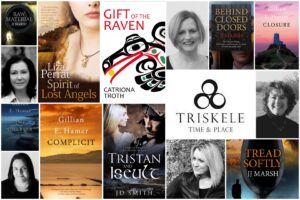
Five individuals working together as an author collective. We look like a small press, marked by distinctive visuals and a cohesive identity. We behave like one, using the Triskele brand as a trusted stamp of quality. But each of us retains the rights to their work. Financial commitments or profits are shared equally.
How does the collaboration work?
We met via online critique sites and liked each other’s style. In 2011, we embraced self-publishing as a team. We read, edit, and encourage development in one another’s writing. It helps that Jane is a successful designer, Kat’s a professional editor and Gilly handles the finances. We generate marketing ideas and champion every book we produce. Although we live in three different countries, we’re good communicators.
What are the biggest lessons you’ve learned in collaborating?
We overstretched ourselves. The original idea was to produce high quality books and support other indie authors. That became a literary festival, book launch parties, an author fair, a review site and constant content production for our blog. Triskele became a weight rather than a buoy. Two years ago, we went back to our core idea and now focus on our own writing. Less stress, better books.
 What advice would you give to someone wanting to enter into a collaborative relationship?
Aim for the best but prepare for the worst. Trust is vital as is equal commitment, but get it on paper. If someone isn’t pulling their weight, they either step up or step down. Agree on a mission statement and review it regularly. Always be honest if something’s not up to standard. Make your brand identifiable and associate everything you do with quality. Share skills and keep learning.
Find out more about Triskele here.


I’ve been in writing for over ten years now, and I can tell you that sometimes it is challenging to achieve successful collaboration for publication. The world of blogging has been somewhat closed lately and is not available to everyone. I sympathize with those who have been writing a not long time and have not managed to develop a basis for collaborations.