



Maribel Steel
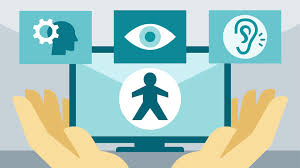
Digital publishing has created such an explosion of options for indie authors in getting their books out into a worldwide marketplace, yet our books often sadly remain inaccessible to millions of readers.
Both print and ebook publications are not reaching the eyes, ears, and hands of so many people who would love to experience the immense pleasure and importance reading brings into our lives due to having a ‘print disability’.
Self-Publishing Accessible Ebooks: A New Guide
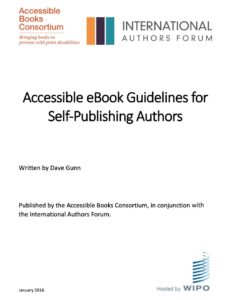
A brand new professional tool offering a comprehensive guide to empower authors in understanding the first steps towards making their manuscript accessible for millions has arrived. This comprehensive publication written by Dave Gunn, Accessible eBook Guidelines for Self-Publishing Authors is published by the WIPO Accessible Books Consortium, in conjunction with the International Authors Forum (IAF), and is being made available to you by the Alliance of Independent Authors.
This is a tremendous resource that every indie author who is keen to create accessible eBooks should peruse.
This set of guidelines the first of its kind. It also provides a highly practical overview of the world of accessible publishing, complete with a helpful checklist, and a “further resources” list.
All this strengthens an author’s sense of confidence in creating their next manuscript in an accessible publication format, and reading through the set of guidelines opens one’s eyes to key terms while raising one’s awareness to current software options when considering the design of an accessible eBook.
One of the highlights of reading through the guidelines as a vision-impaired author is knowing that I can also take advantage of a set of guidelines accessible to both author and reader.
Why Publish Accessible Ebooks?
Katie Webb
As a visually-impaired person and indie author myself, I am not fond of placing people into categories but it is worth pointing out that this group includes those living with a physical or sensory disability (such as being blind or vision-impaired), as well as those having a cognitive and learning disability – with Dyslexia affecting a staggering one in ten people globally. Therefore, it is highly probable that potential readers are not accessing our books and it doesn’t have to be this way. Katie Webb[/caption]
In a few easy steps you can open up your books to the millions of readers who can’t access texts in conventional formats because they are visually impaired or otherwise ‘print disabled’.
I am so grateful to our industry ‘watchdogs’ such as the International Authors Forum (IAF), the Accessible Books Consortium (ABC) and the Alliance of Independent Authors (ALLi) who are dedicated to creating a global network empowering authors with a set of standards that will make more books accessible to more people.
If the seeking of knowledge and the freedom to read books is important to you, I encourage all writers and publishers to seriously consider how creating ebooks in accessible formats is the next frontier to publishing: by taking up the recommendations set out in these guidelines, we open the way forward to create more possibilities for a worldwide readership.
Be a proud link in the chain which enables people like myself to stay connected through our passion for our craft.
Together, we can support each other and bring the focus on reaching a whole new audience by designing our manuscripts in an accessible format available for everyone to enjoy.
Accessible Ebook Guidelines: Click to Download
Accessible eBook Guidelines for Self-Publishing Authors – Download Here
Self-Publishing Accessible Ebooks: A Guide for Indie Authors



Share
Comments are closed.
Latest advice, news, ratings, tools and trends.
News Summary: OpenAI Shuts Down Sora Video Platform; Audible Partners with British Airways
I think I reported on the Sora app when it launched back in October. The app, which enables users to access OpenAI's Sora generative AI platform on their phones to create short video clips, hit the headlines back then for two reasons. In one of the starkest "there's good news and bad news" stories yet to come out of AI, the good news (for OpenAI anyway) was that the launch broke all kinds of records, reaching one million downloads in just five days. That's faster than ChatGPT. In "on the other hand" news, it kind of sucked that people started swamping social media with fake video clips of dead people, like the beloved Robin Williams. And of course, even at the launch the copyright radar was working overtime.
Inspirational Indie Author Interview: Cliff Lovette Reinvents Himself as a Storyteller After a Career in Entertainment Law
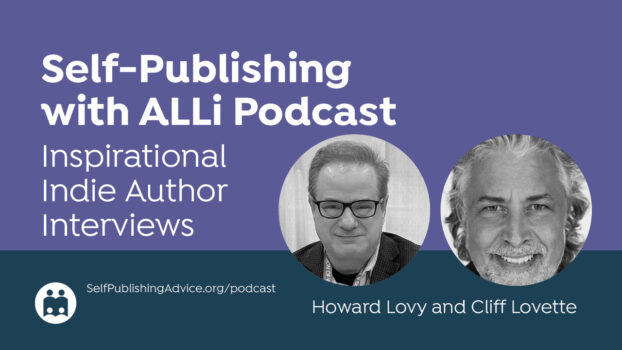
My ALLi author guest this episode is Cliff Lovette, an Atlanta-based author who came to fiction after a long career as an entertainment lawyer, working with major artists during a pivotal time in the music industry. He held onto a remarkable true story about a Soviet circus stranded in the United States for more than thirty years before turning it into his novel. His journey is one of delay, reinvention, and finally taking the leap into storytelling.
News Summary: Jane Friedman Publishes AI Law FAQ; $3 Million Ruling against Meta Highlights Social Media Risks
Jane Friedman has a long history of publishing incredibly useful information for indie authors. And now she has added an extremely helpful compendium of AI law information. In the form of FAQs, it addresses many of the cases and points of law raised by them that will be of interest to writers. From questions of the disclosure of the use of AI to licensing rights, claims of fair use, and whether you can copyright AI-generated material, this is a handy summary of many of the topics you might want to know about.
[…] Reaching all our Readers: Making books that Everyone can read: Katie Webb & Maribel Steel […]
[…] Reaching all our Readers: Making books that Everyone can read: Katie Webb & Maribel Steel […]
[…] Reaching all our Readers: Making books that Everyone can read: Katie Webb & Maribel Steel […]