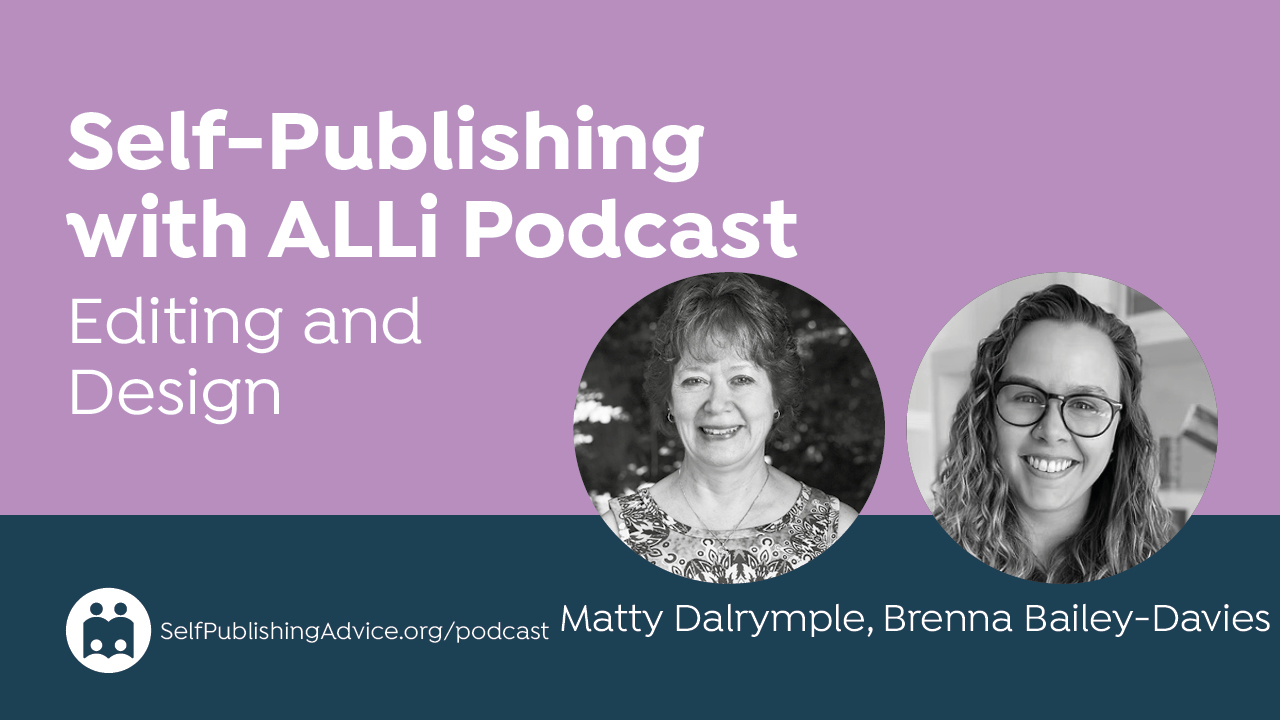
In this episode of the Self-Publishing with ALLi podcast, Matty Dalrymple talks with Brenna Bailey-Davies about seeing self-publishing from both sides of the page, how editorial work shapes the writing process, and how to balance client work with creative work. They also discuss practical lessons authors can take from professional editing, how to handle editorial feedback with confidence, and what it means to understand the publishing process from draft to proofread.
Listen to the Podcast: The Creative Process Through an Editor’s Eyes
Thoughts or further questions on this post or any self-publishing issue?
 If you’re an ALLi member, head over to the SelfPubConnect forum for support from our experienced community of indie authors, advisors, and team. Simply create an account (if you haven’t already) to request to join the forum and get going.
Non-members looking for more information can search our extensive archive of blog posts and podcast episodes packed with tips and advice at ALLi's Self-Publishing Advice Center. And if you haven’t already, we invite you to join our organization and become a self-publishing ally.
About the Host
Matty Dalrymple podcasts, writes, speaks, and consults on the writing craft and the publishing voyage as The Indy Author. She has written books on the business of short fiction and podcasting for authors, and her articles have appeared in Writer’s Digest magazine. She serves as the campaigns manager for the Alliance of Independent Authors. Matty is also the author of the Lizzy Ballard Thrillers, beginning with Rock Paper Scissors; the Ann Kinnear Suspense Novels, beginning with The Sense of Death; and the Ann Kinnear Suspense Shorts, including Close These Eyes. She is a member of International Thriller Writers and Sisters in Crime.
About the Guest
Brenna Bailey-Davies (she/her) is an editor and writer based in Mohkinstsis (Calgary), Alberta, Canada. Through her company, Bookmarten Editorial, she edits science fiction, fantasy, and romance for indie authors and traditional publishing companies, with a focus on stories that include queer representation. She also writes sapphic contemporary romance under the pen name Brenna Bailey and has published five novels, with many more in progress.
Read the Transcript
Matty Dalrymple: Hello everyone. I am Matty Dalrymple and I am here today with Brenna Bailey-Davies. Hey Brenna, how are you doing?
Brenna Bailey-Davies: Hello. I'm doing well. Thank you very much for having me here.
Matty Dalrymple: I am thrilled to have you here. Brenna Bailey-Davies is an editor and writer based in Calgary, Alberta, Canada. Through her company BookMarten Editorial, she specializes in editing science fiction and fantasy and romance for indie authors and traditional publishers, focusing on stories with queer representation. She has five contemporary romance novels under the pen name Brenna Bailey. And BookMarten Editorial is a proud partner member of ALLi, so we always enjoy hearing from our partner members.
I invited Brenna on the podcast to talk about the experience from both sides of the page — from editor to author and back again. I always find it so interesting to hear from people who are seeing the process from both sides of the pen. So tell us: did you start out as an author and become an editor, or start out as an editor and become an author? What was your progression and why did you make the switch?
Starting as an Editor, Rediscovering the Author
Brenna Bailey-Davies: So I started out as an editor — professionally speaking. I mean, if we're going way back, I started as an author because I was writing books in elementary school and even before that. But professionally I started as an editor, first as a freelancer working for indie authors. Then there was a point in high school where I stopped writing because I got the idea in my head that I wasn't creative. But as I was editing books and working on indie author stories, I found them really inspiring and I felt that itch to start writing my own stories again. My spouse was really encouraging me to see myself as creative, and I just jumped in and gave it a go.
Matty Dalrymple: Beyond your spouse giving you the impetus you needed, were there other things that made you revisit that idea that you weren't a creative person?
Brenna Bailey-Davies: I think because I was working with indie authors, I was listening to a lot of self-publishing podcasts — the ALLi podcast, Joanna Penn, Mark Leslie Lefebvre — and I think I had already realized that I was creative. It just took someone pushing me over that line to take the leap. But it was percolating in the back of my head that this was something I wanted to do, that it was a business and a creative mindset I found really attractive — to write your own book and put it out in the world.
Switching Mindsets: Editor vs. Author
Matty Dalrymple: How did approaching creative work as an editor and as an author differ from each other?
Brenna Bailey-Davies: They differ a lot. You have to flick a switch in your head when you go from one to the other. When you're editing, you're looking at someone else's work and you don't have all the behind-the-scenes information that went into it. The creativity you bring to editing is more as an outside observer thinking: how can I improve this based on the author's vision? Whereas as an author, it's my heart and soul being put into the book, my really intimate viewpoint, and I can't step out of it and be that objective observer. There's a lot more emotional involvement for me when I'm writing versus when I'm working on someone else's work.
Matty Dalrymple: I find there are certain kinds of books I can't read when I'm writing certain kinds of fiction. If I'm writing in my thriller series, I can't be reading thrillers because there's a danger that my books are going to start sounding like a lesser version of whoever I happen to be reading. How have you found that — does being immersed in the creative voice of your clients make it harder to develop your own creative voice?
Brenna Bailey-Davies: I think it helps for me. I get inspiration from seeing what other people are doing, the same way I take inspiration from reading books for fun — except I have to keep my professional hat on when I'm editing. But something I did notice along these lines is that it's not so much genres I can't read — it's that I've had to step back from developmental editing for clients, because I find my brain is so full of the big-picture elements of my own work that I can't expend that same energy on client work too. So I've had to focus on copy editing, proofreading, and consulting for clients so I can reserve the developmental thinking for my own drafts.
Matty Dalrymple: That highlights something I think a lot of authors don't realize — that editing isn't just editing. The skill sets are very different. What you're describing is how your own creative work steers you toward one type of editorial work and not the other. Authors shouldn't necessarily be looking to one person for all of their editorial input.
Balancing Client Work and Creative Work
Matty Dalrymple: One of the things we had talked about as a topic was the idea of balancing creative and client work. We've touched on the mindset side of it — what are some of the other things you factor in when you're trying to decide how to balance the two?
Brenna Bailey-Davies: First, let me say I have not found the perfect balance yet — it's very much a work in progress. But something I've had to accept is that it's never going to be 50/50. There are times when my editing business takes precedence, and times when the author business does, and it just depends on what's going on in my life. There are times when I feel like my author business is falling to the wayside, but that's okay because sometimes I need to rely on the finances from editing. Whereas if a launch is coming up or I'm running a Kickstarter, obviously that's going to take more energy and time.
Accepting that there's more of a flow than a 50/50 balance has helped a lot. I also think about my own circadian rhythms — when I'm most creative during the day — and set boundaries to protect that time. I'm not a write-every-day kind of writer, I'm a project writer, so I work in batches. If I know I need to draft something, I'll do my editing work in the morning and draft after dinner. And I have to tell my spouse and friends: this month I'm drafting a book, so I'm not free in the evenings. All the people in my life are very gracious about it.
Matty Dalrymple: That applies to everyone, not just people who have both roles. There are definitely times of day when I'm better at creating content and other times when I'm better at editing it. And it raises an interesting point for authors booking time with an editor — do you have a sense, a couple months ahead, of what your availability is going to look like?
Brenna Bailey-Davies: Generally I'm booked out for editing a couple months ahead, which is useful for clients to know. And if I know I have a big project coming up as an author, I'll also block off more time for myself, which means I'm not available for editing until even later. It's part of the business mindset — thinking of both things as a business. I have to be willing to dedicate the necessary time to keeping each one running.
Business Lessons Across Both Roles
Matty Dalrymple: Are there business lessons you've taken from your editing work that you apply to your work as an author?
Brenna Bailey-Davies: One hundred percent. I think I got a bit of a head start because I was editing first — I was already used to working from home, setting my own schedule, being my own project manager, marketing for myself, building a network. All of that applies to being an author too, because unless you hire people to do things for you, you're wearing all those hats. And because I was already fairly established in the editing community, I had connections that helped me in my author business. I'm friends with a lot of editors, which helps a lot when I need an editor for my own work.
It helped me go into it knowing this isn't a get-rich-quick scheme. It's something I'm doing because it's a passion project, but also because it's a business I hope will make me some income in the long run.
Matty Dalrymple: I'm now curious about an editor vetting other editors for their own work. Like, if you go to a hair salon, you want to find out who cuts the hairdresser's hair. What do you look for when you're vetting editors for yourself?
Brenna Bailey-Davies: I look for people I know are interested in what I'm writing — that's really important to me. People who work in my genre. People whose training and professional development I'm familiar with. Books they've worked on that I've enjoyed. And something that has factored in a lot for me is skill swaps. Because I'm an editor who writes, and I know other editors who write, I can swap with them — I edit their work and they edit mine. Authors can take a lot from this too. You don't have to pay everyone in money. If you have skills like social media, for example, you could barter those.
Matty Dalrymple: Are there other business practices you've taken from your editorial work and applied to your author work?
Brenna Bailey-Davies: In terms of processes, it's mostly the overhead stuff. When I'm working on a client project, I have a Trello board with all the steps so I can move the project along. I do the same with my author work — I map out a publishing schedule and manage my own projects the same way I manage client projects. And then just keeping up with industry trends and following what's happening. I started doing that as an editor, and I've kept it up as an author. And because I already had all that knowledge of the traditional publishing process — how a book goes from roughest draft to polished final — I wanted to replicate that for my indie books so they'd be high quality.
Matty Dalrymple: What are the resources you use to stay on top of industry trends?
Brenna Bailey-Davies: Podcasts, a lot of podcasts. The ALLi podcast, Joanna Penn's Creative Penn podcast, Mark Leslie Lefebvre's Stark Reflections podcast, Wish I'd Known Then with Jamie Albright and Sara Rosett. And Jane Friedman — keeping up with her work. She provides so much, she's on top of all the news. And signing up for newsletters like Draft2Digital's and Written Word Media's, all of those kinds of things.
Matty Dalrymple: I love that at least three of those people are ALLi advisors — Joanna Penn, Mark Lefebvre, and Jane Friedman. We're tapping into the right pool of experts.
Lessons from Traditional Publishing for Indie Authors
Matty Dalrymple: What are some of the lessons from editing traditionally published books that might be valuable for indie authors to be aware of?
Brenna Bailey-Davies: I'm thinking about the number of editing levels a book goes through before it gets published — developmental edits, then line and copy edits, then a proofread. And formatting, which often happens before proofreading. Then cover design, writing the blurb. There are all of these steps, and I wanted to make sure I could replicate that process through my own networks.
Matty Dalrymple: I think it's interesting to consider the formatting step separately. Once I carefully proofread something and then load it into my formatting software, I always page through it to make sure it looks exactly right. And sometimes you find surprises you wouldn't expect.
Brenna Bailey-Davies: Right. Most authors, when they say they need a proofread, they want it done on the manuscript before it's been formatted. But what a lot of people don't think about is that once you format it and you're ready to publish, you can still miss things — headers in the wrong place, page numbers missing, spacing going wonky in a certain line. That's really what proofreaders are for: catching typos but also catching formatting errors. Going over it again as a final polish stage is really important.
Matty Dalrymple: I'm always afraid that making a change — like updating my bio in my formatting software — might introduce an unintentional error. I've had a pool of people who, in exchange for getting the book early, are willing to give it a read, and I've had them do another proofread after I've made changes just to catch anything I didn't mean to change. In fact, I've used a typo bounty — I give them a copy of the book and offer $5 per typo, up to $50. I end up just giving them $50 anyway, but it's an inexpensive way to get a proofread.
Brenna Bailey-Davies: In my very first book, a friend I gave a copy to after it was published found a typo on my copyright page. I was so upset.
Matty Dalrymple: You don't think to read the copyright page — it almost feels like an image, something that doesn't need editing. But yes, absolutely.
How Being an Author Has Improved the Editing Work
Matty Dalrymple: We've talked about how you've applied lessons from editorial work to your author work. How about the other way? How has your editorial work benefited from the fact that you're also an author?
Brenna Bailey-Davies: It's given me a more holistic view of what publishing and writing looks like, because now I know exactly what authors are going through. I know how hard it is to sit down and write, how hard it is to finish a draft, the feelings involved in the whole process, and how close you can get to the work. Most editors know this theoretically — yes, a work is an author's baby. But I think it's one thing to know that in theory and another to go through it yourself. So when I come at my editorial work now, I feel like I have an increased sense of empathy for what the author went through in writing it, and I'm able to keep that in mind as I'm communicating with clients and structuring my services.
For example, one of the services I offer is called VIP Publishing Guidance, specifically for authors who are nervous about self-publishing or want someone to walk them through it. It's five hours of time where I sit down with an author and help them through all those steps. Because even though I knew all of that stuff in theory before I published, it's still very different to actually sit down and fill out a metadata page or find keywords. You hit snags and it stops you in your tracks.
Matty Dalrymple: I think on top of the mechanics, there's also what I might call the coaching or therapist role — though I'm not quite sure what to call it. Sometimes an editor almost needs to act as a therapist for their author client who is about to go over the edge. Being able to come at that from the point of view of having had that experience yourself is very valuable. To what extent do you feel there's a creative coaching element to your work?
Brenna Bailey-Davies: There's definitely a coaching element — editing for indie authors involves a ton of it. A lot of it is explaining what things mean or what they are, because sometimes writers are coming in with very little or no publishing experience. And now I can say, from working on my own book, that I got stuck in a similar spot and this is how I got over that hurdle. I have multiple strategies to help them work through a sticking point with their characters or flush out the world-building a little more, because I've had to try so many strategies with my own work.
Matty Dalrymple: And you have a fairly specific editorial focus, which I think is so important for authors to realize — you want an editor with experience in your genre, because they understand the tropes, the conventions, what should and shouldn't be done. And they have a pool of examples to draw from. If you're trying to illustrate a point, being able to say, a successful author in this genre does this is so much more useful than speaking in generalities.
Brenna Bailey-Davies: And it's honestly very satisfying when the example I can draw from is something from my own experience. I read a lot, so I can draw from books I've read, but when I can say, this happened to me and this is what I did — that's satisfying for me, and I think it's gratifying for the client because they realize you're in the trenches with them. You're not working from an ivory tower.
Building and Using Networks Across Both Worlds
Matty Dalrymple: You mentioned building networks in both the writing and editing worlds. Can you talk about how you went about that and how you've tapped into those networks?
Brenna Bailey-Davies: When I first built my editing networks, it was primarily online. Twitter was the big publishing hub at the time and I built a lot of my relationships with other editors there. Then when I became an author, I built most of that community on Instagram. But something has shifted with social media and I'm not getting as much traction as I used to. I've moved away from it a bit and realized that the more in-person events I go to — or specific Zoom events, conferences in particular — the more I'm able to network meaningfully.
There's so much overlap between events that editors and authors go to. And in a lot of ways it's taken the pressure off networking for me, because whether I'm talking to editors or authors, I feel like I have a valuable perspective to offer. I'm just coming from a place of my own experience rather than trying to sell myself, because I come from both worlds.
Matty Dalrymple: Being able to immerse yourself in a community just as a member, not as a salesperson — it's more comfortable for everyone. And I think I'm going through a similar phase of backing off social media. I just started posting on Substack earlier this week. I'd held off because I'm a big fan of building on land you own and putting content on your own website. But I was developing a presentation that involved publishing articles and people always ask about Substack, so I thought I should really have experience with it. And I'm having so much fun — it really feels like what good social media felt like years ago, when it really was social and not just an advertising platform.
Brenna Bailey-Davies: That's good to hear because I've also been considering moving to Substack.
Matty Dalrymple: I've only been on there for about a week, but it does feel like a place where people have ideas as opposed to memes. A more productive and creatively fulfilling place to be.
Navigating Feedback from Both Sides of the Page
Matty Dalrymple: The final thing we wanted to talk about is navigating feedback from both sides of the page. How should an author deal with the kind of feedback they're likely to get from an editor?
Brenna Bailey-Davies: This is a really interesting topic for me. I work for both traditional publishers and indie authors. One traditional publishing packager I work for told me when I started: do not put in reader comments — the little reactions like, ‘oh wow, that was surprising' or ‘I really loved this line.' Their reasoning was that career authors don't like that. But as an indie author myself, seeing my editor's reader comments is my favorite part of getting editorial feedback. How they related to the text, what they liked, what they found funny. It's a very human-to-human connection in the text.
And I hear the same from my indie author clients — almost every time I send a feedback questionnaire after working with someone, they say they loved those comments in the manuscript. So I would respectfully disagree with that packager's advice, because I think those reader comments are really fun and also really valuable.
Matty Dalrymple: Absolutely. I've actually asked my editor to do that — I said, if you laugh at something, can you just put an LOL in there? Because in an overall assessment of the book, an editor isn't going to say that line on page 27 was really funny. It just gets lost. But knowing that the reader reacted in that moment is both very fun and vitally important for craft development. And it's just knowing that your editor is actually engaging with your work, that they're a human being with reactions and not a robot going through the manuscript.
Brenna Bailey-Davies: Exactly. And especially with mysteries — if an early reader is tracking their suspicions, saying ‘at this point I think so-and-so did it, now 10 pages later I think it was someone else' — that's so valuable for understanding whether you've built the red herrings and suspects the way you intended.
But also, a note for authors on receiving criticism: it can be really difficult, because not all the feedback is positive. Something that I always tell authors when they receive their manuscripts back — take space. Read over the report, look through the comments, but don't work on it right away. Get some emotional distance first. If something put your walls up, step back, gain some objectivity, and ask yourself why that wall went up. Is it because you care deeply about this particular thing? Because it's really personal to you? Or because you think the editor is genuinely wrong? You have to be able to think through it without just reacting in the moment.
Matty Dalrymple: I've had that experience — my editor said he felt it was unrealistic that two characters had met before. And I realized it wasn't that it was unrealistic, it was that I hadn't painted the scenario in a way that illustrated why it was realistic. It was a small island community, so those people would run into each other. It wasn't that I needed to remove the familiarity — I needed to set it up more effectively so it landed as believable. So think about what's underneath what the editor is actually saying.
Brenna Bailey-Davies: Exactly. Even if you don't agree with the specific comment, it could be indicating that something else needs to be adjusted. And sometimes a video call is really useful — the tone, or the layer underneath, can get lost in writing. If you're confused, being able to say to your editor: can we hop on a call? I'm a little confused about this — that can be super helpful.
Matty Dalrymple: Saying it as ‘I'm a little confused about this,' not ‘I want to get on the phone and yell at you because you didn't recognize my brilliance.'
Closing Thoughts
Matty Dalrymple: Are there any final tips you'd like to share from the editorial point of view that would be helpful for our listeners who are mainly authors?
Brenna Bailey-Davies: This is one I've heard from other editors who are authors, and I strongly disagree with it, so I'll share my two cents: if you are an editor who is an author, I strongly suggest not just editing your own work and putting it out there. It is so important to get someone else's eyes on it. You could be the best editor in the world, but your own work will have things in it that you can't see because you're so close to it. Even typos — our brains fill in the gaps. You need someone who has distance from your work to go over it for you.
Matty Dalrymple: Especially when it comes to character motivation — I know my character so well that I know why they're doing something, and it's always useful to have someone else say: it's really not clear to me why that character did that. And then I can make it more explicit. Well, Brenna, this has been such a lovely conversation. Please tell everyone where they can go to find out more about you and BookMarten Editorial.
Brenna Bailey-Davies: Thank you again for having me. If you want to find my editing work, that's at bookmarteneditorial.com — B-O-O-K-M-A-R-T-E-N editorial dot com. And my author work is at brennabailey.com. There are links on each website to the other as well.
Matty Dalrymple: Thank you so much.
Brenna Bailey-Davies: Thank you.