



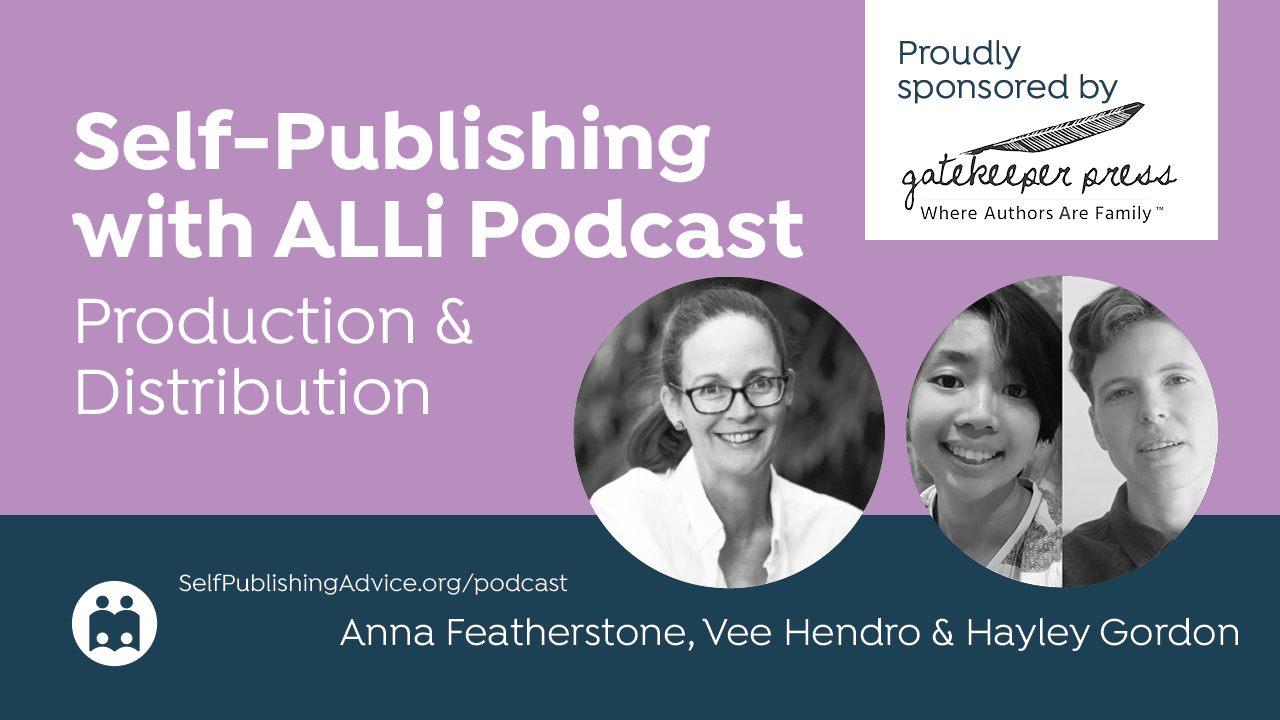
How do you turn a literary world into a collaborative storytelling experience? In this episode of the Self-Publishing with ALLi podcast, Anna Featherstone talks with Vee Hendro and Hayley Gordon—the award-winning duo behind Storybrewers Roleplaying—about producing their book- and card-based role-playing games, including Good Society: A Jane Austen Roleplaying Game and My Late Father’s Correspondence. Together, they explore how indie creators can merge writing, design, and ethics to craft imaginative, inclusive, and immersive books.
Listen to the Podcast: How Role-Playing Games Blend Literature, Ethics, and Imagination
Sponsor
This podcast is proudly sponsored by Gatekeeper Press — your partner in premium independent publishing. Empowering authors with expert guidance, 100% rights, 100% royalties, and global distribution. From editing to marketing, their all-inclusive services help you publish professionally and confidently. Gatekeeper Press — Where Authors Are Family.
Thoughts or further questions on this post or any self-publishing issue?
If you’re an ALLi member, head over to the SelfPubConnect forum for support from our experienced community of indie authors, advisors, and team. Simply create an account (if you haven’t already) to request to join the forum and get going.
Non-members looking for more information can search our extensive archive of blog posts and podcast episodes packed with tips and advice at ALLi's Self-Publishing Advice Center.
And if you haven’t already, we invite you to join our organization and become a self-publishing ally.
About the Host
Anna Featherstone is ALLi’s nonfiction adviser and an author advocate and mentor. A judge of The Australian Business Book Awards and Australian Society of Travel Writers awards, she’s also the founder of Bold Authors and presents author marketing and self-publishing workshops for organizations, including Byron Writers Festival. Anna has authored books including how-to and memoirs and her book Look-It’s Your Book! about writing, publishing, marketing, and leveraging nonfiction is on the Australian Society of Authors recommended reading list. When she’s not being bookish, Anna’s into bees, beings, and the big issues of our time.
About the Guests
Vee Hendro and Hayley Gordon are the award-winning designers and married duo behind Storybrewers Roleplaying, an Australian studio known for emotionally rich, character-driven tabletop role-playing games that explore history, literature, and queer narratives. Their work has earned multiple honors, including two ARPIA Game of the Year awards, Best Tabletop Game at SXSW Sydney, and back-to-back wins at the PAX Aus Indie Showcase. Based on Gadigal land in Sydney’s inner west, they live with their dog Holiday and a rotating crew of foster cats. More at linktr.ee/storybrewers.
Read the Transcript
Anna Featherstone: Welcome and thanks for tuning in from your special part of this beautiful planet. I'm Anna Featherstone, sharing information and inspiration today from the lands of the Gadigal people, the original storytellers of this land in Sydney, Australia.
We are being joined by two fascinating storytellers who are about to share their approach to creating, producing, and distributing words and ideas in ways you might not even have thought of. There's so much interesting info here. This is going to be a two-episode podcast.
So, we're about to welcome Vee Hendro, and Hayley Gordon. They're the duo behind Story Brewers Role Playing; award-winning indie creators known for beautifully crafted, emotionally resonant role-playing games in book and card form.
Together, they design, write, illustrate, and produce narrative driven games with book formats as a central piece. So, games like Good Society: A Jane Austin Role Playing Game, and the single player title, My Late Father's Correspondence, which is a read and reply game set in 1832, for all you Regency era fans and beyond.
So, welcome Vee and Hayley.
Meet Vee and Hayley: The Creative Duo Behind Story Brewers Role Playing
Vee Hendro: Hello, my name is Vee. Thank you so much for having me here. I am the creative lead at Story Brewers Role Playing, and let me introduce you to my wife, Hayley.
Hayley Gordon: Yes, I'm Hayley. I am also a lead game designer, and I take care of most of the writing and also the less fun parts of the business, like the logistics and admin as well.
Anna Featherstone: Fabulous. What a dynamic duo.
We met at South by Southwest Sydney recently, and I wandered into the games pavilion, and on the right-hand side were masses of screens and masses of games with music and video, and all sorts of creatures and everything. Then I moved into the tabletop game section, and I was just wandering through, and I was like, wait, there's a hardcover book and a spiral bound book and packets of cards on this table. I'm like, what are books doing in the gaming pavilion?
So, tell us your story.
Discovering Role-Playing Games
Anna Featherstone: Firstly, how did you come to be in the role player game space, and what skills and background do you both bring to your indie game and publishing business?
Vee Hendro: That's a fascinating question in that we don't have any sort of prior background. This is such a new and emerging field; it's not like you can get a degree in tabletop role playing games, which is what we do. In fact, I used to work as a migration lawyer back in the day, so it was a complete shift from what I was doing in my day job.
How it really began was that Hayley and I started playing these sorts of games for fun, for ourselves, and getting hooked on this sort of medium of interaction and collaborative storytelling, and pretty soon we just wanted to make our own, because a lot of the biggest names out there in our space is very much combat oriented RPGs about fighting monsters, like Dungeons and Dragons, and we just saw the opportunity to tell a different kind of story. That's how we began.
And every other skill that we've developed over the years has been from DIY spirits and learning, whenever we were faced with something unfamiliar that we've never tried before, we just tried our best to find the information out there from the internet and anyone who would talk to us about it, and then try it ourselves.
Anna Featherstone: And Hayley, what was your background?
Hayley Gordon: I also have a law degree, but I didn't practice law at any point. I gave it a brief try and then I noped out, but I've always been somebody who has enjoyed writing. When I first left school, I was like, I'm going to be a playwright, but years passed and that did not happen.
So yeah, I think it was more than being a skill that I brought in, and just something that drew me to the format.
Anna Featherstone: That's so interesting because being a playwright, really now you're creating play, and giving theatre to people and putting it into their own hands. I love how you both speak about your independent spirit. That's the whole Alliance of Independent Authors, that's why people listen. It's like, you can learn things, and you can innovate, and you can share with community to learn more and take your passions to build into something.
I'm fascinated by the whole Dungeons and Dragons type thing, but you two just were looking for something a bit more based in history, and different ways of looking at the world. It was funny, because when I was at your stand, one of your fans came up and he was actually a game designer in the other section, with the combat games and all the video stuff, and he started telling me how he plays your game in cafes with friends all the time.
So, they go to cafes, they take your book and everything. Because I was still confused, I'm like, why is there this hard back book? How is this part of a game? So, he explained to me that it's like a game manual.
I'm like, that makes it complicated. Does everyone have to read this book before they can play? And he said, no, you just have the convener reads it, like the main person, they explain things, but then during the game it becomes a reference tool when people want to go deeper into the characters and deeper into the game.
So, can you explain a little bit for people like me, who maybe back in the day I played one of those murder card games, what are role player games? Explain the card packs that come along with the book and just give us an idea.
Hayley Gordon: For sure.
Creating Good Society: A Jane Austen RPG
Hayley Gordon: Roleplay games in the kind of format that we create them, I think, is something that a lot of writers would take to naturally because at its heart, it's sitting down either with some friends or by yourself, to tell a story together.
We call it a game, but what the game does is two things. Firstly, it brings the inspiration for what you're telling the story about. So, in the case of our game, which is Jane Austen-Esque stories that you're telling, it's going to help you know who your characters are, and what they want, and then the second thing that the game will bring is the way in which you tell the story.
Depending on the game, this might involve telling you whether you succeed or fail at certain things, or it might be more like our game where it tells you the kind of format that you're telling the story in particular stages of the game.
For example, our game has a letters phase where you switch to writing letters, whether you write them down or you say them out loud. So, it's telling you how you're telling the story.
At its core, you're still just telling a story by yourself or with friends, but the game helps you to do that.
And exactly as you said, in the case of Good Society, the book contains those rules that can tell you the different phases of how you tell the story and how you're going to work together to tell the story, and the cards provide the inspirational material that you use to make your characters.
There's also a bunch of inspirational material in the book as well. So, in a lot of ways it's a scaffold for telling a story. That's what a game is to us.
Anna Featherstone: Okay. So, you are not just storytelling though. You've got literary storytelling and then you have to build in game mechanics as well. How do you approach that?
Vee Hendro: I think that the way that we always approach our game making, a lot of the heart of roleplaying games, especially for us, is in characters, grounded characters, 3D characters that have complex relationships with each other, and desires and drama with each other.
So, we start there in terms of who are you going to be playing in the game, and then what kind of interesting stories and themes are we going to generate around that.
So, in the case of Good Society: A Jane Austen Role Playing Game, I think we wanted to really give people a lot of options in who they're playing, whether that's the heir or the cornerstone of a family. That's why they're on cards. So, they can have over 40 different choices of what you might start out the game trying to do.
Then the other half of it is that we wanted it to feel very immersive and very much in pulling from the tropes and themes that you might see in those works, in terms of the literary storytelling.
We often talk about this thing that we call the heart of the game. It's like the feel and vibe, and we're crafting that long before we're crafting specific mechanics. So, in terms of our game, the heart of the game is to feel like you are authoring a Jane Austen novel together with your friends and then the mechanics layer on top of that later.
So, the letter writing phase that Hayley mentioned, that actually came out of us watching, we were some ways into developing this game, and we were looking for inspiration, and we were watching Love and Friendship, the movie. There are some really funny scenes in that film where they're reading out letters that they'd received, and we were laughing at one of those moments and realized, wow, obviously letters are a huge thing, and it would be really fun to have that in our game.
Both because it'll just be fun and it's thematic, but also from a game design perspective, it's a very interesting thing because only two people will know fictionally, because in our game you do say that letter aloud for the whole table to hear and appreciate, but fictionally the two characters whether writer and the recipient of that letter are the ones that know the content of that letter. So, it does give this sort of texture to the game that not everyone knows that information. Maybe someone's declaring their love for another, and then you proceed with the game knowing that, but your character not knowing that. So, that's fun.
A lot of our mechanics that we pull from stuff we've seen and ways we want to incorporate that kind of literary storytelling in our game.
Anna Featherstone: Have you ever been approached by authors to develop games based on their books?
Hayley Gordon: Not yet, but it's possible.
Anna Featherstone: I was just literally thinking, what another great marketing tool for authors to be able to immerse their fans in their books even more.
Can you play the game online, or do you have to be in the same room?
Hayley Gordon: You could be in the same virtual room, a Zoom call or something like that is definitely good enough to play, and usually there'll be some sort of play aid that just helps you keep all the information together if you're playing digitally, but it works just as well.
Anna Featherstone: As playing in a cafe or at a friend's house? Okay, cool.
So, what's the ideal number of players for a game like Good Society?
Vee Hendro: Usually around three to five. Five of you, like a lot of people in chaos. Four is probably a safe, good number. I personally really love three because it is a tighter story. But two people is also a perfectly fine number of players to play, but it's very focused too because you are two characters and you do play other supporting characters all the time in Good Society, but it just means the main characters are about two.
Exploring Solo RPGs with My Late Father's Correspondence
Anna Featherstone: Okay, and then I saw on your table as well, you had another title called, My Late Father's Correspondence, which is a single player game, but also you said you can play it with two people.
Tell us about that game and how and why you created that one.
Hayley Gordon: Yeah, it's a great one to bring up now because it works in a completely different way to Good Society. So Good Society is closer to, what you might think of as a typical role-playing game. My Late Father's Correspondence is a bit different.
It is a letter writing game, so the way you go through the game is entirely by writing letters. It is, like you said, a game that you usually play solo or there is a two-player variant as well.
The idea behind that game is that you are playing a character called Agatha, whose father has just passed away, in 1832, as you mentioned, and you're dealing with all of the correspondence coming in for himself and also for you. When you're doing that, you're discovering a lot more about yourself and some family secrets are coming out along the way as well.
So, it's more of a guided story, but it still focuses on that idea of inhabiting a character, in this case Agatha, the central character, and thinking about what she's feeling and thinking and writing from her perspective.
The impetus behind that one was, I definitely do a lot of storytelling in that era. I think it came from Good Society originally, and so it's just a time period I enjoy, but also, I've always been fascinated by stories about grief and change, and the way that you get to know someone differently after they've passed away, when all the parts of their life start coming out.
So, that was the inspiration behind that game.
Anna Featherstone: I love how you guys think about this.
Production Insights and Challenges
Anna Featherstone: Let's talk a bit about the production side of things. So, for that book, for My Late Father's Correspondence, you chose an A5 size spiral bound, 70 pages of detailed handwritten letters and documents.
You even researched historically the ink colors, the stationary, the postmarks. Is that correct?
Hayley Gordon: Yes, that is, we spent a lot of time researching those things.
From my perspective, as somebody who loves history, one of the things I wanted for the game was for it to be as much of an immersive experience as possible, and also for you to be able to learn more about the people who are writing to you by looking at things like the cover of the letters and the stationary that they use.
So, we use that to both evoke the period, but also to give an individual kind of character and extra details to everyone who is writing to you.
In that game, we removed as much of the instructional text in the portion of the game itself as possible, with the idea that you can basically just enjoy the experience without getting snapped out of it by extraneous material and adding those details is part of creating that.
I know Vee can speak more to the specifics.
Vee Hendro: Yeah, some specific things about the spiral bound was because I wanted it to lay flat on your table so that when you are writing your reply to the letters that you see in the book, you can refer to it easily.
So, it was really practical user experience decisions like that, and I think that book was all of the handwriting I did myself after researching. I had all these handwriting samples from the time, and I was trying to craft my own versions of handwriting from different characters, like Hayley was saying. I would sit there and think and develop a writing style for each of the characters that I felt reflected their personality a little bit.
So, it was a lot of fun to make, a lot of interesting artistic decisions to be made, and it's not perfect, but I love it.
Anna Featherstone: It's so cool. It's like you're translating, but through handwriting. Personalities and the era. Oh my goodness. You'd be good at writing those hoax letters as well, where you send them in, because you could do it in anyone's handwriting and no one would know it was you.
So, did you ever try for a traditional game publisher, or did you go straight to indie?
Vee Hendro: Straight to Indie. It's very difficult to go through the game publisher route, I think, in TTRPGs, it's just not very big. There's not that many opportunities and like I said, we'd always had the indie spirit. It was just two of us in our living room at the time, just making games, dreaming the dream.
Anna Featherstone: I love that.
We'll talk about audience actually in the next podcast episode, because we're breaking this into two because there's so much to talk about, but I can just see that you went down your own rabbit hole, had so much fun, and through that you developed an audience who enjoyed that. Rather than trying to be vanilla and do what everyone else was doing, you're owning your space.
Balancing Story, Art, and Mechanics
Anna Featherstone: So, with role player games, it combines story art and mechanics. How do you balance those creative layers when you're doing the design and editing and production?
Take us behind the scenes: idea, then prototype, then to the final product.
Vee Hendro: Hayley and I are co-designers of the games that we make, and I think that's a really big boon, because obviously we are married, we live together, we spend every waking minute together and we're obsessed with these games and have fun doing it with each other; this creative partnership's very fulfilling for both of us.
So, between us, the story, art, and mechanics are very easy to discuss in an interchangeable sort of way.
I think at the very start, when we have an idea for a game, say, oh, okay, we want to make a Jane Austen role playing game, what might that look like, what is the heart of the game?
That conversation bridges all three of those things, but in no specific way. We follow, through discussion, like hours and hours of us just discussing back and forth different ideas, researching a bit, or looking up interesting things on the internet and then coming back to each other and hashing out that core experience of the game. I think that takes quite a while, but we can have a really free and open discussion.
Once we have a great idea of, the core of this game, we know what the heart of this game is, it's about realizing that as well as we can, as a game and as a product. So, that's when all of that next layer of decisions come in for us.
We might have touched upon it in that, but that's when we really start to think about, okay, if this is going to be like a hardcover book. Yeah, of course it will be, because a Jane Austen book, it's a very literary genre. We want to make a beautiful book that feeds in well with, and we're talking about audience in the next one, but what the expectations of that game might be.
What sort of art do we want for this game? So, we might audition different styles, but we also will have that discussion of, we want to make sure that the art's really diverse because we don't want this to be just vanilla, like you said. We want it to be diverse. We want people to look at the cover and see, hey, we can have lots of different types of people play this. We can have queer stories in this game system, which might not be what you see, but it's something that is important to Hayley and I.
So, that's the next layer of discussion and production elements. So, we'll start commissioning art, talking to artists. At the same time, we're also usually doing play testing, which is a huge part in our game where we are getting groups of people together, usually online, because a lot of our players are not in Australia. And we'll run four weeklong, one session a week, for four weeks, play tests for our games and things like that, through our online Discord or through other channels that we've built up online where we can get play testers.
Anna Featherstone: Which is a bit like for writers, that's like first readers, like having people read your drafts and taking that feedback.
Vee Hendro: I'm not familiar with this, but what we often do is we're watching people play, because we're often running it at that point because no one else knows how to run this game and facilitate this game except for us. Because we haven't written the manual yet, we have to run it. Therefore though, we get to see everyone's reactions live and we kind of see the points where they're stuck in their storytelling or that sort of thing.
Anna Featherstone: Or when they have a highlight, like when they're laughing?
Vee Hendro: Yeah, exactly.
Anna Featherstone: That makes me want to put readers in a room and watch them read a book. Like, how interesting?
So, it's like taking it up that next level of seeing physical reactions as well.
Vee Hendro: Yeah, exactly, and we could talk about play testing a lot because we love it so much.
Then at the end of the play testing, we finalize the rules and that's when the manual gets made. We've got to be reasonably certain of what the rules are to make as good a manual for those rules. So, that's like developmental editing and a lot of technical writing happens at that point. Then Hayley will do the bulk of the writing and I'll do the layout.
So, a lot of the play materials as well, we'll have revisions during play testing, but it's not until this point where all the rules are locked that I will get all of the final play materials together. Then once all of those pieces come together, we always do a crowdfunding thing.
Anna Featherstone: We can actually talk about crowdfunding in the next podcast episode, I think, because that's where we'll talk more distribution.
With the Jane Austen game, you chose to do that as a hardback, and you could have done it as a paperback. Why did you go the hardback?
Hayley Gordon: We wanted to evoke the sense of those books from the 18 hundreds that have those beautiful hardcover covers to them, and really give people the sense of, as much as this is a game, it's also a book that you can pick up and read and get that kind of sense.
Vee Hendro: These manuals, like you said, they have to be taken to many cafes. So, it's nicer to be a tiny bit more hardy.
Anna Featherstone: What have you learned about selecting printers and materials for the different types of books you've done as well as your card decks?
Hayley Gordon: I think the main thing when you're working with printers, generally in games manufacturing, if you need components like card decks, there's a small number of printers who create those kinds of components. Whereas for books, your choices are unlimited. You can print books in many places.
I think for us, an essential thing is choosing printers. We usually select them by word of mouth. We like to talk to other people who have printed before or ask them where they've had really good experiences and then follow where other people have found value and have found good quality.
Usually, when you work with a printer, one thing I've learned is it's very useful to ask them for samples ahead of time about the page stock or the cover stock that you're going to use. Most printers will be happy to provide that so you can get a really good sense of what your book is going to look and feel like once it's been printed.
Anna Featherstone: Before the book gets printed, what kind of tools are you using to write, to do your design, to get it all together?
Vee Hendro: It's very easy, it's all the things you would do. A Google Doc for all the writing. I use the Adobe Suite for a lot of my layout and graphic design. Just a tablet to draw with if there's any graphics that I need to make. But I think the heart of it is just in the conversation that we do with ourselves.
I know for a lot of RPGs, even if you're doing it solo, just thinking is so much a big part of idea generation. So, daydreaming.
Anna Featherstone: Don't tell me you use your brain.
Vee Hendro: My brain in very specific circumstances only must be in a daydreaming, open-minded state.
Anna Featherstone: I'm all for daydreaming. Literally, it makes you more creative in the workday as well, just daydreaming. Everyone in the office should be given 15 minutes at least a day just to daydream. Just sit there, look blankly; that's creation.
Inclusivity and Accessibility in Game Design
Anna Featherstone: So, in the letter writing game, I noticed you had three QR codes on the inside, and your mission emphasizes doing right by players, by inclusivity and accessibility, and the environment. I saw that QR code allowed people to download a different font or something. So, if they found it hard to read your beautiful handwriting personalities, that they could access it in a different way. Tell us about that.
Vee Hendro: Yeah, absolutely. That came out of just me knowing that not everyone can read cursive and I was not confident that everyone would be able to read all of my cursive.
So, we definitely want to give people a way to look easily online, and also if you are playing it with a screen and you need to copy and paste text, perhaps it'll be easier through having a separate PDF.
So, we definitely try to think about those things when we're making the game because a lot of game making is about anticipating people's needs and experiences through your product. Not just the story, but how are they actually going to pick it up and read it and experience it.
We also have one of the QR codes leads to a music playlist for background music, so you can get into the vibe. I think the last one in that one was actually historical commentary videos that Hayley did to showcase some of the underpinnings, and you could talk to that a bit more, I think.
Hayley Gordon: Those were just because people enjoyed them and I love history.
I guess I wanted to highlight all of the thought and consideration that had gone into the game, and give people an opportunity to have a bit more understanding that they could use to get those little juicy details about the characters from what was written, and then people were like, we would like more of this actually.
I was like, very well.
Anna Featherstone: Oh my God, I love that. So, you are allowed to just go down your whole historical research rabbit hole and have fun with it, and then that builds out your player reader experience as well.
Hayley Gordon: Yeah, very much like you said before, I think about how we've just done our own thing and followed our own passions and tried to bring those to life in a way that then invites everyone into those things that we're passionate about.
That's our method of connecting with people and we try to follow through that ethos from beginning to end of our products. The idea of going down our own rabbit holes, but then inviting people into them so that they can enjoy them as much as we do.
Anna Featherstone: And with those videos, do you host them on YouTube or on a private link?
Hayley Gordon: Yes, on YouTube.
Anna Featherstone: Are they open to everyone or do you have to have a certain link?
Hayley Gordon: They are open to everyone. I do say at the beginning of each one, spoilers beware, just in case someone randomly stumbles across them, but I think the vast majority of people watching them have the game.
Anna Featherstone: So, the game's not just in hardback and card form and the spiral, you also provide PDFs, is that right?
Vee Hendro: Yes. Whenever you buy one of our games, generally you can also get a PDF version of the game. That comes out of the fact that a lot of role-playing games are, like you said, reference materials. Eventually, when you're playing you want to look up a rule really quickly or refer to some bit of it, it makes it easier to find when it's a digital product, like you can Control F whatever it is that you're looking for.
Also, I think that there are some of the play materials, like the character sheets that you print off before you play. So, we always supply those on our website, they're always up there as play materials, so if you lose them, you can get them. It's just part of the ecosystem of what a tabletop role playing game is expected to have.
Anna Featherstone: Do you get concerned that someone might just copy them and pass them on?
Hayley Gordon: There is nothing we can do about that. If they choose to do, that's their decision, and I know for a fact that has happened on occasion. I'm fairly sure that for a period of time, one of our games was just uploaded on the internet and anyone who wanted to find it, if they really wanted to try to get it for free, they could do that. But our ethos is, people are going to do what they're going to do, and most people who value our games will then actually come and pay for a copy.
We're just going to let it be. I think that's an inevitability.
Anna Featherstone: I think that's for a lot of authors, like when our books are uploaded to free pirate sites. In the end, those people aren't going to be our long-term customers. Anyone downloading free stuff isn't really where you want to spend time with anyway. And then your people become so loyal, of course they want to pay for your games and your books, and support you back.
Wow. Okay. We have so much more to talk about. Actually, I can see in the background, no one can see this, but there's cats jumping around behind you two. They look very excited.
Vee Hendro: Yeah, we foster rescue cats.
Anna Featherstone: Oh my goodness. Are there cats in Regency England? Are they involved in the games?
Vee Hendro: I'm pretty sure there is some art of cats and dogs that appear in that game that I requested for my own satisfaction.
Future Projects
Anna Featherstone: Do you think you'll develop some more in the literary game space? You're also doing other areas too, like, you have a sport game?
Vee Hendro: Yeah, I think our genres tend to be dramatic stories of many different kinds.
We have a sports drama game and that's as much like the dramatic things that are happening to the characters, and then how they take that into their sport, as well as cozier games. We've got one that's like more of a slice of life experience between a mundane human and their supernatural loved one, whether that's a vampire or a werewolf or whatever it is.
We kind of stick to things that we personally like and that can span a few different kinds of genres. We don't really lock ourselves in, but obviously we have the interests that we have.
Anna Featherstone: It'll be fun to check in a few years to see what other interests, what other things you've brought into your lives. Isn't that what's great about being a creator? It allows you to just get more into the things you love anyway, and that curiosity brings out so much fun and depth.
We have so much more to talk about when it comes to audience and distribution, so you're definitely up for another episode. In the meantime, where can people find out more about you and Story Brewers?
Vee Hendro: If you are interested at all in any of the weird gaming thing we've talked about, like I highly recommend it. So many creatives, like a lot of video game developers, a lot of writers, a lot of creatives, I think can learn a lot from role playing because it's a medium that's all about expressing your creative self.
We are on the internet as storybrewersroleplaying.com. We've also got Blue Sky and Facebook, but mainly I would say go to our website, sign up for our newsletter. We don't spam, but we will have every two months, a little newsletter that goes out that has a bunch of things that we're working on, some of the stuff that our community has made that you might want to have a look at, and it's a great introduction to what we do.
Anna Featherstone: We'll definitely put those links in the show notes as well. But that's great, thank you so much. We will be back with you in the next episode.
But to you listeners out there, thank you too for being a part of the ALLi Podcast family. I'm Anna Featherstone, and until next time, I hope you experience many wonderful bursts of creativity, writing, productivity, generosity, and joy in your life. And maybe some role-playing games. Catch you next time.

This podcast sounds fascinating! I’m curious to know how you tackle the integration of ethical themes in your role-playing games—any tips for indie creators looking to do the same?