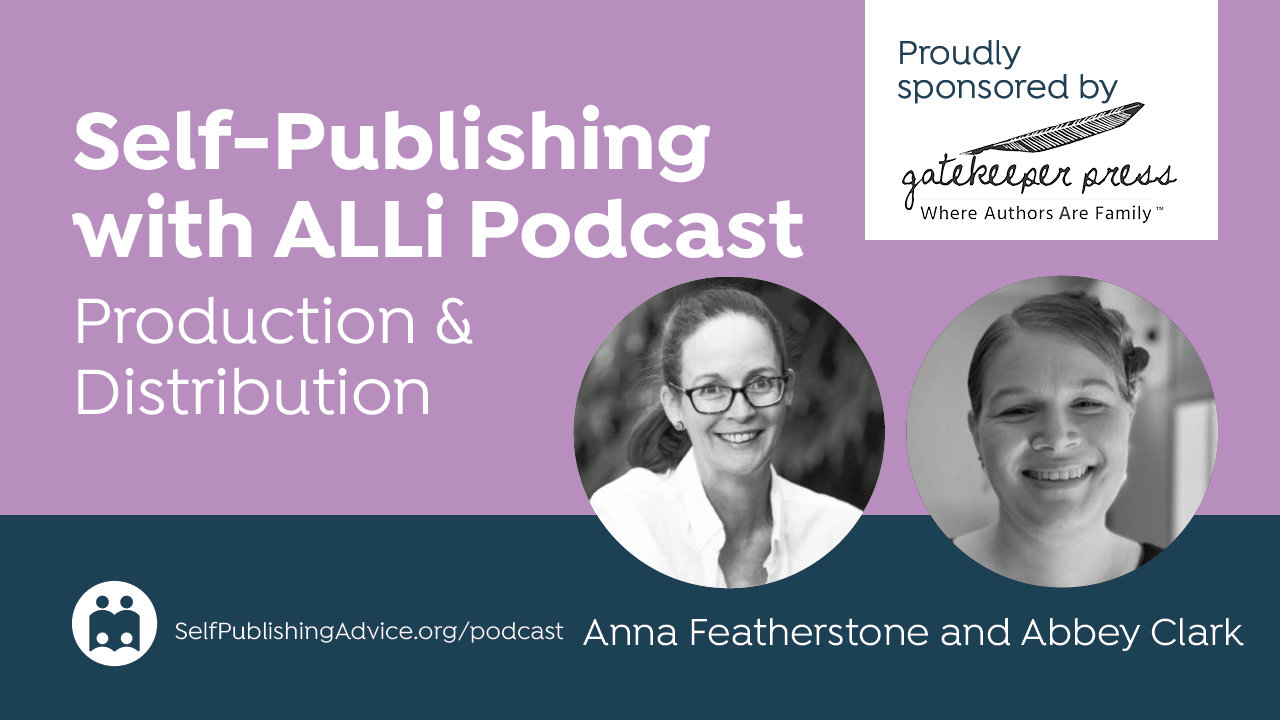
ALLi nonfiction adviser Anna Featherstone speaks with Abbey Clark of NielsenIQ BookData Australia about book metadata—what it is, why it matters, and how it shapes discoverability and distribution across the publishing ecosystem. Clark offers clear, practical advice on when to set up metadata, how to keep it updated, and the common pitfalls authors and publishers can avoid. The conversation prompted Featherstone to update her own metadata right away and offers useful guidance for any author who wants to give a book the best chance of being found.
Listen to the Podcast: The Digital DNA of Your Book — Metadata Insights
Sponsor
This podcast is proudly sponsored by Gatekeeper Press — your partner in premium independent publishing. Empowering authors with expert guidance, 100% rights, 100% royalties, and global distribution. From editing to marketing, their all-inclusive services help you publish professionally and confidently. Gatekeeper Press — Where Authors Are Family.
About the Host
Anna Featherstone is ALLi’s nonfiction adviser and an author advocate and mentor. A judge of The Australian Business Book Awards and Australian Society of Travel Writers awards, she’s also the founder of Bold Authors and presents author marketing and self-publishing workshops for organizations, including Byron Writers Festival. Anna has authored books including how-to and memoirs and her book Look-It’s Your Book! about writing, publishing, marketing, and leveraging nonfiction is on the Australian Society of Authors recommended reading list. When she’s not being bookish, Anna’s into bees, beings, and the big issues of our time.
About the Guest
Abbey Clark is the account manager for metadata at NielsenIQ BookData Australia, where she oversees a wide range of clients across metadata services and works on consumer data projects. She joined NielsenIQ BookData in September 2022 after nearly twenty years in the book industry, with experience in retail, publishing, and library supply. Clark holds a bachelor of arts in creative writing and literature.
Thoughts or further questions on this post or any self-publishing issue?
If you’re an ALLi member, head over to the SelfPubConnect forum for support from our experienced community of indie authors, advisors, and team. Simply create an account (if you haven’t already) to request to join the forum and get going.
Non-members looking for more information can search our extensive archive of blog posts and podcast episodes packed with tips and advice at ALLi's Self-Publishing Advice Center.
And if you haven’t already, we invite you to join our organization and become a self-publishing ally.
Read the Transcript
Anna Featherstone: Welcome, and thank you for tuning in from your special part of this beautiful planet. I'm Anna Featherstone, joining you today from the Unseated Lands of the Biripi people, the original storytellers of this land — a coastal area on the mid north coast of New South Wales in Australia, where the sea, giant goannas, koalas, native bees and birds would have you thinking you're in a fairytale.
But today we're not in a fairytale. We're diving into a reality that every author and publisher needs to understand — and that's distribution and visibility for your book. Even if it sounds a bit dry and a bit techy, metadata is so important, and we talk about it a fair bit at ALLi because of that. Think of it as the digital DNA of your book — all the key information that helps people, systems, and booksellers find, understand, and sell your book.
And we have the person today who can help us make sense of all of that. We're joined by Abbey Clark, Account Manager for Metadata at Nielsen IQ Book Data Australia. Welcome, Abbey.
Abbey Clark: Thanks for having me, Anna.
Anna Featherstone: You're like the author's friend. We are very lucky to have you with us. You work at the heart of book discovery, helping publishers and authors ensure their data is accurate and complete and powerful enough to travel through the global book ecosystem.
What Is Metadata and Why Does It Matter?
Anna Featherstone: So let's start with the basics. What is metadata, exactly, and why does it matter so much?
Abbey Clark: You're absolutely right that it's your book's DNA — it's the building blocks of how you get your book out there and talk about it. It's all the information used to create, describe, arrange, promote, and sell your book. It's then used by publishers, distributors, libraries, all our book-people friends, search engines, and eventually readers.
Anna Featherstone: When did all this metadata stuff begin?
Abbey Clark: Oh, good heavens. Well, long before my time. It's been going on for a really long time. Before computers and spreadsheets and all the digital systems, it all started back with physical catalogs. Booksellers used to get catalogs from publishers and look up each of the books available — it was almost like the white pages or the yellow pages, if anyone remembers those. So it's been around for a very long time. We just do it slightly differently now, like we do with everything else.
Anna Featherstone: So a lot of authors just think, oh, there's a metadata thing I have to fill in on a publishing platform — and they kind of glaze over it. What's the bigger picture?
Abbey Clark: Think about it this way: how do you tell someone about your book without any of the details? How would you tell them what it's called, how much it costs, where to purchase it, what it's about? Without those key things, how would you tell a friend? How would you sell it to an audience? It's not just another tick box to get through at the end of the day. It's your best sales rep. It tells everyone what they need to know about your book.
And metadata goes across retailers, into library catalogs, into search engines, both online and offline. The other big thing to remember about metadata is that it also allows for market measurement — it gives authors and publishers of all shapes and sizes the information they need to make informed choices, to see what the trends are, where something's going, where something might be slowing down. It's really intrinsic to how you sell.
Anna Featherstone: So on the other side — why would a bookseller or librarian actively look up new entries? How do they use it from their end?
Abbey Clark: It obviously depends on who they are. A retailer might use metadata completely differently from a library. But they use it essentially for their own customers. A library might have a regular client who only looks for Australian native gardening books, and you've just published one. If your metadata is in that library catalog, they can see it as a new entry and say, oh, we've got a new one. It's a discoverability tool. It leads people to your book.
And a retailer is the same. They might have someone come in looking for a gift for a twelve-year-old who is obsessed with astronauts, and you've just written this really well-researched, beautifully illustrated book about space and the Australian space program for that age group. The retailer looks it up on the database, finds it, and leads them directly to that book — and there's a sale.
New, Forthcoming, and Backlist
Anna Featherstone: Is there a ‘new' tag, and how long does that last on a book?
Abbey Clark: New books are usually in that first twelve months — so the first year is generally considered new. But then you've also got pre-publication, which is almost as important. That's where you do all of your marketing and push out information so people know it's coming. It builds excitement — someone will see that the book is coming out on a certain date, they'll get excited, and they'll pre-order it or plan to pick it up from their local bookshop. So there's forthcoming and there's new.
And then you go into backlist. Don't forget backlist. Backlist is also important. Just because your book has been out for over twelve months does not mean it's not important.
About Nielsen IQ Book Data
Anna Featherstone: Tell us what role Nielsen IQ Book Data plays in the book industry globally.
Abbey Clark: We are at the heart of the industry. We collect metadata for English language books — mainly English language — from over 60,000 publishers worldwide. And it's not just publishers — it's also suppliers and self-published authors. We have a database with just over 54 million records. We've only just ticked over 54 million, and it's been going for a very, very long time. We connect with libraries, retailers, and search engines — pretty much anybody and everybody within the book supply chain.
Anna Featherstone: So that's a huge global footprint, right in the back end of all the systems. Once someone enters a record or updates it, how long does it take to go through the system and get out there?
Abbey Clark: When we receive your metadata — either a new addition or an update — it goes through our backend systems and goes through all the checks and balances, usually over a 24 to 48 hour period. And then from there it immediately goes out and is disseminated to all the different systems.
Anna Featherstone: Is there any limit to how many times we can go in and update our entries?
Abbey Clark: Absolutely not. A record is not static — it's completely dynamic. If someone can see that a book has been around for five years and the metadata hasn't been updated since the day it was first entered, it's not telling me the information I need right now. It's telling me the information from five years ago. So it's actually really important to remember that it's always changing. It might not change super frequently, but if you've just put in your data and you think, oh, I need to update something, just go in and update it. It's not a problem.
When to Complete Your Metadata
Anna Featherstone: So when should we first complete our metadata — when we do our ISBN registration, or before we upload to IngramSpark, or once the book is completely finished? How early is too early?
Abbey Clark: Have your metadata ready to go as soon as you can. Because then as soon as you've purchased your ISBN, you've got that metadata ready in your hands. You're not running around wondering what the book was about and what you wanted to put in, because you've got a thousand other things on your mind. Do it as you go. And again, you can change it at any point.
If you decide three months after publishing that a particular classification doesn't work, or you need to change the price, or whatever — you can change it. Take your time and do it right the first time, but have your metadata ready to go as soon as you can.
Anna Featherstone: Yeah, because I often find with my own books that I have no idea what the final page count is going to be at the time of publication — I might not have done my index yet, or I'm not sure of the exact dimensions. So I can basically fill in my major descriptions and all the key details and just come back later and update the page count.
Abbey Clark: Yeah, absolutely. As long as you've got the basics down — your ISBN, your title, your author, and maybe just a basic description — you can put that in a file or wherever you take your notes and then add as you go along. As I said, it's dynamic. You can add and update as much as you please.
Keeping Metadata Consistent Across Platforms
Anna Featherstone: This is something I always get confused about — the interplay between different systems. Since this is a global podcast, different authors around the world use different ways to get their ISBNs, and we go through different systems. When we do that we're often asked to fill out metadata there as well — but that's not you. So we have to fill it out there, we need to fill it out with you, and then we might also fill it out with IngramSpark and other places. What's your advice on that? Do we do them all at roughly the same time? And what happens if we have something different in one place versus another?
Abbey Clark: What I would advise is to keep a record — in whatever format works best for you, whether that's writing things down, a spreadsheet, a phone app, whatever suits your processes. Once you have all of your core metadata fields gathered together, do them one at a time but all together, so you can keep everything consistent.
Then if you need to make small tweaks for different regions — different spelling for the US, a different price for New Zealand — you can note those as you go and update accordingly. Consistency is key. Because if someone is looking up your book across different search engines or retailers or your own website, you want them to see the same information no matter where they go. Wherever your metadata has gone, your readers want to see that consistency — with the exception of regional things like price and availability.
Anna Featherstone: Are there separate fields to fill in for different country details?
Abbey Clark: I can only speak for Nielsen IQ, but obviously with pricing there would be a different price in Australia versus New Zealand versus South Africa versus the UK. Most other things would probably stay the same, unless you decide to have a slightly different title for, say, the Commonwealth versus the US. In that case you would actually use two different ISBNs.
It's quite common to have a US Rights Edition and a UK/Commonwealth Rights Edition with two completely separate ISBNs. They won't be the same because they're completely different rights markets. Harry Potter is the classic example — it's Harry Potter and the Philosopher's Stone in the UK, but Harry Potter and the Sorcerer's Stone in the US. Two separate titles, two separate ISBNs, technically two separate publishers.
And always have a different ISBN across formats. If you've got one book and you're doing a paperback and an ebook and an audiobook and a hardback, each individual format should have a different ISBN. It's to track where your sales are going — you might notice higher sales in ebook, or some new sales in audio. And it also matters for the end user: if you are looking for a book and the hardback, paperback, ebook, and audio all have the same ISBN, how do you know which one you're getting?
The Core Metadata Fields
Anna Featherstone: So what are the core metadata fields we should focus on getting right from the very start?
Abbey Clark: The list is long, but these are the base of your metadata pyramid. You'll have your ISBN and your title. Your author — or contributor, if you prefer that term. You can also put in an editor if it's a short story compilation with multiple authors. If it's audio, you can put in your narrator or narrators — that's really important.
Then your format, your imprint or publisher, and sales rights — where you're allowed to sell that book. Your product properties: weight and dimensions, how tall the book is, how wide, how many pages, how heavy. It might not seem important, but it really is. Obviously your price and availability. Where your book is being distributed — if you are a self-published author selling your own books, you would put yourself in as the distributor. Also series information if it's part of a series, because you want people to be able to find book one if they're discovering you at book four. An edition number if you have multiple editions. And an audience code and your classification codes. Those are your core fields.
Anna Featherstone: What is an audience code?
Abbey Clark: An audience code is essentially who your book is for. A general audience code means anyone from zero to 84 — or however long you live. If it's just for adults — eighteen and over — you would put in an adult audience code. If it's for children, you would put in a children's audience code.
Anna Featherstone: And do you have those as a dropdown menu that people choose from?
Abbey Clark: Yes, it's in our Title Editor program. Title Editor, just to give it some context, is our free publisher portal. You register and you can add all of your metadata into Title Editor, and then we upload that to data feeds and into our database so people can discover your book. If you do get stuck, feel free to get in contact with us — we're happy to help.
Anna Featherstone: I'll be honest — when I first signed up, the process felt a little old-fashioned, not super intuitive. I had to email for some help. But the help did come, and it works. You just have to stick with it.
Abbey Clark: Yeah. Follow along as best you can, and if you truly get stuck, send us an email and we'll help you as best we can. The URL is www.nielsentitleeditor.com — and we'll put that in the show notes as well.
Fields That Boost Discoverability
Anna Featherstone: Which fields have the biggest impact on discoverability?
Abbey Clark: The dynamic ones — these are my favorites. We actually produced a white paper in 2021 that our UK colleagues put together. We looked at the correlation between the completeness of a record and sales. This report, and others we've done in previous years, always points towards the relationship between a strong product record that includes descriptive content — things like an author biography, a long and short description, images, and keywords — and higher than average sales compared to those records that don't have those fields completed.
You might not necessarily think of putting in an author biography, but just a short one so people get to know you. Other helpful fields: a table of contents if you've written nonfiction, so people get an idea of what subjects you'll be covering. And reviews — if you have a review from a reputable source, put it in. It shows that others have read the book and recommend it. And that's another discoverability tool.
Anna Featherstone: And that's something we should be going back in and updating — even three years later if we get another great review?
Abbey Clark: Absolutely. Just pop it in the review field. And it does take time, but it's so worth it in the end. For example, if someone wants to support a local author and they don't know where you are, why would they choose you? But if they know you're Australian — or Canadian, or South African, or wherever you happen to be — why not? It doesn't have to be ‘I live on such-and-such street in Geelong.' It could just be ‘Southern Victoria' or ‘Queensland' or ‘Australia.' Just enough so your readers know where you are.
Keywords: Quality Over Quantity
Anna Featherstone: Sometimes on social media, people really stuff their keywords. Is there any drawback to doing something like that, or should we try to get in as many as we can?
Abbey Clark: There is a drawback. There's no right number, and it's really about getting it right rather than getting in as many as possible. Five really well thought-out keywords are going to be so much better than fifty random words that may or may not have anything to do with your book. So sometimes less is more.
The guideline I always come back to is: think like your reader. What problem do I have that needs to be solved by a book I need to purchase? What search terms would I put into a search engine, or into a library catalog, or into a retailer's website? What kind of questions would I ask if I walked into a bookshop?
For example, if you've written a cozy fantasy about a female witch who lives in a cottage, has a garden, does pickling, and has a squirrel detective friend who solves mysteries in the village — how would you ask for that? Your keywords might include ‘cozy fantasy,' ‘squirrel,' ‘cottage garden,' and other specific elements. Be specific.
A few other tips: don't use words like ‘current,' ‘latest,' or ‘bestseller' — unless you can back up ‘bestseller.' Using ‘current' or ‘latest' actually ages your book, because a decade down the track it's no longer current or latest. Don't include swear words — unless that's literally what your book is about. And don't put in website URLs, because if that URL breaks at any point, people can't get to it anyway.
Anna Featherstone: And do you rate or adjust anything we put in?
Abbey Clark: No, not at all. Whatever you put in and send to us — whether it's an addition, an update, or anything else — we do not change it. If something needs to be changed and it's flagged with us, we will ask you to change it, because it's not our place to do that.
When and How Often to Update
Anna Featherstone: So when are ideal times to go back in and update our metadata?
Abbey Clark: Personally, I would go in every couple of months, or twice a year, or once a year — whatever works with your schedule. Everyone is really busy. But if you've got five minutes and you can see your sales have slowed, just quickly check your price, your availability, your publishing status, and your keywords. Make sure they're working for you, because that's their job. Their job is to supplement your classification codes and to sell your book out in the world. If they're not doing their job, go in and update them. Keep them fresh.
If you win an award, pop that in. Any new reviews. And think about this too: every year new words enter the language. Words like ‘AI slop' and others that win word of the year. If your book is about something related to that, it might be worth introducing new language. The way we talk changes all the time, so your keywords need to update with it.
Books written pre-pandemic or during the pandemic might need adjustment — certain topics that were very taboo back then are now quite open and acceptable to speak about. If you keep your keywords and description the way you talked about something ten years ago, it's not going to help you in the long run. Your book might be the best book ever written on that subject, but if your keywords and description aren't reflecting how wonderful it is in today's language, it's not going to resonate with today's readers.
Anna Featherstone: And obviously it's a much bigger job for authors with scores of books versus those with just a few. But for every author it is definitely worth going back in and relooking. I'm talking to myself here — Anna, get back in and update your data.
So besides Nielsen, are there other places that are repositories of metadata that we should look at updating? So not just you, but also IngramSpark, Amazon KDP…
Abbey Clark: Obviously us. And think about your website shop, if you have a shop where people can purchase directly from you. That's a really important one to update as well, because you have to think of yourself as a retailer for your own book. Essentially, anywhere you've put your metadata, those are the best places to update it. If you've got one version over here that's the latest, and one over there that's from pre-publication, that's not going to help you. People are going to be very confused.
AI and Metadata
Anna Featherstone: Now we've got AI on the scene. Is Nielsen IQ Book Data developing anything in that area, or how is that whole scene evolving?
Abbey Clark: AI tools are being used within metadata practices — not necessarily by us, but they are being used generally speaking to save time when creating metadata. It does save you time, but it can also create more issues than you had before you put it into the AI tool. That's because we have best practices and different standards, and sometimes the AI just isn't up to scratch with those standards, and the output can become unusable. It still needs to be sense-checked at the end of the day.
It might tell you this goes in this field and that goes in that field, and great, it's saved you twenty minutes. But it could be completely wrong because it's put the wrong thing into the wrong field, or it just doesn't mesh well with what you've been doing. You are the best person to deal with your metadata because it's yours. As we said at the top of the podcast, it's your book's DNA — it's the building blocks of what makes it it, short of the actual amazing writing.
It may save you time, and I understand that everyone is very time-poor. But spend that little bit of extra time. You can use AI as a tool to help — if you need to write a description, pop in what your book is about and ask it for three sentences for a short description, and it can help. It's there to assist, but not to write all of your metadata in one go.
Cover Images
Anna Featherstone: Your research has shown that the more metadata you have filled in, the better the book sales tend to be. Including images in that — is there just room for the front cover?
Abbey Clark: Best practice is just the front cover. No hands holding up the book — we just need an image of the front cover. If you've got sprayed edges, that's fine — just twist it slightly to show that, but honestly your best practice is just the front cover. If there's something special about your book, put it into the description. That's the best place for it.
Classification Codes and Accessibility
Anna Featherstone: You mentioned classification codes earlier. Can you say a bit more about those, particularly for children's books?
Abbey Clark: With children's books you've got classification codes that tell people exactly what's in the book. You'd start with your base code — children's, whatever the category happens to be — and then you'd have supplementary codes. Going back to that space book for a twelve-year-old: your base code would be children's, and then you might add codes for astronauts, planets, and other things around that core topic. And then you can add qualifiers.
You can put in the interest age range for that particular book. You can tell us if it's about the Australian Space Agency by putting in Australia as a region qualifier. You can also put things in about accessibility — if you've used dyslexia-friendly type, for example, you can put that in as a qualifier and also in the description, so people can see it. That makes it more accessible for those with dyslexia who are your target audience.
Anna Featherstone: That's actually a really good point — for people to add that into their metadata if their books are accessible. Hopefully more and more people are learning how to produce accessible books.
Abbey Clark: And why wouldn't you tell people about it? The more people reading, the better, as far as I'm concerned.
Final Tips and Where to Find Abbey
Anna Featherstone: Any last tips, Abbey?
Abbey Clark: Take notes and then go and do it. You can't over-optimize metadata — unfortunately it's very underutilized, because there is that mindset of set and forget: once it's done, it's done, I never have to look at it again.
But your book is your baby. You've spent so long writing it, working with a cover artist — or designing the cover yourself, in which case all hats off to you. You've done all this work — why wouldn't you want to shout about it to the world and tell your audience all about it, so they can read it and then tell all their friends? As a reader myself, if I read something incredible — whether it's from a self-published author or otherwise — I will tell every person within a twenty-kilometre radius that they have to go and read it. And if my friends read it and love it, they'll go and tell their friends. It's all word of mouth. But if they can't find you, they're not going to purchase it.
Anna Featherstone: So before we wrap up, Abbey — for people wanting to learn more or get started on their metadata, where can they find out more about Nielsen IQ Book Data and the resources you offer?
Abbey Clark: You can find us at nielseniq.com/book-data, or get in touch via [email protected] with any specific questions. We're also on LinkedIn for regular newsletters and blog posts. We're on Instagram at @NielsenBook. And we also have a monthly podcast called the Bestseller Podcast, hosted by my UK colleagues, which covers bestsellers, trends, and all sorts of bookish topics.
We also have our sales measurement service, which is Nielsen IQ BookScan. We collect point-of-sale data from over 1,500 outlets in Australia and over 300 in New Zealand — and from around the world as well. You can use that sales data to inform decisions around the life cycle of your book and maximize sales. We have a huge range of options available for authors and publishers. I'll also include our [email protected] and [email protected] for our New Zealand listeners.
Anna Featherstone: Brilliant. Well thank you so much, Abbey. You've encouraged me to go back in, because I know I should have done it a long time ago. I need to update everything — and it really can help us amplify our reach. We really appreciate it.
Abbey Clark: It's been a pleasure. Thank you.
Anna Featherstone: Thank you, Abbey. And thank you to everyone out there for being part of this creative, curious, entrepreneurial, and caring ALLi podcast family. I'm Anna Featherstone. Here's to reading your words someday — catch you next time.