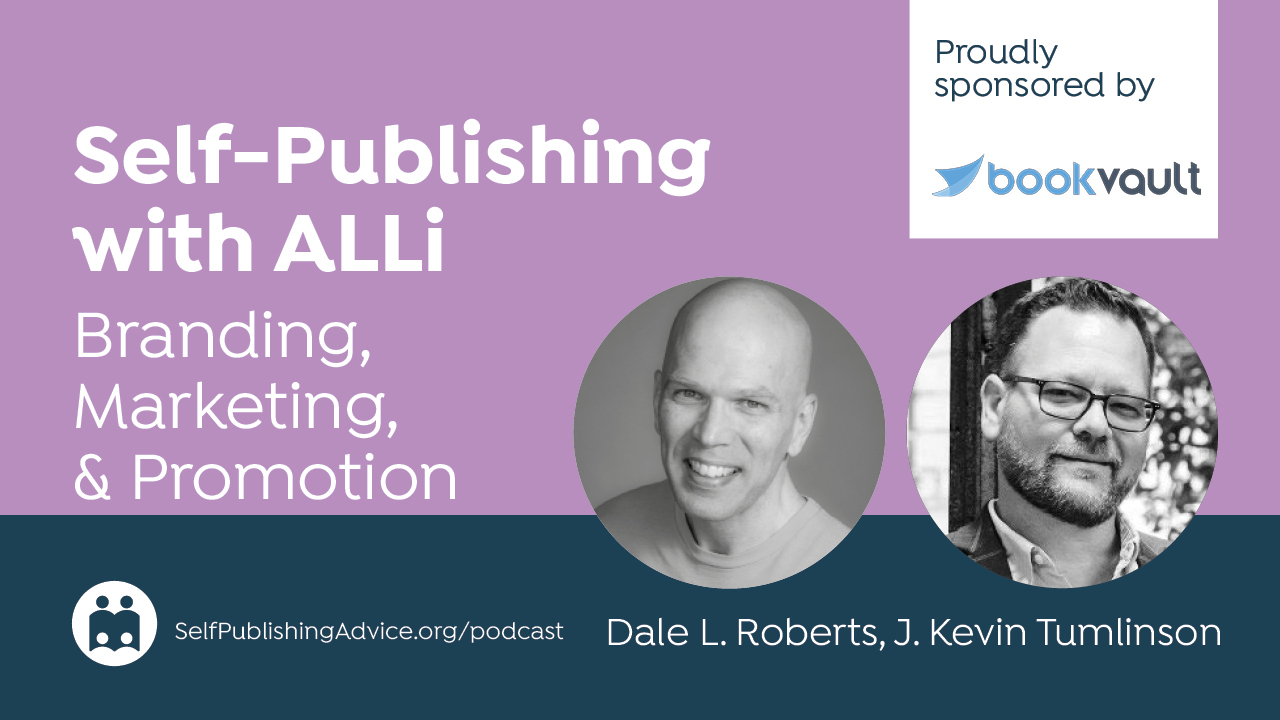
In this episode of the Self-Publishing with ALLi podcast, Dale L. Roberts talks with J. Kevin Tumlinson about building a personal author brand that attracts loyal readers. They explain why branding is about human connection rather than logos, how your mindset can shape your writing career, and how to create a brand that grows with you. The conversation includes practical tips on finding your voice, taking smart risks, and building long-term relationships with your audience.
Listen to the Podcast: How Indie Authors Build Loyal Readers
Sponsor
 This podcast is proudly sponsored by Bookvault. Sell high-quality, print-on-demand books directly to readers worldwide and earn maximum royalties selling directly. Automate fulfillment and create stunning special editions with BookvaultBespoke. Visit Bookvault.app today for an instant quote.
Thoughts or further questions on this post or any self-publishing issue?
If you’re an ALLi member, head over to the SelfPubConnect forum for support from our experienced community of indie authors, advisors, and team. Simply create an account (if you haven’t already) to request to join the forum and get going.
Non-members looking for more information can search our extensive archive of blog posts and podcast episodes packed with tips and advice at ALLi's Self-Publishing Advice Center.
And if you haven’t already, we invite you to join our organization and become a self-publishing ally.
Now, go write and publish!
About the Host
Dale L. Roberts is a self-publishing advocate, award-winning author, and video content creator. Dale’s inherent passion for life fuels his self-publishing advocacy both in print and online. After publishing over 50 titles and becoming an international bestselling author on Amazon, Dale started his YouTube channel, Self-Publishing with Dale. Selected by Feedspot and LA Weekly as one of the best sources in self-publishing of 2022, Dale cemented his position as the indie-author community's go-to authority. You can find Dale on his website or YouTube.
About the Guest
J. Kevin Tumlinson is an award-winning, bestselling thriller author and seasoned podcaster known as the Voice of Indie Publishing. With a background in film, TV, and radio, he’s helped thousands of authors build self-publishing careers while traveling the world with his wife, Kara. His debut novel, The Coelho Medallion, won a 2016 Shelf Notable Indie award, and his passion for history, archaeology, and science fuels both his fiction and his public speaking. Kevin is also the former host of the Wordslinger Podcast and co-host of Writers, Ink, regularly working from coffee shops and hotel lobbies across the globe.
Read the Transcripts
Dale L. Roberts: Struggling to get your author brand to actually sell books? You're not alone, but today's guest knows exactly how to fix that. J. Kevin Tumlinson is a longtime friend and one of the sharpest minds in indie publishing. He is a prolific author, the former director of marketing at Draft2Digital, and now he's the head of Author Anchor through Book Brush where he helps authors build powerful lasting brands that convert.
Kevin's been in the trenches as both a writer and a strategist, and today he's breaking down what successful author branding really looks like in 2025 and how to make it work for you. Welcoming to the show J. Kevin Tomlinson. How you doing, buddy?
Kevin Tumlinson: I'm good, man. I sound so much better when you introduce me than when I introduce me.
Dale L. Roberts: We're actually going to be at Author Nation together; I can be your hype man before you hit the stage.
The Essence of Successful Author Branding
Dale L. Roberts: Let's go ahead, let's get ourselves focused and talk a little bit more specifically about branding, marketing, and promotion.
Let's just start here, what do most authors get wrong about branding when they first start out?
Kevin Tumlinson: I think one of the things that happens is authors tend to think of their brand as, I don't know, it's all about the marketing and not about the relationships.
I think that successful branding, successful marketing, successful anything in this business or any other business, is really putting the thought into how does my relationship work with my key audience, my target market, or my target reader; what does that look like? How do I maintain it? How do I do it in such a way that they feel like they know me. That's the thing, you want them to feel personally invested in you.
That's what a strong brand looks like.
You see this, by the way, with all the major brands out there. If you look at Nike or McDonald's or Apple, we know that these are mega corporations, but we still feel a personal connection to them because of the way they've orchestrated their brands.
So, that's what you want to aim for as an author.
Dale L. Roberts: What was that like for you when you first started? Did it click for you instantaneously, because if I can recall, you have a marketing background prior to your work as an author, right?
Kevin Tumlinson: Yeah, which was a cheat code, I’ll be honest. I did come in already knowing how to structure this.
With me coming in, I had a pretty strong sense of self, we'll say. I knew who I was, and I knew who I wanted to be when I represented myself to the reader and to the world. So, that's how I attacked it right from the start.
I didn't have to spend time figuring out my own brand. I think that everyone can do that. I think that if you are coming in as a fresh new author, you've spent this energy writing the book.
You get a lot of advice. Part of your advice is to imagine that ideal reader, and imagine the outcome you're looking for. That's perfectly valid advice and you should do that. I think though that the companion to that is, who is it that you see yourself as when it comes to that relationship? What does it look like for you to be the kind of author you want to be?
There's this concept of fake it till you make it, you've heard a lot. I think a lot of people get it wrong philosophically, but the gist of it is true for everybody. You should go in behaving as if you've already accomplished the thing that you're trying to accomplish.
Maybe you don't have the cash to throw around the way you might want to, but you can certainly adopt the swagger of it. Don't get arrogant about it, but you can come into this internally representing yourself as someone who needs to be respected in this role, and you need to reinforce that to yourself, but everything you create for the promotion of you and your work needs to reflect that.
My brand is bluesy and if you listen to the Word Slinger podcast, the opening of that is like this slap guitar thing, and anytime I do ads for my books or whatever I get a blues riff. That's part of my brand and I embrace that kind of, I don't know, bourbon and cigars, even though I don't really smoke cigars anymore, but that sort of energy is what I'm going for when I'm presenting myself.
I want you to see me as somebody who's on top of his game and comfortable, and has that sort of energy. So, that's something I consciously do in all my branding. It affects my logo. I have a logo for my work which reflects that. It reflects the color schemes I use. It reflects the fonts I choose for my covers, for my website, all of that.
My wife actually, she's gone into doing interior design work as part of her business. She does this thing that I really appreciate, and I think it would benefit authors, is she creates what she calls a mood board and it's the color scheme of, she'll do it for a room, but she's also done it for me as almost a brand exercise for me in decorating my office.
So, there's the colors, but not just the colors. There'll also be a style of furniture. One of the things I carry with me at all times is my bright red Swiss army knife, so that factors in. Little touches like that, and she's a genius at this.
So, I think that's the kind of thing that could benefit authors is to have a mood board like that to help you determine what your brand looks like, and then that's how you represent yourself when you go out to your readers and elsewhere.
Adapting and Evolving Your Author Brand
Dale L. Roberts: Now, is that something that you're married to for the rest of your life? Or can you change that? Can you pivot? Can you adjust on the fly?
Kevin Tumlinson: Yes, you can adjust on the fly; you should adjust on the fly.
For those of us who are kids of the eighties, think about McDonald's in the eighties versus McDonald's now.
In the eighties, if you went to a McDonald's restaurant, there was this big nightmarish playground area with giant monsters with hamburgers for heads and things like that. Bright primary colors, that sort of thing. If you go into McDonald's now, it's a completely different environment. They've gotten rid of the playground environment; they've got brushed metal and clear glass windows. The restaurant's a square rather than a sort of hut shape. The only thing the same is the logo, and even the logo has changed slightly since the eighties.
Dale L. Roberts: It's just knowing that major brand has shifted over time to where they're at now, whether good, bad, or indifferent, it's been changed.
Kevin Tumlinson: There's two factors that determine when your brand should change. One is you and the other is your target audience or your target market. You will evolve as an author. As you get more into this, learn more, develop more, you'll start to recognize that your tastes have changed. The perspective you have changes. Maybe you mature or maybe you learn how to lighten up.
But as you evolve, your brand should evolve to reflect that. So, keep that in mind.
Then the second of those is the tastes of the audience. Your readers also grow, and you couldn't write the same books today that were written 10 years ago and expect them to do well, you understand that instinctively. Even though you may still be in the same genre, what you are crafting and the way in which you craft it and relate it to that audience will change, and if it doesn't, what ends up happening is you become that author they used to know.
If you're not current, if you're not growing with them, then you're no longer relevant. You start to lose relevance; you'll age out basically. There are authors I loved back in the nineties. In the early part of my writing career were authors that, if they put out a book, if their name appeared in a phone book, I was going to buy that phone book and read the whole thing. Now, those same authors, I love and respect them, but they didn't grow with me. They're still the same kid on the playground that I used to hang out with, and we didn't grow together, and so we're no longer together. Maybe they'll release something that I'm interested in every now and then, but for the most part, they lost me as a mega fan because they didn't grow with me.
You do need to keep that in mind; that's an important part of branding.
The Role of Instinct and Trends in Author Branding
Dale L. Roberts: Is that something that you just go through gut instinct on, or are there ever signs that I know I need to pivot
Kevin Tumlinson: People are going to hate my answers no matter what I say on that. I am a gut instinct guy, because I'm a pantser by nature, but I think that you can't be a pantser or go by gut instinct if you don't also have some innate understanding of how humans work.
As authors, the business that we're in is the study of human beings and the study of how humans think and work and operate. So, there is a lot you can do to keep up with trends in a way, keep up with the evolution of culture.
There's no shame in paying attention to what other people are doing. You don't have to imitate them per se, but you can pay attention. What's the hot thing right now?
You don't want to try to try follow trends, you don't want to always be chasing trends.
Dale L. Roberts: That's a treadmill that you never get off of.
Kevin Tumlinson: You'll never get off of it and you'll never succeed at it, because you'll always be lagging slightly behind, but one of the wonderful things about humanity is we operate in waves of patterns. If you are paying attention and allowing yourself to be a part of the zeitgeist of whatever moment you're in, you'll start to have, I think of it as synchronicities, you'll start to pick up on things. You'll start to recognize patterns. The great thing about being a human is we are pattern machines. We look for patterns. We understand patterns instinctively. You can nurture that as a skill. You don't have to try to guess ahead. All you have to do is start letting your imagination run on.
We're talking about the creative writing part now, but this can apply to branding as well. You can let your imagination run and the thing that sparks excitement in you is the thing you should focus on. 9 times out of 10, there will be others who are also excited about that idea because you're picking up on a pattern and expressing it as the zeitgeist of the moment and the culture.
In terms of branding, this happens all the time. It's funny, the bigger a brand gets, the less likely it's going to evolve quickly. It'll glom onto certain trends, and you actually tend to see, as a brand grows and ages, it becomes more conservative over time.
That's not a political statement; I mean that they are less willing to take risks.
Dale L. Roberts: Very homogenized. There's less risks, there's more, okay, I want to please more people.
Kevin Tumlinson: Look at Apple in the early 2000s. Everything they did, there was a lot of bright color. The computers themselves were a sort of gelatin color, blue, green, red.
They also were doing a lot of ads with the silhouette thing. They would license really expensive music for their ad spots. They didn't go the traditional route of hiring a bunch of celebrities to stand around with their product, they embraced the youth scene, they embraced the current version of our culture at that time. That was highly experimental. You just don't see that now. Apple's ad campaigns now are very drab.
It's usually Tim Cook or somebody standing on the stage, that's the most advertisement from Apple anymore, or it's a very subdued, subtle kind of thing.
That's because they grew to a point where they don't need the name recognition anymore and there's a greater risk, in their minds, to take the chance and do something outstanding and flamboyant than there is to just do the same old thing.
You're not going to see another 1984 ad from Apple ever again. You know what I'm talking about with that? The ad where they were mimicking 1984. You'll never see that kind of ad from Apple ever again. You will probably see it from others.
Ironically, people ape that same ad as if it's creative to take that and repurpose it ironically or otherwise.
Kevin Tumlinson: What you do see from smaller brands, especially emerging brands, is they're the ones that are usually the most willing to take risks, and those who are most willing to take a risk are going to reap the most rewards.
You might also take a few black eyes and hits here and there if you aren't cautious or whatever, but, caution, who needs it? Go out and do the creative inventive thing. If you think it's going to work, try it.
Try it low key and small scale at first, if you need to, but going out and being intentional about being loud and proud about your brand and what you're trying to tell, because frankly, you owe it to the readers to let them know that this book exists.
It's a service you're paying to them and to the universe to let them know, here is something you're going to love. Books change lives, and they change our culture, and they change everything. So, if you're not out there, giving it a 110% and trying to stir the waters as rapidly as possible, if you're not being a gator in those waters, then you're going to get left behind.
For small brands, that's my recommendation; take the risk, take the chance.
Use tact, use common sense. Don't go off and try to offend people.
People do that, and you and I are both in the YouTube space and the podcast space, and the people who are willing to go off and be trolls, they see rapid growth, but then they also see a pretty long-term plateau.
What's the next big shock thing you're going to do? Basically, if you use up all your ideas and you've shocked everyone as much as possible, people expect it from you. Nobody goes to an M. Night Shyamalan movie without thinking that there's going to be a twist ending anymore.
Dale L. Roberts: That is part of his brand.
Kevin Tumlinson: That's part of his brand, and it's okay that's part of his brand, but he lost the edge of surprise by leaning into that so heavily. Instead of trying to do something creative and new with each IP, he tried to do the same thing. He learned a card trick, he did some closeup magic, and he broke the magician's first rule, which is never repeat a trick.
Dale L. Roberts: I'm wondering, as we're just hashing this out, coming back to some of the authors, let's say they are starting things out. What about the authors out there that really don't know what they want to be when they grow up, or they're not confident about putting together a brand, what kind of recommendations would you give to them so that way they could be able to take a step in the right direction?
Kevin Tumlinson: I think when you don't know what you want your brand to be, first look at the things that excite you most. Look at the other brands, other authors, and even outside of this space, look at the television shows you like. What's the music you like? What are the things that you feel are, in some ways, intrinsically are part of your story?
Then take elements of that and start hodgepodging it together to mold some clay into the image that's as close to you as you can think of. Or not just you, but the you that you ultimately want to be. Effectively, what I'm saying is, use the mirror of culture and the stuff that you find interesting and exciting to help you shape an initial brand.
If there's somebody out there that's just crushing it the way you want to crush it, don't try to imitate them, but take inspiration from them.
If you were a YouTuber and you were looking at Mr. Beast, you're never going to be able to keep up and compete with the way he's doing things now, but look back at his roots. How did he get started? What were the patterns he was working in?
Do the same thing with, if there's a show on Netflix that you like, if there's music that you like to listen to, what is it about that? Try to examine it.
Don't overthink it, but try to look at it and ask, what about this resonates with me? What about this is me? Because the reader is looking for a book that feels like them, that's what they're doing. So, you want to be able to convey to them in the language of images, and color, and copy for your book description, the ads you run; you want to convey to them, this is the experience you're going to have in the book, and this is the piece of it that's like you.
That's what you're trying to convey to that reader to attract them to read this book that they'll fall in love with.
Dale L. Roberts: I'm wondering, off the top of your head, and I know this puts you on the spot, are there maybe three authors that you've seen that just absolutely nail their branding?
Kevin Tumlinson: There's me.
Dale L. Roberts: Yes, of course. J. Kevin Tumlinson, everybody's got to go check that out.
No argument, that's no joke, you actually locked in on that.
Kevin Tumlinson: I appreciate that. I'll say, and I'm a bit biased here because JD and I are co-authors, but JD Barker knows his audience and knows his brand.
For that matter, so does James Patterson. Whether you like his writing or not, I'll confess, I'm not the world's biggest fan of James Patterson's writing per se. I've read hundreds of his books by now, he's not on my list of top authors, but what I can say about him is he is an absolute genius when it comes to branding and marketing.
Dan Brown, his branding is so good that the dude hasn't written a book in seven years, and the minute that he announces that a new one's coming out in another year, it sells millions of dollars in copies. How do you get that kind of branding? That's what I'm looking for.
If you look at those examples separately, they're all in the same general category of thrillers, but look at them specifically, and they're completely different in the actual sub-genre they're writing, the audience that they're talking to, the way in which they promote, completely different.
But they have, with the exception of JD, who has, I would say, a more moderate name recognition, but I think he's going to grow, I think he's already on a growth path, you could say James Patterson or Dan Brown in any circle amongst any of your friends, whether they are readers or not, there's a better than likely chance they're going to know who you're talking about.
That's the kind of branding we should all be aiming for. I want you to know my name.
That by the way brings up another point, and I may have to dance around this a little because I haven't put a ton of thought into this yet. But there's always the question of what should I market more? Should I market the book, or should I market myself?
The answer in some respects would be both. You're going to hear, you want to market the actual book, of course you do. But I think a lot of authors, one of the mistakes they make is they don't market themselves at all and if they do, it's not enough.
Why Author Branding is All About Building a Personal Connection with Your Readers
Kevin Tumlinson: Here's the beauty of the author-reader relationship. you do at some point form a kind of bond between you and that reader. I have been very blessed in that my readers have been amazing, and they reach out to me, and they always have.
Now that I'm on forums like Substack or whatever, where it's even easier for them to reach me, I hear from them all the time. That's a huge blessing to an author to have that kind of feedback, and relationship.
They have always felt like they knew me because of the writing, and they read the stories, but when I get reviews on Amazon, do you want to know what the number one thing that's brought up always in almost every review?
They almost never comment on the story of the novel itself. They're almost always responding to, in every book I write, I put this author's note at the end called ‘a note at the end'. I do the same thing on Substack and in my newsletter and everything. When I get responses from people, 90% of the time, maybe 99% of the time, that's what they were actually responding to.
Dale L. Roberts: It's the note at the end.
Can I steal that? That's an amazing idea.
Kevin Tumlinson: I welcome theft of that. I stole it. I forget the author who did it first. She called it something with a little more adult language. Originally, I called it ‘stuff at the end of the book', and then my brand evolved, and I grew that up a little and I called it ‘a note at the end'.
But this is the real beauty of this concept, of an author's note at the end, and I make mine very personal. It's like a blog post really at the end of the book, and not everyone does it this way, most people don't.
Most of the time when an author does an end note of some kind it's, I did this research at the Harvard Library.
Dale L. Roberts: It's very dry.
Kevin Tumlinson: Like they're trying to give a behind the scenes of the process of developing the novel, and I think there are readers who love that. I for one, like reading that, but I actually want to know the person behind the story I just loved enough to read from end to end, because by the time they get to the note at the end, they have read the novel.
It's not like somebody's skipping ahead to read that.
So, here's the message. They not only love the book so much so that they read it word to word, end to end, beginning to end. They were so enthralled that they kept reading the stuff that wasn't part of the story, and then they responded to that.
Talk about qualifying a lead, in marketing terms, like now I've got them on the hook, right?
And at that same point in the book, I'm asking them to join my mailing list. I'm asking them to go to Substack and subscribe and get a free eBook, and I'm asking them to go find other books and to leave a review, because that's the moment. I've gotten their attention. I've gotten them hooked already. If they didn't give a crap, they wouldn't have finished the book.
So, that's the moment to form your relationship with the reader.
In terms of branding, just to swing this back around, that note at the end, that's become part of my brand. People know to expect that from me, and I've done it in everything. I've even done it on social media posts. I'll have a social media post, and I'll have a note at the end sometimes.
I use that nomenclature a lot because it's part of my brand. So, you should look for things like that, that are indicative of that relationship that you either have or want to have with the reader.
What you're trying to give them is a touch point, something recognizable that they will always associate with you, and once you've done that, you could drop that anywhere and then they're going to respond to it.
I use a note at the end as it's really funny because I don't need to do it in my Substack posts. Why would I need a note at the end of a blog post or whatever?
Sometimes, it's completely non sequitur. Sometimes it has nothing to do with that post. Sometimes it's just a continuation of that post.
But when people comment, they always comment on that part.
I could spend that whole post asking questions, but the one question I ask in the note at the end is the one they answer, and maybe that's because it's the last one they saw, but I don't think so. I think what's happening is they're relating to that. It's like I set aside a special note just for them, and that's part of my brand, is that when you come to me as a reader we have a relationship, I’m looking out for you, I’m offering you the most authentic part of myself and there's no filter; you're just getting pure Kevin Tomlinson, and if you can handle that, if you like that, if you love that, then we're going to get along just great.
That's my brand.
Dale L. Roberts: Speaking of your brand, our time is starting to wrap up here together. How can listeners get hold of you?
Kevin Tumlinson: You can find me personally at kevintumlinson.com and if you go there, there's always a link that sends you to the Substack. I like people to join me on Substack at kevintumlinson.substack.com. Then everything else I do; you're going to find links everywhere.
Dale L. Roberts: By the way, I can wholeheartedly endorse your Substack. You put out like two to three per week? Is it more than that?
Kevin Tumlinson: A couple a week, because I host the Word Slinger podcast on Substack now. So, there'll be an episode of that, and then my weekly newsletter on Fridays. Then occasionally I do a little extra something here and there.
At first, I thought I was going to lose people, but what I discovered wonderfully was I did lose people then I started gaining a lot more people. I've watched the little graph, I started up way up here and then it dropped, and then three months later it was above where it started.
So, there were people who didn't like getting an email every week or twice a week or whatever.
Dale L. Roberts: You finally found the tribe though, it sounds?
Kevin Tumlinson: Right, and isn't that the point? Your branding actually should be that screen that helps you sift away the parts of the reader audience that are not yours, they're not there for you.
It's that adage, if everyone's your customer, no one's your customer. So, the whole point of branding is to, and I think big brands miss this all the time. The whole point of branding and marketing is to funnel people down to where there's a perfect match between you and the group that you serve.
That's what you're trying to do. That's your end game.