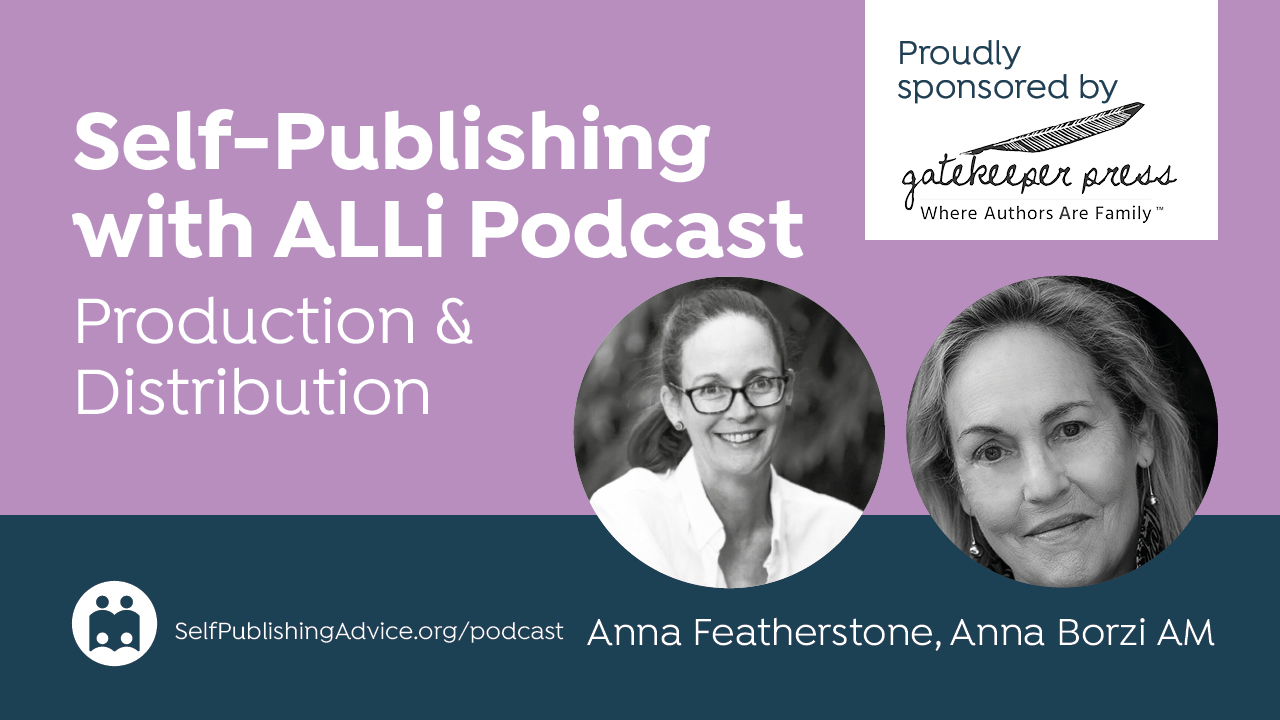
ALLi nonfiction adviser Anna Featherstone speaks with Anna Borzi AM, chair of the First Nations Writers Festival and its publishing imprint, First Nations Publishers. They discuss how the volunteer-led charity has grown from a literary festival into a global publishing and distribution platform for Pacific writers, often where no other option exists. The conversation covers publishing in an authentic voice, professional production on a lean model, print-on-demand and direct sales, and a strategic move away from costly festivals toward sustainable social media marketing.
Listen to the Podcast: Using Indie Platforms to Publish First Nations’ Stories
Sponsor
This podcast is proudly sponsored by Gatekeeper Press — your partner in premium independent publishing. Empowering authors with expert guidance, 100% rights, 100% royalties, and global distribution. From editing to marketing, their all-inclusive services help you publish professionally and confidently. Gatekeeper Press — Where Authors Are Family.
About the Host
Anna Featherstone is ALLi’s nonfiction adviser and an author advocate and mentor. A judge of The Australian Business Book Awards and Australian Society of Travel Writers awards, she’s also the founder of Bold Authors and presents author marketing and self-publishing workshops for organizations, including Byron Writers Festival. Anna has authored books including how-to and memoirs and her book Look-It’s Your Book! about writing, publishing, marketing, and leveraging nonfiction is on the Australian Society of Authors recommended reading list. When she’s not being bookish, Anna’s into bees, beings, and the big issues of our time.
About the Guest
Anna Borzi AM is director and chair of First Nations Publishers. She is a former international investment banker, entrepreneur, and award-winning author who has advised ultra-high-net-worth individuals, major fund managers, global financial leaders, governments, and industry bodies. Over the course of her career, she broke numerous glass ceilings in the financial services sector. Borzi has worked internationally and has longstanding ties to First Nations cultures. She was raised in Papua New Guinea, from village settings to the capital city, and has family connections to the PNG Highlands and Southern Region. Her great-grandfather was Aboriginal. She was awarded a Member of the Order of Australia in 2005 for her contribution to financial services.
Thoughts or further questions on this post or any self-publishing issue?
If you’re an ALLi member, head over to the SelfPubConnect forum for support from our experienced community of indie authors, advisors, and team. Simply create an account (if you haven’t already) to request to join the forum and get going.
Non-members looking for more information can search our extensive archive of blog posts and podcast episodes packed with tips and advice at ALLi's Self-Publishing Advice Center.
And if you haven’t already, we invite you to join our organization and become a self-publishing ally.
Read the Transcript
Anna Featherstone: Welcome, and thanks for tuning in from your special part of this beautiful planet. I'm Anna Featherstone, joining you today from the Lands of the Gadigal people, the original storytellers of this land, in Sydney, Australia. Today's conversation explores what publishing can look like when it is led by purpose and deep respect for voice.
I'm joined by Anna Borzi, who is the Chair and Director of First Nations Publishers. Anna brings an extraordinary breadth of experience to this work — from international investment banking and advising governments and global institutions, to growing up in Papua New Guinea and living alongside First Nations communities around the world. Over the past four years, she has become an indie publisher, helping First Nations writers from across the Pacific share their stories. Welcome, Anna.
Anna Borzi: Hello. I am so excited to be here.
Anna Featherstone: This is going to be a bit confusing because we've got two Annas in the room.
Anna Borzi: They're special.
From Finance to First Nations Publishing
Anna Featherstone: You've had a career in global finance and all sorts of interesting things. What drew you into First Nations storytelling and publishing?
Anna Borzi: I'll just list them very quickly. I grew up in Papua New Guinea — some people call it abandoned, but I like to say I left home at six months old. Almost all of my growing-up years were in Papua New Guinea, and I experienced it from village life to the towns. I had an enormous relationship with the cultural diversity of Papua New Guinea, which has 860 different languages. I never had a television — I've always read books, always.
And I got to a stage in my life where I thought: what am I going to do now? The Stella Women's Awards in Australia were having their tenth anniversary, and I always bought all their books each year, the shortlist and so forth. And I thought: I wonder about Pacific writers. And I found — this is just summarising — basically no books. And I thought: well, we'll just have to publish them. So I reached out around the Pacific to have authors send in their manuscripts, and that's how it started. This is our fourth year.
Anna Featherstone: I love how reading books just leads us on different journeys and opens our eyes to all sorts of things. Deciding to go and look for underrepresented writers to help them is just brilliant. So how do you think about voice and ownership and representation?
Anna Borzi: The most important thing is that we started, and we remain committed. We decided we wanted everything in their own voice — that's a term we use all the time. As they write it, it's not standard English literature; it's specific literature in English. Everything had to be in their own voice. We also wanted to raise their physical profiles. That fed into how we started — first as a festival, and then as a publisher. And I should say: it's not just me.
Starting as a Festival, Becoming a Publisher
Anna Featherstone: So you originally started by running a writers' festival. What did that look like, and how did people apply or get invited?
Anna Borzi: We reached out to people whose books the judges approved — judges who look for culture and other issues contained in the books, and who are very alert to the work not being whitewashed. In other words, still in the author's own voice, as we keep saying. So we reached out to authors from the Pacific and also invited manuscript submissions. In the first year we had our inaugural short story, and we brought in friends who were indigenous to Australia to participate in that first festival.
Anna Featherstone: And out of some of the books that came through the festival process and that you're publishing now — tell us about one or two that have stood out.
Anna Borzi: I'm not allowed to say anyone stood out more than the others — but the first one was incredible. It was from the Solomon Islands, and I sent a copy to Ambassador Caroline Kennedy. She had just been at the Solomon Islands and she wrote back with a two-page, warm response about her experience reading it. It was about the Solomon Islanders who saved her father, and she mentioned that she and her grandson had just swum the same area where her father was rescued during the Second World War. For me, that was an absolute standout.
And then in the second year we had a prominent judge from Papua New Guinea write the memoir of his grandfather, which tracked a hundred years from an obscure mountain village — no contact with the outside world — to this grandfather's remarkable life, including his relationship with Queen Elizabeth II. He holds every award she could grant, right up to the highest. And the author sent us photos which we included in the book. The story of a man born in a little cave in a mountain who ends up with that kind of connection to the world — it's amazing.
Another author who is close to bestseller status is Annie, whose second book I'm currently editing. I'm just amazed at her ability to share the deepest, most important things happening in Papua New Guinea, in her own voice. You have to read it carefully — but you have to read it. Each one has struck chords with me, partly because of my own memories from growing up in Papua New Guinea.
And the most recent one is a young gentleman from the mountains region of the Philippines — the Igorots, as he calls them — who wrote a fantasy novel to share with the world the history and legends of his people. People call them myths, but to his community they're fact. It's an amazing story. We've just published it, and we're about to go up there — all the local officials are coming out to celebrate the publication.
The Publishing and Distribution Process
Anna Featherstone: How do you get from manuscript to published book? Take us through that journey.
Anna Borzi: Until now we've had everything happen in one very intense month. We've done that for four years. We now accept manuscripts all year round, and the manuscript goes untouched to the judges. They make a financial award to the author — up to $5,000 Australian dollars — giving quick financial recognition for their work. Then I do what I call copy editing, without claiming to do it in the purest professional sense. Some manuscripts are difficult reads, some are excellent English. I do what I can.
Then we have a fabulous team — Busy Bird Publishing, who came on board almost immediately. They were recommended to us by IngramSpark. They do typesetting and that kind of thing. We register everything with our ISBN, and everything comes back to us, but they handle the technical side. Then we distribute globally through IngramSpark.
Anna Featherstone: So are you doing print books and ebooks?
Anna Borzi: No ebooks. We only do print, distributed globally through IngramSpark. And our market share is predominantly UK and US.
Anna Featherstone: And what marketing do you do to help people discover the books?
Anna Borzi: We're on all the socials, and I've found that works for us. I'm constantly exploring new ways to get not only the brand but the books out there. One thing that's coming with IngramSpark — not set up yet in Australia — is a direct commercial link so we can sell from our own website. At the moment we link to Amazon, which has worked reasonably well. Sales are up every year. But we want to sell direct because that improves royalties, and we take almost no royalties compared to commercial publishers. We're happy if a commercial publisher comes along and picks up one of our authors, by the way — we'd be thrilled.
Royalties, Contracts, and the Charity Model
Anna Featherstone: After the initial prize, do you do ongoing royalties for book sales?
Anna Borzi: Yes, absolutely. We keep a very modest percentage of the royalties — we contract the authors and we tell them to seek legal advice before signing. My concern, coming from an investment banking background, was that some of these books should be films, and I wanted to make sure the authors were protected from anyone who might come along and not pay them appropriately. They're not familiar with this industry in most of the places we publish from, so having our foot on a small component of the royalties means we can help protect them.
Anna Featherstone: So First Nations Publishers operates as a charity?
Anna Borzi: A hundred percent charity. Everyone is a volunteer except for people like our typesetters, and even their fees are very low. Yes, there's compliance work — we report to the government, everything is audited by a third-party accountant, and we report to the relevant government entity. I think that brings a platform of honesty and transparency. I'm not suggesting anyone else is dishonest, but these authors have had a rather difficult history with certain institutions over the past couple of hundred years. So going in and saying: here's our contract, this is how we operate, here's our audit — that matters. And compliance isn't actually that hard. Just do the right thing and tell the truth.
Output, Errors, and Print on Demand
Anna Featherstone: About how many books are you planning on publishing this year?
Anna Borzi: We've already got three manuscripts for three books — two leftover from the May 2025 festival that we're finalising now. And we've already got manuscripts coming in for this year, so it could be up to five. There's a huge amount of work to get it right on every single page.
Anna Featherstone: That's a good thing about print on demand through IngramSpark — if you find major errors, you can go in and update the files. Have you had to do that?
Anna Borzi: We've had to do it a couple of times. On one occasion we uploaded the wrong interior file for a book — a crime novel called Jewel, which I love — and it went public. Someone wrote a scathing review on Amazon, which we can't remove. It would've been nicer if he'd just written to us to say there was a problem, but there we go. It's an absolutely brilliant book, set in Papua New Guinea, action-packed, highly descriptive — you don't know what's going to happen next. We got the correct interior, uploaded it, and it's sold well since.
Marketing and Discovery
Anna Featherstone: How does a book begin to sell well? Are you spending a lot of time on descriptions and back-cover blurbs? How are people discovering the books?
Anna Borzi: Australian universities are a natural fit for us, and I've spoken to several here. But we haven't been picked up at all, despite offering discounts — which is a pity, because our purpose is to take these stories global so people can know about the peoples of the Greater Pacific.
So we pay for advertising on social platforms — through the charity, I should say. And most of the funds come from me personally, but that's what I want to do. We're going to take a different path once we get the commercial links available through IngramSpark Australia.
Recently, for our last festival, I paid for Google advertising on one of our short films. I thought: I'm going to do this properly. I sent it out there and our sales exploded — well, for us. I'm not talking hundreds, but they were very good for our scale, and it took people to our website. I take on board the advice from the ALLi podcasts, which have been very helpful. It's about gaining confidence, taking ideas, and running with them.
Anna Featherstone: I think that's a really good point for any listener. We're all at different levels and stages. It's just listening a little, trying things, getting some things wrong, and keeping growing.
Anna Borzi: Yes. And we are grateful that organisations like ALLi are out there and willing to share the knowledge, so that other people can read magnificent books.
Anna Featherstone: What is so wonderful about ALLi and the whole indie author community is this willingness to share and lift people up, because we all recognise the power of stories that aren't getting published by traditional media.
The books you're publishing — they're not to UK literary standards, because that's the whole point. They're not meant to be. They're about real people in their real words, authentic and different.
Anna Borzi: There's nothing else like them in the world. Everything else is so homogenised. Our interest is getting these stories out in their own voice — they just want their stories told.
Translation, Language, and the Future of Pacific Literature
Anna Featherstone: With all the translation tools available now, are you thinking of translating any of the books back into native language?
Anna Borzi: It's a very good idea. But just to give you a sense of the scale: Papua New Guinea has 860 languages. Australia has around 300. And then every island in the Pacific might have two or three languages. The thought of doing that is quite difficult, and I simply don't have the resources or the time at this stage. We have to work within our resource constraints, and that's fine.
Anna Featherstone: What are the lengths of the books you're publishing?
Anna Borzi: Our criteria are on the website — up to about 65,000 words for a full book. For our First Nations anthologies, which we produce every year from short story submissions, it may be less than that. For short stories, we don't take any rights over them — authors can publish them elsewhere. But we do take all royalties from anthology sales, and they receive an upfront modest award and free copies of the book to sell themselves. Sometimes when we go and visit authors in their towns and villages, you can see the reaction of the local community — the pride and joy at seeing one of their own have a book published and sold around the world. It's a raising up of an entire village.
The Chief Executive of Papua New Guinea's cultural commission wrote to me to say thank you for recording their stories. I wrote back and said: I'm not recording them at all — it's your people who are recording the stories. We are just a platform for taking those stories to the world.
Anna Featherstone: And it does feel like the work you're doing creates an early groundswell that encourages writing in those places — so over time you get even more rich stories coming out.
Anna Borzi: Yes. And much of the work that has come out of the Pacific before has been whitewashed or academic — nothing wrong with academic, but our interest is in getting the stories out in their own voice. I'm a research analyst, and when I look at how Indian literature took off, or how Asian literature has grown, or how indigenous Australian literature is now at boom level, or how African literature is exploding — I think Pacific literature will reach that same tipping point. We've already been invited by two international literary awards to submit books. If we get shortlisted, I'd be ecstatic. There is a rising group of readers around the world who won't think twice about buying a book from Papua New Guinea, India, Germany, or Aberdeen.
Walkabout Festivals: Taking the Celebration to the Authors
Anna Featherstone: Are you doing any talks and presentations where you can sell direct at conferences?
Anna Borzi: We hosted a festival every year, and while book sales at the events weren't great, we filmed them and put the footage online, which attracted a lot of attention and brand building. We're doing something different now — we call them Walkabout Festivals, a slang term used across pidgin-style countries. We're going to the Philippines in two weeks, we went to Papua New Guinea at the end of last week, and we're visiting various Melanesian countries so that authors can celebrate with their families and communities. We pay the airfares because we have a purpose: these books need to get out there. We also freight books up to the authors so they can sell copies locally and keep all those royalties on top of international distribution.
AI, Authenticity, and Lessons Learned
Anna Featherstone: With the rise of AI and people jumping on various bandwagons, how do you ensure the authenticity of the works you're putting through?
Anna Borzi: Everything is checked against an authenticity tool before we hand out awards and prizes. I'm also very strict about who has access to the core documentation. Everyone who submits must provide certified ID, and we check all their socials and any other online presence — they have to declare all of that when they submit. We do background checks, and they know we're doing it.
Anna Featherstone: Was there anything you over-invested in early in your publishing journey that you'd approach differently now?
Anna Borzi: On two occasions we spent a fair bit of money on public relations to get our books out there. The PR people were the most delightful, competent, high-delivering people — but we did not get one donation nor sell one book across those entire three-month campaigns. 51 million impressions from our media last year. Not one dollar. So that's a big one. I'd rather spend that money on Facebook advertising or Amazon ads, where we typically do generate several book sales per campaign. It doesn't cover the advertising costs, but it moves things forward.
We're going relatively quiet until IngramSpark gets its direct commercial link up in Australia — it's already running very successfully in the US and UK.
On Writing, Purpose, and Final Thoughts
Anna Featherstone: Are you thinking of writing any books yourself?
Anna Borzi: People tell me I should write my story. I wrote most of my career every day — a minimum of four typed pages distributed daily around the world, plus fifty to a hundred page strategic research reports each year for major banks and global institutions. So I've written a lot. Just not on the creative side. Maybe my memoir wouldn't be too creative — it would just be fact. But not on the storytelling side, not yet.
Anna Featherstone: Well, when you finish your manuscript, at least you'll know how to publish it. What would you like to say to the audience — either about publishing or about helping other authors?
Anna Borzi: I'm a great believer in the power of words. I would just encourage new authors and established authors alike to write more stories, because stories reflect who we are and who society is. Whole nations are built on stories. It is such an important thing to get those stories out into the community everywhere.
And don't just publish for the village next door. As I say to people in Fiji: we are not publishing for the village next door. We're publishing for someone in Arkansas, someone in a town in Germany, someone in Aberdeen. And somewhere in all those places, there is someone who wants to read your story. So just put the stories out there. A short story a week could make a book.
Anna Featherstone: That is so true. Well, Anna, we're going to put links to First Nations Publishers in the show notes. Thank you so much for sharing your experience and insight, and just for doing what you're doing — bringing these unheard stories to the world. They're not untold, because they're being told in their own countries. But they are unheard by so many in the west. And thank you for reminding us that publishing can be very ethical, professional, and genuinely look after authors when it's done with real intention.
Anna Borzi: Thank you. I am so honoured to speak with the people from ALLi, and I constantly listen to your podcast. Thank you so much.
Anna Featherstone: And to all of you out there listening, thank you for being part of our ALLi Podcast family. I'm Anna Featherstone, sending you the best writing and publishing vibes wherever you are. Catch you next time.