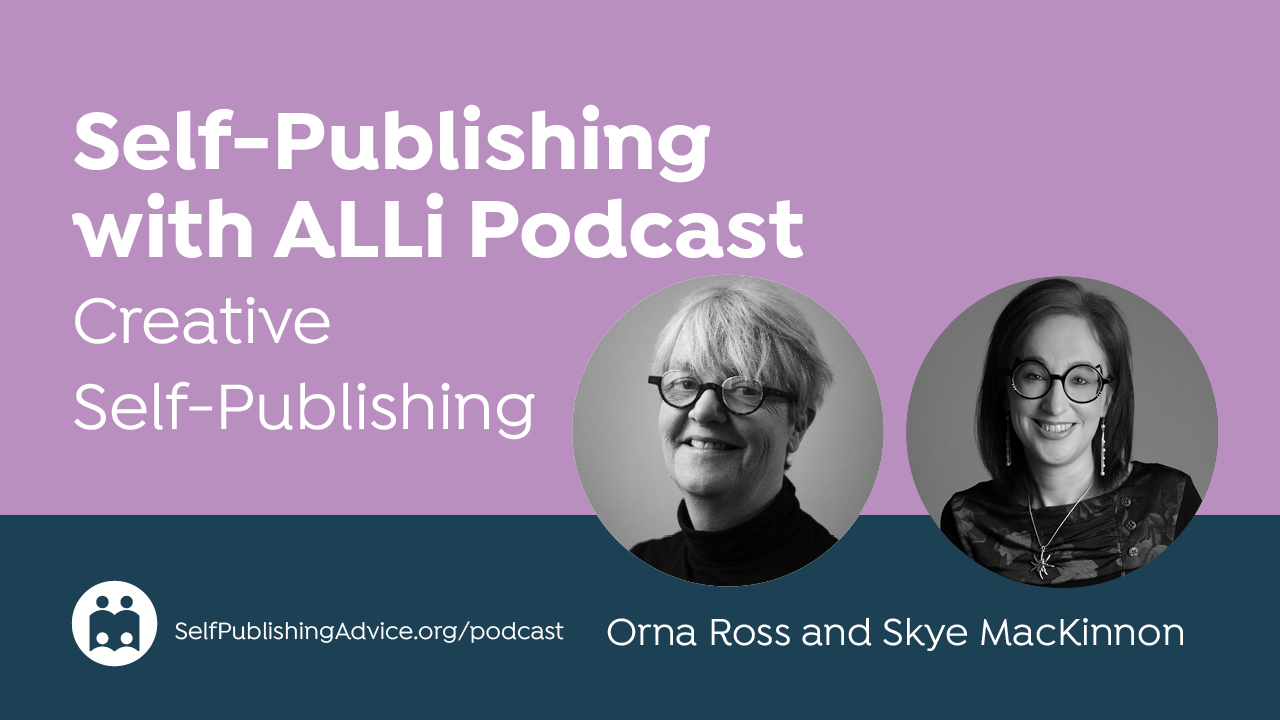
Germany is the third-largest book market in the world, and unlike the English-language market, it is not yet saturated. Skye MacKinnon has turned her second publishing language into her bestselling one across three pen names and more than seventy translated titles. In this conversation about the newly released second edition of her book, Self-Publishing in German, she tells indie authors how to decide which of their books to translate first, where AI earns its keep and where it quietly ruins things, and how on earth you market a book in a language you don't speak.
Listen to the Podcast: Self-Publishing a Book in German
Show Notes
Further Reading
How Authors Sell Publishing Rights
Sponsor
Our Creative Self-Publishing stream is brought to you by Orna Ross's Go Creative! program—helping authors harness the power of creative flow in writing and publishing.
About the Host
Orna Ross launched the Alliance of Independent Authors at the London Book Fair in 2012. Her work for ALLi has seen her named as one of The Bookseller’s “100 top people in publishing”. She also publishes poetry, fiction, and nonfiction and is greatly excited by the democratizing, empowering potential of author-publishing. For more information about Orna, visit her website.
About the Guest
Skye MacKinnon is a USA Today bestselling author, self-publishing educator, and translation expert who has published more than ninety books across multiple pen names and genres. A former journalist and science communicator, she is known throughout the indie author community for her work on wide publishing, foreign-language translations, and international book marketing. Through her books, coaching, and leadership in the Wide for the Win community, she helps authors expand their reach beyond the English-language market, drawing on her own experience publishing more than seventy translated titles in German.
Thoughts or further questions on this post or any self-publishing issue?
 If you’re an ALLi member, head over to the SelfPubConnect forum for support from our experienced community of indie authors, advisors, and our own ALLi team. Simply create an account (if you haven’t already) to request to join the forum and get going.
Non-members looking for more information can search our extensive archive of blog posts and podcast episodes packed with tips and advice at ALLi's Self-Publishing Advice Center.
Read the Transcript
Orna Ross: Hello and welcome to the Self-Publishing with ALLi podcast. I'm Orna Ross, and I'm here today with the wonderful Skye MacKinnon. Hi, Skye.
Skye MacKinnon: Hi. Thank you for having me.
Orna Ross: It's wonderful to have you. For those who don't yet know, you've just brought out a new edition of your Self-Publishing in German book.
Skye MacKinnon: Yes. It's been a bit of a whirlwind, because I did a Kickstarter campaign for this, so the launch has been drawn out much more than a normal book launch would be. But yeah, it's out now — my baby's out in the world.
Orna Ross: Wonderful. Talk to me a little about it, and about your own history with publishing in German. I know you're the kind of person who, as soon as you figure something out for yourself, you want to tell everybody else how to do it as well. When did you start? You were an early adopter of the translation thing, which is becoming more widespread for indies now.
Skye MacKinnon: Yes. I got the process started in 2019 and published my first German translations in 2020. Back then I was looking for resources on how to do this beyond just pressing publish on Amazon KDP — I wanted to know everything there was to know, and I just couldn't find the resources in English. I have the advantage that I speak German, but even so, that information wasn't out there. I come from a journalism background, so I'm very good at research and I love going in depth. I was thinking about how I could share this with other authors, because I was talking to co-authors and others at around the same stage of their careers, and we were all looking into translations. There's no point in everyone doing the research themselves and spending so much time on it. So I thought: I'll write a guide. It started as a series of blog posts and then turned into a book.
But I realized quickly that I couldn't just cover everything — there was so much, and it was all moving. The book was out of date a week after it was published because Tolino introduced print books, and that was never in there. I couldn't have an up-to-date guide, so I also created a Facebook group to go with it where I would share updated information. Then for quite a while I just focused on that and my own translations. By now I think I have about 70 translated books in German across different pen names. Then at some point people kept saying, ‘Is there going to be another edition?' And so at some point I agreed to do the second edition. It turned out to be a much bigger project than I thought. I thought I would just update a few chapters and add a few more about things like Tolino print books and AI translations. But I ended up rewriting the entire thing. It's now more than double the length of the original, goes way more into detail, and took me about five months instead of the one or two months I had scheduled. It's become quite a beast of a book.
Orna Ross: Good for you — though we have to find another word for very big than beast, because it's marvelous and it's very easy, in fact, to work through. I know how hard it is to make a book so comprehensive read so simply and clearly. Well done. It's a fantastic resource that anyone considering going into the German market should take a look at for sure.
Why Germany Is Different: Tolino, Print Culture, and Market Structure
Orna Ross: Germany is now the third-largest book market in the world — and has been for a long time. Yet you say it still has room for indies in a way that English-language markets don't anymore. What makes Germany structurally different?
Skye MacKinnon: A few things. Germans love to read and have always loved to read, and that hasn't changed. But while in a lot of English-speaking markets the focus has gone more and more to digital, print still plays a really big role in Germany. I was just there last month, went to some bookshops, and it's just amazing seeing how gorgeous the books are — not just special editions, but normal books have sprayed edges and foiling on the covers. It's a feast for the eyes. And that whole bookshop culture is still very much a thing: you go in and get a proper recommendation, someone shows you to exactly the right section, tells you about the book that's just come out. People there are still very knowledgeable about books, and it's not just the selling — it's the actual enjoyment of reading that is still shared in bookshops.
Then the market structure is very different. We're used to Amazon being the dominant player. All my books are wide and I'm a big fan of being wide — I'm part of Wide for the Win. But in Germany, even if you're completely pro-KU for your English books, it's really worth looking at the whole market, because it's very different. Amazon only has 40 to 45 percent of the e-book market there — less than half, which is a big structural difference.
That's because when Amazon was starting out and growing, the German bookstores saw the threat and banded together to create the Tolino ecosystem. They all share the same e-reader, the same electronics, the same system. So you can go into various bookstores in Germany on their websites and find that Tolino system. Readers with a Tolino e-reader can buy in different stores — they can even go to the website of their favorite local indie store and buy books there, supporting the indie bookstore but reading on the system they're used to. Because of that, Tolino has about 40 to 45 percent of the market as well — they equal Amazon because they all work together and pool their resources. I always say I wish they'd done that over here, because I would love to have that alternative that is just as powerful and therefore quite attractive to us as indie authors.
Orna Ross: Indeed.
Skye MacKinnon: So just because you do something a certain way in your English-language strategy doesn't mean you have to do exactly the same for your German books — or any language, really, because every market is different. Yes, you know a lot about how to publish a book, but just forget a lot of what you already know, because things like covers are different, the platforms are different, the retailers, the distributors, the pricing. Even yesterday I was showing someone that book spines are the other way around on German books — a small detail you wouldn't be aware of unless you'd been in a German bookstore. There are a lot of small differences, even though in general, publishing is publishing.
Distribution: IngramSpark, Tolino, and Getting into German Bookstores
Orna Ross: Could you address the distribution piece in particular — IngramSpark and Amazon and how the Anglo-centric approach differs?
Skye MacKinnon: Of course. It used to be that you could use IngramSpark, as a lot of us do, to get your German books into bookstores or at least onto bookstore websites. That changed because Germany has a fixed pricing law — very simply, your book has to be the same price at every store. IngramSpark kept going against that, randomly discounting books, and at some point German retailers had had enough and blocked books from IngramSpark from their stores. For a while that left a bit of a gap — there wasn't an easy way to get print books into German stores — until Tolino introduced print books.
Tolino, as I mentioned, is that network created by the stores. In the beginning when I wrote my first edition of the book, it was just e-books. Now they have print books, and just a few months ago they also introduced audiobooks. They now offer pretty much all the formats we need, and they get you into bookstores. There's a central catalog in Germany which all the bookstores and libraries use to find what's available, and Tolino gets you into that. Their dashboard is all in German, which makes it a bit harder, but every browser now has a translation plugin, and I know plenty of people who don't speak a single word of German and handle it very well. In the end it's always the same: uploading to a German distributor is the same as using Draft2Digital or PublishDrive — they want your metadata, the same information they always want. Nothing extra.
Orna Ross: Can you use Tolino to upload books in English, or is it just German-language books?
Skye MacKinnon: You can upload English books. I've started doing that as well. Before I was using Draft2Digital to get into Tolino for my English books, and I realized I was leaving money on the table by not being direct. So I started uploading direct, and it's totally straightforward. They do have promotions, which is why I highly recommend going direct. They don't really run promotions for English books, but if you have German translations, they have a team that speaks perfect English, and they're very approachable — I always compare them to the Kobo team in terms of how friendly they are. I've had long discussions about reading and books with them.
They have promotions where you can be featured on banners, in their newsletter, or in various places across the different websites in the network. You might be featured on a banner on Thalia, and then get an ad on Hugendubel, and then be in a group promo on ebooks.de. Because it's a network of stores, you reach a lot of different stores through that one relationship.
They also have a program called the Lieblingsbuch program — the favorite book program — where they choose books to be featured in brick-and-mortar stores. I was lucky enough to have one of my books chosen, and it was featured in hundreds of bookstores in Germany, on a table with a little sign. So they do a lot to support indies getting into bookstores, which is usually quite hard.
AI Translation: The Biggest Change in Five Years
Orna Ross: Between the first edition and this one, what has shifted most?
Skye MacKinnon: AI. When I wrote the first edition, it was just getting started. DeepL was out there and it was okay for translating a blurb maybe, but even then there were issues — it would translate ‘steamy' as dampfig, which is the cooking term for ‘steaming,' not what you want for romance. Same with ‘spicy' — it would use the word for a spicy taste like pepperoni, not the romance sense. That has completely changed now. There are so many tools that offer authors a one-click AI translation. I decided I couldn't cover that in one chapter anymore, so it became an entire section.
I know lots of people are very anti-AI and lots are very pro-AI, and both camps can be loud. I didn't want to take a side in the book because it's a guide, not a personal statement, just a resource. So I offer all the information, highlight lots of different companies that offer AI translations as well as editing, and I also go into the legal requirements. Quite a few German distributors and retailers require you to label your books as having AI in the production — Tolino, for example, needs you to state that in your impressum, which is your copyright page.
I also have an article from a professional translator who read about five different AI translation samples I gave her and compared them, giving her opinion on whether they were ready to publish. You have to take that with a pinch of salt because AI is taking away her job, so she would naturally be critical. But as a native speaker, and having tried AI translation myself — not for my main pen name but for others as experiments — it's at a stage where it can produce a very good base product. But in my opinion, you still need the human touch in editing, and not just proofreading. AI doesn't really make typos, but you need an editor who looks at the words, the sentence structure, the context, because AI will make mistakes that completely change the meaning of something, and that still happens quite frequently.
AI has made translation more accessible by reducing costs by thousands of pounds per book, which has brought a lot more people into the market. That in turn is shifting trends. German covers are quite different, but now you see many authors who didn't do their research or just didn't want a separate cover, so they use their English covers. In romance, for instance, the German trend has been toward more abstract object covers — very pretty, very aesthetic — but now you see lots of English-style covers with man-chest in genres where that's common. That's moving at a very rapid pace and it's exciting to watch, but also a bit scary.
Orna Ross: There is a fear that AI translation will flood the German market, and all the markets, with books that aren't great — AI slop — and thereby sour readers on indie publishers and indie authors in particular. Do you share that fear?
Skye MacKinnon: To an extent. I'm in quite a few groups where authors are using AI translations and just churning them out without necessarily thinking about the market — seeing it as a way to make money rather than respecting the German reader in the same way they'd respect their English reader. I sometimes find it a bit hypocritical when authors who are very anti-AI in everything else use AI for translations, which makes me think: do they have the same regard for their German readers? Because those readers want exactly the same as English-language readers: quality, a good book they can get lost in.
Readers are becoming more aware of AI translations and more critical. They're taking steps to avoid them. As soon as your blurb sounds AI-translated or has any kind of errors, German readers are saying, ‘I'm not even going to touch that book.' If the title is slightly off — clearly too literally translated — readers notice. They're also teaching each other to look at the metadata to see if a translator is listed, because now that so many lower-quality books are swamping the market, they've become more savvy. If you do have a human translator, make that very central to your messaging. Make it clear in all your metadata that this is a human-translated book, because readers are coming to value that more.
Choosing Which Book to Translate First
Orna Ross: For an author with a backlist, how do you choose which title to translate first?
Skye MacKinnon: A few factors. The easiest is just looking at your current sales and checking which of your books are already selling in Germany — or in the German-speaking market, which also includes Austria, Switzerland, and parts of Italy. That gives you an indication of what kind of books might be popular there.
Listen to word of mouth from other authors in your genre. Then look at the retailers — I prefer not to look at Amazon because the algorithms change so quickly. I prefer to look at Thalia, the biggest bookstore chain, and see what's trending there in my genre. How many reviews are there as a general indication of how well books are selling?
When I started, I also looked at evergreen tropes. Some of my books were quite trendy but I wasn't sure if those trends would carry over to Germany or last. So instead of going with my best-selling series, I went with one I thought had longer-lasting potential.
There's also a quirky thing about Germany: some genres sell spectacularly well there that aren't that popular elsewhere. Westerns, for example — if you write Westerns, translate them into German. It's remarkable. When I was talking to Draft2Digital for research for my book, they said something like 80 percent of all the Western books that sell across their platform are sold in Germany. Also, anything with a specific location works very well — if your book is set on an island, in the mountains, in New York City or London, and the location is almost like a character, Germans love that. If your book ticks those criteria, it's an instant yes.
The Biggest Mistakes: Legal Requirements Authors Miss
Orna Ross: What is the single biggest mistake you see English-language authors making?
Skye MacKinnon: The legal requirements — something that is often overlooked. There are two important ones beyond the fixed pricing law. The first is title protection. German titles are automatically trademarked, and you cannot use a title that has already been used without written permission. I see this all the time — people using their English title because they love it, but if there's already a German book with that title, that author or publisher could technically force you to unpublish or change your title. I always recommend doing your research first. If you're really in love with your title, ask the author or publisher of the existing book — if it's not in the same genre, most of the time they'll say yes. I did that personally for one of my books where the existing publication was a children's book and mine was an adult urban fantasy. They were happy to give permission.
The second is the impressum. It's the copyright page, and you need to have one in your books, and also on your website if you're targeting German readers. It includes your legal name, address, who your printer is, who your translator is, and if you used AI, several distributors and retailers require you to state that there too. I keep seeing authors who don't do this, either because they don't know or because they don't want to give away their legal name and address — understandably, as most of us aren't big companies with big offices. But there is an entire industry now of people who report authors who are not compliant, and you then have to pay a percentage of your income, which can get really, really expensive. With AI they can now automate that reporting process, so they're not just going after bestsellers — smaller authors are being targeted too. It's really important to adhere to these requirements.
Translation as Investment: Costs and Realistic Timelines
Orna Ross: Translation is obviously an investment. You don't see the returns immediately. How should an author think about this, and what's a realistic timeline to earn back?
Skye MacKinnon: In general, you shouldn't be doing translations until you can afford to perhaps not have that money for months or years — not necessarily lose it, but not have it accessible. Don't go into debt for translations, because as exciting as it is, there is no guarantee you make your money back. That said, most people I talk to do make their money back, and a survey I did for the book showed that a lot of them made their money back within months rather than years. For me personally, a good release gets money back within a month. I've had books take longer, especially later in a series, but once you add box sets and other formats, that speeds up considerably.
Translations are expensive. There are certain books I won't translate because I don't think they'll sell in that market. If you have a human translator, costs depend on the size of your book, but a few thousand is the general ballpark — typically five to eight euro cents per word. Translations tend to be longer than the original, so if the price is based on the translation rather than the original, factor that in. And depending on whether editing is included in your price, there can be additional costs. Different covers, formatting if you can't do it yourself — it all adds up. But for me it's always been worth it, as long as you do the research and treat it as a business.
Marketing in German When You Don't Speak the Language
Orna Ross: Marketing is the part that scares authors most when it comes to translations. How do you market in a language you can't read?
Skye MacKinnon: I speak German, so it's easy for me — but I've also done French and Italian translations, so I understand what it's like not to speak the language at all, and that really helped inform my writing of this book. It is harder, of course, but you have to remember that you already know most of the strategies. You know how to write and run a newsletter. You know how to do social media. You know what works for your genre. You can learn a lot from what you're already doing.
On social media: I know lots of authors who have German or foreign-language accounts. I only have one for another pen name — for most of my work, I just don't have the time. But I do sometimes post in German on my main accounts, always with a little flag in front of each post depending on the language. That's worked quite well. The algorithms are getting savvy and will show your German content to German readers. I've never had a complaint from an English-language reader about me posting in German on my mainly English Instagram.
Paid ads is something a lot of people use — I don't personally, because I don't like spending money. Very Scottish in that regard. But it's a solid strategy, and for that you don't need much German. You can use your blurb or ask your translator to translate a few ad copy options. Nowadays most AIs are very good at creating ad copy in a foreign language without you worrying it's saying something it shouldn't.
There's also Lovely Books, which I personally love. It's the German Goodreads — except nicer. People are more lovely there than on Goodreads, which I don't generally visit because those reviews can be frightening. On Lovely Books you can create an author account, and readers can follow you and get free notifications whenever you release a new book. You don't have to do anything for that other than create an account. Free marketing — why not? They also have book clubs and read-alongs where you can give away copies of your book, and the depth of discussion that happens can be amazing. Readers will write entire essays about your book, come up with surreal theories about minor characters who had three sentences in the entire book.
If you don't speak German, you can interact in English or use AI to translate for you. If you tell readers, ‘Sorry, I don't speak German so I'm using ChatGPT to translate, but my books are human-translated or thoroughly edited,' they understand and they're grateful for the interaction. They'd rather have that than nothing at all.
My German newsletter is a really important tool. I wish my English newsletter had the open and click rates my German one has. I get a spike in sales every time I send one, which is beautiful to see. And I realized a bit too late that I already had a lot of content. When I published my original book in English, I wrote newsletters, I did social media posts. In the beginning when I did my first translations, I was writing everything from scratch until I realized: why am I doing this? I could just go back to my old newsletters, translate those, and send them. That takes very little time. I repurpose existing graphics and existing content, and I wish I'd done that from the start.
Has Working in the German Market Changed How She Writes?
Orna Ross: Has working in the German market changed anything about how you write or see your own books? Has the experience of translation had an effect on your writing?
Skye MacKinnon: In a way, yes. My books have become more Scottish, because I realized just how exotic that is to German readers. My American readers would already say ‘Oh, that's amazing, a book set in the Highlands or in Edinburgh' — but that's on steroids for Germany. They love everything to do with Scotland. So my marketing has shifted slightly toward that angle, and I think my English books may have become even more Scottish than they already were.
Also, I've become more willing to experiment with covers. I had one series where I created a completely different cover style for the German market. Then when trends were shifting slightly in the English market, I already had these covers, so I used them for my English series. They weren't necessarily what I would have chosen as the most genre-appropriate covers, but because they were so pretty and had worked so well in German, I ran with them. Usually information flows from the English market to the German market — this time it went the other way around.
The same happened with audio. My German audiobooks did really well, and I have one series there with a publisher who asked me to record a little message for listeners at the end. I did that, and then I did the same for my English books. Now at the end of all my audiobooks I have a short message: ‘Thank you so much for listening. I'm the author. I would love a review, and I have lots more audiobooks — go to this website to find them all.' I get great feedback for that because listeners love getting even a tiny message from the author. It feels more personal. Things like that can move in both directions, and you can learn a lot from other markets if you're willing to put in the time to research them.
Closing and Where to Find the Book
Orna Ross: Marvelous, Skye. Thank you so much. Where can people find out more about the book and about yourself?
Skye MacKinnon: The book is called Self-Publishing in German, second edition. It's everywhere. You can also get it direct from my store at skyemackinnon.com/shop. And I have a dedicated page for authors with advice, resources, and where you can also get in touch with me for one-to-one chats: skyemackinnon.com/authors.
Orna Ross: Fantastic. And thank you for all the work you do for authors over the years — on Wide for the Win and other projects. You're really generous with your time and I know the author community values it very much.
Skye MacKinnon: Oh, thank you so much. It's been lovely chatting with you.
Orna Ross: Lovely. Take care now. Bye-bye.
Skye MacKinnon: Take care.