Updated July 2026 | Originally published May 2022 | By AskALLi Team
You've finished a book! Hurrah. Now you need to publish it. Which means metadata, back matter, front matter, and a copyright page. But what exactly is supposed to go in a copyright page? How much legal wording do you need, and what are those key phrases? This guide covers the classic elements, plus two things every indie author now needs to consider: AI disclosure and EU product safety requirements.
Creating Your Copyright Page: An Introduction
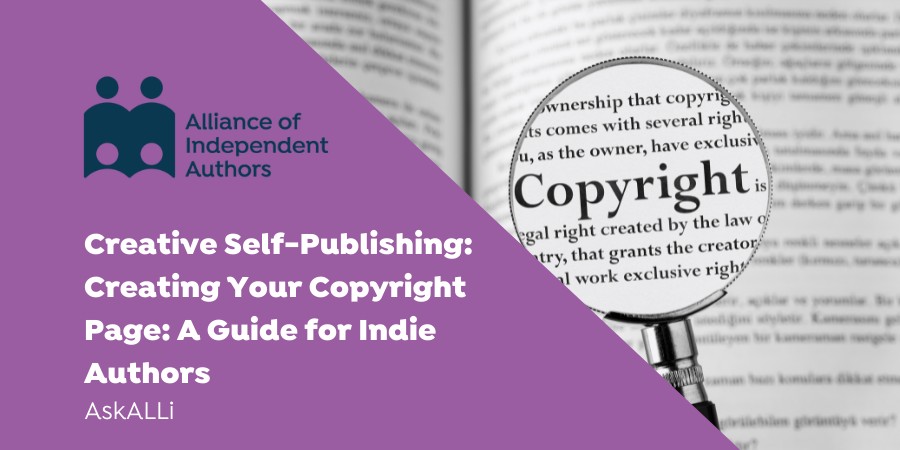
The copyright page is a page found in most books, traditionally in the front matter, but now often in the back matter of the book. It indicates the copyright status of the book and is referred to by interested parties for information about the publisher. It may also include cataloging data for librarians. It also declares the copyright status, e.g. “all rights reserved,” or “creative commons license.”
This page doesn't assert your copyright, it is purely for information. Copyright is yours from the moment of creation. What it does is announce to interested parties that the work is under copyright, that you are the owner, and how you want your work to be reproduced or replicated.
A copyright page has one or more of these elements:
- a copyright notice
- a rights reservation statement
- a disclaimer
- an AI disclosure statement (optional, increasingly common)
- GPSR compliance information (required for physical books sold into the EU)
A Copyright Page Structure
Feel free to adapt anything below for your copyright page. Just remember to enter your own details, as appropriate.
The Copyright Notice
This declares to readers that you are the owner of the copyright. It has four components:
- The copyright symbol: ©
- The word “copyright”: Since the copyright symbol isn't recognized in some countries, reiterate it as a word so that there's no confusion.
- The copyright owner's name: Your name or pen name.
- The year of publication: this is the year you publish the work, not the year you first created it.
Together, it will give you the copyright notice, for example:
Copyright, © [Your Name] 2026
Do You Need the Next Steps to Publish Well?
In this free guide to independent publishing, you'll learn the frameworks, mindset shifts, and foundational principles that make every publishing decision clearer from day one.
The Rights Reservation Statement
This statement informs the reader that rights are reserved under the copyright notice and should be respected. The classic statement, which you'll see in most trade publishers' books, reads something like:
All rights reserved. No part of this book may be reproduced in any form or by any electronic or mechanical means, including information storage and retrieval systems, without permission in writing from the publisher and copyright holder, except in the case of brief quotations embodied in critical articles and reviews.
But given that the statement just reiterates the rights already granted by copyright protection and publishing contracts, many authors now prefer a shorter formulation:
All rights reserved.
You will also see:
All rights reserved. The moral rights of the author have been asserted.
The author's moral rights are a feature of British law. This highlights the fact that there is no international copyright legislation. Different countries have different laws, and the US and many other countries don't recognize the distinction of moral rights.
The Berne Convention of 1886 is an attempt to get over these differences, an international agreement that mandated several aspects of modern copyright law, agreed to by all countries that are party to the Convention. They agree to mutually recognize the copyrights held by each other's citizens, so the Convention provides for moral rights, the right to claim authorship of the work and to object to any mutilation, deformation, or other modification of the work that would be prejudicial to the author's honor or reputation.
The Disclaimer
Disclaimers are not full protection against being sued, but they are widely used in book publishing. Here are some standard disclaimers, if your book requires one (not all books do).
- For Fiction: This is a work of fiction. Any resemblance to actual persons, living or dead, events, or locales is entirely coincidental.
- For Creative Nonfiction: This is a work of creative nonfiction. Some parts have been fictionalized to varying degrees, for various purposes, with some names, dates, places, events, and details changed, invented, and altered for literary effect or to protect the privacy of the people involved.
- For Memoirs: The events and conversations in this book are accurate to the best of the author's ability, although some names and details have been changed to protect the privacy of others.
Do You Need the Next Steps to Publish Well?
In this free guide to independent publishing, you'll learn the frameworks, mindset shifts, and foundational principles that make every publishing decision clearer from day one.
AI Disclosure: A New Consideration
If you used AI tools anywhere in the making of your book, whether for brainstorming, editing, translation, or cover art, you may want to add a short disclosure statement to your copyright page. This is not currently a legal requirement in most jurisdictions, but it's becoming a mark of transparency rather than a stigma, and some retailers treat it as a separate obligation from what's printed on the page itself.
A simple, honest line is sufficient, adapted to what you actually did:
This book was written with the assistance of AI tools for [brainstorming / editing / research], with all content reviewed and revised by the author.
Cover art created with AI-assisted tools.
Two things worth knowing:
- This is in addition to, not instead of, platform-level disclosure requirements. Amazon KDP's AI content disclosure is a separate checkbox in your title's metadata during upload. Disclosing on the copyright page does not satisfy that requirement on its own, and vice versa.
- The legal picture around AI and copyright is still moving. US courts have confirmed that fully AI-generated work without human authorship cannot hold copyright, but the more common scenario, using AI with substantial human direction and editing, is still being tested in the courts. This doesn't change what belongs on your copyright page today, but it's worth knowing the ground here isn't fully settled.
GPSR: What EU-Selling Authors Need on Their Copyright Page
If you sell physical books into the EU (including via Amazon, IngramSpark, or your own site), the EU's General Product Safety Regulation, in force since December 2024, requires specific information to appear on your copyright page (or back cover), since books aren't sold in packaging that could otherwise carry it.
You'll need to include:
- Manufacturer (publisher) details: your name or imprint, a postal address, and an email address.
- EU Responsible Person details: if you (the publisher) are based outside the EU, you must appoint an EU-based representative and list their name, postal address, and email address too.
A simple template:
Manufacturer (Publisher): [Your name/imprint], [postal address], [email address]
Authorized EU Representative: [name], [postal address], [email address]
This only applies to books placed on the market after December 13, 2024, so backlist titles published before that date don't need retroactive changes, though many authors are updating reprints and new editions as a matter of course. Guidance on enforcement is still described as sparse in places, so if you sell significant volumes into the EU, a specialist compliance service (several now exist specifically for indie authors and small presses) may be worth the modest annual cost rather than navigating this alone.
Copyright Notice Examples
Below are a couple of examples of copyright pages, one more extensive than the other, including acknowledgments and editor information. The second example includes ISBNs, which is helpful for librarians and book retailers who may want to order different versions of your books.
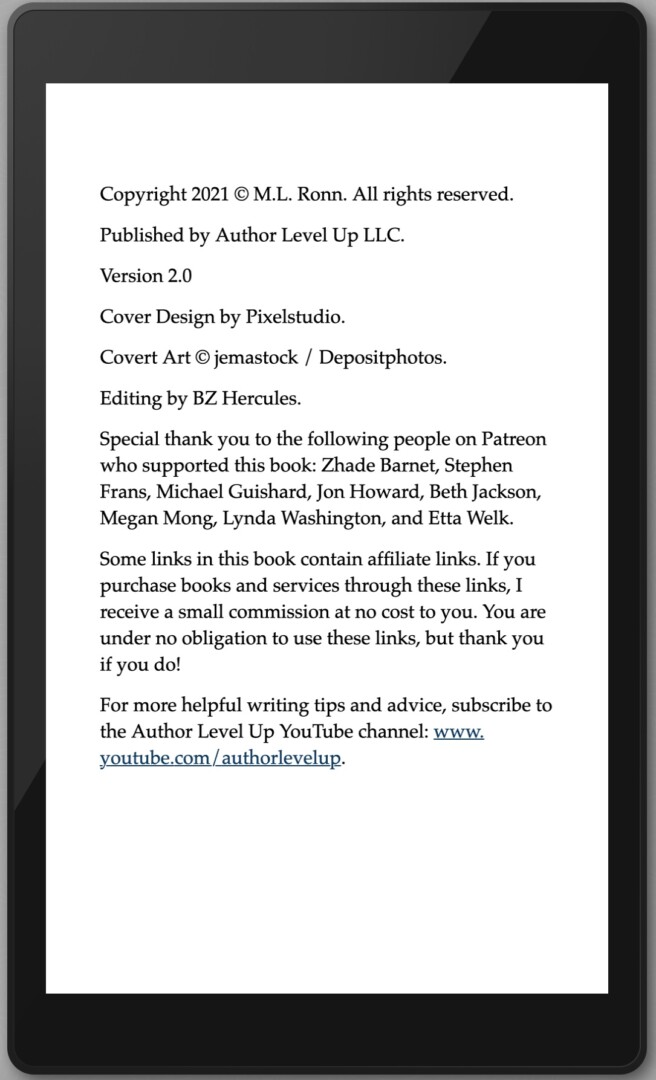
ML Ronn copyright notice
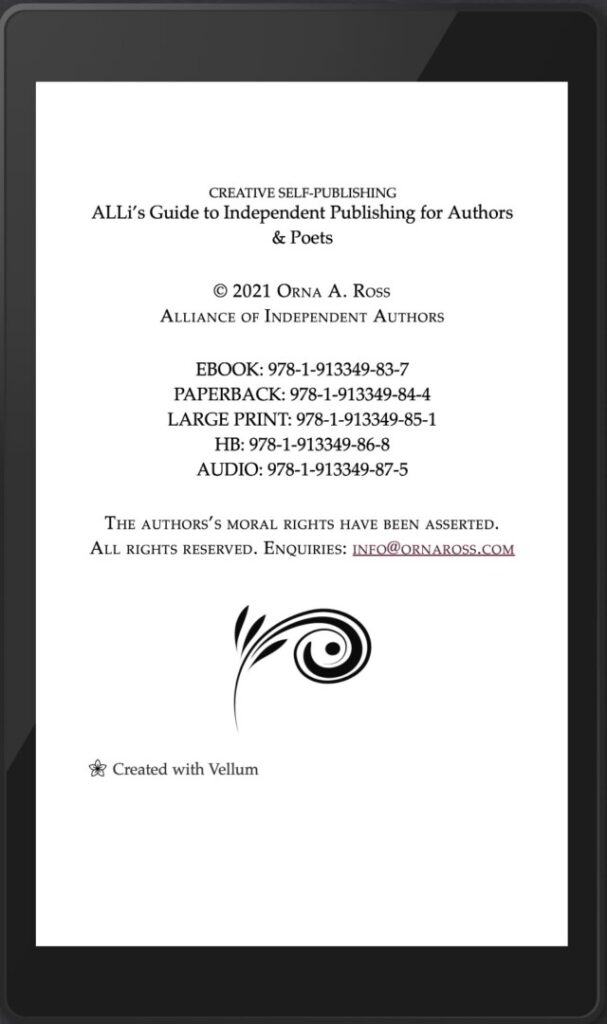
Orna Ross Creative Self-Publishing Copyright Page
Do You Need the Next Steps to Publish Well?
In this free guide to independent publishing, you'll learn the frameworks, mindset shifts, and foundational principles that make every publishing decision clearer from day one.
Alliance of Independent Authors
The global non-profit association for indie authors
ALLi members get all guidebooks free, personalised advice, and access to a community of thousands of working indie authors. If you're serious about selling more books, membership is your next step.